It was the best of games, it was the worst of games. Okay, not really, it was pretty awful all the way through. Almost as awful as reading Charles Dickens. Almost.
For the ninth time in nine games this season, Auburn got off to an extremely slow start on offense, failing to get anything out of its first drive and not running its first play in Arkansas territory until the 1:32 mark of the second quarter. However, unlike the last two games, Auburn’s defense was able to keep the team in the game (much easier to do against Arkansas than LSU or Ole Miss, admittedly) and the offense found its footing in the second half, scoring 20 points and ultimately outgaining Arkansas by 9 yards on the day while allowing just one sack and not turning the ball over.
In the #discourse online, I’ve seen a lot of comments about how Auburn radically altered its gameplan or playcalling in the second half, and even speculation that Auburn changed playcalling duties at halftime. I want to say from the top that this is silly, and that it’s very funny to me how the good plays always seem to be called by the coach people like and the bad ones are always from the coach people want to scapegoat. Funny how that works.
Having watched the game again, I can say that Auburn really didn’t radically alter its approach in the second half. There wasn’t a dramatic change in playcalling nor in personnel. What really happened was that the Tigers got out of their own way and executed better, actually delivering on some of what we were promised this offense would look like.
Most crucially, Auburn (the SEC’s third-most-penalized team going into this game) had zero offensive penalties in the second half, a drastic reversal of the first half when two holding penalties near midfield killed the Tigers’ two most promising drives prior to the end-of-half drive that yielded their only three points of the half. Another data point here is third downs: in the first half, Auburn had an average of 9.1 yards to go on third down (and failed to convert the 3rd and 1 and 3rd and 2 they had on their first two series), while in the second half, they averaged 5.67 yards to gain. The difference in first down conversions is also stark: just six in the first half compared to 14 in the second half.
The same basic deficiencies that the team has had all season were still on full display here, particularly the inability to establish any kind of consistent running game outside of Byrum Brown; Auburn’s RBs combined for 50 yards on 15 carries for a gruesome 3.33 (repeating, of course) yards per carry. Freshman WR Deshawn Spencer averaged 5.5 yards a pop on two sweep plays, while Brown once again had more carries and yards than all of his other teammates combined.
This was one of Brown’s best games as an Auburn Tiger, as he avoided turnovers and sacks even as the offense struggled in the first half, and, while the Tigers once again failed to generate a meaningful number of explosive plays, the few they did have were mostly the product of Brown using his legs to extend plays and make defenders miss in the open field. This isn’t something you can build a consistently successful offense around, but it does paper over some of the problems temporarily, which is probably what Brown was brought here to do to start with.
Anyway, enough rambling, let’s dive into some film. Auburn opens the game with the power-toss concept that we discussed in the Georgia game review. Arkansas is lined up in a very light box, using the tite front we also discussed in the Georgia game review. This play is a good illustration of the wide splits of the veer and shoot putting horizontal stress on the defense. Honestly though, this play isn’t a great way to use it. In theory, Brown would be reading a defensive end or overhang LB for this play, but there’s nobody there for him to read, so he just tosses it by default instead of running the ball against a box where Auburn has good numbers (5 on 5), and the field safety is able to come down and make the tackle for a short gain.
As a side note, I really hate this play. I hate tossing the ball like that from a shotgun alignment. Either get under center and run a proper toss sweep or run it as a speed option. Even when the QB tossing the ball to a RB in a sidecar alignment goes well, it looks janky and mechanically awkward. Hate it.
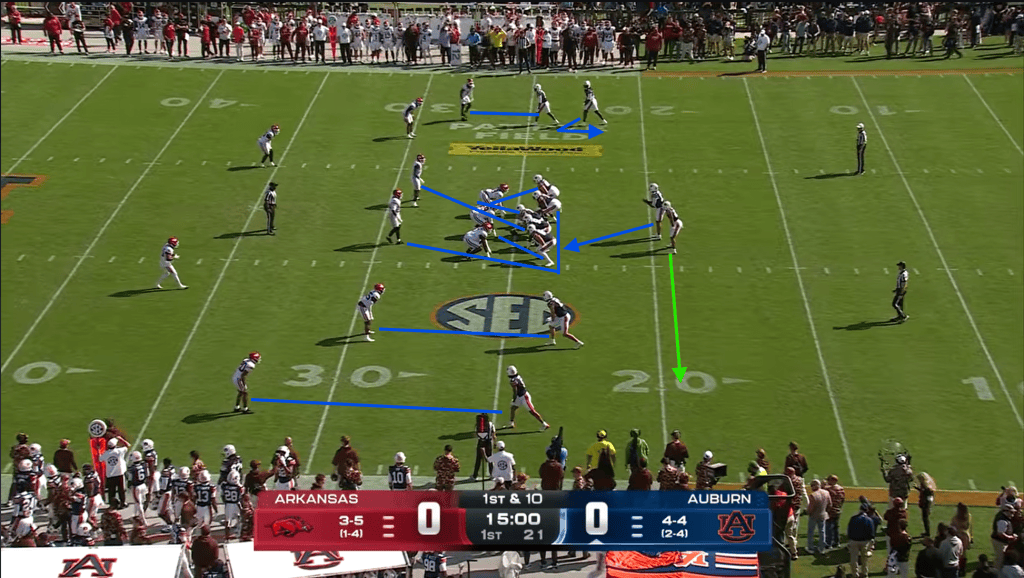
After Auburn got to a rare third and short and still failed to covert, Alex Golesh decided to go for it on 4th and 1 at his own 34, a decision that’s objectively correct but will get you yelled at by the boomers if you don’t convert it. Thankfully Auburn does pick this one up, utilizing a fairly simple RPO. The offensive line and RB are blocking for a lead play for Brown off right tackle, while the outside receivers are running hitches. Brown is reading the nickel Sam, who would normally be lined up over the slot receiver, Christian Neptune, but is walked up close to the edge of the box for some reason. With the safety sitting 12 yards off the ball, there’s nobody even close to Neptune, so it’s an incredibly obvious read for Brown to just flip the ball out to him right away for the easy conversion.
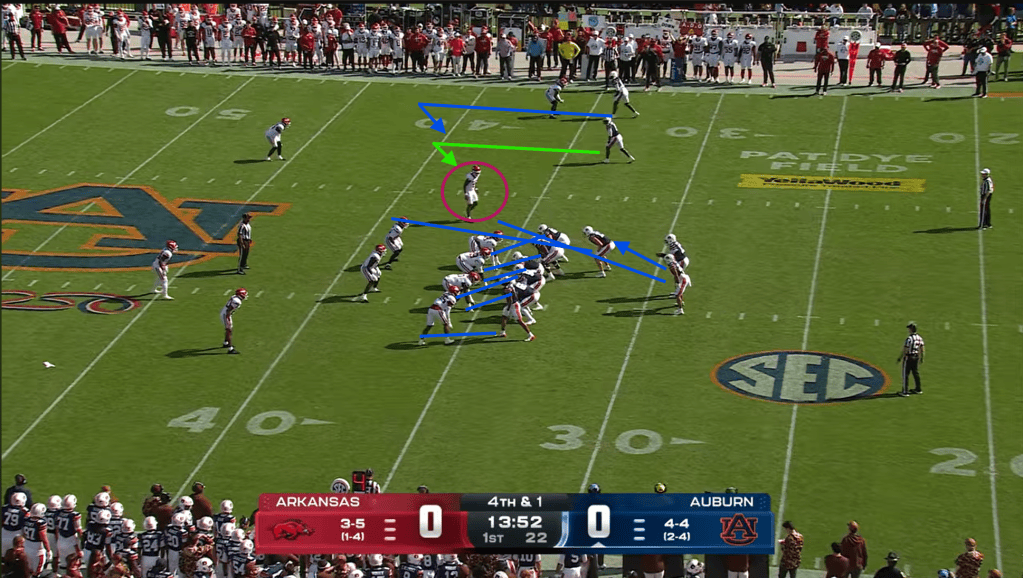
The Tigers would not be so fortunate on their next set of downs. Facing another fourth and short, Joel Gordon goes back to the well with the QB run from a heavier set, this time using a “G lead” scheme, a variation on a power scheme where the playside tackle and TE block down, the playside guard pulls and traps the end man on the line of scrimmage, and the RB lead blocks on the playside LB. The problem here is the LG, Kenneth McManus IV (highlighted in red in the screenshot), who manages to get onto his man, but gets pushed back, closing the hole and forcing Brown to look elsewhere for running room, which he’s not able to find. The Arkansas defender doesn’t even use great technique here (he should be trying to “wrong shoulder” the trap block and go inside of him, rather than around him), but he’s able to bully McManus with brute strength, which is the next best thing. Auburn was lucky that Arkansas’ kicker was unable to convert the ensuing field goal attempt.
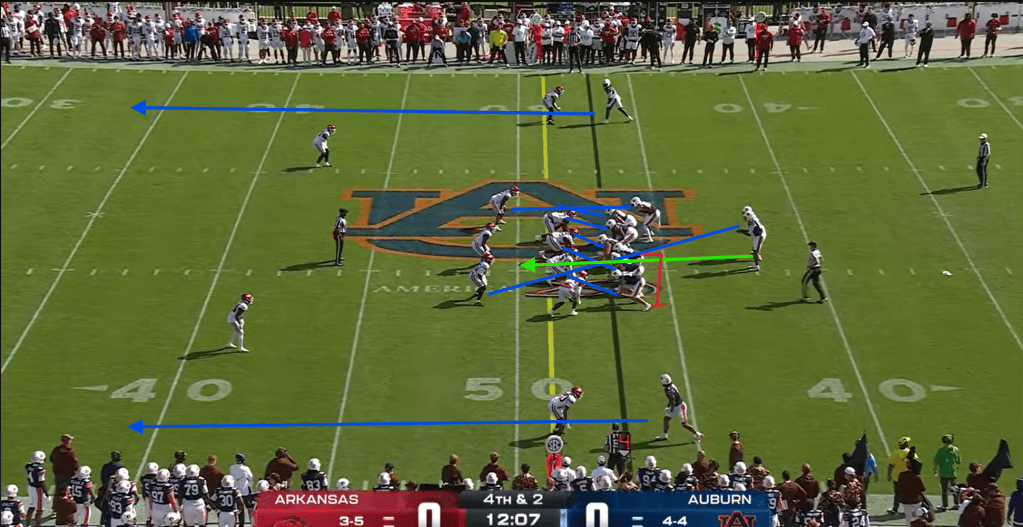
Auburn opened their next drive with a strange play design that I don’t really understand. Starting from an empty set, they motioned the slot receiver to create a 4×1 look, then ran a spot screen with the bunch receivers while the outside receivers ran vertical. I’m not really sure what the goal was here, but Byrum Brown should’ve taken off immediately, as Arkansas only had four players in the box, all of whom were rushing, leaving nobody at the second level; if he had been able to get past the initial rushers it would’ve been an easy first down. Instead he holds the ball waiting for a guy running a vertical against a corner with safety help to get open, which obviously doesn’t happen, and he has to eat the ball in the end. A run for no gain on second down and an incompletion on third and long led to a punt. As has so often been the case this year, a first down dud left the Tigers behind the chains and they couldn’t recover.
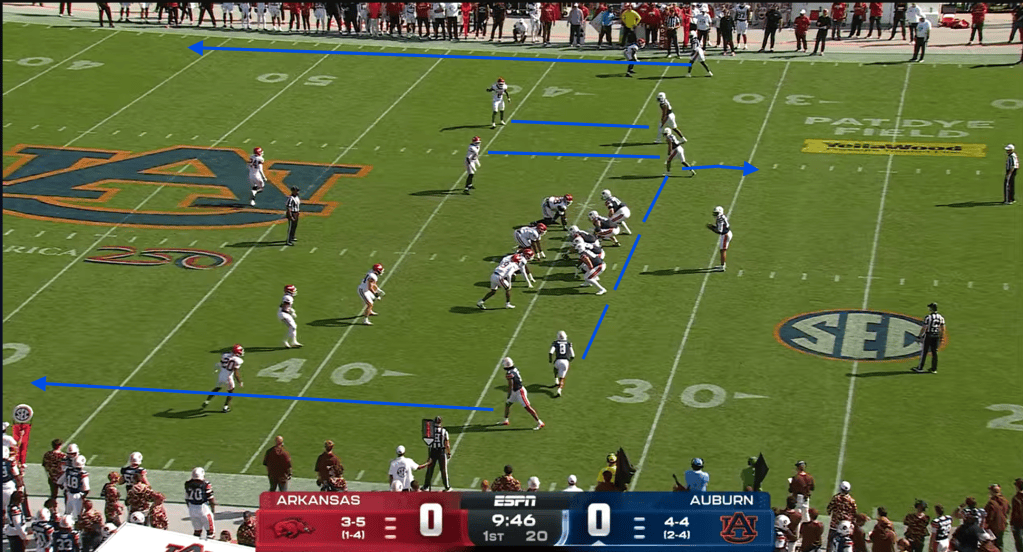
On the next drive, the Tigers opened with…a successful play on first down? Thanks to a well-executed receiver screen? I feel like I’m taking crazy pills. Alas, this success was short-lived. This time, the issue genuinely was the playcall rather than the execution (although the execution sucked too). On 2nd and 3, Gordon and Golesh reached deep (probably too deep) into their bag, attempting a WR reverse that was basically dead before it even got started. Auburn is showing some kind of sweep or speed option look into the boundary, with the TE lead blocking toward the backside. I don’t know who was assigned to block the overhang LB here, but nobody does, and he’s able to penetrate and disrupt the timing of the pitch back to Bryce Cain, and at that point the play is dead in the water. This one probably needed a few more reps in practice. Auburn gave up a sack on the ensuing third and long (the left side of the offensive line got beat by a basic stunt, go figure) and had to punt again.
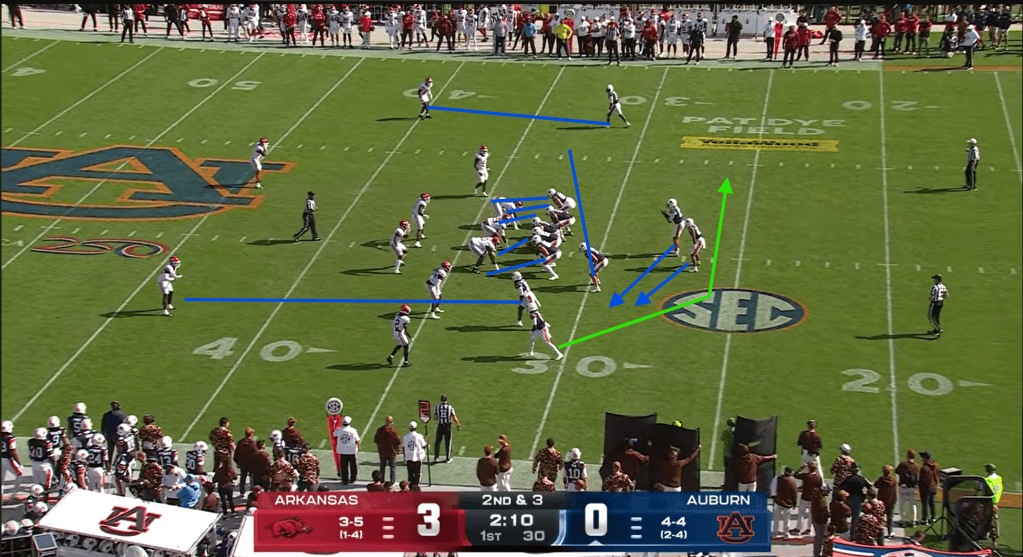
After a short run to start the next possession, Auburn dialed up a QB draw, a play they’d rely on heavily throughout this game, which makes sense given the offensive line’s struggles handling even a four-man rush. This one is particularly well-timed, as Arkansas is bringing pressure from the boundary (red arrow) and dropping their Mike LB to the boundary, leaving an open lane for Byrum Brown to run through, and the defensive backs are playing quarters with off coverage on the outside. Unfortunately, McManus got called for a hold while picking up that blitzer. He looks like he’s a bit slow to identify that that’s the man he’s responsible for releasing downfield and picking up, and it’s either grab him or let him blow up the play. An incompletion and a failed screen on the ensuing second and third and long led to Auburn’s third punt of the game. Worth keeping this play in the back of your mind though, because the coaching staff was setting something up here.
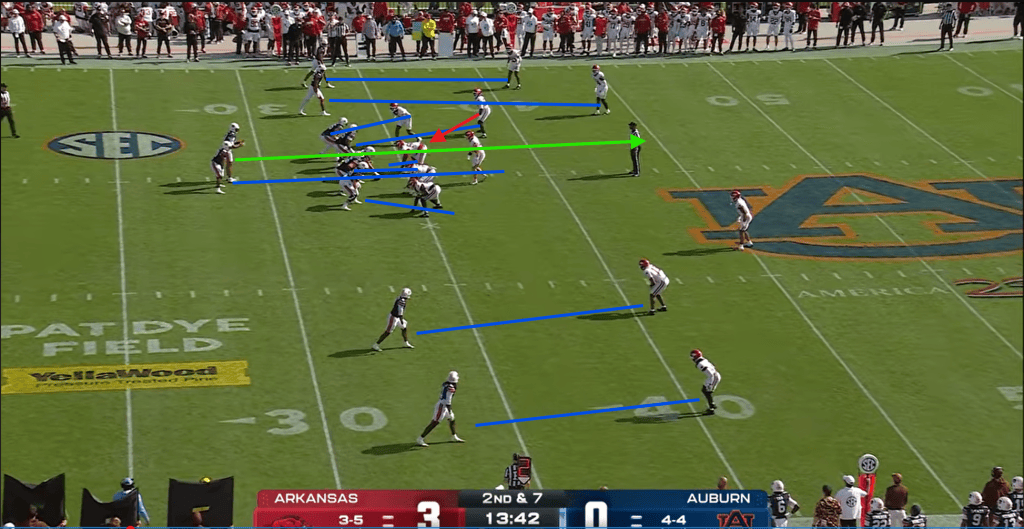
Now down 10-0 after a quick Arkansas touchdown drive, Auburn opened their next possession with an RPO design that I don’t think we’ve seen this year. The Tigers set up with two off-ball tight ends and run a mid-zone scheme to the left, with the playside tight end, Jake Johnson crossing the formation on an arrow route. Brown reads the backside defensive end (circled in red) like he would on a zone read play, but instead of keeping the ball after the DE bites on the run, he flips it out to Johnson in the flat. The Tigers use a crack scheme on the perimeter, with the wide receiver, Keshaun Singleton, blocking down on the playside LB and the other tight end arc blocking the corner. Great design, love this play, keep it in the back of your mind for later.
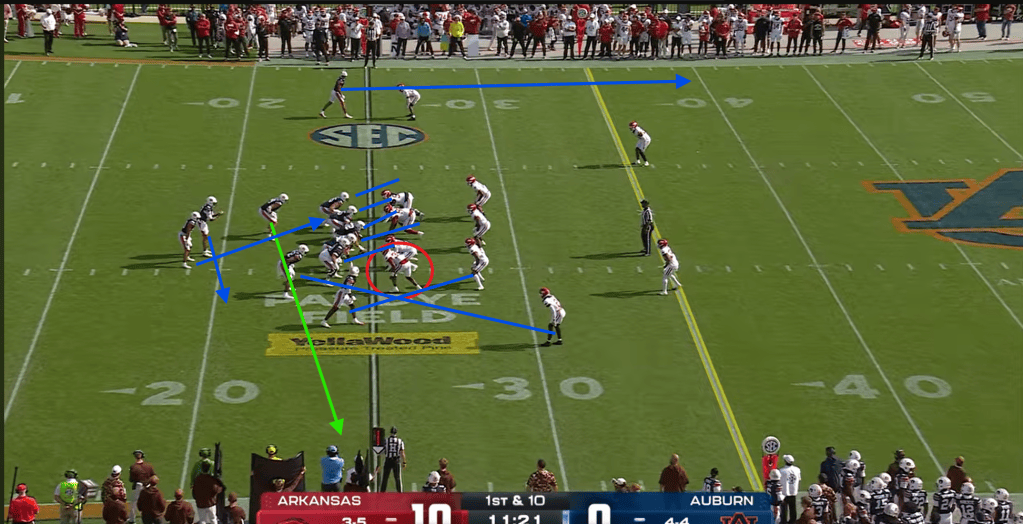
After picking up the first down with a short run, the Tigers were able to do something I’ve been clamoring for more of this year: throwing downfield play-action off of tempo. In this case, it’s a Y Cross or flood concept with the backside receiver running a dig. This is a great call against quarters coverage (which Arkansas is in here) because the crossing route will pull the backside safety down and away from the middle of the field (red arrow), opening up space to hit the dig from the backside. Brown does a good job of identifying this and hitting his man in stride. I do kind of wish they’d had him running a post on the backside instead of a dig, because that might’ve gone for a touchdown, but it’s still the exact kind of play we need to see more of from this offense: using tempo to force the defense into a base coverage and attacking that base coverage with a simple coverage beater.
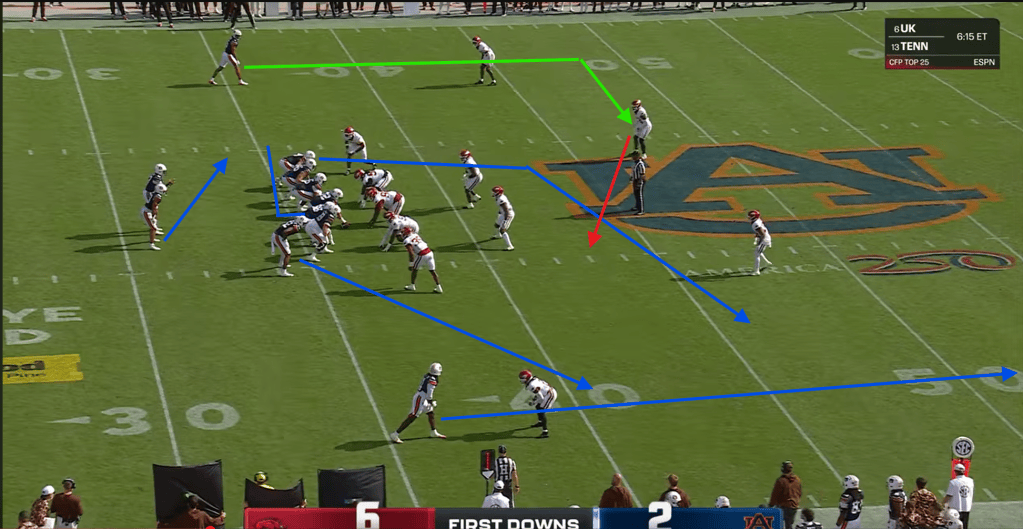
Unfortunately any sense of positive momentum from this play was short-lived. Auburn got up to the ball quickly and ran a mid-zone lead into the sideline out of an unbalanced look, trying to outnumber the defense to the playside and get the off-ball tight end, Arlis Boardingham, out in front of Jeremiah Cobb. It doesn’t really work since he doesn’t get the block on the nickel Sam that would’ve sprung Cobb for a big gain, but Kenneth McManus (who I’m not trying to pick on, I promise) is called for holding anyway, pushing the Tigers offense back behind the chains. The Auburn offense once again couldn’t dig itself out of a hole starting on 1st and 20, and they were forced to punt again.
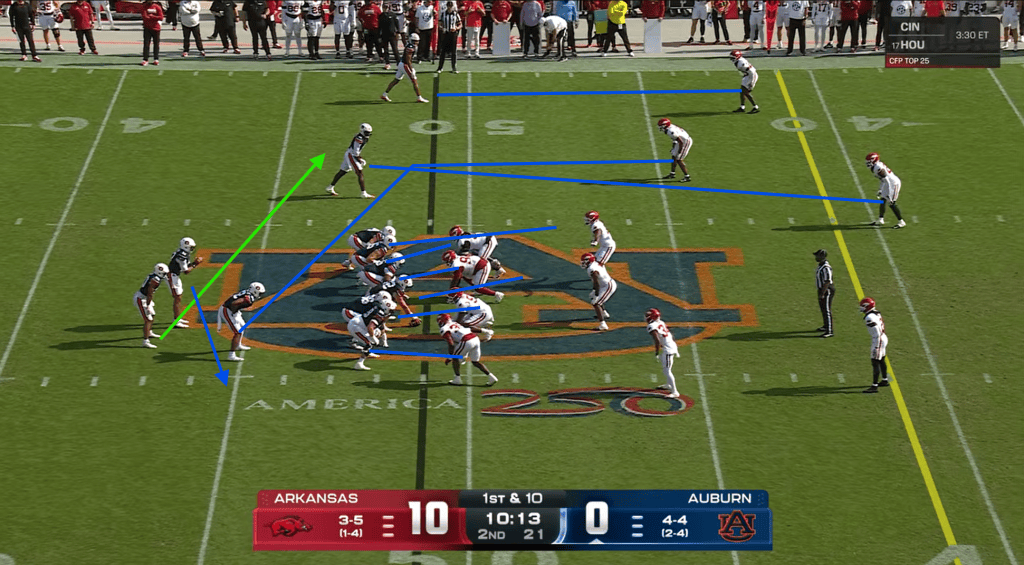
After one more uneventful three-and-out, Auburn got the ball back just after the not-two-minute-warning and led their only successful drive of the first half. Gordon and Golesh open the drive with a play that they’d set up with the QB draw earlier in the game. Much like the draw play above where McManus was called for a hold, they line up in a four-wide set, and have Jeremiah Cobb act as though he’s going to lead block for a draw. This time, however, Brown stops short, sets his feet, and lobs the ball to Cobb. The field safety bites down hard on the fake draw (red arrow) and Cobb has no issue sprinting past the flat-footed Mike LB to get wide open for a huge gain and take Auburn into Arkansas territory for the first time all day. Fantastically simple-but-effective play design.
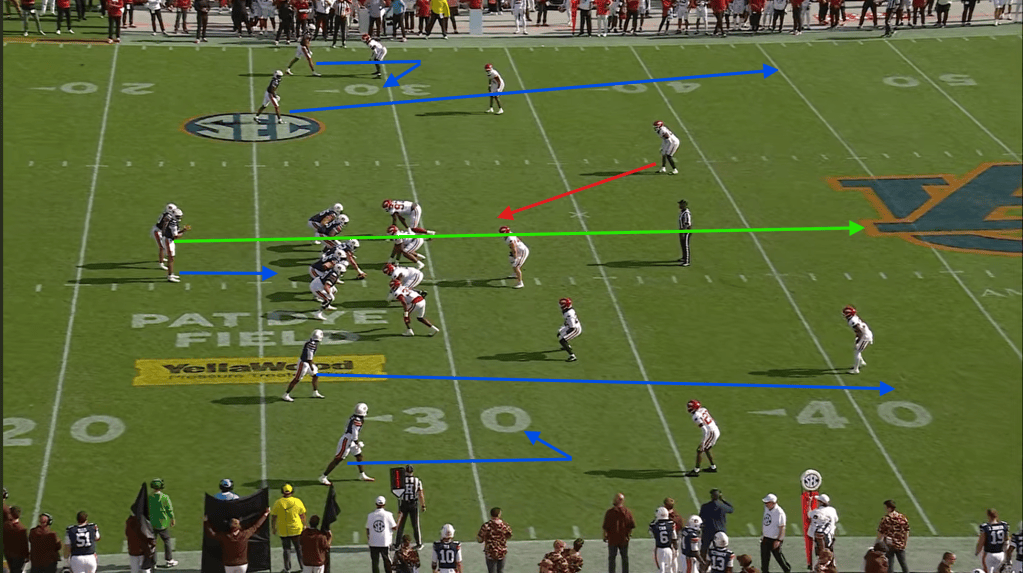
On the next play, the Tigers were able to push the tempo and looked to turn their big gain into another one by attacking downfield against a discombobulated defense. The Tigers ran a drive concept out of a compressed formation, a variation of the standard shallow cross concept where the shallow and the dig route come from the same side of the formation, rather than the opposite side. Long-time West Coast Offense staple, almost everybody in football runs some version of it. The Tigers pair this with a high-low concept on the front side, with Christian Neptune running a deep out or sail route. Arkansas is in some kind of quarters or quarter-quarter-half look here, and the safety on that side gives Neptune an enormous cushion (red arrow). He’s unable to get back down fast enough to disrupt the play and the Ice Giant makes a great catch along the sideline for another big gain. Also shoutout to Jeremiah Cobb for a great blitz pickup there. After a bit of faffing around that included an inexcusable delay of game penalty, the Tigers would settle for a field goal on this drive to cut the halftime deficit to seven.
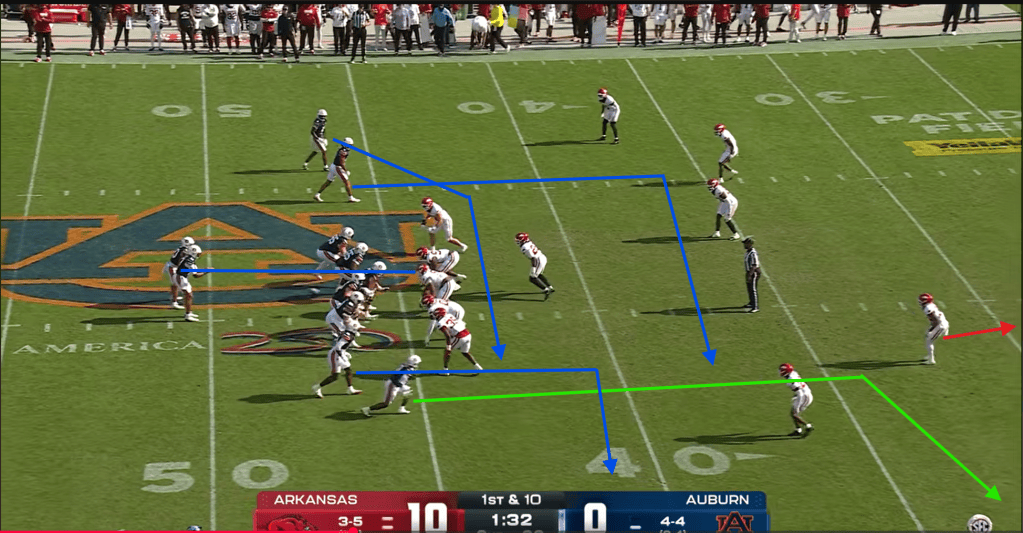
Arkansas opened the second half with a long, meandering drive that didn’t yield any points but did burn about five minutes off the clock. On their first possession of the second half, the Tigers came out with a much simpler look than their opening drive of the first half, which I very much appreciated. If there was any general critique I had for the first half playcalling, it was that they were doing a bit too much and had gotten away from the basics and needed to get back to the bread and butter of the offense. To quote Calvin’s dad quoting Henry David Thoreau, “simplify, simplify.”
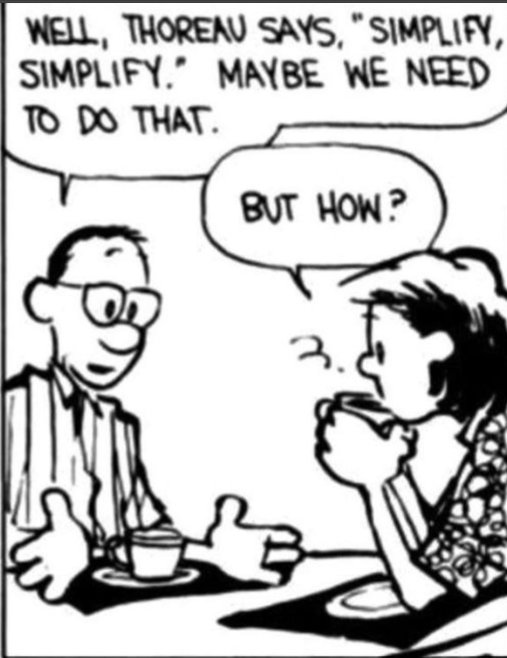
Answering Calvin’s mom’s question, the non-stuffed Tigers motion from a 2×2 look into a standard slot formation and run an inside zone insert scheme. The receivers on the backside of the play are running hitches and Brown has the option of either handing off or throwing the hitch based on what the nickel Sam (red circle) does; classic RPO football. However, in this case, he takes the third option: a pre-snap read to the backside receiver. This is sometimes referred to as an access or “gift” throw, i.e. if the defense is giving you a gift by playing the corner (light blue circle) ten yards off the ball when your guy’s running a quick hitch, you take it. That’s what Brown does here, and it gets the Tigers moving in the right direction. It would’ve been a bigger gain if not for his slow release, but that’s not something that’s fixable at this point in his career so Auburn just has to live with it.
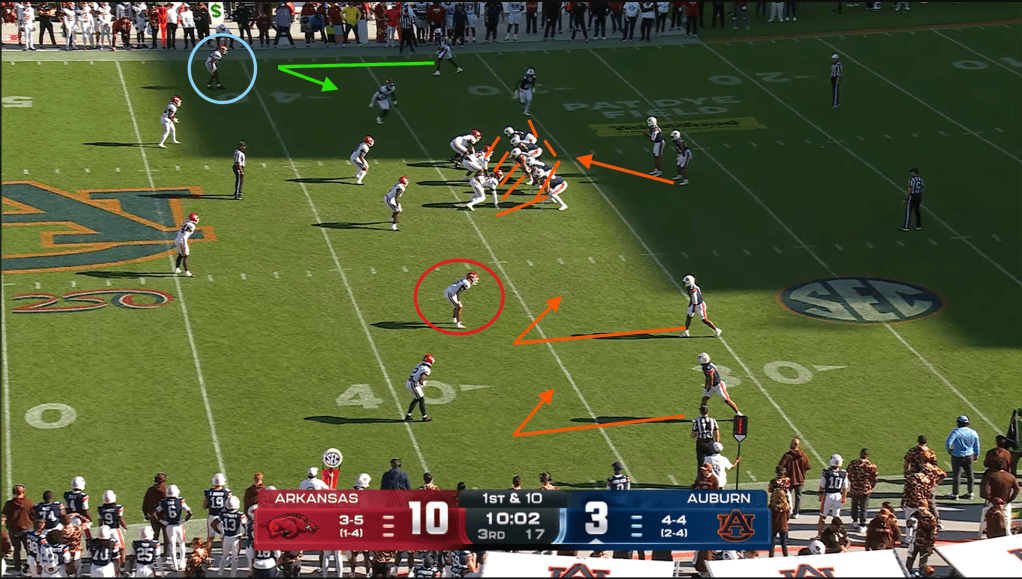
Like the Tigers’ opening drive of the first half, they also faced a 3rd and 1 on their first series of the second half. This play provides a good example of my point that the Tigers didn’t radically alter their playcalling from the first half and mostly just executed better. This is the same play they used to convert the 4th and 1 on the opening drive of the game, a QB zone run with hitches on the backside. Once again, Arkansas’ nickel Sam (red circle) isn’t lined up anywhere close to the slot receiver, making this an essentially free conversion. No idea how they didn’t fix that issue but we’ll take it.
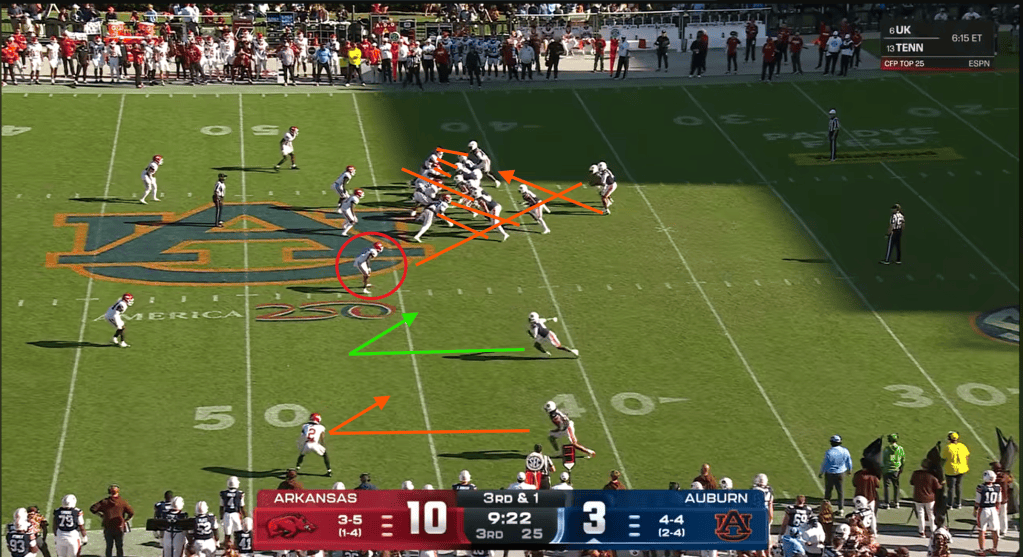
On the ensuing first down, Auburn runs a play that doesn’t work, but once again sets something up down the road. Auburn motions a receiver (Christian Neptune) into the backfield to create a split-back look. They run what’s known as a “bash” or “back away” scheme, where the play hits away from where the RB is aligned. In this case, they’re using a GT counter scheme, with the backside guard trapping the playside defensive end and the backside tackle wrapping the playside LB. Spencer runs a sweep path in the other direction, and Brown will read the backside DE (red circle) and either give or keep it like a normal read option play. The playside defensive end correctly wrong-shoulders the pulling guard, who in turn does what he’s supposed to do and seals him inside, but the backside tackle (Stanton Ramil) doesn’t get the playside LB (in this case the nickel Sam fitting from the slot; red arrow) wrapped, and he’s able to make the tackle on Brown. Keep this one in mind for later though.
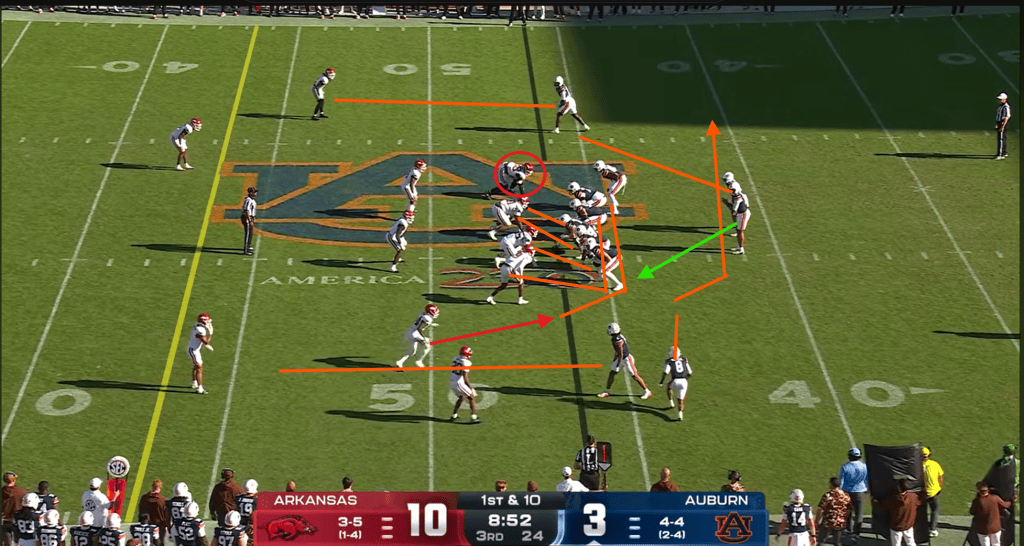
A failed screen (what else?) on second and long set up a 3rd and 14 (one of only two third-and-long situations the Tigers would face in the second half), which Byrum Brown almost but didn’t quite convert with his legs, setting up another 4th and 1. Quick question: does this play look familiar? Well, it should. It’s the exact same QB zone/hitch RPO the Tigers had already run twice in short yardage. Arkansas still doesn’t really line up correctly, but in this case Brown elects to take the ball himself and is easily able to pick up the first down. Baffling to me that Arkansas only has six guys inside the tackle box and is playing two high safeties in this situation, but I guess there’s a reason Ron Roberts only lasted one season as Auburn’s DC.
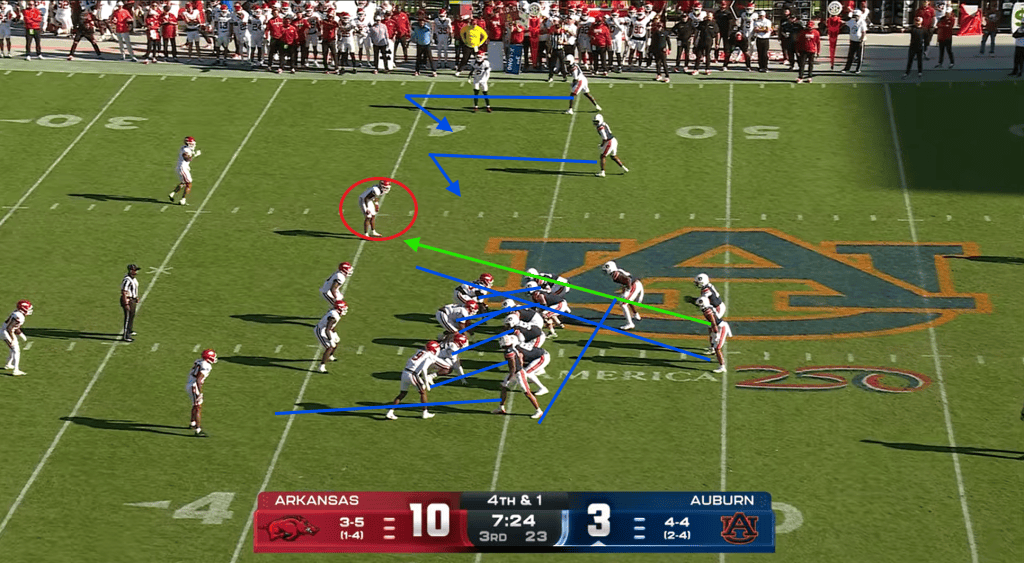
On the ensuing first down, Auburn’s offense finally starts to feel like the veer and shoot. The Tigers get set up and snap the ball quickly. They use a scheme I’ve seen called counter smack, a variation of the standard counter run where the H-back/TE skips to the backside of the play before coming back to wrap the playside LB, which Auburn had already run a couple of times in this game. Brown is once again reading the nickel Sam (red circle) with the option to throw a hitch route to the slot receiver, and I actually think he could’ve done that here, since the Sam is kind of in no-man’s land thanks to Auburn’s wide splits. However, he opts to hand it off and a great second effort by Jeremiah Cobb gets Auburn ahead of the chains.
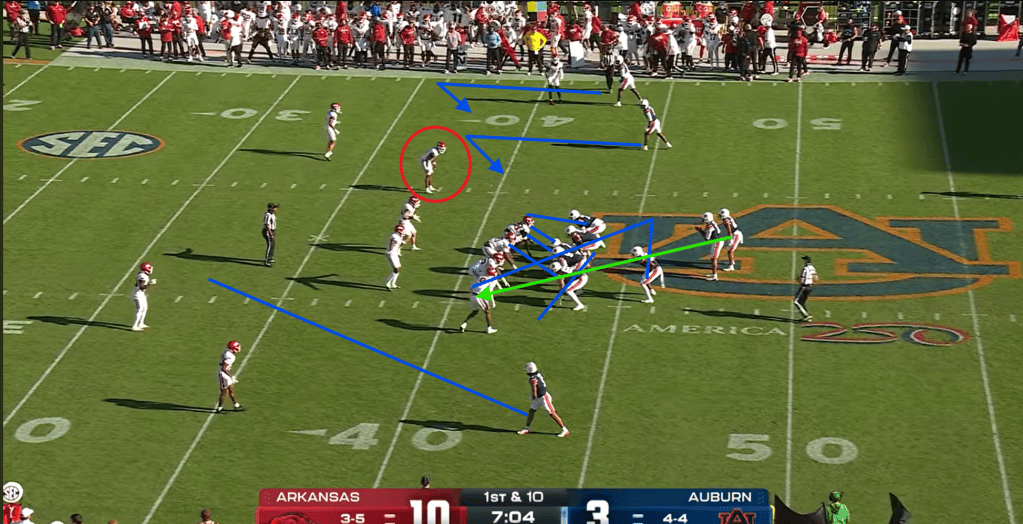
After a pass interference penalty moved Auburn into the Arkansas red zone for just the second time all day, Golesh and Gordon went back into their bag and pulled out this strange-looking formation with three players stacked one behind the other on the left side of the formation. Auburn fakes the toss to Cobb and then hits Arkansas with a perfectly-designed pass concept. The outside receiver runs a post to pull the backside safety, the top receiver in the stack runs a wheel to pull the corner wide, and the playside safety drops deep (red arrows), while the playside LB (red circle) gets caught staring into the backfield at Cobb, leaving the seam wide open, and Brown finds Chaz Nimrod for the Tigers’ first touchdown of the game. Fantastic play design all around. Unfortunately Alex McPherson missed the extra point, leaving Auburn behind by one.
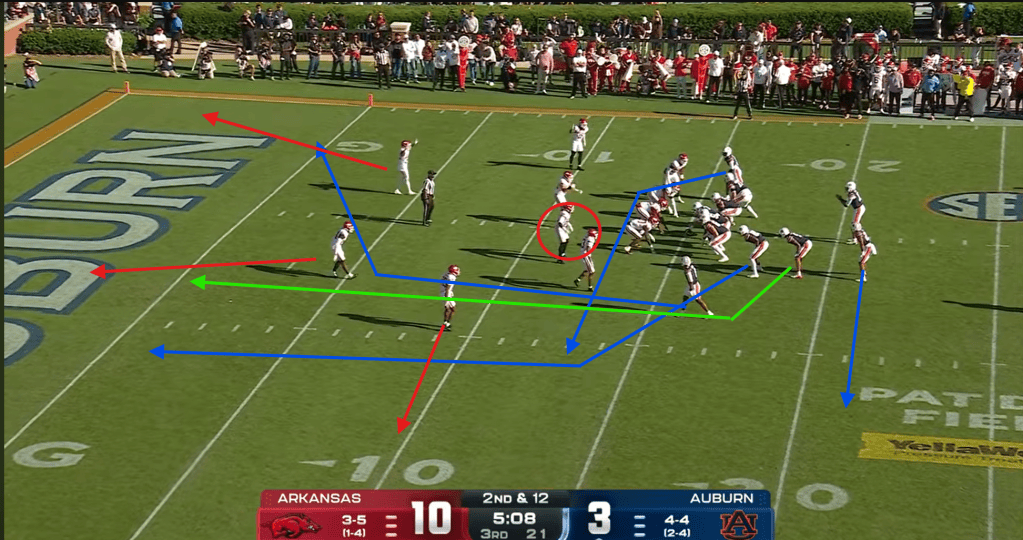
Arkansas kicked a field goal on their ensuing drive, extending their lead to four. After a short run by Brown on first down to start Auburn’s next drive. The Tigers lined up with a heavier look, using 12 personnel (one RB and two TEs), something offenses will often do against teams like Arkansas that like to play the lighter boxes and the tite fronts against spread sets. Auburn is using a zone scheme here with a hitch by the backside receiver, while Brown is reading the extra fitter to the box, in this case the boundary safety in quarters coverage, who’s already flying up to the ball at the snap (red arrow). I actually don’t like the hitch here and would prefer to run a slant or glance route (pink arrow) with that receiver unless the receiver really can’t get inside of the corner, since that type of route directly attacks the area the safety vacated. In any case, Brown once again takes the gift on the backside. It’s not a great throw, but it gets the Tigers a first down.
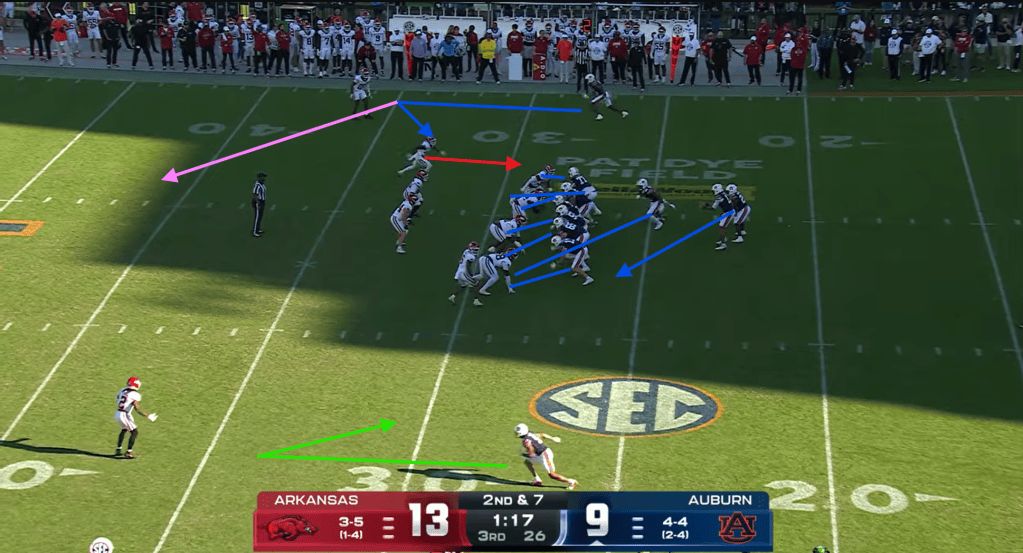
After a Byrum Brown scramble produced another first down, Auburn went right back to the well with this play. Arky was struggling to get lined up quickly due to Auburn’s tempo, and they once again gave the backside WR a massive cushion, so Brown once again smartly takes the gift. I honestly don’t know why Arkansas was playing so soft in coverage, but it’s clearly the same quarters coverage they were trying to play on the previous play I highlighted because you can see the field safety flying down into the box again. Either way, the heavier personnel was clearly messing with whatever they were trying to do defensively.
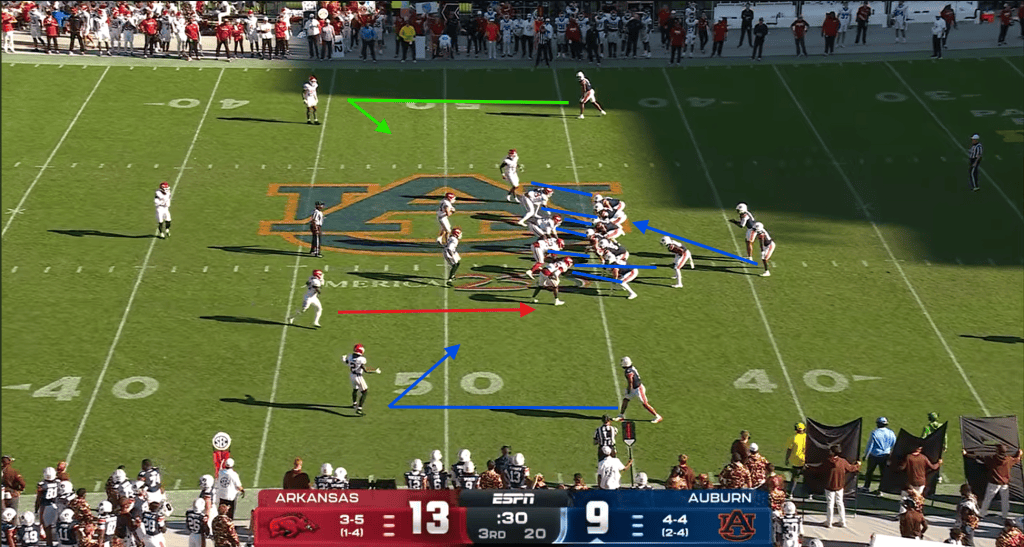
The Tigers picked up the first down on a short run and then opened the fourth quarter by taking a deep shot off of a flea-flicker. As fun as that is, I’m not going to get into it here since it didn’t work and Arky didn’t bite on the fake. On the following play, however, they bit hook, line, and sinker. Auburn is running the same counter smack RPO we discussed above, but in this case, Byrum Brown pulls the ball out and keeps it around the end, and there’s nobody home. I’ve watched this play back several times and I’m still not quite sure whether this is an actual read option play or if this was an improvisation by Brown after he saw the nickel Sam (red circle) walking up to blitz. Either way, it’s a huge gain on the ground, and I’d really love to see more of these types of concepts (like some more true zone read, which we oddly don’t run much of; they should let Byrum get his Nick Marshall on).
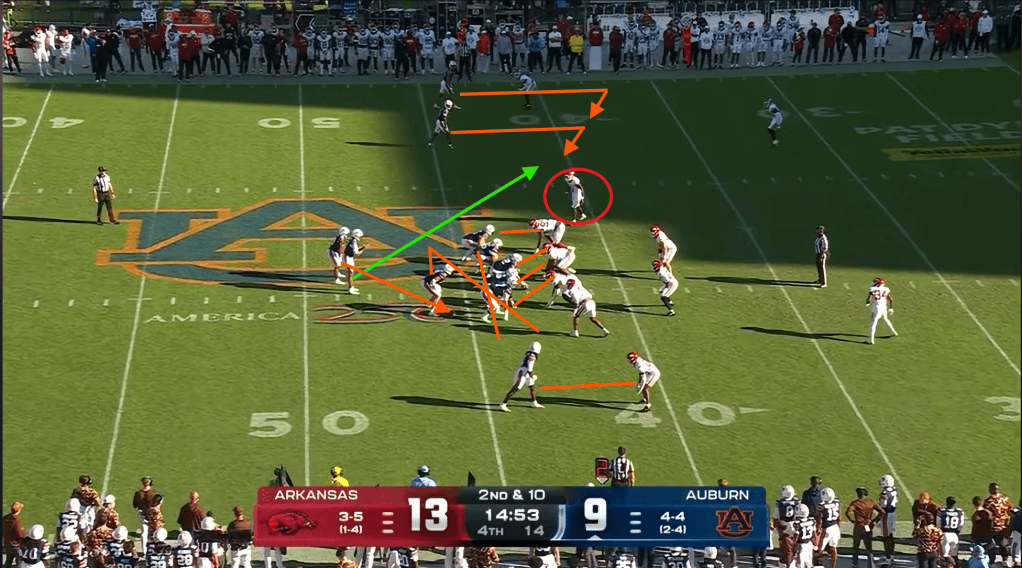
After an unsuccessful QB run on the ensuing first down, Auburn went back to the GT counter bash scheme we discussed before. However, this time, the Arkansas DE (red circle) crashes down hard, and Brown hands off to Deshawn Spencer, who gets some not-great-but-good-enough blocking on the perimeter from Jake Johnson and Omar Mabson and is able to get around the corner to set the Tigers up with a goal to go situation.
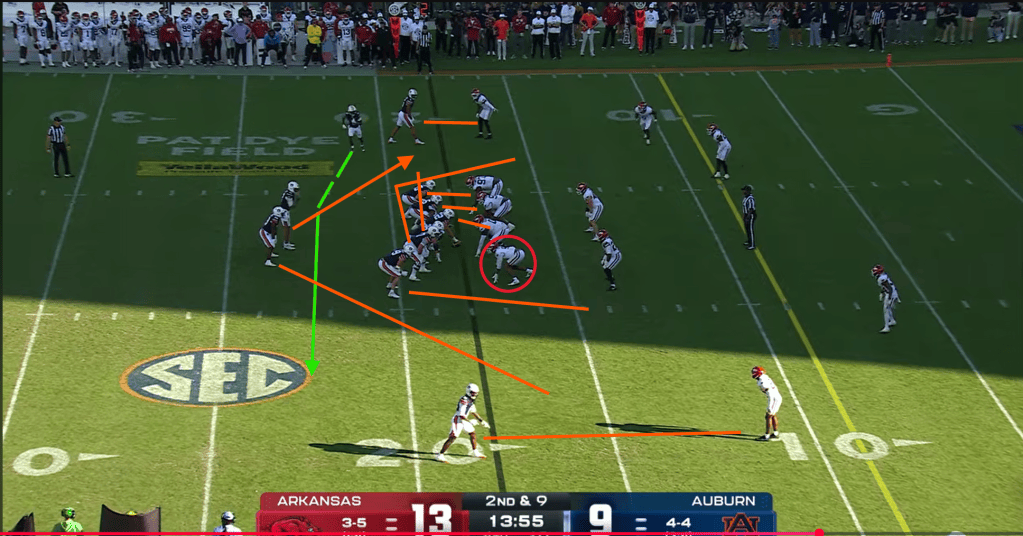
On second and goal from the 5, Auburn went with another similar read option concept, in this case a power read play (sometimes referred to as “dash”). Auburn of course was one of the progenitors of this concept back in the early 2010s during Gus’ first tenure on the Plains because it was a great way to make use of the talents of a guy you might remember by the name of Cameron Newton. Here’s a famous rep of him and Onterrio McCalebb running this play which may have permanently damaged my hearing as a student.
The backside guard is going to pull and wrap to the playside LB like a normal power play, but instead of having the TE or fullback trap the end man on the line of scrimmage, the QB will read him and either hand off to the back or keep it. This is a weird looking play because it seems like Jake Johnson ought to be lined up on the playside to block on the perimeter and Chaz Nimrod does about the wide receiver-est blocking job I’ve ever seen, but Auburn’s playside offensive linemen washes down the defensive line and there’s basically nobody home after the DE chases the sweep.
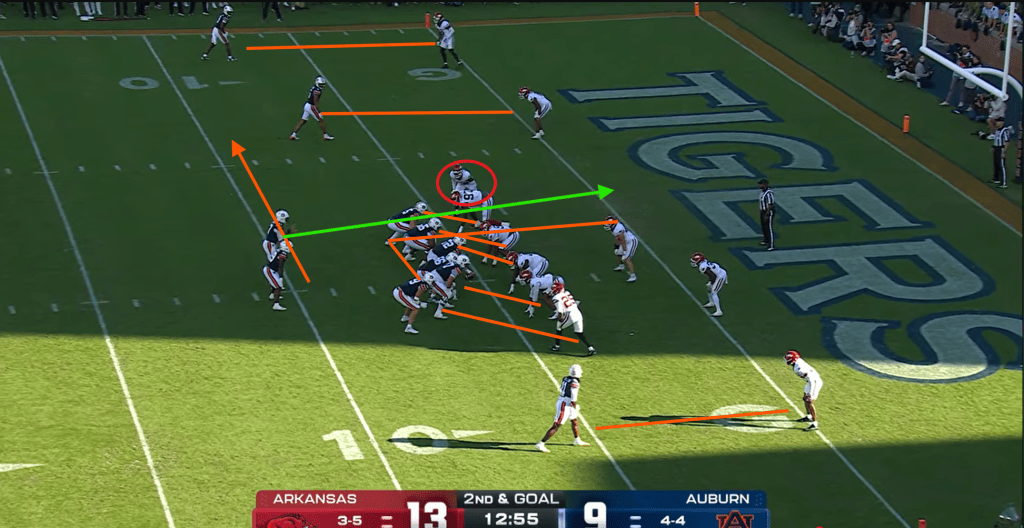
Arkansas got a lucky bounce off the upright to tie the game at 16 on their next possession, followed by an exchange of punts. Facing a tie game inside six minutes to go, Auburn ripped off its biggest play of the day on the first play of the ensuing drive. Not much to analyze here; it’s a simple QB draw and Byrum Brown just makes a great play. The Arkansas safety comes on a blitz but he’s really undisciplined and overruns the play, allowing Cobb to neutralize him, while Cole Best manages to get at least a piece of both Arkansas LBs, allowing Byrum to make a move back to the middle of the field with nothing but green grass in front of him. Same exact play we’d had a good run with in the first half that got killed by a penalty. Execution matters.
And I have to say, seeing a QB put his hand into the ground to catch his balance before making a charge down the middle of the field toward the south end zone brought back another memory of that 2010 LSU game…
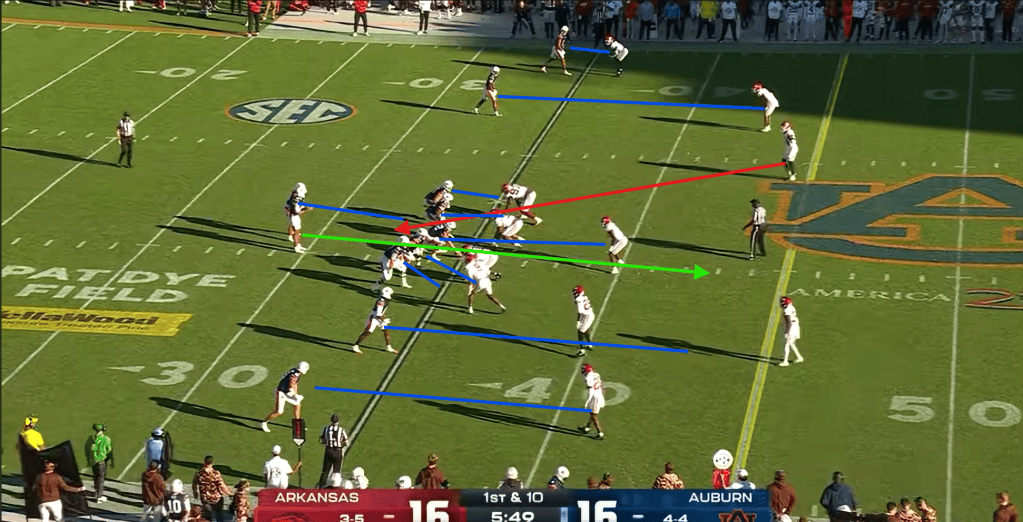
After two unsuccessful runs for a total of -2 yards, Auburn faced only its second third and long of the entire second half. Once again, this is a case where there isn’t a lot of Xs and Os to analyze, it’s just a guy making a great play. Arkansas brings a zone blitz, with the defensive ends and linebackers rushing and the defensive tackles dropping into the underneath zone. Auburn seems to be running some kind of switch-vertical concept with Jake Johnson running a shallow crossing route underneath. Arkansas gets a free rusher, but Byrum Brown makes him miss, and Keshaun Singleton does exactly what you want a receiver to do in the scramble drill: he gets himself into the QB’s field of vision, and he finds open grass. Brown does a great job of keeping his eyes downfield and finds him wide open for the touchdown to put the Tigers back in front.
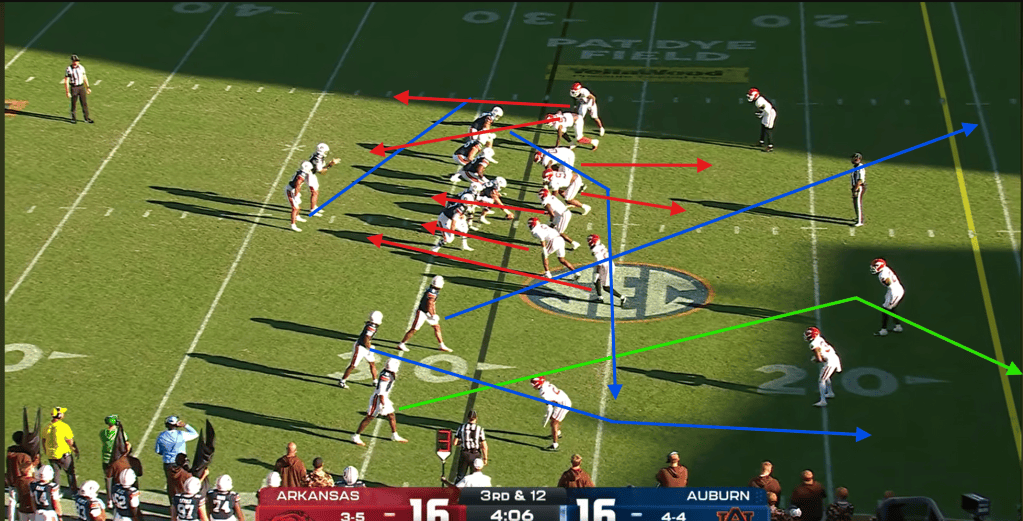
Arkansas was able to tie the game with a touchdown inside two minutes, but left Auburn enough time to take the ball down the field for a final drive to win the game. The Tigers went right back to the well to open this drive, running the exact same QB draw concept they’d used to start the previous drive. Arkansas is a bit more disciplined this time around, and they’re able to limit Brown to an 11-yard gain, but it gets the Tigers that crucial successful first play to get the tempo rolling.
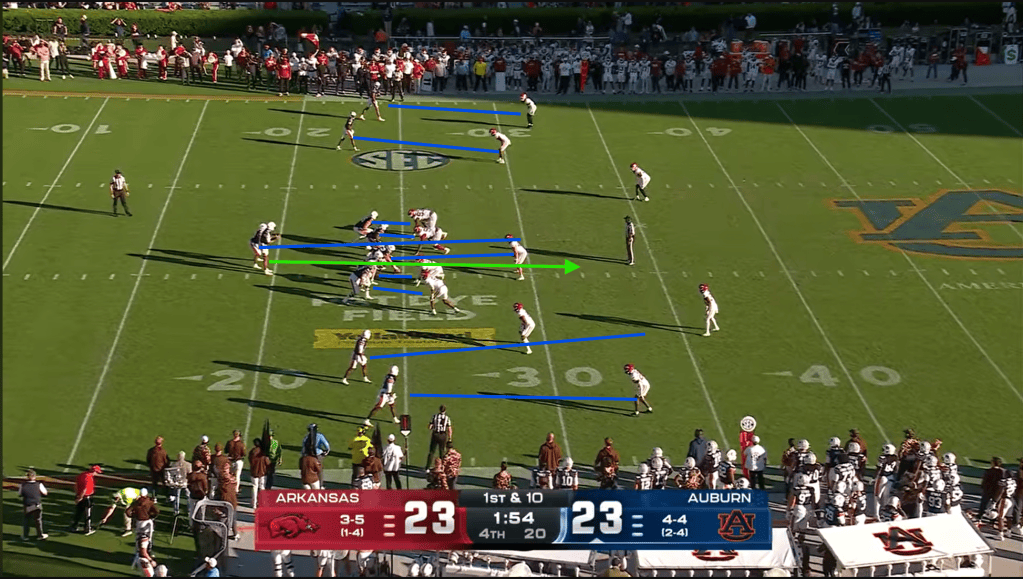
After a fortuitous drop on a checkdown that would’ve gone for a loss and kept the clock moving, Brown is able to successfully push the ball down the field in the dropback passing game to get the Tigers into Arkansas territory and to the edge of Alex McPherson’s range with time to spare. Auburn runs a concept that I’ve variously seen referred to as “bow” or “spin” that seems to be popular among veer-and-shoot adjacent coaches (e.g. Rhett Lashlee at SMU). The inside receiver runs a stick route, while the outside receiver runs a dig route over the top. I’m honestly not sure what Arkansas is doing in coverage here; it looks like a bust to me. They have the LB walling off the stick route, so they should have the corner and the boundary safety available to cover the dig route, and yet neither of them does. Regardless, Brown finds Singleton running open behind the defense and is able to find him for a big gain.
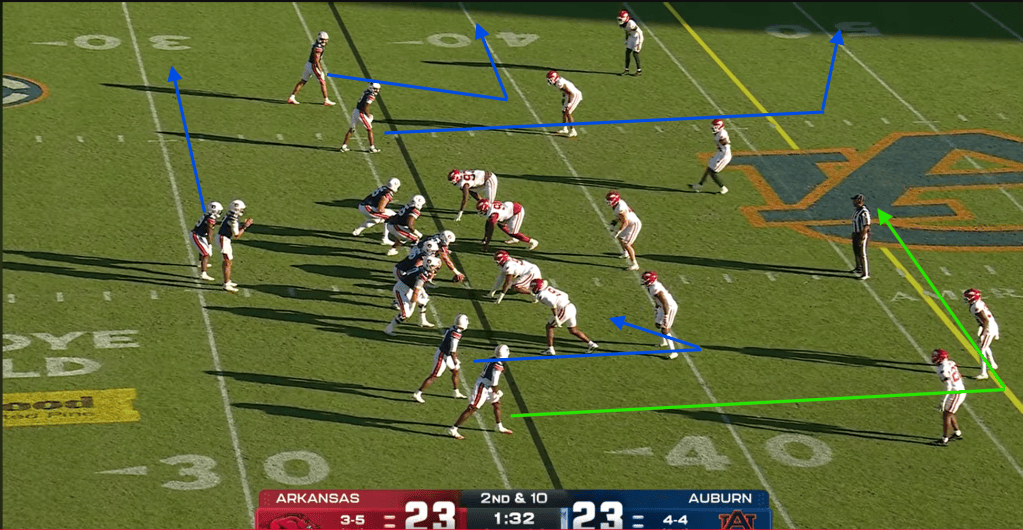
A series of four short gains on the ground, three of them by Byrum Brown, got the Tigers into field goal range with time to spare. Ideally, they would’ve run the clock all the way down and then kicked the field goal, but Brown, for all his excellence, made a mistake that probably brought back some PTSD from the 2021 Iron Bowl and stepped out of bounds on a play where he probably could’ve stayed in bounds and gotten a first down that would’ve ended the game. This is the same TE arrow RPO that we discussed before. Brown reads the backside DE (red circle), who chases the zone, and he pulls the ball. However, in this case, Arkansas is in man coverage, and the Mike LB (red arrow) is able to get over and cover Jake Johnson, so Brown makes the smart decision to keep it himself. I guess he’s a bit off balance there at the end and maybe his momentum carried him out of bounds, but he probably had the first down if he didn’t go out. Auburn failed to convert the third and short and had to kick the field goal earlier than they would have liked. Fortunately, Arkansas did nothing with their last possession, and the Tigers held on for a win that was more difficult than it needed to be, but better than a loss.
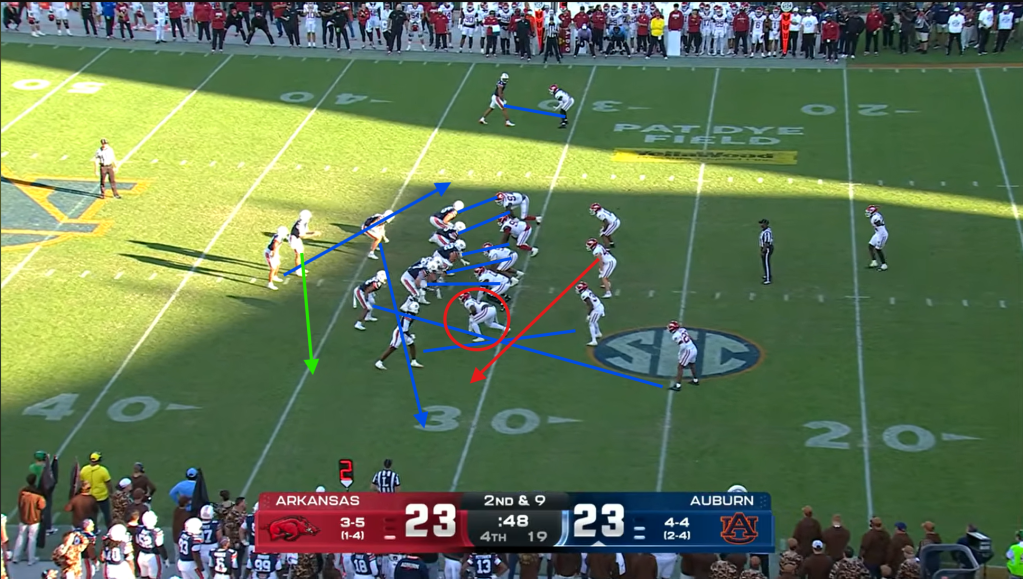
So, to recap, I really don’t think that Auburn radically altered their playcalling or approach to the game in the second half versus the first. The fact that so many of Auburn’s successful plays in the second half were just better reps of plays they’d tried to run in the first half bears that out. Obviously there were a few plays (the pop pass to Cobb off of the QB draw, for example) that were set up by plays they’d run earlier, but the biggest thing was just avoiding the drive-killing penalties.
The real question is how can Auburn get this kind of execution out of the gate instead of screwing around for a quarter and a half to start every game before getting into gear. I really don’t understand the core issue there, and maybe it’s something psychological that’s beyond the scope of an Xs and Os blog. It’s not something that’s sustainable, and we saw what happened when you do it against a team that’s ready to jump you from the first whistle like LSU. I think a lot of it just comes down to what we’ve talked about before, which is the inability to run the ball consistently outside of Byrum Brown due to the weakness of the offensive line, which will only be solved by a couple of years of strong recruiting and player development.
Fortunately, Golesh, et al., managed to stave off a defeat that would’ve seriously dented the goodwill they’d built up from the Georgia win, and getting a big OL commit right afterward should solidify people’s willingness to trust in the long-term vision they’re building toward. Beat a Moo State team that’s looked rudderless on offense without Kamario Taylor and have a successful SoCon Challenge Week, and we’ll be 7-4 and playing with house money going into the Iron Bowl.


Leave a Reply