-
What can we expect from Alex Golesh’s offense?
#AuburnFast is back on the menu
In a shocking turn of events, Auburn’s athletic department has made a competent decision in regard to the football program by hiring South Florida head coach Alex Golesh. Golesh took over a USF program that had gone 1-11 in 2022 under Jeff Scott and immediately took them to a bowl game in 2023, following that up with another 7-win campaign in 2024 and a 9-win season this year, missing out on the championship game in a crowded American Conference.
I want to be up front and say that I would have preferred Jon Sumrall over Golesh. That was my feeling all along and it still is, in spite of how things shook out. That said, Golesh is our guy (and he was in my original top four candidates that I posted before Hugh was even fired, ahem), so let’s take a look at what he brings to the table from an Xs and Os perspective.
Prior to moving to USF, Golesh spent two years as Josh Heupel’s offensive coordinator at Tennessee, running Heupel’s version of the veer-and-shoot offense. Before that, he also worked for him at UCF, running the same system.
I’ve already discussed the veer-and-shoot on the blog before (when Hugh Freeze brought in Philip Montgomery and then scapegoated him for his own terrible coaching), but let’s take another look at the basics of the offense and the unique features of Golesh’s version.
VEER-AND-SHOOT BASICS
The two key components of the veer-and-shoot are pace and space. Obviously most college offenses these days are up-tempo and spread, but the veer-and-shoot takes both of those things to the extreme.
Even by veer-and-shoot standards, though, Golesh’s offenses are fast. His offenses at USF have ranked 2nd, 2nd, and 1st in the country in seconds per play, the best statistical proxy we have for tempo; Tennessee was 1st and 2nd in his two years there as well. It’s safe to say that #AuburnFast is back.
The veer-and-shoot takes spacing to the limit, using all 53.3 yards of the width of the field. This screenshot from USF’s game against Boise in the first week of this season illustrates this well. USF’s outside receivers are lined up almost on the sideline, and even their inside receiver is lined up on the numbers.
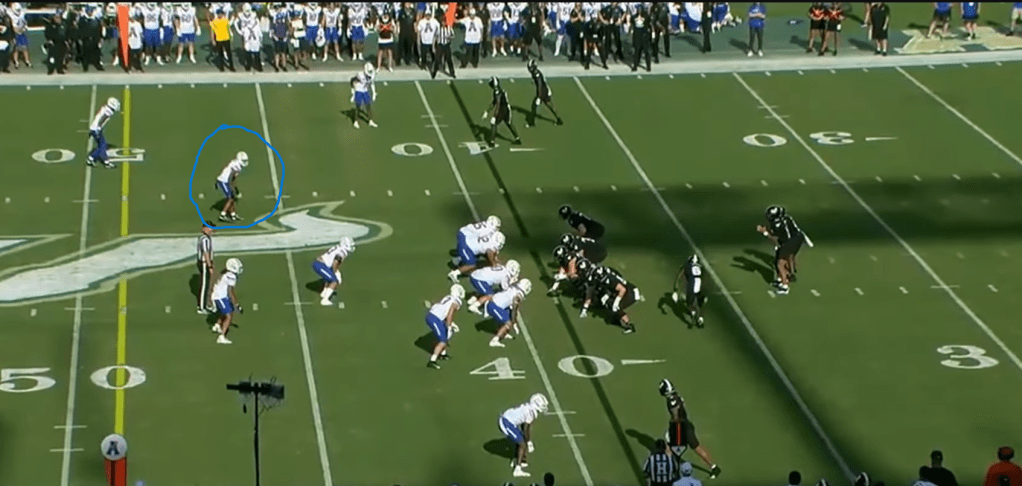
This extreme spacing serves two purposes. The first is to isolate defenders, which is illustrated by the receiver at the bottom of the screen. He’s lined up so wide that he’s barely in the picture, but look at the defender lined up over him: there’s nobody in a position where they could possibly help him. The veer-and-shoot loves to exploit these one-on-one matchups by attacking downfield with vertical option routes (more on that later).
The second purpose is to put defenders in conflict. If the defense is going to play a zone or match coverage with two safeties, which the majority of college teams do on the majority of their snaps nowadays, there will always be one player who is responsible for both a zone or a receiver in the passing game and a gap (usually the B gap) in the run game. In this case, it’s the guy standing at the top of the bull logo, whom I’ve circled in blue.
Like many modern spread offenses, the veer-and-shoot makes heavy use of run-pass options (RPOs), which attempt to exploit that conflicted defender by reading him and either handing the ball off if he stays in his pass coverage zone or throwing a route that attacks that zone if he comes down to fill his gap. By using such extreme spacing, the veer-and-shoot maximizes that conflict, forcing the defender to fully commit and making the read easier.
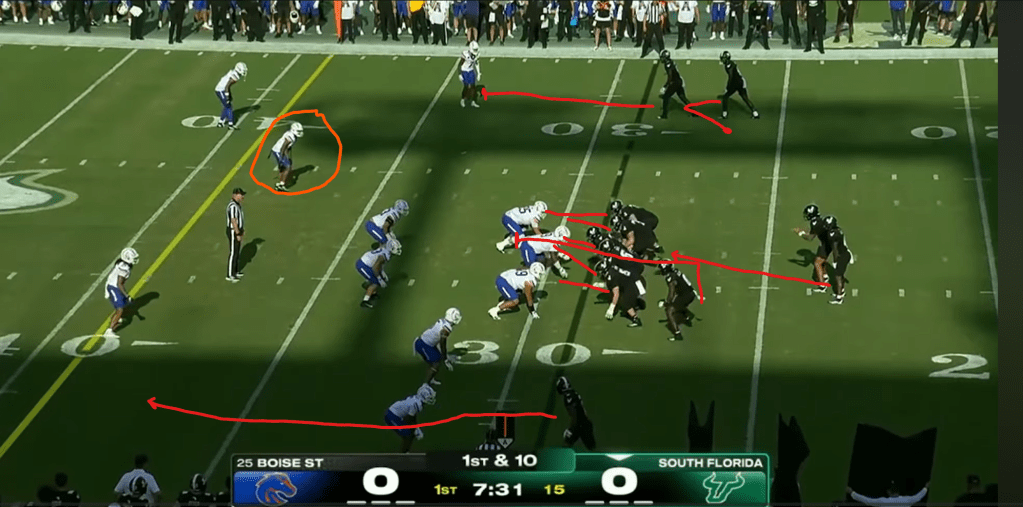
The clip below shows a good example of this, where the conflict player (again the safety lined up on the hash) comes down to fill his run responsibility, and the Bulls’ QB, Byrum Brown, pulls the ball and whips it out to the receiver on a spot screen for a decent gain.
Veer-and-shoot teams have a variety of combinations of runs and pass tags that they can use to attack the defense. Most veer-and-shoot offenses will emphasize quick hitting, downhill runs to maximize the advantage gained from putting defenders in conflict. The faster the run hits, the harder they have to commit to stop it. For the most part, Golesh’s run game consists of inside zone, power, and counter concepts. I’m not going to go into those in detail, but I’ve linked the fantastic WarRoomEagle’s breakdowns from the dearly departed College and Magnolia blog (RIP, comrade).
The pass tags generally consist of quick receiver screens and quick-hitting routes like hitches and slants. Again, I’m not going to break these down in detail, but this post from the veer-and-shoot subreddit (a good resource for additional Xs and Os info) includes some of the most common ones (as well as what I think are Art Briles’ original coaching points and terminology).
So what does the defense do to counter this strategy? Well, the most obvious answer is to bring an extra defender into the box, eliminating the need for the defender lined up outside the box to play a dual responsibility. If you’ve got the dudes to play man-to-man on the outside, then this strategy basically nerfs the veer-and-shoot, if the defense can’t exploit it. This was the problem for Auburn’s knock-off veer-and-shoot during the Philip Montgomery debacle.
Fortunately, competently-run veer-and-shoot offenses that aren’t being undermined by the head coach’s meddling do have effective answers. In the original Briles version of the veer-and-shoot, the answer to this defensive response was usually to throw one of their deep choice routes, which take advantage of the isolation of defenders I mentioned above. This is a play-action pass concept where the playcaller tags one receiver on a deep option route, with the basic rule that “you get one move to get open deep”. This could turn into a vertical route, a fade, a post, or even a curl route if the receiver can’t win deep. The other receivers on that side of the field run routes designed to pull defenders away from the option route and keep that defender isolated. In Art Briles’ version of the offense, the receivers on the other side of the field would take the play off, but Golesh seems to prefer to have them run actual routes.
This is basically a one-read play for the QB, where he’s told before the snap who to throw to. It’s often paired with the aforementioned tempo to try to catch the defense napping or take advantage of them being discombobulated after a big play.
This is a good example of using deep choice routes off of tempo from USF’s game against Miami earlier this year. In this case, they’re running a choice route to the outside receiver at the top of the screen. The inside receiver runs a dig or square-in route designed to occupy the safety, which it does, leaving the outside receiver one-on-one with the CB, and he’s able to beat him deep for a huge gain.

Golesh’s offense, like Briles’, can and does run this concept with any receiver. On this play, they throw deep choice to the single receiver at the top of the field. Here, they’re running it to the single receiver at the top of the screen. The two receivers on the other side run dig routes to pull down the safeties (who were playing kind of shallow at the snap), and this works well; the choice route runner sees this and breaks to the now-wide-open middle of the field on a post route for a big gain into the red zone.
Now that we’ve got a good grasp on the basics of the offense, let’s take a look at some of the unique features, or at least distinctive features, of Alex Golesh’s take on the veer-and-shoot.
UNIQUE FEATURES
The first is another answer to the aforementioned problem of the defense equalizing numbers in the box, which Briles didn’t use that often but which Golesh uses extensively: get the QB involved in the run game.
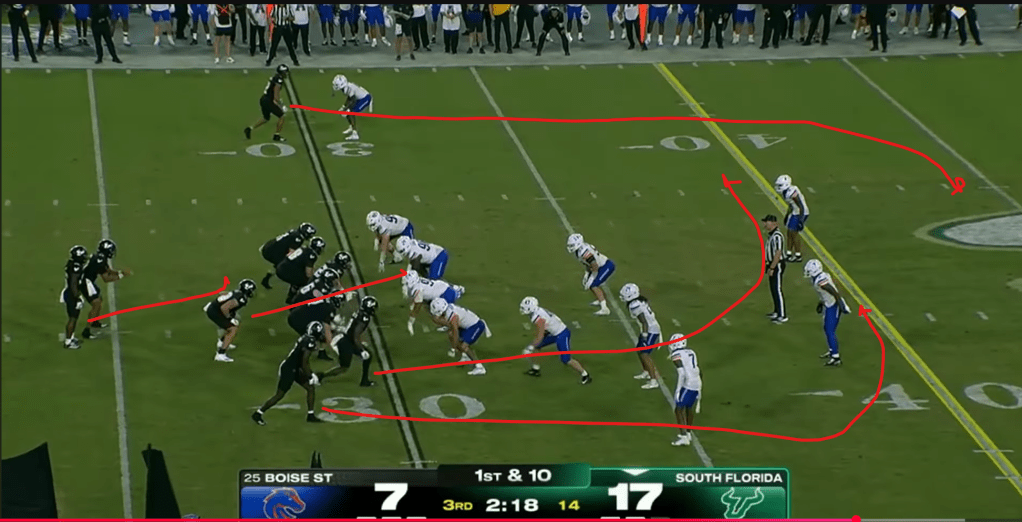
In this case (the very next play after the one shown above), Boise is playing six-on-six in the box against an 11 personnel set, but the safety on the hash is starting to creep down into the box. USF runs a zone read, in this case, the arc-read version that Gus Malzahn used to great effect during the Nick Marshall era, with the H-back/TE pulling across the formation to block the guy who would usually be responsible for tackling the QB. Byrum Brown gets a pull read from the defensive end here, and he’s able to get outside and tiptoe down the sideline for the TD to blow the game open late in the third quarter.

The next is the use of a variety of dropback passing concepts. The dropback game for Art Briles’ veer-and-shoot was relatively basic, but the use of such wide splits limited what they could do in terms of the dropback passing game, especially over the middle. They ran some shallow crossing concepts, but that was about it.
Golesh, perhaps as a result of working with former Mike Leach QB Josh Heupel, includes more of the air raid-style dropback concepts, including the Pirate’s beloved mesh concept. In this case, it’s a variation on the now-popular mesh-rail version of the concept. The basic idea of mesh is that two receivers will run crossing routes from opposite sides of the formation, passing each other (meshing) to rub off defenders in man coverage. The single receiver and the #3 receiver in the trips run the mesh here; the #2 receiver runs a sit route behind the mesh, and the motion man runs a wheel route on the outside. I’m not sure how Golesh teaches the progression here, but a common method is to have the QB peek the wheel, then look at the sit, and then come down to the mesh as his checkdown. Brown does a good job of getting through his progression, finds one of the mesh runners wide open, and the Bulls should’ve converted on third and medium but got a bad spot, in my opinion.

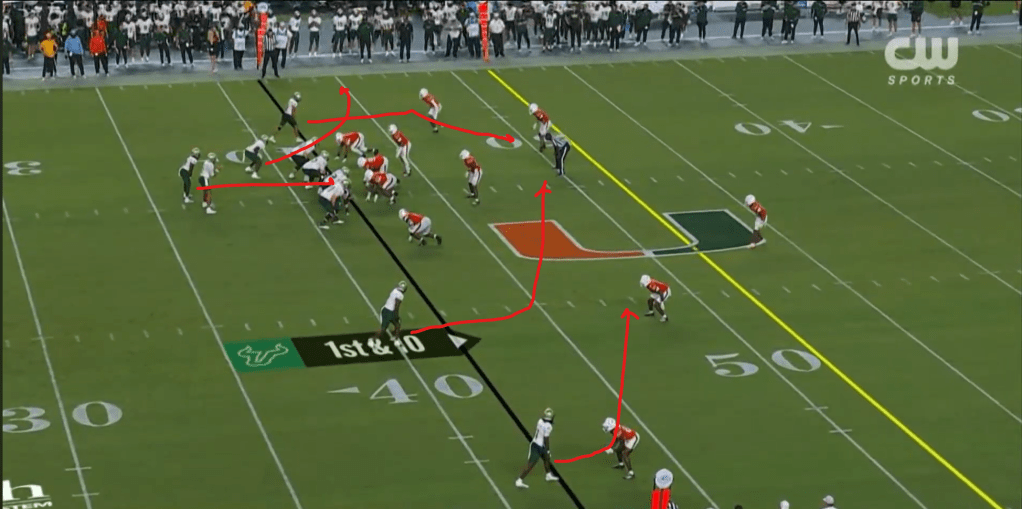
A final unique feature of Golesh’s veer-and-shoot is his use of compressed formations, which he mentioned in his introductory press conference. This is another way of using space in an extreme way; it’s just the exact inverse of the veer-and-shoot’s typical wide splits. Instead of a maximum stretch on the defense, you’re maximally compressing the defense, which facilitates routes over the middle and getting rubs against man coverage, like the mesh concept above. They especially like to do this when they’re lined up into the boundary and in the red zone, where vertical space is already compressed and their extreme spacing and deep ball threats aren’t as effective.
Here’s an example from the Miami game of the Bulls using a tight receiver split into the boundary. They’re running a common air raid quick game concept, with a slant route from the outside receiver, a flare route from the inside receiver, and double slants on the backside. The compressed formation helps create a rub to get the flare open, but Brown misfires on the throw and it’s incomplete. You get the idea, though.
Next, let’s take a look at the type of personnel that Golesh will be looking for to run this offense, and how Auburn’s existing personnel (pending the portal) might fit into his scheme, and what he’ll be looking for in recruiting.
PERSONNEL REQUIREMENTS
As with most offenses, the veer-and-shoot lives and dies by its quarterbacks. That said, Golesh isn’t necessarily going to be looking for prototypical pocket passers. If you look at the clips above, you can see that his USF QB, Byrum Brown, has a pretty janky throwing motion that is far from NFL ready, but he still put up over 3,000 yards this year. Hendon Hooker was a similar story at Tennessee. The main things Golesh really needs from his QB are a strong, accurate deep ball and the athleticism to make plays in the run game. Hmm, I wonder if Auburn has anyone on the roster who fits that description?
For the wide receivers, there’s only one real requirement.The veer-and-shoot runs on speed, especially out wide. Guys like Jalin Hyatt, who ran a 4.4 at the NFL combine two years ago, was one of the most explosive players in college football when he played for Golesh at Tennessee. Again, does that remind you of anyone on the roster?
One thing Auburn fans will be delighted to hear is that Golesh is something of a tight end guru. After a decade plus of subpar tight end play, hope may finally be on the horizon. Golesh doesn’t necessarily get the tight end involved in the passing game all that much, mostly just RPOs and pop passes, but they’re a major part of the run game, and the very first commit Golesh landed was from a tight end.
I don’t think there’s necessarily a prototypical veer-and-shoot running back, as the practitioner of the offense have had success with big guys, little guys, and everyone in between. Since the offense is primarily focused on inside runs, obviously you need a guy who can take a licking and keep on ticking, but there aren’t really any hard positional requirements.
Finally, in terms of the offensive line, the veer-and-shoot’s reliance on inside zone and power blocking schemes, as well as on play-action pass protection for deep passes, means that you do need some guys with decent size and athleticism up front. This is the main thing that concerns me going into next year, since Auburn’s last truly elite offensive line is more than a decade in the past. We’ll see what Golesh and his staff are able to cook up here.
Before we wrap things up, let’s take a look at some of the potential pitfalls of the veer-and-shoot offense that Auburn might have to contend with.
POTENTIAL PITFALLS
The first major pitfall is the one that Tennessee ran up against in their games against Georgia while Golesh was there. If the other team has the dudes to match you man for man on the outside, they can play with one high safety and eliminate the conflicts and deep threats that the veer and shoot runs on. The QB run game can alleviate this somewhat, but you’re still looking at the same problem I referred to above that plagued Auburn’s 2023 offense. The answer to this problem mostly lies in recruiting, rather than scheme.
The second is the relative lack of complexity in the passing game. Again, this is something Golesh has managed to mitigate by incorporating a more complex, air raid-derived dropback passing game, but the wide splits limit what you’re able to do in terms of the route tree. Those receivers standing almost on the sideline aren’t running many out-breaking routes or crossing routes. You’re also not really able to get many of the rubs I talked about above, which limits your ability to manufacture completions against man coverage. Again, I think Golesh has done better than most of the veer-and-shoot guys in mitigating these challenges, but it’s still something to keep an eye on.
The last major issue I see is the #narrative that the offense doesn’t prepare QBs for the NFL, which isn’t a problem for the offense itself so much as it is in recruiting, where opposing coaches who run more of a pro-spread style of offense can hit you on it. Usually I would dismiss this as nothing more than talking head nonsense, but the fact of the matter is that there hasn’t really been a veer-and-shoot QB who’s gone on to have sustained success in the NFL, including Golesh’s best QB, Hendon Hooker. Now, to be clear, a college coach’s job is to win college football games, not serve as a farm system for the NFL, but this is something that will be used against you as a negative recruiting tactic. That said, you’re not necessarily fighting for the same types of QBs as the guys running more pro-style offense, so you can mitigate the damage caused by this #narrative somewhat.
That’s all I have for now. I’ll likely be back with more of a proper preview in the spring once we have a better idea of what the roster is going to look like, but things should be fairly quiet here for the next few months.
SOME ADDITIONAL VEER AND SHOOT RESOURCES:
Kendal Briles’ install sheets from when he was at Florida State in 2019 (a rarity because Briles the elder was notoriously secretive about his offense)
Part I of Ian Boyd’s two-part series on the veer-and-shoot (paywalled but his newsletter is worth it, imo)
-
Derrick Nix’s Offensive Quick Fix
Say that five times fast.
Glory hallelujah! The moment this blog has been waiting for for three long years has finally come. Hugh Freeze is gone and Auburn can move on from his shambolic tenure. And what better way to do that than by dancing on his grave? Join me as we take a look at one of the most jarring examples of addition by subtraction you’ll ever see.

I haven’t written much about the Auburn offense over the last year or so, because frankly who cares, but if I had, there are a few specific criticisms I would have made of Hugh Freeze’s lackluster, clogged-toilet offense: the over-reliance on the use of 12 personnel (1 RB, 2 TEs, and 2 WRs) on a team that didn’t have good tight ends, the lack of tempo, the lack of an effective QB run game, the lack of an effective downfield RPO game, the lack of a true three-step passing game, and a complete absence of any kind of play sequencing (where one play sets up another).
Guess who immediately checked all of those boxes once he was given full control over the playcalling on every down? That’s right folks, Derrick Nix got it in one, with a gameplan that, if you can believe it, utilized the strengths of Auburn’s personnel with plays that actually built upon one another to form a coherent system, rather than a disconnected mishmash of personnel and plays run at a pace so slow that Kirk Ferentz would tell you to speed it up. Let’s take a look at how Nix utilized the concepts I outlined above to put together one of Auburn’s best offensive showings of the 2020s (which was as depressing a sentence for me to write as it was for you to read, I promise).
PERSONNEL
I don’t really need to cut up film to discuss this one, so I’ll get it out of the way first. After a few years with a bevy of good tight ends on the roster, the 2025 Auburn offense has…one good tight end? Maybe none? Brandon Frazier’s mobility is limited after his recovery from injury and Preston Howard hands are hard enough to cut diamonds, so I think the answer is none. Despite that, Hugh Freeze spent an inordinate amount of time with two tight ends on the field during his last miserable few games on the Plains. This decision was made all the more baffling by his refusal to actually run the ball. Wide receiver is the strongest position group on the team, so being more pass-oriented makes sense, but then why would you only have two of those great wide receivers on the field at a time? This is like Dadaist personnel usage. It’s an abstract art form I can’t even get my head around.
Auburn ran 82 offensive snaps against Vanderbilt and by my count, they only used multiple tight ends on eight of them, less than 10%. Almost the entire game was spent in 11 personnel, generally with Preston Howard as the sole tight end, although he was often lined up as an additional slot receiver rather than a true inline or Y-off tight end. Nix moved him around a good bit as a receiver and perimeter blocker with mixed success and got him involved in the passing game with…less success because he can’t really catch, but it was a better use of him than what Hugh Freeze was doing at least.
THE QB RUN GAME
Auburn announced Ashton Daniels as the starter during the week before the game, which I personally saw as rearranging deck chairs on the Titanic, but it turned out that Derrick Nix actually had a concrete reason for this decision, namely that he wanted to get the QB more involved in the run game. This is something that Auburn has desperately needed this season. If you’re going to run the ball successfully, you have to have a way to equalize numbers in the box. If your QB is handing the ball off, then you’re automatically losing one potential blocker. Thus, unless the defense is playing with two high safeties on every snap, they’re going to have an extra man in the box. See mom, that semester as a math major served me well!
One of the easiest ways for a team to equalize numbers if they don’t have a strong enough passing game to scare the other team into playing two high safeties is to get the QB involved in the run game. If he’s carrying the ball (or potentially carrying the ball) instead of just handing it off, you get that extra man back and the numbers are equal again. This was something Auburn did a fair amount in the season-opening win against Baylor (the only game where the offense looked any good this year before Hugh was fired) but after that, the QB run element disappeared and so did most of Auburn’s offensive success.
Derrick Nix signaled his intention to bring that aspect of Auburn’s offense back from the very first offensive snap of the game. Auburn starts in a compressed formation with Eric Singleton, Jr. aligned in a way that suggests he’s probably going to go in jet motion, which he does. Auburn runs a power read concept here, originally brought to national prominence by the 2010 Auburn offense.
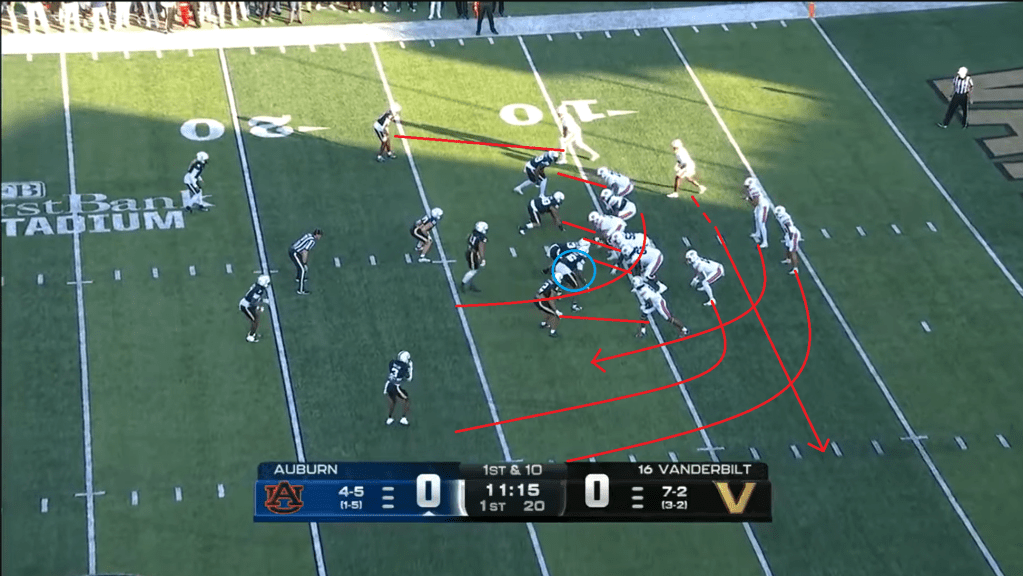
The offensive line blocks like a traditional power play, with the playside linemen blocking down and the backside guard wrapping around to block the playside linebacker. However, instead of having a fullback or tight end kick out the playside defensive end, he’s left unblocked, and the quarterback will read him and either hand the ball to the sweep man or keep it himself and run the power play depending on what he does.
Auburn made a ton of hay running this play with Cam Newton and Onterrio McCalebb back in the day. It’s not quite as successful here, as Vanderbilt does a good job in pursuit and stalemates the perimeter blockers to string Singleton out and hold him to a two-yard gain, but it was encouraging to see something like this right out of the gate.
Another advantage of having a QB like Daniels who’s good with his legs is that he can make plays for you when the blocking breaks down or when receivers don’t come open. Daniels didn’t actually end up scrambling all that much, six times in total, but he had a success rate of 66.6% (repeating, of course) on those scrambles, with all four of his successful scrambles resulting in a first down (and another successful conversion via scramble wiped out by a holding penalty). Whether you can technically consider these successful plays is debatable, since they’re improvisations after the play you actually called break down, but having a QB with the presence of mind to get out of the pocket and run instead of eating sack after sack is a good change of pace.
Here’s a good example from Auburn’s first drive of Daniels extending the play and converting the first down with his legs. Auburn motions Jeremiah Cobb out of the backfield and runs a deep cross concept, where Daniels is looking to hit Eric Singleton over the middle. Vanderbilt is in quarters coverage here and has two defenders bracketing Singleton, but Daniels does a good job of feeling the pressure coming and escaping the pocket to convert the first down. Auburn would score on the next play; more on that in a moment.
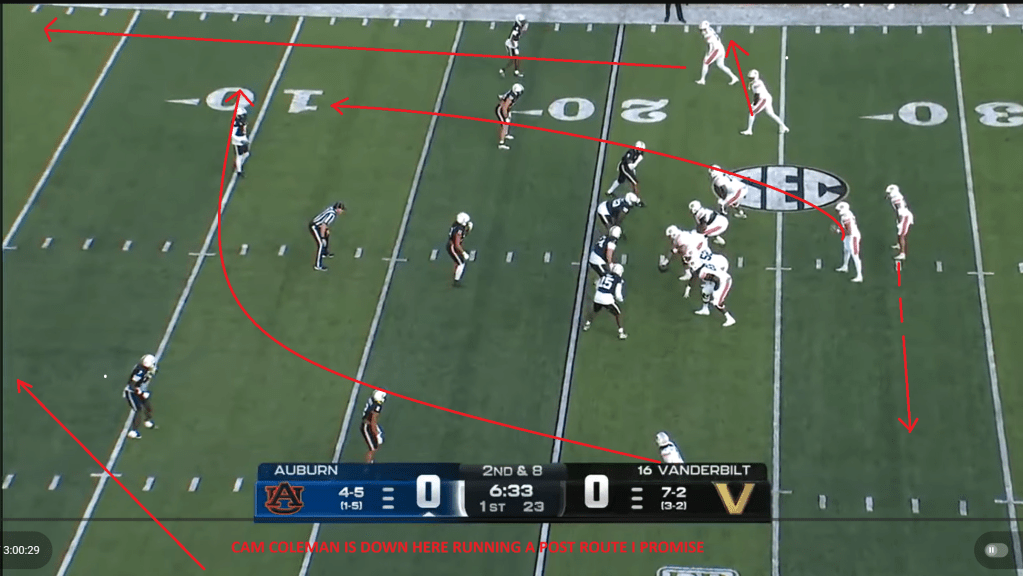
Nix also utilized Daniels’ legs on a few straight QB runs. Auburn’s second touchdown of the night came on a QB power play, with Daniels taking it to the house from 11 yards out. This is the same blocking scheme as the power read play above for the offensive linemen, but now the tight end will kick out the defensive end like a normal power concept. Usually the RB would be used as an additional lead blocker, but he just kind of wanders outside here. I’m not really sure what he’s doing to be honest, but whatever it is freezes the playside linebacker long enough that he’s an easy mark for the pulling guard, whose block springs Daniels for the TD.

Nix went back to the well with this play right before halftime, and it should have resulted in another Auburn touchdown, if it hadn’t been wiped out by an extremely questionable holding call.

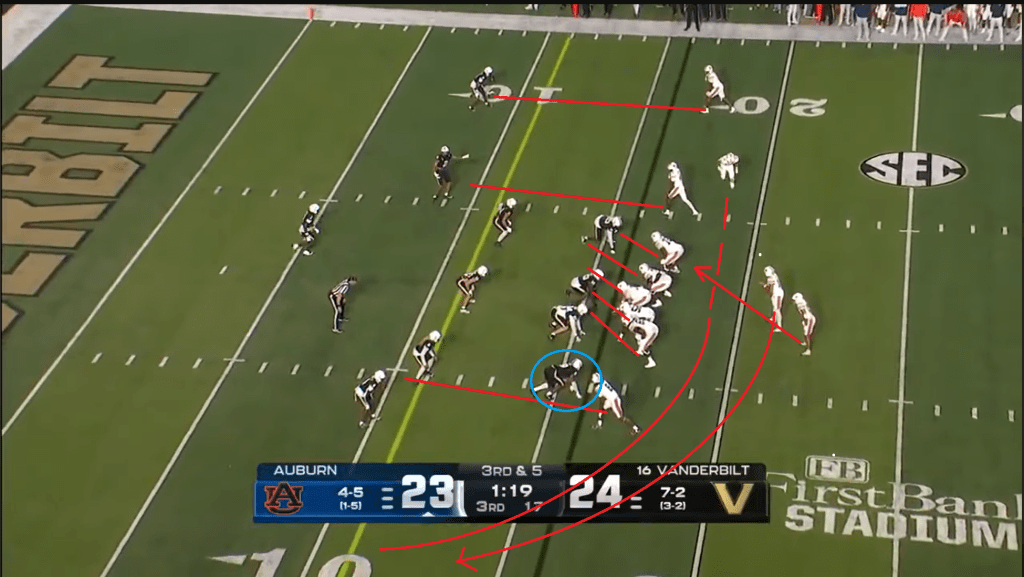
Daniels got the Tigers’ offense one more touchdown with his legs late in the third quarter. This is a good example of incorporating motion into the QB run game. Auburn is just running a basic zone read here, with the tight end coming across to block the overhang player on the playside (the guy who would usually be responsible for tackling the QB). This was a staple of Gus’ offense during the Nick Marshall era, and if you squint a little bit, that #12 might start to look a bit like a #14 here. (Ignore the hold by Preston Howard there, they owed us one after the weak holding call on the last play I showed and Vanderbilt got away with much worse.)
THE DOWNFIELD RPO GAME
Auburn’s RPO game was often ineffective under Hugh Freeze. Part of the reason was that Jackson Arnold’s hesitancy and indecision made him a bad RPO QB, but part of it was the lack of any sort of real downfield RPO threat to constrain the second and third level defenders. There were intermittent flashes where Hugh Freeze’s offense did this well (check out my writeup on the Alabama A&M game last year for a good example) but those occasions were few and far between this season.
Vanderbilt is a pretty aggressive team on the defensive side of the ball in terms of bringing heat from the second and third levels. If you don’t give their guys in the back seven something to think about, they’ll play aggressively downhill against the run and bring outside linebacker and corner blitzes on you all night. The first example I was going to use to illustrate my point here was the first touchdown of the game, but I realized that this ended up not being much of an RPO because there was no real “option” to read.
Auburn is in 12 personnel here (boo!) and this kind of illustrates why 12 personnel didn’t work well for this team. Vanderbilt has rolled their safety from the wide side of the field down into the box, and shuffled their safety from the boundary side over to the middle. Auburn is running a zone concept paired with a glance route by Eric Singleton on the boundary side. Usually, Daniels would be reading that boundary safety to hand off or throw the glance, but since he’s rotated to the middle of the field, there isn’t really much to read, and the glance ends up basically being free and it’s an easy touchdown.

Another good example of a downfield RPO concept, in this case attacking the second level defender, comes from Auburn’s third drive. Auburn is in a tempo situation here after an 11 yard gain on the first play of the drive. They get to the line and get set quickly in a 3×1 11 personnel look. Auburn pairs a zone run with a shock concept on the three-receiver side (a variation of stick where the #1 receiver runs a hitch, the #2 receiver runs a fade, and the #3 receiver runs a stick). Daniels is reading the outside linebacker lined up on the hash to either hand the ball off or throw the stick. Since he stays home here, Daniels hands it off and Cobb rips off another solid gain into Vanderbilt territory.
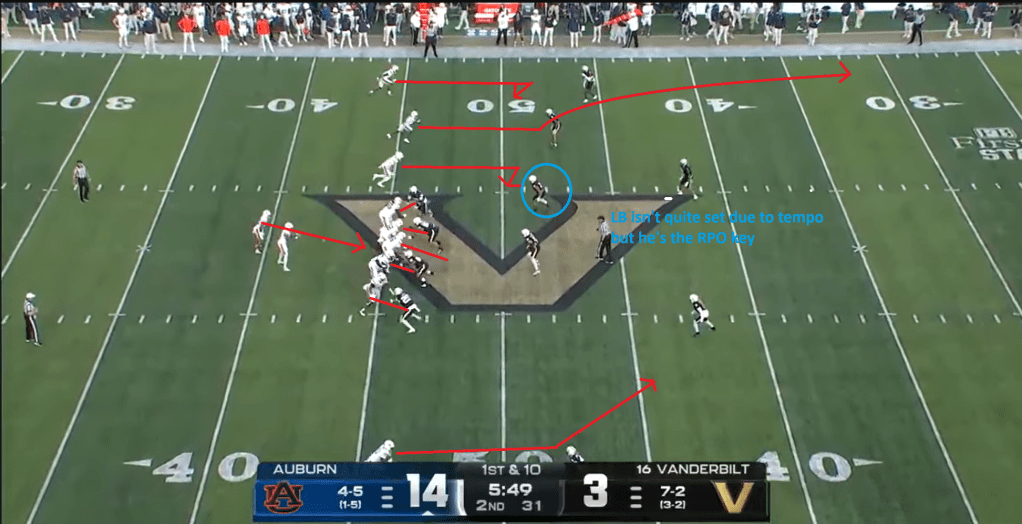
Although there’s a stoppage for a Vanderbilt player who lost his helmet, Auburn does something I love here, which is to get right back up to the line after a big play, snap the ball as fast as possible, and run the same play. This was something the good Gus Malzahn offenses would do if they got a big play. Once again, Daniels hands the ball off to Cobb, and this time it’s an even bigger gain to get Auburn into the red zone.
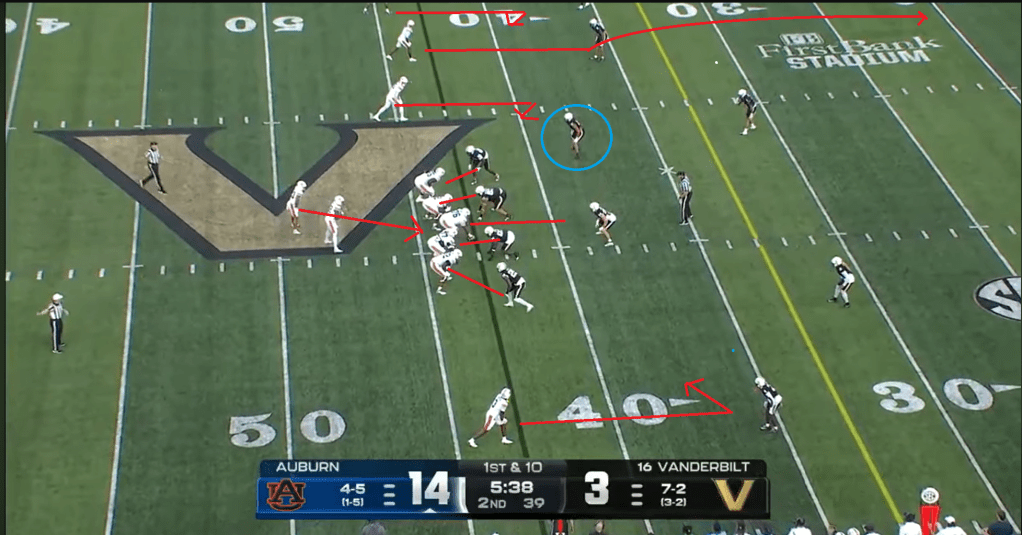
One most play I want to look at, again using this exact same zone + shock combo, was the first play of Auburn’s second drive of the fourth quarter. After being backed up by a false start on first down, Auburn runs this same RPO. However, Daniels notices here that Cam Coleman is matched up 1-on-1 on the backside, and the safety is over on the hash too far away to help (out of the picture here unfortunately), so he puts it up on the fade to Coleman and lets the best receiver in the country go make a play for him, which he does. Although he’s likely decided before the snap that he’s throwing the fade to Coleman, he does a good job of at least selling the post-snap RPO read to make sure the safety doesn’t get over in time to help on Coleman. It took a review, but Auburn got a big play here (and then got up and ran this same play again after the review for another 15-yard gain, it’s like living 24/7 in Candyland).

THE THREE-STEP PASSING GAME
Another issue Auburn’s offense suffered from under Hugh Freeze was the lack of a real quick passing game. In the modern era, many teams have folded their quick game into their RPO concepts, which makes sense; there’s no need to run hitches, slants, or quick screens if they’re already built into your run game. However, Freeze’s offenses also lacked any kind of real underneath passing game, like stick, snag, or shallow crossing concepts. These kinds of plays are important for controlling the second level defenders and keeping them from teeing off on your QB, as often happened to Jackson Arnold. Even Auburn’s deep passes tended under Freeze tended to lack any real underneath option, which was part of the reason Arnold ended up eating so many sacks.
Nix obviously didn’t have time to go through and reinstall Auburn’s entire passing game, but he did have a few three-step concepts that he leaned on throughout the game. Wow, a having a few plays that you’ve repped really well instead of just whatever random stuff the coach happens to come up with on gameday? Perish the thought!
We saw the three-step game on display on Auburn’s first series of the game. After two unsuccessful running plays, Auburn faced a third and eight. This was a situation where you’d almost put money on a sack under Freeze, but here, Nix sets Daniels up for success with a play that’s designed to get the ball out of his hand quickly. Auburn is in an empty set and has some type of middle hook concept called with the #1 receivers running spot routes and the #2 receivers running deeper hooks. Vanderbilt is in man or man-match coverage and has everybody covered initially, but Daniels extends the play with his legs and is able to move the chains.

On the very next play, Nix calls another quick pass from an empty set. This time, it’s a regular stick concept to the wide side of the field paired with a hitch and a glance to the boundary side. Daniels gets the ball out in rhythm to Singleton on the stick and gets another first down. Imagine that, getting your QB some quick completions out of the gate to get him in rhythm with his receivers.
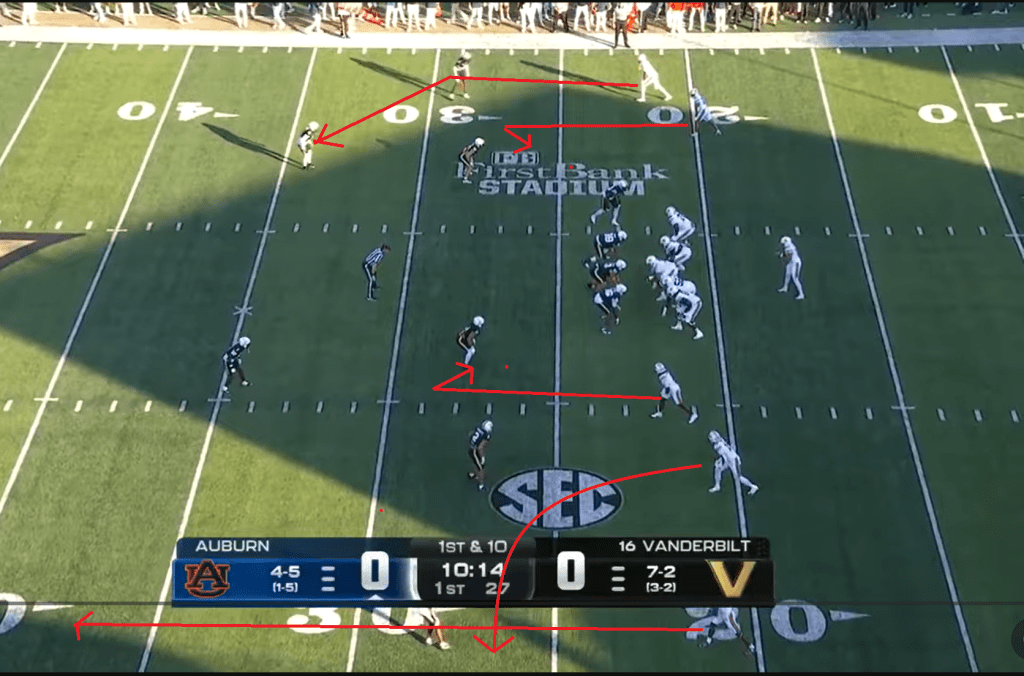
Eventually, Vanderbilt started playing more man on third downs to clamp down on Auburn’s underneath passing game. Man coverage tends to nerf the stick and spot concepts Auburn had been relying on in the three-step game pretty well, but Derrick Nix had another idea up his sleeve, which brings me to my last point…
PLAY SEQUENCING
Yes, unlike Hugh Freeze, who seemingly never made a single adjustment in his life, Nix has the all-important counter to the defense’s counter. In this case, it’s a stick-nod play, where the receiver settles down like he’s running a stick route, and then bursts to the middle of the field, so that a man or zone defender who clamps down on the stick is left flat-footed. That’s exactly what Auburn runs here on the second play of their penultimate drive of regulation. Although Daniels ends up throwing the slant to Cam Coleman instead, Singleton was open on the stick-nod after the defender bit on the route.

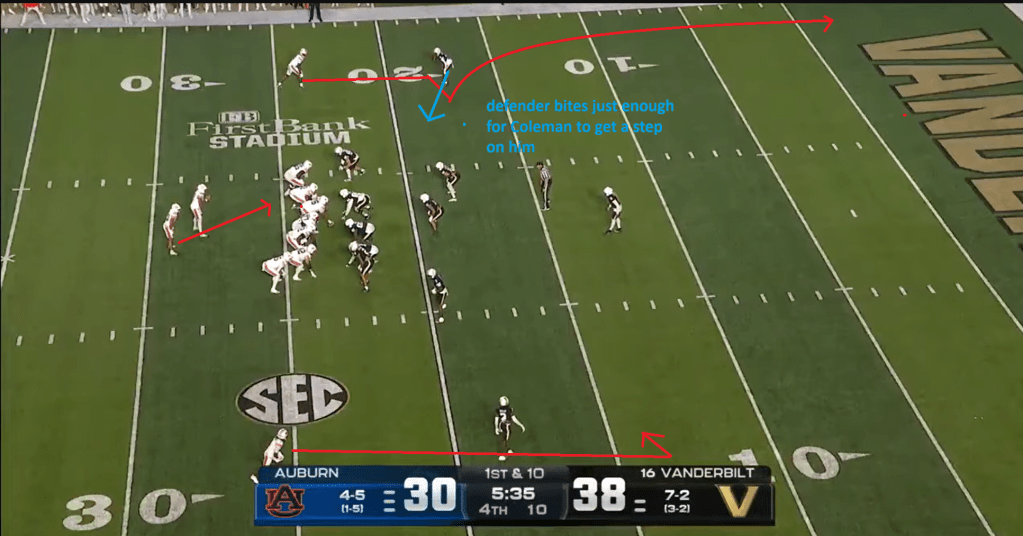
Another good example of play sequencing came on the denouement of that drive, the incredible touchdown catch that Cam Coleman made, followed by the game-tying PAT that sent the game to OT after some baffling coaching decisions by Vanderbilt on their last drive. Auburn had been working that zone/glance RPO I discussed above quite a bit, to the point where the defender who was lined up on Coleman was starting to cheat inside to cut it off. Here, Coleman runs a sluggo route, faking inside before heading up the sideline on a go route. Coleman makes an absolutely otherworldly catch for the touchdown here, but it was set up by great play sequencing to get him just enough separation from the defender to work his magic.
ONE LAST THING…
Unfortunately, it wasn’t all sunshine and roses for Auburn in this game. Despite the refreshing performance from the offense, Auburn’s defense got carved up by Diego Pavia and lost the game. I don’t really blame the remaining coaching staff for this since they were dealt a pretty rotten hand by Hugh Freeze and didn’t even have the luxury of a bye week to work out their new responsibilities, but simply put, good programs find ways to win these types of games and bad programs find ways to lose them.
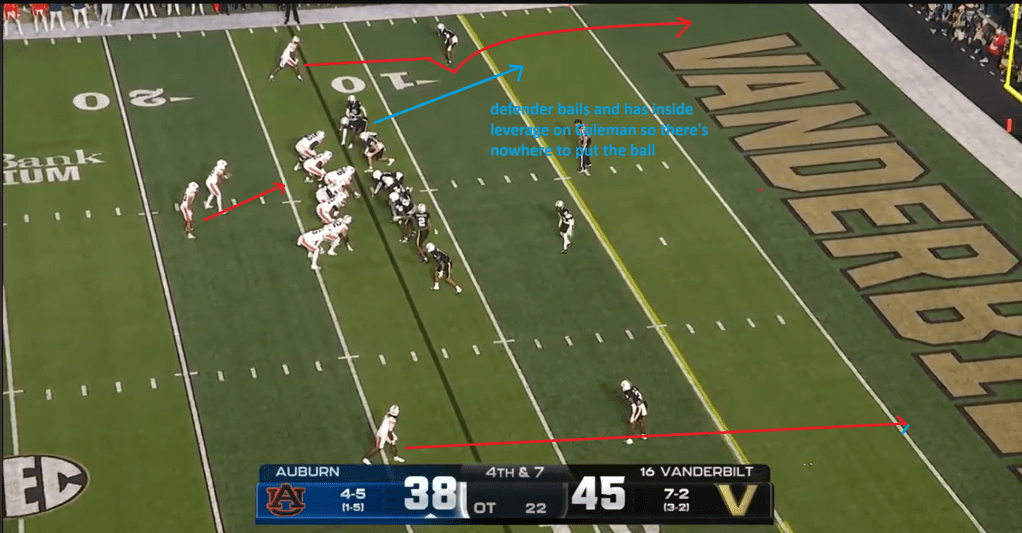
One of the very few playcalls I can really criticize from Derrick Nix was the last play of the game. If it looks familiar, it should, because it’s the exact same play as Auburn’s last touchdown in regulation. Vanderbilt is showing zero blitz before the snap here, but before Auburn checks to the sideline, we see one of the defenders start to peel off to shadow Coleman on the inside. This would’ve been the time to change the playcall and get into something else (although that was a bit limited since Auburn was in 12 personnel here, ahem), but Auburn went ahead with the play and had nothing because it was a one-man route to Coleman, who was bracketed by two defenders and had no chance of making a play even if the ball had been catchable. Old habits die hard, I guess.
I wouldn’t expect much more from the blog this season until the new coaching hire is made, as long as there’s some kind of Xs and Os angle to be interested in there. I don’t really plan on writing another article on coaching candidates since my thinking from the last one hasn’t changed very much. I’m working on a book (on a subject totally unrelated to the subject of this blog) at the moment and don’t really expect to have much time for the blog for the rest of the year anyway. We’ll see what happens. It’ll be hard to do worse than Hugh (knock on wood).
-
Some Thoughts on Auburn’s Impending Coaching Search
After yet another disappointing loss to a ranked team and yet another anemic performance from Hugh Freeze’s offense, Auburn finds itself at 3-3 and staring down the barrel of a third straight losing season under Hugh Freeze. I spoke my piece on Hugh Freeze last year and don’t really intend on rehashing that discussion here since I think all of the criticisms I made in that piece have held up. Auburn football still sucks for the same reasons because Hugh Freeze is a bad coach who is fundamentally incapable of fixing those problems, and it’s time for Auburn to move on from him.
So that brings us to the big question: who can we hire to get Auburn out of this half-decade-long malaise? After two catastrophically bad hires, Auburn has to nail this coaching search. In my last post on this blog, I gave a few criteria that I thought Auburn needed to look for in the next coach:
- SEC coaching experience, preferably as a head coach,
- An organic connection to Auburn, and
- Experience building a program
I think those criteria are still a good starting point, although I want to rephase #2 a bit. I don’t think the new coach has to have a connection to Auburn per se, but he does have to represent the values that Auburn claims to believe in and needs to contribute positively to the image of the program and the university. The next coach will probably need a year or two to turn around the mess that Harsin and Freeze will have left him, and a prerequisite for patience is buy-in from the alumni and the university community, which Freeze never had due to his various scandals and personal character issues.
The new coach doesn’t have to be an Auburn Man™, but he can’t be someone who detracts from the university’s reputation like Freeze. With that in mind, I’m going to start with the candidates who are unacceptable for non-football reasons and who won’t be considered in this post.
The Non-Starters
- DJ Durkin. I’ve seen a lot of chatter about firing Freeze mid-season and letting Durkin audition for the job. Ignoring the on-field advisability of this decision, this shouldn’t be a consideration because Durkin would be just as detrimental to the program’s reputation as Freeze, if not more so. I live in the DC area and was living right down the road from College Park during Durkin’s tenure there, so I had an up-close view to the scandal that ensued after the death of University of Maryland player Jordan McNair under Durkin’s leadership and his subsequent dismissal from the university. Durkin has never owned up to his failures in this incident and never properly accepted responsibility for his actions, which made him a natural fit for Hugh Freeze’s staff, but should make him unacceptable to the Auburn community as a leader of this program. DJ Durkin needs to be out the door just as much as Hugh Freeze does.
- Jon Gruden. I can’t believe I even have to seriously address this, but there seem to be people who unironically think Jon Gruden would be a good coach for this program. Look, let me put it this way: I’m 35 years old. Jon Gruden last coached in college football before I was born. He has no experience working in the current landscape of college football, which is a night-and-day difference versus 2019, much less 1989. UNC is giving us extensive proof that even a great NFL coach can’t just come down to the college level and magically make a program relevant, and Jon Gruden was far from a great NFL coach. He was a ~.500 coach for his career and his only real notable achievement was winning a Super Bowl in 2002 in his first year with a Tampa team that Tony Dungy had built. Outside of that, he was a mediocre at best NFL coach. I think the football argument against him is conclusive enough, but he was also fired from his most recent head coaching gig after he was discovered to have engaged in series of disgusting homophobic and racist email exchanges. Hiring someone with that kind of scandal in their recent past would be just as divisive as the Freeze hire and would generate even more negative coverage of the Auburn football program. It’s a terrible idea both on and off the field.
There are other people out there who would be obviously unacceptable for personal character reasons (Art Briles, Urban Meyer, etc.) but I haven’t seen even the dumbest of the dumb internet fans advocate for them, and I think the cases against them are self-evident, so I’m going to move on to some actual good candidates.
The Top-Tier Candidates
I want to be clear that I don’t think the guys I’m going to list in this tier are the only good options available to Auburn, but they are guys who I think would be widely agreed to be excellent hires by those with any modicum of ball knowledge and would be positively received outside of the program as well. Also note that this list is not in any particular order.
- Rhett Lashlee (Head Coach, SMU): Rhett Lashlee has gotten a good deal of buzz among Auburn fans for fairly obvious reasons: he’s done an excellent job with SMU in their first foray into power conference football since the collapse of the Southwest Conference, taking them to an ACC title game appearance and a CFP appearance in their first season in the conference. He’s also got a clear connection to Auburn, having served as the Tigers’ OC during the early, fun years of Gus Malzahn’s tenure. Like his mentor, he espouses an up-tempo, run-and-play-action style of football that would be a welcome change after Hugh Freeze’s disastrous attempts to build his offenses around the “talents” of Payton Thorne and Jackson Arnold The appeal of someone who’s not only a successful P4 head coach but who was also involved in a positive, successful period of Auburn football is pretty obvious, and I think most knowledgeable fans and outside observers would agree that Lashlee would be a home-run hire for Auburn. However, prying him away from SMU might be tough, given that SMU has extremely deep pockets and Auburn probably can’t just outbid them for Lashlee’s services. Auburn does have the advantage of being in the SEC rather than the ACC, and unlike SMU, will undoubtedly remain among the “haves” no matter what kind of upheaval college football experiences in the near future. Would Lashlee jump ship to Auburn? I’m not sure, but it would be a great thing for Auburn football’s future if he did.
- Jon Sumrall (Head Coach, Tulane): Jon Sumrall has gotten a lot of buzz as one of the up and coming head coaching talents in college football and will likely have his pick of P4 jobs this offseason. His Tulane team is one of the premier G5 programs in the country and still has a shot at the G5 playoff bid for this season. He has SEC coaching experience at Kentucky and Ole Miss and has experience coaching and recruiting in Alabama from his two stints at Troy. The main issue here is that, as I noted above, Sumrall will have his pick of P4 jobs this offseason. Florida will likely be looking for a new head coach this year, and all of a sudden it seems like Penn State will as well. Would Auburn be the most attractive option among those? I’m not sure.
- Eli Drinkwitz (Head Coach, Missouri): The head coach of Auburn’s next opponent, Eli Drinkwitz is an appealing option for many of the same reasons as Rhett Lashlee: a guy off the Gus Malzahn tree who has experience working on the coaching staff of a championship-winning Auburn team, in this case as a QC assistant on the 2010 national championship team. Philosophically, Drinkwitz has diverged from Gus a lot more than Lashlee has, building his offense as a wide zone-oriented system, an approach that is less common at the college level but would nonetheless be a good fit for Auburn, as he would restore a run-first ethos to the offense. I wrote at length about this style of offense as practiced by Jeff Grimes at Baylor back on the old College and Magnolia blog (RIP, comrade) but it seems like the Fanpost archive there is no longer accessible, so I can’t link it here. Ian Boyd wrote a good two-part series on the wide zone system in college football that you can read here. Like Lashlee, the question with Drinkwitz isn’t whether he’d be a good hire, but whether he’d actually leave his current gig for Auburn. He’s led Mizzou to back-to-back ten-win seasons and is well on his way to a third with the Tigers sitting at 5-1 after a narrow loss to Alabama yesterday. That loss might actually be the key to Auburn’s pitch: Mizzou simply has a lower ceiling as a program than Auburn does, given its lesser resources, facilities, and recruiting base. Would Drinkwitz give up a high-floor job in the interest of a higher ceiling at Auburn? I don’t know, but it can’t hurt to try.
- Alex Golesh (Head Coach, USF): Alex Golesh, who rose to prominence as Josh Heupel’s OC at Tennessee, has quickly taken USF from the dregs of the AAC to one of the country’s premier G5 programs, largely thanks to his high-scoring veer-and-shoot offense. Hugh Freeze dipped his toes into the veer-and-shoot world with Philip Montgomery as his OC, but Auburn never really implemented the system fully and didn’t reap much benefit of it. Golesh has proven that he can successfully implement the system on his own and build a program around it quickly. Tennessee has demonstrated that a veer-and-shoot offense can be sustainable in the SEC, and after watching Auburn’s offense sputter and fail to get out of first gear for years, a team that could put up points the way Golesh’s offenses at Tennessee and UCF have would be a welcome change of pace. I think this would be by far the riskiest of the four coaches I’ve listed here, however, since Golesh is only halfway through his second season as a head coach and hasn’t necessarily proven that he’s capable of sustained success over a longer period. He would certainly be an exciting hire, and would be the most gettable of the four coaches on this list, but he would probably have the lowest floor as well.
Other Names
I think the four names listed above should be the starting point for Auburn’s coaching search, but I have seen a few other names thrown around that I wanted to at least address here. Again, these are in no particular order.
- Glenn Schumann (DC, Georgia): On the one hand, I get the love for Schumann: he’s another guy off the Saban-Smart tree, who’s been around their successful programs and been on the staff of championship teams. And hiring a Georgia DC has worked out pretty well for Oregon in recent years. On the other hand, I think it’s odd that people have latched onto him given that, from what I can tell, Georgia fans really aren’t impressed with him and want him gone, rather than being afraid someone is going to poach him. It’s also odd to me given that, if Auburn wanted to poach a Georgia coaching staff member, there’s Schumann’s co-DC, former Auburn safety Travaris Robinson, right there. I don’t know if T-Rob is ready to be a head coach or would even want the job, but that’s kind of beside the point. Hiring a coordinator with no HC experience is a major risk in a situation where Auburn really can’t afford a low-floor hire. I think there’s an element of cargo-cult science going on here; hiring Georgia’s DC worked for Oregon, so hiring Georgia’s DC must be a recipe for success, right? Unfortunately, that’s not how it actually works, and I don’t really see the appeal of Schumann when there are significantly more proven options available.
- James Franklin (HC, Penn State (for now)): 2025 has been…an adventure for Penn State head coach
Frames JanklinJames Franklin. Penn State started the season in the top 5 of the preseason polls, coming off a playoff appearance and with national championship aspirations. After a close loss to Oregon, however, the wheels have rapidly come off for Penn State, with back-to-back humiliating losses to arguably the two worst teams in the B1G, UCLA and Northwestern, and now there are credible rumors that Franklin’s job is in serious danger. Franklin had success at Vanderbilt back in the day and I still think he’s a good coach who brings a high floor to a program, but his inability to win the big games at Penn State has reached meme-level infamy, and I don’t think he’s going to land on his feet immediately if Penn State cans him this year. (EDIT: LMAO Penn State fired him less than five minutes after I hit “publish” on this post, impeccable timing) - Clark Lea (HC, Vanderbilt): I see the appeal here. Clark Lea has turned Vanderbilt from the laughingstock of the SEC to a team that’s hanging around the periphery of the top 25 consistently and has beaten both Alabama and Auburn. Lea is a Vanderbilt alum though, and I can’t imagine he’s looking to jump ship. Also, this might be a hot take, but I think Jerry Kill is doing a lot of the heavy lifting in turning Vanderbilt into a competent program on the offensive side of the ball. I think he’d be a good hire on paper but I don’t think he’s likely to be an option.
- Curt Cignetti (Head Coach, Indiana): Curt Cignetti has pulled off one of the most stunning turnarounds in the history of college football, taking an Indiana team that has basically never been relevant in football to the playoff in his first season and taking them to a #3 ranking this season after a huge win over Oregon at Autzen. However, I think the problem here is obvious: there’s no way he’d leave Indiana, where he’s already set for life. Also, he’s 64 years old, so I think he’s going to be content to see out his career there. Great coach, almost certainly not an option for Auburn
Random Names
Here’s a couple more guys who are out there but probably won’t get serious consideration and might not even be on the table.
- Cadillac Williams (RB Coach, Las Vegas Raiders): The only time in the last five years when the otherwise putrid vibes around the Auburn football program were turned around was during Cadillac Williams’ brief tenure as the Tigers’ interim coach after Bryan Harsin was dismissed in the middle of the 2022 season. He remained on Hugh Freeze’s staff early on before being dismissed after the 2023 season under murky circumstances. To be fair, Cadillac was a bad fit for Hugh Freeze’s staff since he was an actual Auburn man who accepted responsibility when the team failed instead of passing the buck onto someone else, so that breakup may have been inevitable. If those murky circumstances were actually the result of some wrongdoing on Cadillac’s part, then I think it’s unlikely he’d be considered for the HC job this time around, and you can legitimately question whether he’s ready to be an SEC head coach with no HC or even OC experience anyway, but he’s a name that could conceivably come up in these discussions.
- Todd Monken (OC, Baltimore Ravens): I haven’t seen anything to suggest this is even within the realm of possibility, especially given that he just signed an extension with the Ravens, but given the corvids’ struggles on offense after Lamar Jackson went down with an injury, there’s a nonzero chance he’ll be job hunting this offseason. He won two titles as the OC at Georgia and did an excellent job turning around Southern Miss after Ellis Johnson crashed their program in 2012. I don’t think this is a realistic option, but a guy can dream.
- Gus Malzahn (OC, Florida State and former Auburn Head Coach): lol
Anyway, these were just some disorganized thoughts on the future of Auburn’s program to prove that I’m still alive and the blog isn’t dead. I don’t really plan on writing any more about the program under Hugh Freeze’s leadership because frankly, who cares. Freeze isn’t going to turn this around and I think all but his most delusional defenders have realized that, and blogging about the Xs and Os of a team whose head coach is about to be fired feels like writing about the engineering of the Titanic’s engines after it had already hit the iceberg. Once Freeze is officially gone and we have some actual solid intel on where Auburn football might be going, I’ll be back with some more concrete analysis.
-
Hugh-phoria
Hugh Freeze is running out of people to blame for Auburn’s failures.
Them superpowers gettin’ neutralized, I can only watch in silence. The famous coach we once knew is lookin’ paranoid and now spiralin’.
If there’s one thing that’s always impressed me about Hugh Freeze, it’s his ability to avoid accepting responsibility for anything at all costs. After an embarrassing 6-6 season last year, Freeze fired both of his coordinators and brought in two people who were ostensibly his guys. After the Cal game, we were told it was Payton Thorne’s fault and that the coaching staff had only called one bad play. Last week, Freeze followed through on his scapegoating on sent out Hank Brown as Auburn sleepwalked through a win against New Mexico that was close for way longer than it should’ve been. Then at halftime of this week’s embarrassing home loss against Arkansas, Freeze promptly threw his erstwhile savior of the program under the bus, saying we needed a QB who wouldn’t turn the ball over before pulling him and going back to Thorne as Auburn failed to mount a comeback against the Hogs, and then saying he had no idea where we should go next at QB after the game.
We’ve cycled through coordinators, position coaches, quarterbacks, receivers, and offensive lines over the last seventeen games, but Auburn has still struggled to perform, and it’s time that we start looking at the one constant throughout those games: the head coach. Bill Parcells famously said that if you’re a head coach, “you’re either coaching it or allowing it to happen,” meaning, of course, that everything that happens within your program is ultimately the head coach’s responsibility. Freeze seems to have embraced the exact opposite of that philosophy; any success is a credit to his coaching, while any failure is someone else’s fault.
Well, too bad Hugh, I’m not letting you off the hook. Let’s take a look at the film from Auburn’s last three games and see how Freeze’s Tigers have underachieved so horribly to start the 2024 season.
It’s always been about love and hate, now let me say I’m the biggest hater
Cal
Let me say straight away that Auburn losing any of its first four games this season would have been a disaster, but to lose two of them, in the way that they did, is a damning indictment of Freeze as a coach and a program leader. The worst part of the Cal game was how much it resembled the New Mexico State debacle last year: a team came into our house more motivated, more prepared, and better-coached and just straight up beat us. That just should not happen, regardless of the stature of the opponent, but especially not against teams with clearly inferior talent, and it’s an unambiguous sign of a fish that’s rotting from the head down.
Auburn’s first drive brought one of the only positives of this entire game, with the Tigers taking the ball down the field for a score to open the game, their only touchdown until the closing minutes when it was too late to matter. Of course, even this wasn’t an unalloyed success, as Auburn was fortunate to avoid disaster on the second play of the game.
I don’t really even know where to begin on this utterly bizarre play. Auburn is running some type of play-action bootleg with what looks like a flood concept on the play side, where the offense sends three or more receivers to the same side of the field to overload (“flood”) the zone defense. Thorne fakes to Hunter and then rolls to the same side he fakes to, which doesn’t make much sense, then tries to shovel the ball to Hunter(?) and is very lucky that on review, the referees decided that the ball hit the ground during the course of this weird little pinball game. By the way, big shoutout to the homie DoABarrowRoll on Youtube, give the man a follow if you like watching film.
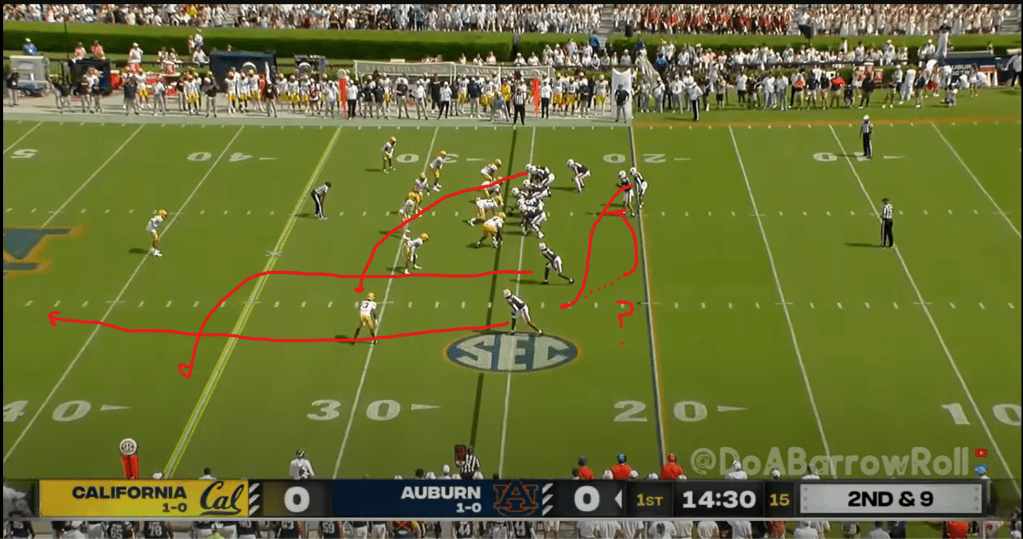
A couple of plays later, Auburn is able to generate one of its few explosive plays of the game. After a first down handoff where Payton Thorne missed the read on an RPO, Auburn took a deep shot off play-action down the sideline. Cal is playing man here and the safety lets himself get sucked too far into the center of the field to help the corner up the sideline, allowing Cam Coleman to get free, and Thorne (who throws off his back foot a bit here) finds him for a big gain.

Three plays later, Auburn manages to get in the end zone, albeit with Thorne and KLS creating outside the confines of the offense. I’m not entirely sure what Auburn is running to the three-receiver side of the field due to the TV angle (maybe a shock concept? put a pin in this), but KLS is running a curl route into the boundary, then gets into the scramble drill and he and Thorne are able to connect for the touchdown. Not the best throw by Thorne, but he put it where only KLS could get it, and KLS makes an outstanding catch. Enjoy it while it lasts, because Thorne is gonna spend most of the rest of the game putting the ball where only Cal defenders can get it.
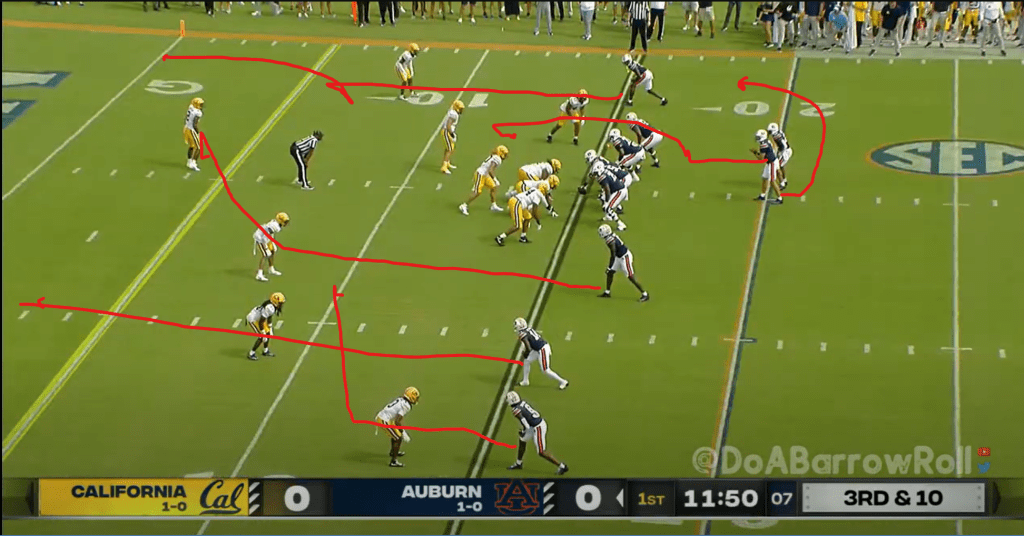
Cal responded to this score converted their first drive into a touchdown by carving up DJ Durkin’s defense. While the defense certainly had its issues in these three games, I’m going to be primarily focusing on the offense because this is a takedown of Hugh Freeze and the offense is his responsibility. Freeze would infamously say after this game that the coaches only made one bad playcall and that the rest of the problems were bad execution.
I’m going to debunk this lie right out of the gate by showing you two back-to-back bad playcalls. Here, Auburn is facing 3rd and 2 just across midfield. Again, it’s 3rd and 2. Jarquez Hunter, one of the country’s best RBs, is in the game. He’s right there, you can just hand him the ball. Instead, Auburn goes with another rollout flood concept like the play we just looked at above, and Rivaldo Fairweather drops the ball. It’s worth noting that nobody was really open here because Cal was in man coverage and Auburn was running a primarily zone-beating concept. Cal consistently played man in high-leverage situation, so calling a zone beater here is, by definition, a bad playcall, to say nothing of throwing the ball at all in this situation.

On the very next play, Freeze, again, goes to the air. Once again, Jarquez Hunter is right there. He’s there. Hand him the ball and let him get two yards. It’s that simple. Instead, Thorne tries a deep shot on 4th and 2 and it falls incomplete, giving Cal great field position. This is some type of shock concept, a trips concept where the #2 receiver runs a fade route while the other two receivers run underneath routes. It’s a good concept against man coverage since the slot fade route is maybe the hardest thing for a man coverage defender to deal with without safety help. The QB is supposed to peek the deep route and then get back to the underneath routes, especially in a situation where you, again, need two yards. Instead, Thorne never gets off that first read, launches it deep, and misses his receiver. But he never should’ve been put in that position. Back-to-back bad playcalls.
Back to back? I like that record. I’m gonna come back to that for the record.

On Auburn’s very next offensive play, Payton Thorne throws the first of his four* interceptions in this game. Honestly, though, this one really isn’t on him. Auburn is in a bunch set running either inside zone or duo (insert meme here) with the single receiver into the boundary running a glance route. Thorne is reading the boundary safety here, much like the way Auburn exploited Alabama A&Ms boundary safeties in the previous game. Thorne makes the correct read here; the safety comes sneaking down into the box before the snap and Thorne pulls it and throws the glance. It’s not a perfect throw, but it hits Cam Coleman in the hands, only for it to bounce off his hands and right into the waiting arms of a Cal defender.

The last two Auburn possessions of the half ended with a couple of key game management decisions from Hugh Freeze that one might generously call strange, but I’m not feeling generous, so I’m gonna call them bad. First, Auburn faced a 3rd and 4 and actually ran the ball for once. This is actually a pretty interesting design. Auburn lines up in a bunch set to the left and then motions a receiver across the formation to run a sort of crack/arc blocking scheme on the perimeter, with the WR blocking down on the safety and the motion man arc blocking the corner. This is essentially a triple option play, with a standard zone read on the defensive end and a secondary read on the linebacker with Rivaldo Fairweather coming across on an arrow route. Here, the first defender crashes down with the RB, while the LB goes to cover Fairweather, so Thorne correctly keeps and picks up as much as he can. All well and good, right?
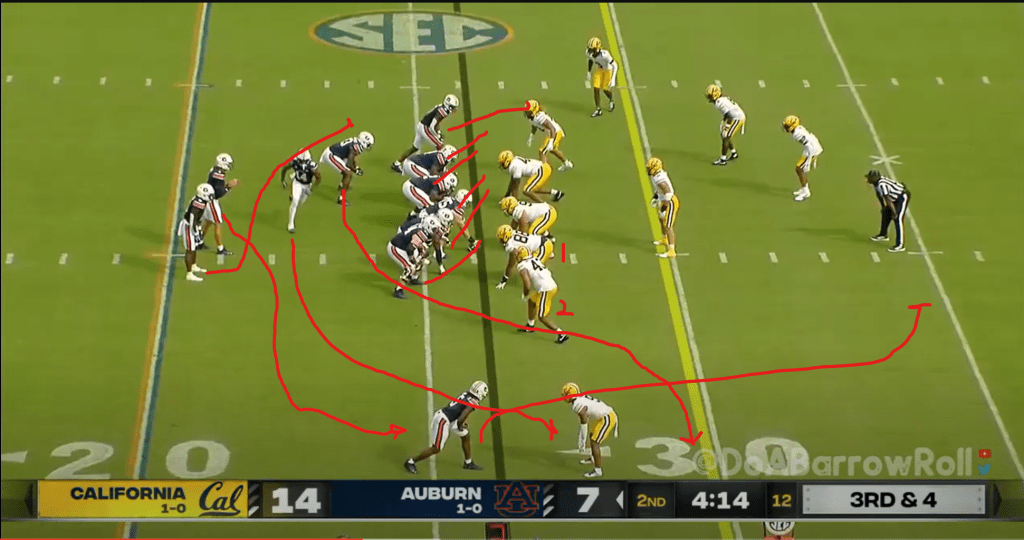
Well, no. The ref marked Thorne short here. For the record, I think the ref got the call wrong here; it looks like Thorne got the first down. Which makes what Hugh Freeze did all the more baffling: instead of challenging the call, he sent out the punt team. Not challenging the call is one thing; a mistake, in my view, but maybe he didn’t want to risk losing it this early in the game. Fine, but then its fourth and inches. You don’t trust your offense to get that inch against Cal? You really have that little faith in your offense? To be clear, the numbers are unambiguous about this: you always go for it on 4th and 1, even at your own 9 yard line.
Auburn got the ball back with 58 seconds left deep in their own territory, but got themselves into good field position thanks to a heady play from Payton Thorne. Here, Auburn is running a simple four verts concept. For the uninitiated, this is exactly what it sounds like: all four receivers running vertical routes. I’m not going to get into the nuances here because nothing comes of the route concept, but Thorne does a good job of stepping up in the pocket, seeing space downfield, and taking off for a good gain. This got Auburn down to the fringes of field goal range with about 18 seconds left.
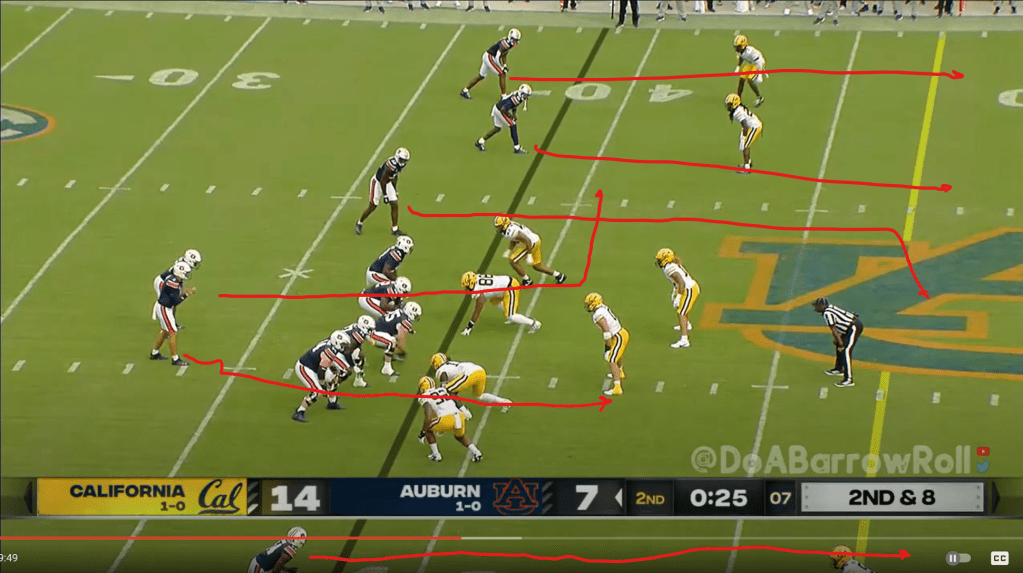
Here’s where Freeze makes another baffling decision. Rather than getting up and spiking the ball and then trying to maybe get a bit closer for the field goal attempt, he opts to send his true freshman kicker out to try a 60-yard field goal. I mean they put the dang line right there on the screen, Hugh. Unsurprisingly, Towns McGough couldn’t convert from 60 yards out and probably had to be at least a little resentful of his head coach for setting him up to fail like that.
Field goal, punt y’all, they punk y’all
Auburn got a stop coming out of the half and, in what would become a familiar story, had terrible field position to start their next drive. However, something amazing happens: Hugh decides to RTBD. And what do you know, it worked. Here, Auburn has a 3rd and 2 at their own 20. This is a variation of the RPO we saw on the interception earlier, with an inside zone concept paired with a glance route by the single receiver into the boundary (who you can barely see here, thanks TV camera angles). Here, however, the safety stays home on the hash and Thorne correctly hands it off to Jarquez Hunter, who rips off a big gain.
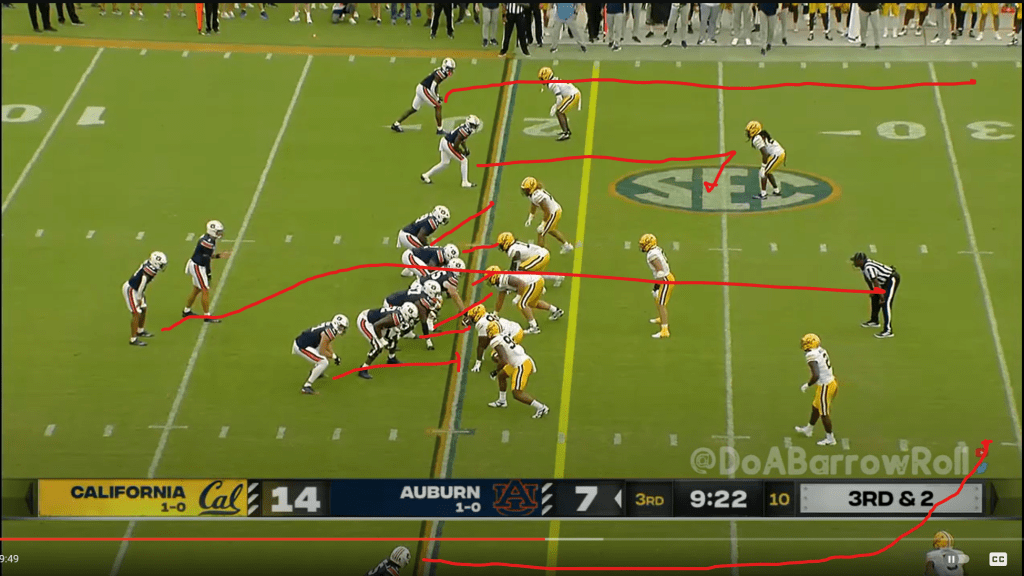
Here I want you to think back to the halcyon days of 2013 with me for a minute. When Auburn had an explosive run in 2013, the vast majority of the time, Gus Malzahn’s response was to immediately get the team to the line and run that play again to exploit whatever weakness they had found in the defense, often leading to another big play as the discombobulated defenders were unable to react correctly. Good times.
So, back in our 2024 dystopian hellscape, how does Hugh Freeze take advantage of the same situation? By calling three straight passes, of course. I want to look at the first of these three plays, because if this was executed correctly, it’s one of the most nonsensical play designs I’ve ever seen. I honestly can’t tell what’s supposed to be happening here. The offensive line is blocking a counter scheme; the playside linemen block down, while the backside guard pulls and kicks out the playside defensive end and the TE or H-back pulls and blocks the playside LB. The way the offensive line blocks here, it looks like they might actually be faking a counter scheme and running play action. I can’t tell exactly what the receivers are doing, but it looks like the single receiver is running a glance while the other side is running a slot fade concept. However, what the receivers are doing doesn’t really matter, because both the pulling guard and the TE completely whiff on the blitzing Cal defenders and Thorne is dead to rights before he could even get into his progression.
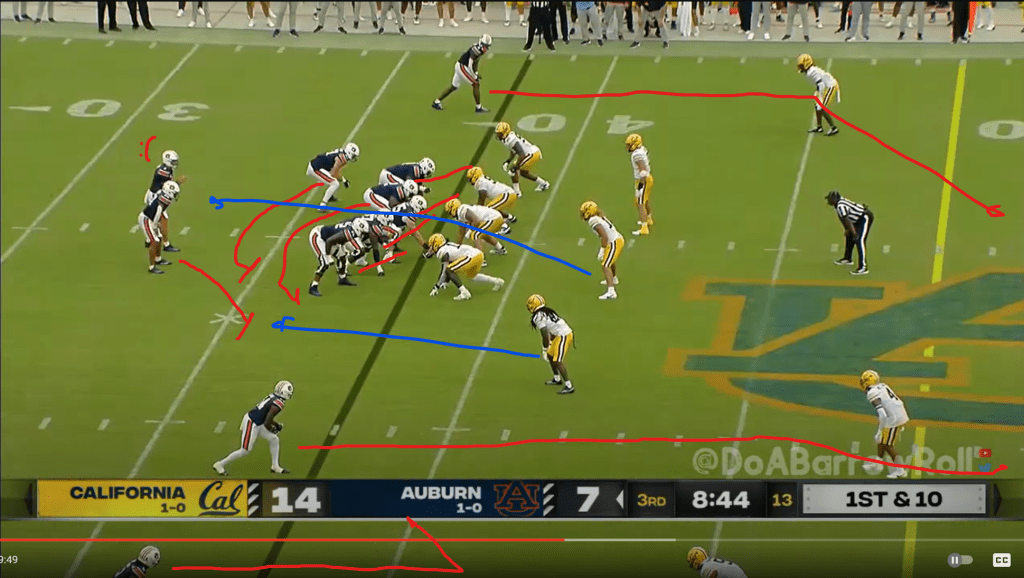
That’s how you follow up your best running play of the day? Really, Hugh? Auburn was forced to go back to the air on the next two plays as well, resulting in another short completion and a sack after another breakdown in protection, followed by a punt. The offensive genius at work, ladies and gentlemen.
For much of this discussion, I’ve gone easy on Payton Thorne, since most of what’s happened up to this point isn’t really his fault. I say that because most of what’s going to happen after this point is gonna be his fault. Let’s start with the first of his three* second-half INTs. Auburn had just gotten a stop against Cal’s offense and gotten the ball back to the offense in decent field position for once. This is some type of crossing pattern; I can’t tell what’s going on the two-receiver side, but they seem to be running clearouts to open space for the crossing route from the backside. At the time, people seemed to think that Thorne got hit here, resulting in the ball being deflected into the defender’s hands, but if you watch closely, the defender actually doesn’t touch him. Thorne just throws off balance and can’t get any power on the ball, and throws a wounded duck right to the defender. Absolutely hideous.

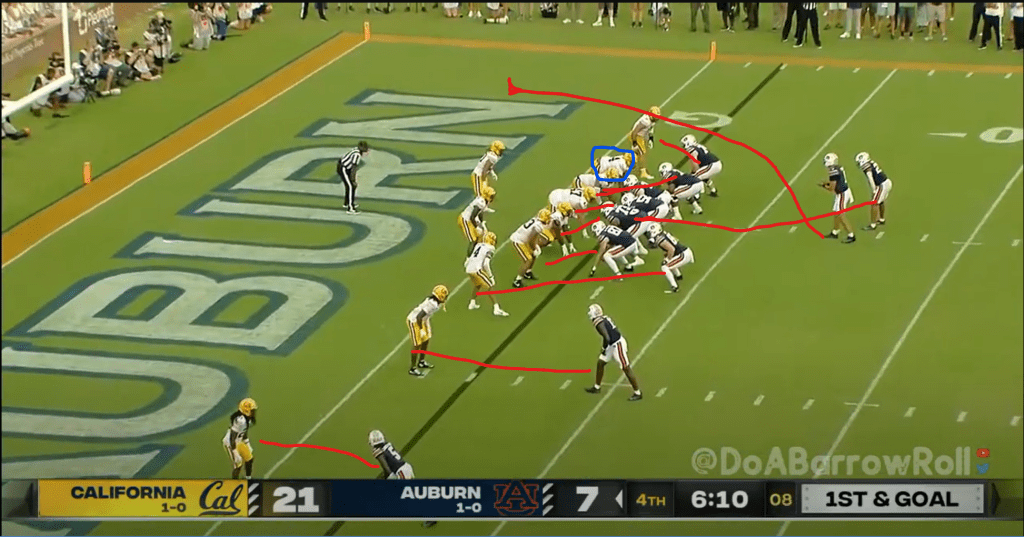
Auburn’s next drive ended with a fumble by Jarquez Hunter, which Cal cashed in for a touchdown after refusing to take advantage of the many gifts Auburn had given them for most of the game. Now down by two touchdowns in the fourth quarter, Auburn was in a desperate position and had to throw the ball, which is never a good thing. Auburn actually managed to get the ball downfield after a good drive, and, after what should have been Thorne’s second pick of the second half was wiped away by a dubious DPI, was able to cash in with a short touchdown run. This is just a basic zone read. It’s a clever little design, using an unbalanced set and then attacking the short side after the Cal defense overloaded the unbalanced side. Thorne is reading the DE (circled in blue) and makes the right decision to keep it and runs in untouched to keep Auburn in the game. Thorne probably pimped this TD a bit too much considering we were still losing to Cal at home but whatever.
That was a nice play right? Fun stuff. Anyway, hope you enjoyed it because it’s all garbage from here on out. Auburn’s defense got a stop and gave the offense an opportunity to get the ball down the field and tie the game. After a completion on the official favorite pass concept of this blog, three man snag (which I’d be diagraming if this were a happy post), Thorne threw his second* interception of the second half. This is just a boneheaded throw that’s completely inexcusable from a sixth-year player. Auburn is running the same play-action concept that I diagrammed above, with the single receiver on a vertical route and the backside slot receiver running a post. Cal is in some kind of pattern-matching quarters coverage here, and the corner has this route absolutely blanketed. I have no idea why Thorne threw this ball. You’d lose your mind at a ninth-grader who made this throw in a JV football game. I know this article is supposed to be a takedown of Hugh Freeze, but Payton Thorne made himself hard to defend here.
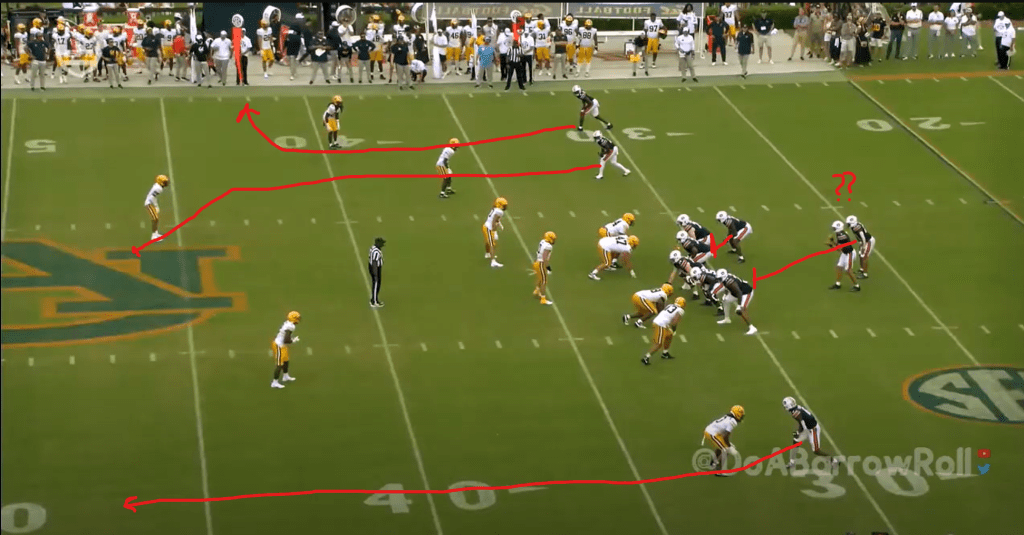
Auburn’s defense actually was able to get the ball back to the offense for a long-shot last-second drive. I had honestly already turned the game off, but I’m sure some of y’all were naïvely hoping for some Jordan-Hare voodoo. False hope is a fate worse than death, however, and Thorne immediately threw his third* pick of the second half. This looks like some type of Y Cross variation with a curl route on the backside. I don’t really know what Thorne is looking at here or really even who he’s throwing the ball to. I think he’s trying to hit the curl route, but it’s an awful throw that put a cherry on top of a truly humiliating defeat. Hugh Freeze was wrong to throw Thorne under the bus publicly rather than taking responsibility for the defeat himself, but I can’t defend either of these last two throws by Thorne. Brutal.
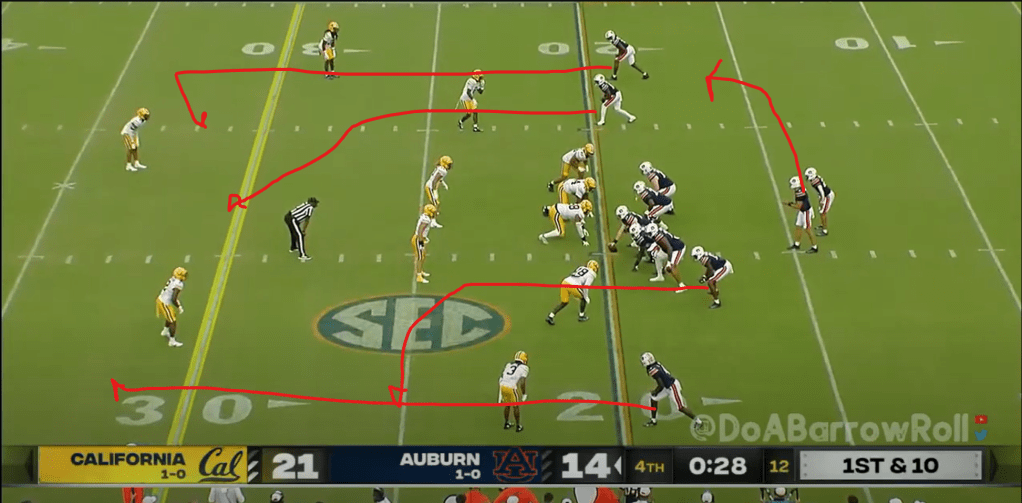
And I’m fine with it, I’ll push the line with it
Pick Thorne off one at a time with it
We can be on a three-hour time differenceNew Mexico
I’m not going to get that deep into the film of the New Mexico State film because it’s really not that interesting from an Xs and Os perspective due to the talent difference and the Xs and Os are really tangential to the purpose of this article. Coming into this game, New Mexico was arguably the worst defensive team in the country. They had been roasted alive by their first two opponents, giving up 35 points in a loss to FCS Montana State and then 61 in a loss to Arizona. Freeze used what should’ve been an easy game to give RS freshman Hank Brown his first collegiate start, I guess hoping that would be enough to get him up to speed before SEC play. Of course, this really exposes the major flaw in all of this, which is that if Payton Thorne was bad enough to get benched after game two, why did Freeze roll with him as a starter to start with instead of getting a better QB in the portal? I saw some people praising him for making the move, but in reality, it’s an indictment of Freeze’s program management.
Anyway, on to the game. New Mexico started the game with the ball and promptly marched right down the field on DJ Durkin’s defense and kicked a field goal. I focused on the offense in the first review since Auburn’s problems were almost exclusively on that side of the ball. In this game, though, the defense bears a large amount of responsibility, largely due to Durkin’s insistence on playing light boxes (6 players or fewer) while New Mexico spent most of the game in 11 or 12 personnel (1 RB and 1 or 2 TEs), meaning they had an equal or even greater number of blockers than we had potential run defenders. This early big play from New Mexico illustrates that quite well. Auburn is in what Mike Elko calls a “split” front, with a defensive lineman lined up in a 0 technique (directly over the center) and two linemen in 5 techniques (on the outside shoulder of the tackles). The inside linebackers are lined up over the guards, with the buck (edge player) lined up outside the 5 tech. This is a very easy front to run the ball against because three of the four players on the line are outside of the tackles, leaving only the two linebackers to control the B gaps.
Here, New Mexico is running a zone read concept, reading the backside 5 tech with the TE coming across to kick out the buck. The QB makes the correct read and hands the ball to the RB, who cuts back through the wide open B gap for a huge gain. But why was that B gap so open? With two defensive linemen set up outside the tackle, the only available defender to step up and fill the B gap is the backside LB, who…goes flying into the A gap for some reason I can’t explain, leaving the B gap wide open.

After Auburn’s defense managed to bow up and hold the Lobos to a field goal and a great return from Jeremiah Cobb, the Tigers took over for the first drive of the Hank Brown era in great field position. The offense wasn’t super efficient here, taking nine plays to punch the ball in from 32 yards out. Here Auburn runs a familiar concept, an RPO pairing a counter scheme with a glance from the single receiver, reading the inverted safety. He creeps down into the box pre-snap, making the read easy for Brown, who makes the right read and hits Camden Brown in stride for a touchdown.
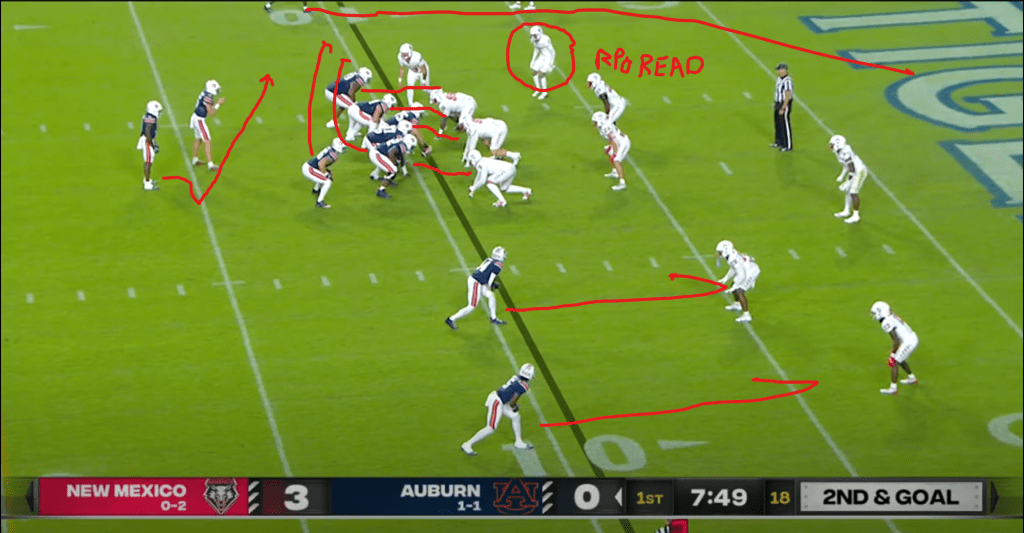
New Mexico managed to score late in the first to take a 10-7 lead, arousing the attention of the Twitter sicko demographic. I’m not gonna get into this drive too much since it was mainly an Auburn defender getting cooked in man coverage on a go route, but I’ll add that Auburn being behind in this game is a great indication of how Hugh Freeze’s Tigers trailing in this game is a sign of the team once again showing up mentally unprepared to play against an inferior opponent.
On the ensuing drive, Auburn once again moved the ball well, with the bulk of the yardage coming from a Hank Brown bomb to KLS. This is just a straight-up shot play off play-action, although I do want to point out a couple of things. One, at the top of the screen, you see two receivers stacked on top of one another near the sideline. I think this is an inheritance from Philip Montgomery and the veer-and-shoot, which loves these types of stack alignments to confuse defenders about their pass coverage responsibilities. Second, I do want to praise Brown here for doing a good job of looking off the safety here before getting back to KLS on the deep route, making sure the overmatched corner has no help over the top. It’s a nicely-placed ball and a big gain for the Tigers, who would punch the ball in shortly afterward on a Jarquez Hunter run.
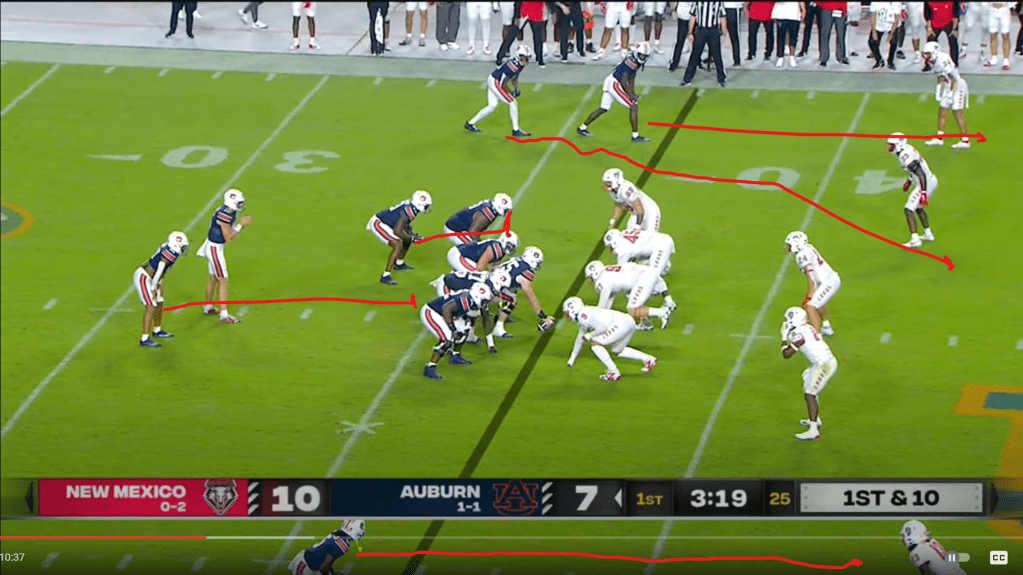
The next New Mexico possession ended with a bizarre interception by Jeremiah Thompson, setting the Tigers offense up with good field position. Auburn got the ball down into a goal to go situation, but couldn’t punch the ball in and had to kick a field goal. This failure illustrates two things: Freeze’s insistence on getting overly cute in short yardage situations and Auburn’s weakness up front on the offensive line. Both Montana State and Arizona ran for nearly 8 YPC on New Mexico, but Auburn couldn’t punch it in in a goal-to-go situation with three tries. The last of these was a farce of a play where Brown and Alston were apparently not on the same page. This looks like a zone read play very similar to the New Mexico play I diagrammed above, with Thorne reading the backside defensive end and the TE (Rivaldo Fairweather) coming across to block the backside LB. This kind of error really shouldn’t be happening in the third game of the season, and it especially shouldn’t be happening in the low red zone. The low red zone is the place to man up and punch the ball in, not show everyone how clever you are, but Hugh Freeze opted for the latter and ended up leaving four points on the field.
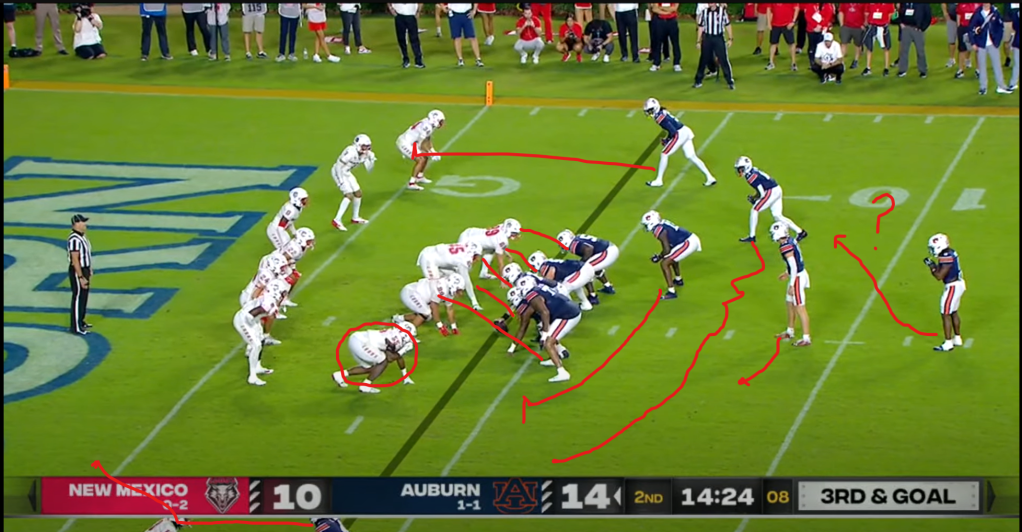
New Mexico managed a couple more big plays in the first half, largely due to busted coverages by Auburn’s defensive backs, but only managed a field goal from it because they kept killing drives with stupid penalties and turnovers. This is the thing that people might overlook if they just look at the final score: New Mexico State would easily have been closer, if not ahead at this point if they hadn’t wasted their forays into Auburn territory due to self-inflicted wounds. Auburn’s defense didn’t really do that much to stop them, and seeing those field goals as victories for the defense isn’t really accurate.
After the half, Auburn came out and did something they had refused to do for most of the previous six quarters and ran the damn ball. I want to note some specifics of the scheme here. This is a wide zone run scheme (sometimes referred to as outside zone, although they’re different things); here’s another article where I discussed this concept in detail in a different context a couple of years ago in a piece that frankly didn’t age well. Unlike inside zone, where the offense is trying to double-team defensive linemen and displace them vertically, wide zone attempts to get the defenders moving laterally and then use their own motion against them by having the RB read the defenders and find an open cutback lane. Most of Auburn’s successful runs in this game came on wide zone plays, while the results of their efforts to run inside zone were mixed at best, suggesting that the offensive line just doesn’t have the dudes to push around a defensive front that, again, gave up 8 YPC to an FCS team two weeks before. I was hoping that this would at least be a lesson to Hugh Freeze to focus on wide zone runs as the base of the offense going forward, but that hasn’t been the case.
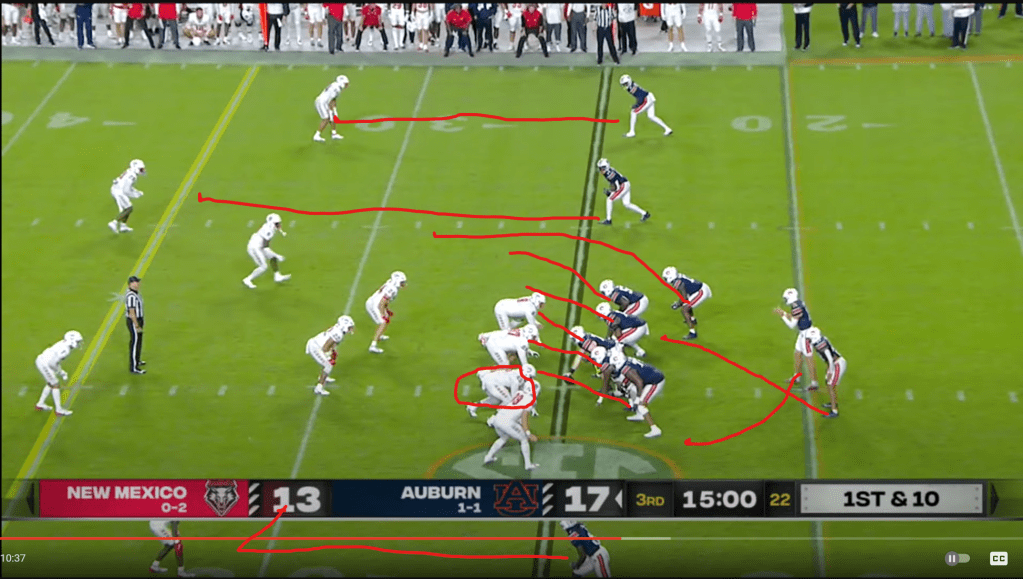
To finish off this drive, Auburn presented kind of the yin to the wide zone play’s yang: the bootleg pass. Auburn isn’t actually faking wide zone here, but this is commonly done off of a wide zone fake. The pass concept is actually a variation of the much-ballyhooed Spider 2 Y Banana, which is basically just a bootleg flood concept with one of the playside receivers running a crossing route to disrupt the defenders. Here, Rivaldo Fairweather comes in motion and runs a spot route to try to keep the LBs from getting outside to cover the flats. The playside TE (Micah Riley) runs a corner route, while the backside TE (Luke Deal) crosses the formation into the flat. Brown rolls to the right, and is just making a simple high-low read off the playside cornerback. If he drops to cover the corner route, Brown will dump it off to Deal, and if he comes down to cover the flat, the corner route should be open. Here, that isn’t really even necessary, since the cornerback gets caught in the wash and the defenders are unable to get back outside to cover Riley, who’s wide open for an easy touchdown pass.
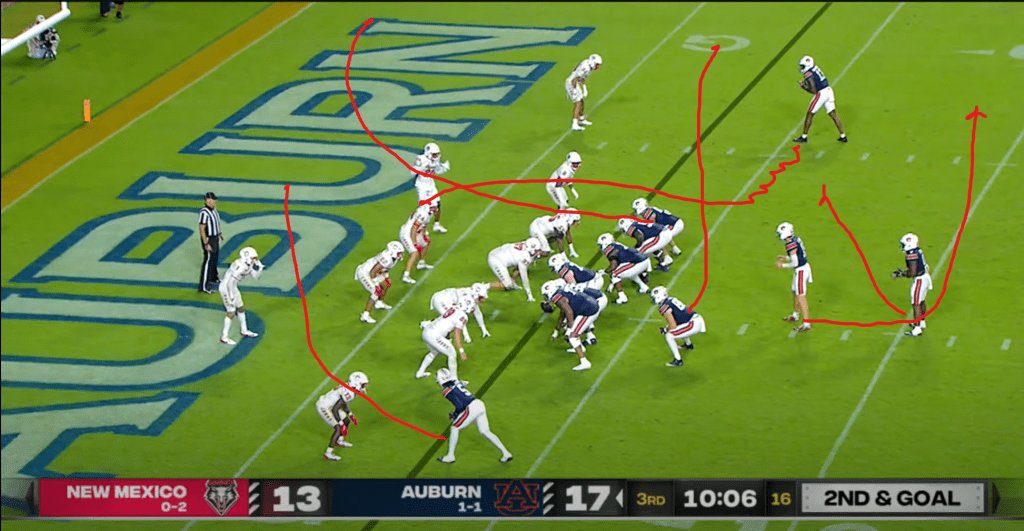
While the tone of this article is obviously overwhelmingly negative, I do want to praise the good things Brown did during this game, because this really isn’t the players’ fault and I don’t want it to seem like I’m blaming them for our problems right now. Hank did a good job of standing in the pocket and getting through his progressions, rather than getting stuck on the first receiver as Payton Thorne has often tended to do, and they’ve led to good results. The next Auburn touchdown was a good illustration of this, with Brown going through his entire progression before finding Jarquez Hunter on the checkdown, leading to an easy score. Not much to say about the actual play design here, looks like some kind of switch concept into the boundary (hard to tell because of the TV camera angles), but I did want to give credit where it was due in terms of Brown’s performance.
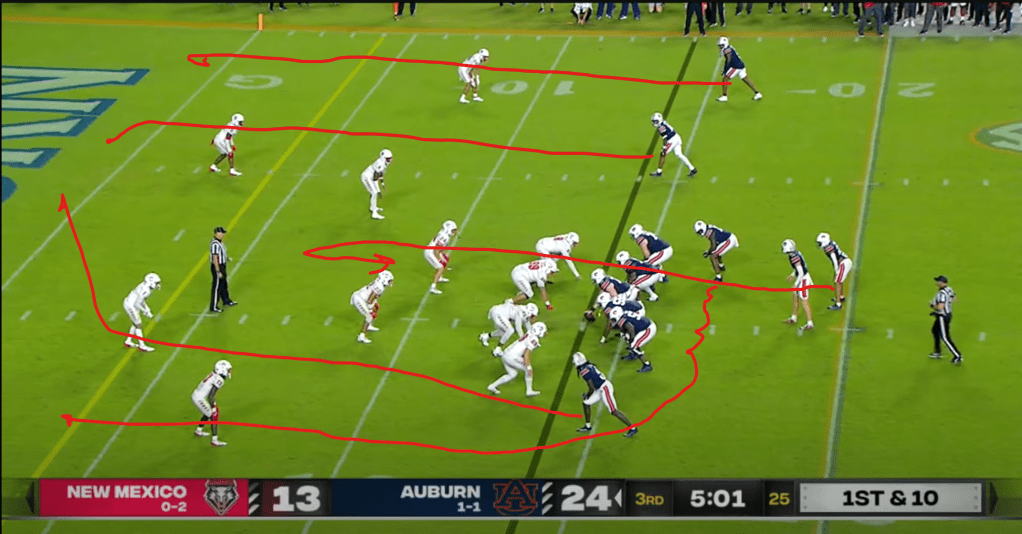
New Mexico’s next drive ended with their final score of the game, which came on a 4th and goal from the 4. For context, Auburn had just blown up New Mexico’s previous play by sending heavy pressure in the QB’s face and forcing an incompletion. Inexplicably, however, Durkin refused to learn from that success and immediately went back to dropping eight guys into coverage and only rushing three, giving New Mexico’s QB basically unlimited time to find an open receiver, who was somehow matched up one-on-one in the end zone. It’s made even more inexcusable by the fact that they were in a seven-man protection here, meaning there were only three receivers out in the pattern, and yet they somehow managed to get a one-on-one. Yeah, I know, he gets away with some pretty blatant offensive pass interference, but that’s beside the point here. You’d think after the 4th and 31 we’d have learned our lesson about playing soft coverage and only rushing three in high leverage situations, but nope. More on this later.

I don’t have that much else to say about this game, as Auburn did manage two more touchdowns to pull away late and make the win look more comfortable than it actually was. I do want to go back to my point about wide zone above though by taking a look about Auburn’s last touchdown. Auburn is in a 10 personnel set here, with four receivers and no tight ends. Wide zone is hard to run without a tight end, since he’s generally the RB’s aiming point for his first few steps. From 10 personnel, wide zone teams will often run what’s known as mid-zone, which is identical to wide zone in terms of the blocking scheme, but the back is now aiming for the playside tackle rather than the TE. This is just a straight mid-zone handoff with no RPO or QB run read, which was executed perfectly, and Damari Alston takes it to the house.

As I noted several times during the course of this review, the final score of this game was pretty flattering to Auburn. New Mexico was able to hang around for most of the first three quarters and was undone as much by their own mistakes as they were Auburn’s efforts at stopping them. Auburn was unable to establish its dominance on the line of scrimmage on either side of the ball, which is the key to controlling games. While a win is a win, I wasn’t celebrating in the way a lot of people were after this game, mostly because I still saw most of the fundamental flaws of this team on display in this game.
If I can wax philosophical for a moment, one of my core beliefs about football is that your ability to run the ball and throw play-action sets your floor and your dropback passing game sets your ceiling. If you can run the ball consistently and protect your run game with play-action, you’re never going to be a bad team; you might not be elite, but you’re not going to be bad. So much of Auburn’s issues in the losses to New Mexico State and Cal and the tense first three quarters of the New Mexico game were down to Auburn’s inability to run the ball consistently and inability to stop the run and get off the field on defense. To paraphrase Vince Lombardi, offensive and defensive schemes come and go, but the fundamentals of blocking and tackling will always be the foundation of the game. Even in a win, Auburn was unimpressive in those areas, and those deep fundamental flaws would come back to bite them almost immediately.
And I might do a show a day, once a lame, always a lame
Oh, you thought the money, the power or fame would make you go away?Arkansas
And now we’ve come to the pièce de résistance of this awful season so far, the big fat egg Auburn laid this week against Arkansas. Arkansas started with the ball, and Auburn’s defense came out looking sharp, forcing the Razorbacks into a third-and-long passing situation. The third-and-Auburn meme has been around for years across several defensive coordinators, and it’s still alive and well with Durkin’s unit in 2024. Auburn rushes six here but fails to maintain gap discipline, allowing Taylen Green to escape and run for the first down. Not gonna talk about the route concept too much since 1. the secondary had it covered pretty well and 2. I can’t tell what it is because of the camera angles anyway.
On the next series, Auburn’s defensive front continued to demonstrate poor discipline. The Tigers’ defense is in a mint front here, with a noseguard lined up over the center and two defensive linemen playing 4-techniques (lined up on the inside shoulder of the offensive tackles. This front is designed to clog up the A and B gaps, a common strategy to counteract spread offenses, which often want to run the ball in those gaps on inside zone or gap schemes. In this case, Arkansas is running an inside zone read, reading the backside 4-tech lineman; this is a bit of a changeup, since the normal way of doing this would be to block the three lineman and read the overhang (outside LB), but here they have the backside tackle leave the 4-tech and block that overhang. This is a clever little tactic to confuse Auburn’s option rules, and it works well, as the 4-tech chases the RB and Green has a huge lane to run through. I also want to point out some poor gap discipline here from Eugene Asante (9), who goes to fill one of the interior gaps rather than scraping over the top to tackle the QB as he was presumably supposed to, turning what should’ve been a modest gain into an explosive play.
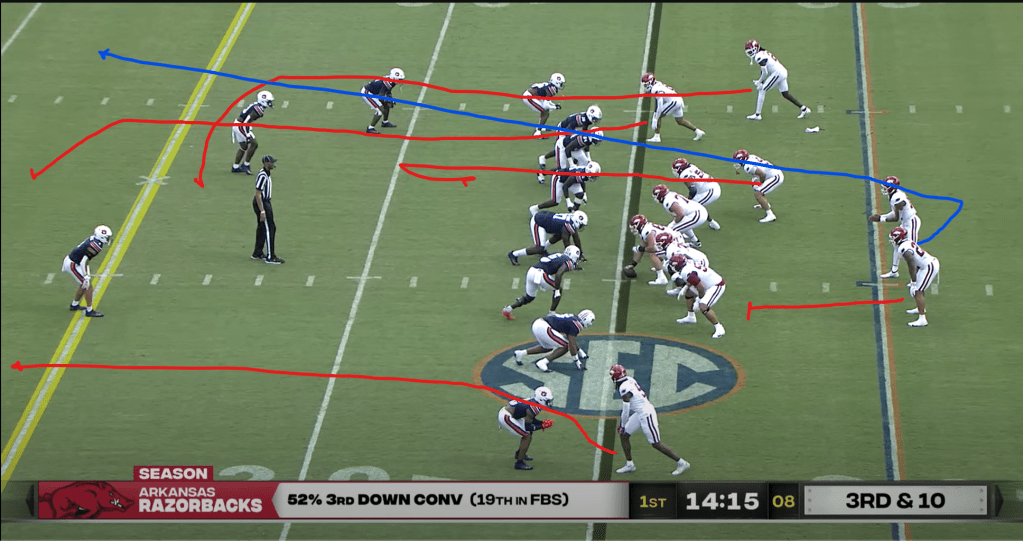
After giving up a couple more first downs, Auburn’s defense was able to bow up and get a third down stop to hold Arkansas to a field goal attempt, which they missed. On that third down, Auburn brought some heat, using the split front we discussed above in the New Mexico game. I don’t know if this is really a scheme win as much as it is just a whiff by the Arkansas RG (72), but it results in a big sack to kill the Arkansas drive.

Auburn was able to channel the momentum from this big stop into a pretty good opening drive, which included some solid work on the ground. Amazing what happens when you RTDB, isn’t it, Hugh? Anyway, this predictably all falls apart when Auburn goes to the air. This is a sort of strange looking play, with Auburn running play-action off of power read action from an empty formation with jet sweep motion, a play that I don’t think they’d ever run with Hank Brown, who has about as much business carrying the ball on a power read play as I do. On the front side of the play, Auburn looks like it’s running some type of post-wheel concept, a common thing to do off of jet sweep motion, where the perimeter blocking scheme often involves the wide receiver blocking down on the safety and a tight end or running back arc blocking the corner. This sets up the wheel route if the corner gets used to seeing and avoiding that block.
This is part of why I think this play doesn’t really work and the playcall doesn’t make much sense. It’s reliant on the defender biting on a play that you haven’t shown them yet. It’s putting the cart before the horse in playcalling terms. I can’t really tell what coverage Arkansas is in here, some type of man or man-match, but the seam route to Rivaldo Fairweather that Hank Brown tries to throw isn’t open. It’s also just a bad throw from Brown, both because he’s forcing the ball into coverage and because he’s throwing off-balance, and it ends up well behind the receiver. He’s probably a bit unlucky that it was tipped directly to another defender, but if you put the ball into dangerous situations, you don’t have much right to complain about the result. Dumb decision that killed a chance for Auburn to take control of the game early on.

Unlike Auburn, Arkansas took advantage of their next opportunity to seize the upper hand in the game. The Razorbacks’ offense methodically moved the ball downfield and found themselves on the edge of the Auburn red zone. That’s when the coverage bust bug that had plagued Auburn in the New Mexico game reared its ugly head again. Arkansas is running some type of crossing pattern here, possibly a drive concept, a variation of shallow cross where the crossing route and the dig route come from the same side of the formation, while the receiver on the opposite side runs vertical to clear out the defenders. I think Auburn is playing some type of match quarters coverage here; this is similar to traditional quarters, where each of the four DBs is responsible for a quarter of the deep area of the field, but with special rules built in where defenders will abandon their deep zone based on what the receivers do. This type of coverage is dependent on good communication and a good knowledge by the players of when they’re supposed to stay in their zone and when they’re supposed to go cover a receiver elsewhere. Clearly Auburn’s young and depleted secondary didn’t do that very well here, as the crossing route comes wide open and Arkansas is able to get the ball down inside the ten. They would punch it in three plays later to take a 7-0 lead at the start of the second quarter.

On the second play of the ensuing possession, Auburn comes out with a play I’m not sure I’ve seen them run before. At first glance I thought this was just a wide zone concept, but it’s actually a variation on the old wing-T down G play. The basic premise is that the playside tackle and tight end are going to block down and seal defenders inside, while the playside guard will pull and trap the defensive end to open up the off-tackle gap. I’m not sure exactly where this came from or why Auburn ran it here, but it works pretty well. The playside OT and TE don’t actually do a great job of sealing their guys (which is why this initially looked like wide zone to me), but the RG delivers a good kick-out block and Jarquez Hunter is able to find the gap for a big gain.
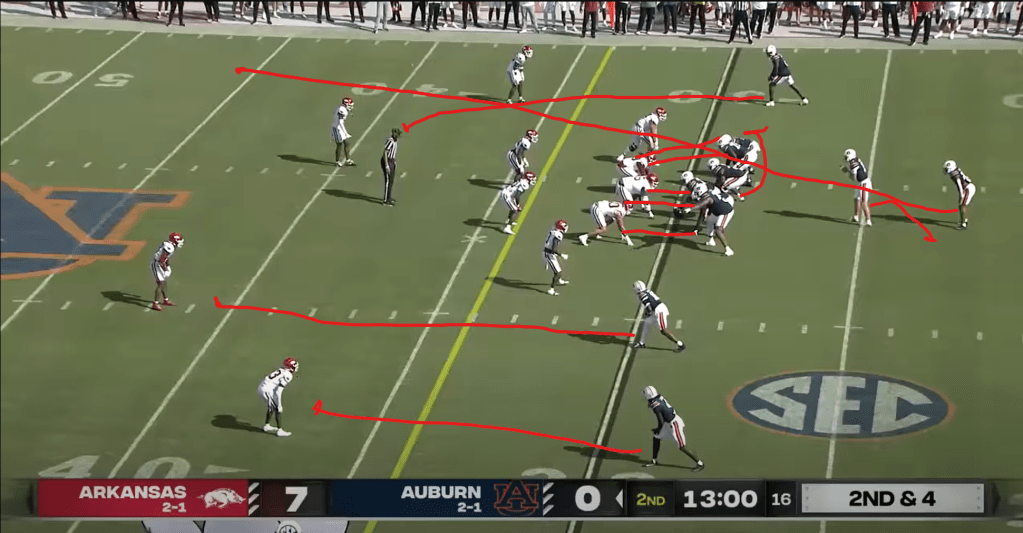
Auburn was unable to do much else on that drive, and the teams exchanged three punts before another Arkansas moved the ball to midfield. Facing a 4th and 1, Arkansas correctly decided to go for it, but Petrino got way too cute with the playcall and instead of running the ball against Auburn’s questionable run defense, he tried to run some kind of rollout pass, which Jalen McLeod blew up to set the Tigers’ offense with great field position and more than two minutes to work with to try and get a score before the half.
Of course, this is the 2024 Auburn Tigers we’re talking about, so they didn’t take advantage of it. Auburn actually did come back to the power read concept I mentioned above. The idea of this play is like a combination of a power scheme with a zone read: the running back runs a sweep path while the backside guard pulls to block the playside linebacker, but instead of kicking the defensive end with the fullback like a normal power play, the offense leaves him unblocked and the QB reads him to either hand off on the sweep or run the power. Like I mentioned above, I can’t imagine Auburn would actually want Hank Brown carrying the ball, but Arkansas kindly obliges as the DE pinches down allowing Brown to just hand the ball to Damari Alston, who rips off a big gain…before fumbling the ball away to Arkansas. He’s correctly carrying the ball in his outside hand, but he isn’t protecting the ball with both hands like he should be going into contact and gets punished for it. Auburn’s RB’s have been severely fumble-prone this year to the point that it has to be a coaching issue rather than being on the players, especially since Auburn’s RB room really didn’t have this issue last year under Cadillac Williams. Huh, weird.

Auburn’s defense managed to get yet another stop, giving the offense another opportunity to get points before the half. You’ll never guess what happens next (you’ll totally guess). On the second play of the drive, Auburn lines up in an empty set. I actually really like using empty sets with 11 personnel, since you can often get good matchups for the RB and TE by lining them up out wide and forcing the linebackers into pass coverage. Auburn runs a variation of the shock concept I described above, with what looks like a slant and a curl on the other side. Arkansas looks to be in some type of cover 3 look here, with three deep zone defenders and four underneath zone defenders. It looks like Brown is working the backside of the concept the whole way, even though it’s into the boundary, leaving less space for the receivers to get open. I don’t know what his progression is here, but whatever he was supposed to be reading, he completely screws it up and throws the ball directly to the zone defender, killing the drive. He kind of stares down the receiver, but he was never open in the first place and I have no idea why Brown made this throw. Big ol’ yikes.

Fortunately for the Tigers, Arkansas decided to join in on the pick party, as Taylen Green threw the ball right back to Auburn on the very next play. With an opportunity to redeem himself, Hank Brown immediately connects with Rivaldo Fairweather for a big gain into Arkansas territory. This looks like some type of flood or sail concept. I explained the way this concept works earlier in the Cal segment, but I will note that Arkansas just straight up busts this coverage, with two defenders covering Camden Brown on the vertical route and nobody covering Fairweather on the sail route. It’s honestly not a great throw from Brown, who kind of throws this one off his back foot, but Fairweather was so wide open that it didn’t really matter.
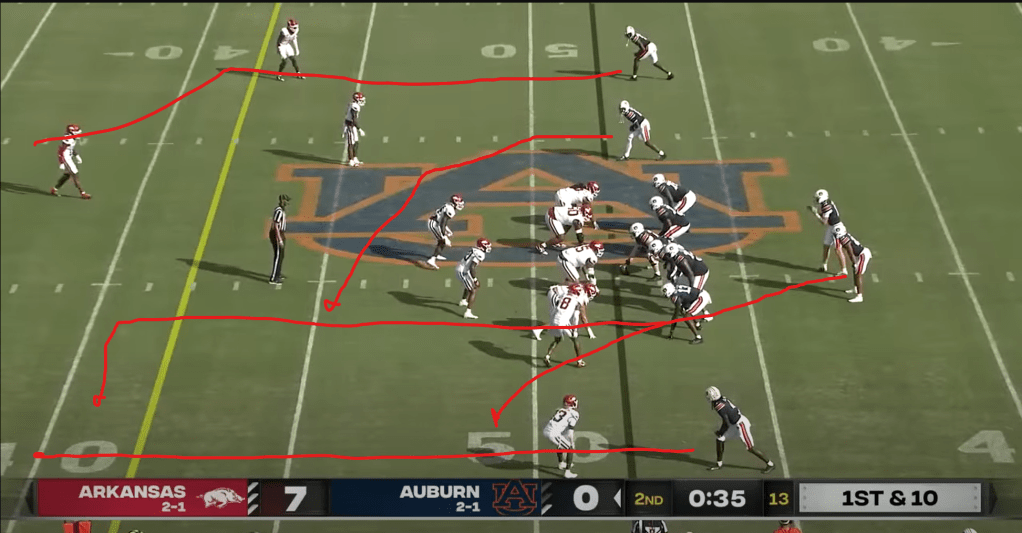
Of course, you already know how this story ends. On the next play, Auburn goes back to the air, running the author’s beloved snag concept into the boundary paired with double slant routes to the backside. Brown decides to work the slants on the backside of the play for some reason (I assume it has to do with either Arkansas’ pre-snap alignment or the drop of the linebackers) and Sam Jackson V manages to get leverage on the safety; however, Brown doesn’t really get his full body behind the throw and it sails on him, straight into the hands of the Arkansas safety. I still can’t tell if he actually caught this or not, but the booth said it was a pick. This was the second straight throw where Brown demonstrated poor technique, and this time it bit him. This raises serious questions about Auburn’s QB development at the moment, since these are mistakes that ought to be worked out of a QB’s mechanics very early in his career. It’s really disappointing to see this happen to Brown after he had such a good start to his career last week.

Never one to look past the surface level or consider his own role in things, Hugh Freeze told the ESPN reporter that Auburn needed to find someone who could hold onto the ball in the second half, and by that he apparently meant going back to Payton Thorne, who, you’ll recall, was benched for throwing four* picks against Cal just two weeks before. This constant shuffling of QBs is reminiscent of other times when Auburn was lacking clear direction on the offensive side of the ball (the 2016 Clemson debacle, Harsin’s QB hokey-pokey with Bo Nix and TJ Finley, and Auburn’s offense last year) and is a sign that Freeze doesn’t really have a clear idea of where things are going with his offense. I want to point this out specifically to counteract a common argument that I’ve seen by his defenders, that we need to give him time to build something. If you’re building something, you have to have a clear idea of what you’re building, otherwise you’re just going to end up as the football coaching version of the IKEA confused man diagram.
Auburn’s first drive of the second half went nowhere and the Tigers had to punt, but with Arkansas threatening to score and go up by what would feel like an insurmountable two scores, Auburn’s defense stepped up and made a huge play. This is a much better execution of the match quarters concept I discussed above and an illustration of why it’s become so popular at all levels of football. I think this is also the exact same drive concept that I discussed in that earlier example, but here Green tries to throw the deep out route on the front side of the play. Kaylin Lee is all over it and is able to undercut it because he knows he has safety help over the top to protect him, and he comes away with a desperately-needed takeaway.
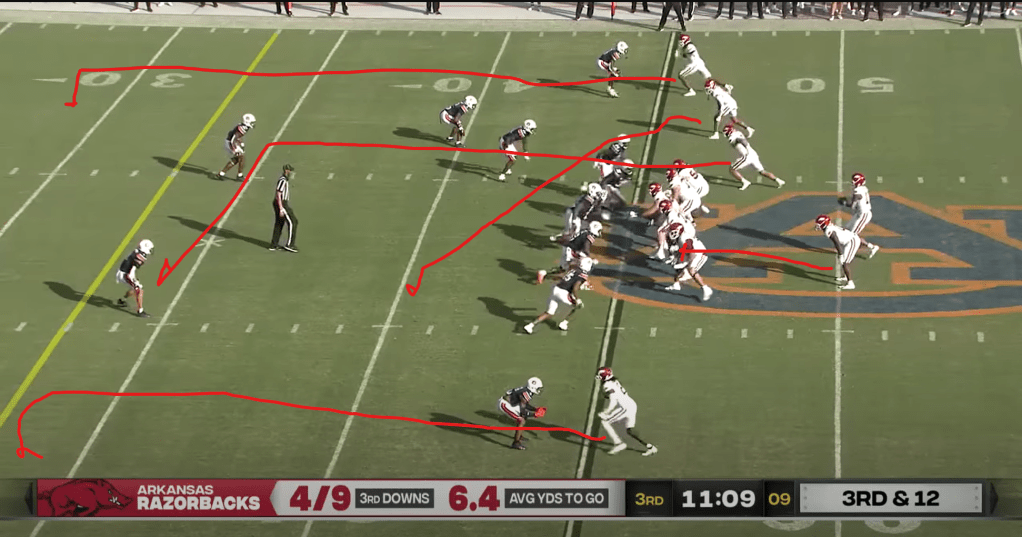
After a good run from Jarquez Hunter allowed the Tigers to pick up an initial first down, Auburn went to the air with a play-action shot. This is very similar to the shot play they were running against Cal, although here KLS is running what I’ve always called a shake route, a vertical route where the receiver initially releases inside before breaking back outside and up the sideline. This is just another coverage bust for Arkansas, as the boundary corner sinks to the flat to cover the RB, who was already covered by the linebacker, and the safety can’t get over the top in time to make the play. It’s not the best throw by Thorne, but KLS continues his stellar early-season form with a great one-handed catch for Auburn’s biggest play of the game up to that point.

For the first time all day, Auburn was able to take advantage of some positive momentum. I can’t quite tell whether this is an RPO or just true play-action attacking the inverted safety, but either way, Thorne pulls the ball out and throws the now-familiar glance route to KLS for the Tigers’ first touchdown of the game.

And now we get to this part. Yeah, sorry, we’ve got to do it. After a disastrous trick play gone wrong resulted in an intentional grounding penalty, Arkansas was facing third and 19 in their own territory, staring down the possibility of giving the ball back to an Auburn offense that had finally found a spark. Of course, that’s not what happened. Auburn’s DCs are apparently never going to learn their lesson about rushing three and dropping eight in these situations, and with all day to throw, Taylen Green is able to roll out of the pocket and uncork a deep ball to a wide open receiver for a touchdown that destroyed whatever momentum Auburn had managed to build up to that point. I honestly can’t really tell what’s going on at that back end of this due to the TV camera angles, but this is less about the breakdown in coverage than it is about the fact that Green had all day to make this throw. If Auburn had brought more than three, he wouldn’t have had time to make that deep throw and this whole thing would have been avoided. How many times do we have to teach you this lesson, old man?
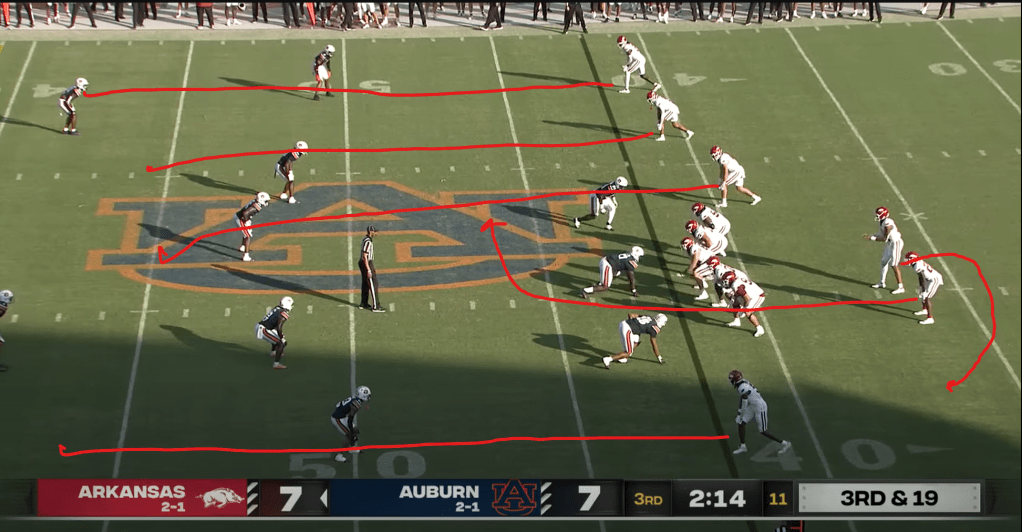
With their backs against the wall, Auburn’s offense responded on the next drive to keep themselves in the game. Nah, I’m just kidding, they turned the ball over again. This is some type of crossing pattern off of play-action, and it’s set up pretty well, as Thorne is able to find Cam Coleman wide open, only to see the ball bounce straight off his hands and right into the breadbasket of the Arkansas defender, surely triggering some PTSD from when Coleman did the same thing against Cal. For as much hate as Auburn’s QBs have gotten for all of the turnovers, their receivers haven’t been doing them any favors either, and this was a prime example.

Arkansas was able to turn that pick into three more points, amassing a ten-point lead that felt more like fifty, given Auburn’s anemic offensive performance up to that point. This time though, Auburn’s offense actually did respond. Facing a 4th and 3, Auburn goes back to a similar play play to the one one which Hank Brown threw an interception on late in the second quarter, running a snag concept from an empty formation. This play is mostly made by the great route from KLS though. He hits a perfect stutter step, convincing the safety that he’s running a hitch, which makes sense given the situation, but after the safety comes crashing down, he bursts out on a slant and there’s nothing but green grass in front of him. He gets a high-five from Rivaldo Fairweather on the way into the end zone, which is one of those things that would be funny if you weren’t losing by two scores at home against freaking Arkansas.
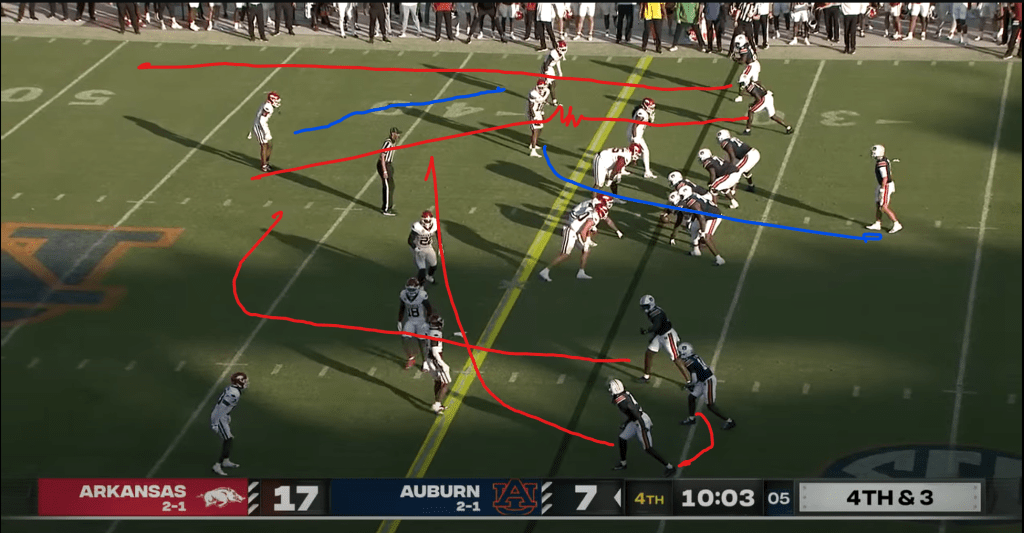
Unfortunately for the Tigers, Arkansas was able to put together a lengthy drive on the ground on the ensuing possession to just about ice the game. I want to look at a couple of plays from this drive, because they’re a good example of sequential playcalling, where one play sets up the next, something Auburn’s offense is sorely lacking, as I mentioned above. In this first clip, Arkansas runs a split zone concept with jet motion to create some misdirection. This variation of the standard zone concept has the H-back come from the playside of the formation across to the backside to kick out the backside DE, creating a split flow action that sets up the cutback for the RB. Note here that the H-back is able to make the block, but the edge defender (6) crashes down pretty hard on him. Petrino saw this and took advantage of it on the next play.

This is the exact same play, except now instead of kicking out the edge defender, the H-back comes across and seals him inside, allowing Taylen Green to keep the ball around the end for another first down. Since he knew how Auburn would respond to the first play, Petrino was able to use Auburn’s defensive rules against them to generate a second big play off of the same action. This is how good coaches structure their offenses, with plays that build off of one another in a cohesive way, rather than just throwing things at the wall and hoping they stick, which is what Auburn’s offense has seemed like for much of the season so far. Arkansas punched the ball in three plays later, and the game was essentially over. Auburn went four and out on their next possession and Arkansas was able to kneel the game out.

For the third time in the last six games, Auburn has lost to an inferior opponent at home, which is embarrassing no matter how you try to spin it. Freeze, for his part, shifted the blame onto his players, as usual, attributing the Tigers’ failures to their inability to avoid turning the ball over. This is obviously true, but keep in mind the Bill Parcells saying I quoted above. If the team is turning the ball over, you’re either coaching it or allowing it to happen. Instead of taking responsibility, Freeze once again threw his team under the bus, prompting a notable former QB of his, Bo Wallace, to call him out directly for it on Twitter.
Over the last few games, Auburn has been so sloppy and undisciplined that multiple people have said to me that this is the worst-coached Auburn team since 2012, worse than even the Potato Famine, and I can’t say I disagree with them. The coaching staff simply isn’t getting the team ready to play or instilling the discipline and focus necessary to win in this conference. I’m not sure I see a win on this schedule other than ULM at this point, because I have no hope whatsoever of the coaching staff actually improving the team over the course of the season, given the lack of development the team has shown from last season to this season. Yet another lost year due to inadequate coaching.
And givin’ him tools to walk through life like day-by-day, know nothin’ ’bout that. Teachin’ him morals, integrity, discipline, listen, man, you don’t know nothin’ ’bout that. Speakin’ the truth and consider what God’s considerin’, you don’t know nothin’ ’bout that.
After four years of underachievement under two mediocre coaches, this feeling of ennui has become all too familiar for Auburn fans. We’re tired of this, and we’ve got to start demanding better from our program and our leaders who have put us in this position. Or at least those of us who can even be bothered to care anymore are tired of it. A lot of us have just checked out altogether, finding better things to do with our Saturdays than sinking time and effort into a team whose coaches are obviously not putting in the time and effort Sunday through Friday. We can’t go on like this, something has to change.
And notice, I said “we,” it’s not just me, I’m what the culture feelin’.
So, where does Auburn go from here? The first step is very simple: fire Hugh Freeze. I know he’ll be the second consecutive Auburn coach fired within two years of being hired, but he’ll also be the second Auburn coach who has deserved to be fired within two years of being hired. He never should have been hired in the first place, for reasons that yours truly articulated two years ago, but there’s no time like the present to fix the problem. There’s absolutely no point in sinking any more precious time into a loser who refuses to accept responsibility for his team’s shortcomings and is clearly incapable of making the changes that need to be made for the team to improve. He’s not capable of performing the job to the required standard, and he needs to go.
From there, Auburn absolutely must nail this next coaching hire. We cannot have a third straight disaster of a coach to plunge this program further into irrelevance. I’ve got a prewrite ready with coaching candidates for whenever we pull the trigger on Freeze, but I’ll say a bit here about what Auburn needs in its next coach without naming any specific candidates.
First, we need someone with SEC coaching experience, preferably as a head coach. We found out the hard way how badly hiring someone who doesn’t understand that It Just Means More can go. Second, they need to have an organic connection to Auburn and be able to immediately relate to the fans and understand its culture, something both of the last two coaches have failed to do. Third, they need to have a proven track record of building up programs, because this is going to be a true rebuild, something that should never happen at a program with Auburn’s level of history and tradition.
Most importantly, however, what Auburn needs in its new coach is a real leader. Real leadership means accepting responsibility for the team’s failures and taking steps to improve them, not continually passing the buck to your players and subordinates. Real leadership means having the team prepared to play week in and week out, regardless of the level of the opposition. Real leadership means putting the school and the program ahead of yourself, rather than expecting the entire Auburn community to cater to your ego. As a fan once infamously said, “we need a leader, not a loser.”
In other words, we need the exact opposite of Hugh Freeze.
We don’t wanna hear you say “Auburn” no more.
We don’t wanna hear you say “Auburn” no more.
Stop
-
Auburn vs. Alabama A&M film review
What did we learn from Auburn’s week 1 win? Did we learn anything?
Okay, so this isn’t going to be a full review of the game film like usual, because I don’t have time to go through and fully chart the game and write that up because I’m busy with my actual writing job, but I at least wanted to give y’all something. With apologies to the late College and Magnolia blog (pour one out for the homie), this is basically just gonna be a “Touchdown Auburn” column, with a few random thoughts at the end.
Also, I don’t want to bury the lede, so I’ll answer my own question up front: no, I don’t think we learned much from this game. It was fun to see the offense show out like this, but the talent disparity between the two teams was obviously huge, much too large for our success in this game to really tell us much about how good this team is.
We might learn a bit more next week, but we also might not, since Cal doesn’t seem to be very good either based on their unconvincing performance against UC Davis. I really don’t think we’ll learn much in this first month of the season (which is good, because I’m not going to have much time to write). These should be four easy wins to start the year, and if they’re not, we might be in trouble. Anyway, without further ado, touchdowns.
Touchdown #1
Auburn opened the game with a bang, coming out of the gate and scoring on a four-play drive that barely ate 45 seconds off the clock. After a long completion to Malcolm
Johnson Jr.Simmons took the offense into Bulldog territory, the Tigers’ first run play of the game gave them their first points on a 34-yard Jarquez Hunter run.This play is a pretty basic RPO, pairing an inside zone or duo concept (it’s hard to tell the two apart, to the point that it’s a meme on football film twitter, I think this is duo) with hitch routes to the field and a slant or glance route to the boundary. The basic principle of duo is for the offensive line to double all of the first level defenders and allow the back to read the LBs and find his own running lane. It’s often described as “power without a puller”, but to me it’s more like inside zone without releasing off the double teams to block the LB. On this play, Thorne is reading the safety to the wide side of the field; if he covers the hitch route by the slot receiver, he’ll hand it off, and if he doesn’t, he’ll throw the hitch.

In this case, the safety flies down to the slot, so he hands it off, and Jarquez does the rest, assisted by some really poor run fits from A&M’s LBs. A&M is in some kind of under/reduced front here, so the OLB into the boundary should be filling the open B gap; instead, he flies way over the top, letting Jarquez cut it back to the gap he should’ve been occupying and take it to the house. Put a pin in this one, we’ll come back to it later
Touchdown #2
Auburn’s second drive was even quicker than its first, with the Tigers scoring on the first play via Payton Thorne’s first passing touchdown of the season. On this play, Auburn is running a flood concept; the basic idea is to send several receivers (usually three or four) to one side of the field, “flooding” that area with receivers and outnumbering the defenders so that somebody has to be open. Generally, you have a short route (in this case a flat route by the RB), an intermediate route (in this case a sail or out route by the slot WR), and a deep route (in this case a post by the outside WR), with the QB reading it deep-to-short.

Alabama A&M is in some kind of cover 6 or quarter-quarter-half (QQH) look, which they used a lot in this game. The idea of QQH is that you’re going to have two defenders (a corner and a safety) who are responsible for a quarter of the deep zone of the field, while another DB (a corner or safety, in this case the boundary corner) is responsible for the remaining half of the field. This allows you to get an extra hat in the box against the run game or an extra underneath zone defender, since the remaining DB (here the inverted safety) won’t be responsible for a deep zone.

The coaching staff obviously knew they’d be doing this, and made a great playcall to take advantage of it. A&M has the two quarter zones to the field and the half-zone defender (the boundary corner) to the boundary; the idea is to use the sideline as an extra defender to limit the amount of space he had to cover. However, this leaves a lot of grass down the boundary hash, since the CB has no safety help inside, and Auburn exploited that well here. The boundary safety goes down to take the out route by the slot receiver, and the outside WR runs a post over the top of him. The WR (KLS) burns the corner deep and since there’s no safety help, Thorne manages not to fumble the bag with a decent throw, and that’s all she wrote.
Touchdown #3
Auburn’s third touchdown was another one-play drive with another good call to take advantage of A&M’s boundary corner. In this case, it’s a play-action pass, with the single receiver (Cam Coleman) running a double move; he’s going to start running vertical, pretend to stop like he’s running a comeback route, and then burst out running vertical again. The idea is for the corner to bite on the fake comeback, leaving him flat-footed and unable to cover the vertical route, which is what happens here. Alabama A&M is playing the same QQH coverage they were playing on the last touchdown, so the boundary corner has no help over the top once he gets burned (you can see the boundary safety coming down to fill against the run and then turn to watch helplessly as his teammate gets cooked).

This one is as much Jimmies and Joes as Xs and Os, and I’m not really sure why A&M chose to put their DB in a situation where he has no help over the top against Cam Coleman, but it makes for an easy touchdown for Auburn.
Touchdown #4
Auburn’s fourth touchdown came out of the Tigers’ first red zone trip, and it was good to see them convert one of these situations rather than settling for a field goal against an inferior opponent (something that happened way too often last year). Here, Auburn is in 12 personnel, with two TEs, two WRs, and a RB on the field. This is an RPO with an inside zone run paired with a two-man pass concept on the outside. Offensive coaches would call this a rub, defensive coaches would call this a pick. The idea is for the outside receiver to “accidentally” run into the defender covering the inside receiver, taking his own defender with him, leaving nobody to cover the outside receiver, which is what happens here.

I’m honestly not sure what Thorne’s read is here for the RPO, but he chooses to throw the flat route, and the rub is successful in getting the inside receiver wide open for an easy score.
Touchdown #5
Auburn’s fifth touchdown came from, and I hope you’re sensing a pattern here, a deep post route off of play-action against the boundary corner in QQH coverage who had no safety help inside. In this case, Auburn used a concept that’s often referred to as Yankee, which is one of the most popular “shot” plays in football; it’s essentially a two-man concept, with one receiver running a deep post route and a receiver running a deep crossing route from the opposite side, not that dissimilar from Gus Malzahn’s infamous “Little Rock” play.

Once again, the corner is essentially helpless against a much better player and it’s another easy touchdown for the Tigers offense.
One subtle thing here I’d like to point out is that, if you watch the outside receiver on the far side, you’ll notice he doesn’t do anything. That was actually the case on the first long pass TD as well. This seems like an inheritance from Philip Montgomery and the old Art Briles/Baylor offense, which frequently told its backside receivers to “hang out” on their shot plays so that they could save their legs until it was their turn to go deep. Auburn actually used some of the wide WR splits that were characteristic of that offense, further evidence for my theory that Hugh Freeze’s rationale in hiring Montgomery was to get access to the Briles system, which he and his acolytes are notoriously cagey about.
Touchdown #6
Auburn’s next touchdown was another successful conversion in the low red zone, this time via Payton Thorne’s legs. Thorne proved himself to be a useful runner last season, but in this case, it was just a matter of taking what the defense is giving you. This is a common play that spread teams run in the low red zone and short yardage; zone read with an arrow screen to the tight end. The Chiefs famously ran this to convert a crucial fourth down and short in the Super Bowl last season.

Here, the defensive end (#1 in the diagram) pinches down on the RB, so Thorne gets a pull read, and the OLB (#2 in the diagram) chases the arrow screen, so he tucks it and keeps it himself for the score. #0 for A&M should’ve been in position to make the play scraping over the top (a common method of defending zone read), but for whatever reason he runs over to take the TE, who is already covered, leaving Thorne open to run it in. Very weird, and I don’t have an explanation for it.
Touchdown #7
Touchdown #7 is almost exactly the same as touchdown #4, from the same formation but flipped to the opposite direction. Again, it’s a zone run with a rub concept on the two receiver side; this time it’s more of a slot fade or smash concept, with the inside receiver running over the top to pick off both defenders and the outside defender running a slant underneath.

In this case, Thorne elects to hand it off instead of throwing the rub. I’m not entirely sure why, since Auburn had two against two out there just like the first score; maybe it was because the slot defender was pressed up this time? Not sure. Either way, Damari Alston was able to put his shoulder down and get over the goal line.
Touchdown #9
I’m going to skip over touchdown #8 since it was just a punt block and there’s not a ton to explain about that, although it was very funny. Touchdown #9 is yet another case of Auburn exploiting the boundary safety in QQH coverage. In this case, this looks like an RPO rather than true play action, with Brown reading the boundary safety to either hand off on an inside zone run or throw a glance route to the single receiver. (He’s covered up by the scorebug here, thank you for incredibly nothing, ESPN.)

Since the safety was inverting as part of the QQH coverage we discussed earlier, this is an easy read for the QB to hit the WR on the glance, and with the corner in a soft technique with no help inside, this is free real estate for the offense, and the A&M DB isn’t going to win a foot race against
MJJMalcolm Simmons.Touchdown #10
Auburn’s 10th and final touchdown (which I didn’t see live because I had already fallen asleep in the third quarter) was a bit odd from an Xs and Os perspective. Auburn is running four verticals from a 3×1 look, with A&M in their usual QQH coverage. Four verticals is a good concept against QQH, since you’re running four guys deep against a coverage with only three deep zone defenders.

Here, however, Brown goes to the quarters side of the field, where Auburn doesn’t have a numbers advantage. The spacing between the receivers isn’t very good either, as they’re basically right next to each other instead of spread apart enough to give each other some room to work. It’s a pretty bad underthrow by Brown, but Sam Jackson V does a good job of working back to the ball and making the catch anyway. Odd play, but it worked out.
Random Thoughts:
- Despite the good result and the personal record number of passing TDs, I didn’t find Thorne’s performance entirely convincing. He still displayed some of the bad tendencies he showed last year, being slow to process reads and late on throws, as well as not setting his feet and missing open receivers as a result. That post he underthrew on the first drive would’ve been a pick against an SEC DB, and the miss on the curl route on Auburn’s fourth drive that forced a punt was pretty egregious as well. I think he’s improved during the offseason, but this wasn’t an unalloyed success for him.
- Auburn’s rebuilt secondary was pretty solid, but did give up some open receivers that a better QB and better WRs would have exploited. A&M’s QB missed some open guys and his receivers dropped some catchable balls. The long completion on the deflected ball was bad luck, but we’ve been on the other side of one of those in a game that mattered a little bit more, so I guess we can’t complain too much.
- It was nice to see Auburn’s offensive line get the job done against inferior competition rather than allowing an inordinate amount of run stuffs. It sounded like the OL was the weak point during camp, but they probably won’t be tested that much during these first four games, so hopefully that will give them a chance to get up to speed before the real season begins.
As I mentioned earlier, I probably won’t have a ton of time to write this month so I don’t know how much I’ll be able to talk about the next three games, but hopefully it should be back to regular program in October when the rubber hits the road.
-
What’s Gone Right for Auburn’s Offense?
Playing Mississippi State, Vanderbilt, and Arkansas. Okay, great, see y’all in the next post.
Okay, fine, there’s more to it than that, but everything I’m going to say here should be prefaced with the caveat that Auburn’s recent offensive improvement has taken place against the three worst teams in the SEC, one of whom has already fired their coach and one of whom probably will in the next few weeks.
That caveat aside, however, there have been some encouraging signs that Auburn’s offense is at least progressing toward the vision that the coaching staff had at the start of the season. Some Auburn fans have debated whether this is a product of Brother Hugh taking over more of the playcalling or having more influence over the offense somehow, but I think that largely misses the point. People like to harp on playcalling when an offense isn’t doing well, but no matter how good the playcalling is, the players still have to execute, and Auburn wasn’t doing nearly enough of that in the first seven games of the season.
THE BIG PICTURE
Probably the most important factor in Auburn’s recent improvement doesn’t even require looking at any film (although we’re obviously going to do that). After the coaching staff blew a very winnable game at home against Ole Miss by re-enacting the 2016 Clemson game (minus the Chandler Cox single wing experiment), Brother Hugh and company finally picked a quarterback and stuck with him. Obviously Payton Thorne is a flawed player; he probably lacks the physical tools to be a top-tier SEC QB and he’s generally good for one boneheaded decision per game. However, the coaching staff was making things way, way harder for him by jerking him in and out of games and never allowing him to get into a rhythm. Ending the revolving door at QB was probably more decisive than anything else I’m going to talk about here, but I think we all knew that already, so there’s no need to belabor the point. We’re going to look at some of the areas where he’s improved later on anyway.
The second factor we should discuss before breaking down film is tempo. Brother Hugh has repeatedly talked about tempo and RPOs (more on that later) as the key component of his offense, and Philip Montgomery was the architect (along with Art Briles) of maybe the fastest-paced offense college football has ever seen, and yet Auburn was plodding along with middling stats in terms of tempo that were a far cry from those of some of the other up-tempo gurus (e.g., Lane Kiffin and Josh Heupel). After failing to top 65 plays in their first three SEC games, the Tigers got off 74 snaps against the beleaguered Ole Miss defense (insert “it’s spelled ‘Ole’ because there’s no D” joke here), 67 against Moo State despite going into the Tubershell for most of the second half, 64 against Vanderbilt despite the Commodores running off a 9-minute drive while losing by two scores in the fourth quarter, and 76 in last weekend’s pig roast.
Tempo is a fickle mistress because it’s not something you can always directly control as an offensive coach. The benefit of going fast is that you keep the defense on their heels and prevent them from substituting, which can generate big plays, but to take advantage of going fast, you have to generate big plays to start with; otherwise all you’re doing is going three-and-out at warp speed and wearing out your defense. Auburn’s offense didn’t crack 5 yards per play against A&M, Georgia, or LSU, but has been at or over 6 yards per play in the last four games. YPP doesn’t tell the whole story, of course; against Vanderbilt, that stat was inflated by several long touchdowns mostly surrounded by ineffective offensive play, while against Arkansas, it was a product of consistently ripping off substantial gains. The latter is really more suited for going fast, and it’s no coincidence that Auburn ran 12 more plays against Arkansas than it did against Vanderbilt.
RPOs
Okay, enough of that, let’s get into what you’re really here for: some film study. There are a few different areas where Auburn has improved substantially over the last three games in terms of Xs and Os, but the most important is RPOs. As regular readers of the blog will know, Brother Hugh and Philip Montgomery were both known as leading progenitors of the RPO game, and most in the know expected that to be the case for their Auburn offense. However, in the first seven weeks of the season, Auburn’s RPO game was mostly ineffective, largely because teams were able to counteract it with man coverage, as I discussed in my last article.
In the last three games, this issue has been less prevalent, as Auburn has faced less man coverage and has had an opportunity to work against the zone defenses RPOs are designed to attack. This may be a function of the individual DCs’ preferences or a function of Auburn simply having a talent advantage over the last three opponents that rendered a man-heavy gameplan undesirable, but either way, it’s allowed the RPO game to overcome its earlier hang-ups and get rolling in earnest.
We saw this on the first play of the first game of the Tigers’ winning streak against Mississippi State. Auburn lines up in their base 11 personnel grouping (1 RB, 1 TE, 3 WRs) and runs a mid-zone run tagged with a stick-arrow concept on the backside. Thorne is reading the backside overhang linebacker and will either hand off or throw based on what he does. Moo is in some kind of quarters look here, and the LB just kind of…sits there, and doesn’t actually take away either phase of the RPO; Thorne hands it off to Jarquez Hunter, who rips off a big gain, but Camden Brown was wide open on the stick route and would’ve gotten a solid gain too had Thorne thrown it to him.

Getting a solid gain on first down is so critical when you want to go fast. Obviously you’d always like to get good yardage on first down, but for teams that want to push the tempo, it’s especially important, since that gives you the opportunity to get back up to the ball fast and attack a disorganized defense.
We saw a good example of that later in the same drive. Auburn got a good gain of about seven yards on first down, allowing them to get up to the ball and snap it quickly on second and short (about 28 seconds left on the play clock). This is another element of the RPO game we’ve talked about before: the pre-snap read. Auburn is running some type of mid-zone or outside zone here with a key screen tagged on the backside, where the receivers are in a stacked alignment (a tactic Montgomery commonly used at Baylor). However, Thorne elects to go with his pre-snap read here, which is a fade route to Shane Hooks, who is matched up one-on-one with the corner here. I don’t know if this is actually man coverage or if it’s some type of pattern-matching coverage where the CB has the WR if he goes deep, but it’s a good read by Thorne because the corner has no safety help and he’s no match for Hooks physically and gets Mossed for an opening-drive touchdown.

Auburn’s revitalized RPO game was on even better display against Vanderbilt, where Jarquez Hunter ripped off two long first-half touchdown runs on the exact same play. This is just RPO football 101. Vanderbilt is in a 2-high safety look (looks like some type of quarters) against Auburn’s 11 personnel set, leaving them with 6 defenders in the box and an overhang player who’s in conflict; he has to account for the slot receiver in the passing game, but if he stays home to cover him, Auburn has 6 on 6 in the box and should be able to run successfully. Auburn is just running a basic inside zone scheme with the slot receiver running a stick route behind the conflicted defensive player. You can see here how he hesitates at the snap, and by the time he gets into the box to help against the run, Jarquez is already out the front door. This was going to be a good gain no matter what, but it’s turned into a long touchdown when the Vanderbilt safety takes just about the worst possible pursuit angle, leaving a wide-open running lane for Jarquez to take it to the house.

Jarquez’ second touchdown was nearly identical to the first. Vanderbilt is in a three-down alignment here instead of a four-down front, but it’s the same situation: two deep safeties, quarters coverage, 6 vs. 6 in the box, slot defender in conflict. The wider angle on this play actually allows us to see another feature of the offense that reflects Montgomery’s Baylor roots: the wide splits from the receivers on the backside of the play, which have the advantage of making the read on the conflict player even easier for Thorne, since there’s no way he can cover the stick route if he’s anywhere near close enough to help in the run game. Thorne hands it off again and once again, the Vanderbilt safety is the goat (lower case), as he whiffs on the tackle almost completely and Jarquez is able to take it to the house. This was the thesis of Montgomery’s Baylor offenses: pace and space to overstress the defense and create busts, and it was on full display here.

I actually want to back up a bit, because the play immediately before that illustrates both the improvement in the RPO game and my previous point about tempo, because it was what allowed Auburn to push the tempo on the play that led to the touchdown. Auburn is in a 2×2 spread alignment here, but it’s still the exact same play: inside zone paired with a stick route on the backside. The defense faces the same problem: if you have two deep safeties, the slot defender can’t possibly help in the run game and cover the stick. In this case, he tries to get into the box and it’s pitch and catch on the stick route for a first down.
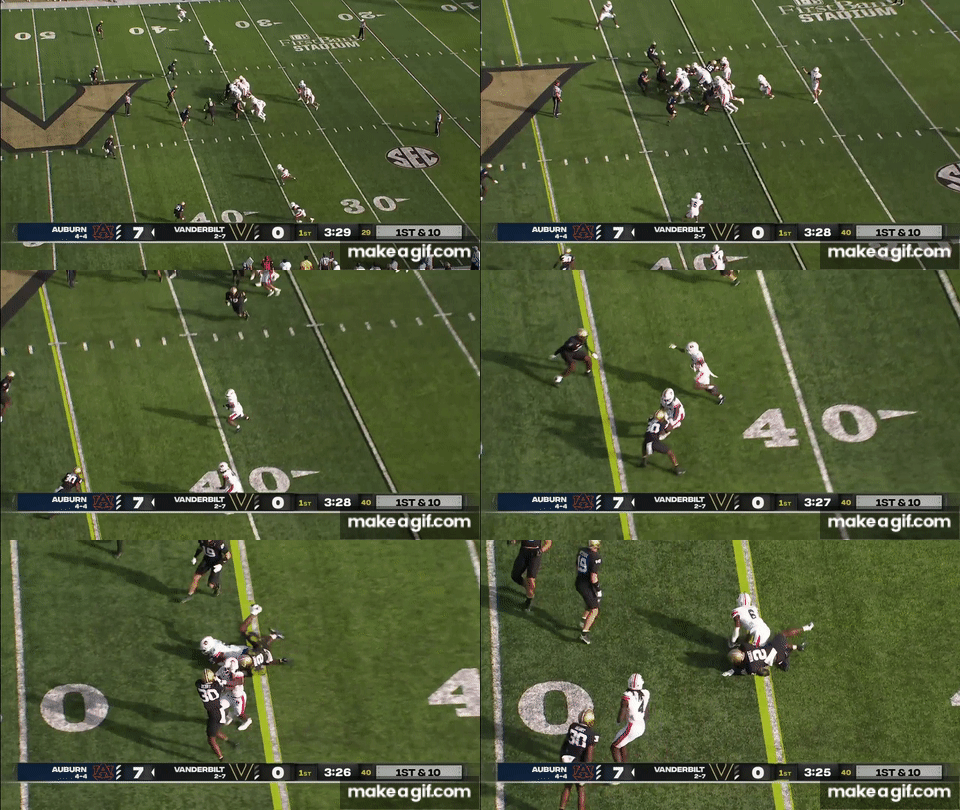
Auburn found success in the RPO game early against Arkansas as well. On the second play of the Tigers’ opening drive, Auburn faces a 2nd and 7 from their own 28. This time Auburn goes with a slightly different RPO concept. The run component is split zone: inside zone with the H-back coming across to kick out the backside DE and open up the cutback lane for the RB (although Luke Deal completely whiffs here); the pass component is a glance route from the single receiver, Caleb Burton. Teams like Arkansas that base out of quarters will often insert the backside safety into the box against the run game to allow them to account for the numbers in the run game while avoiding the conflict described in the above examples from the Vanderbilt game (note that the stick route at the bottom of the screen is covered). However, this leaves the space behind the LBs vulnerable, and the offense can read the safety for an RPO, throwing a glance route in behind the LBs if the safety fills in the box. That’s what happens here, and Burton is able to get some yards after the catch for an explosive play; note that he wins one-on-one against the Arkansas DB, something Auburn’s WRs have struggled to do against better competition.

Auburn’s second offensive touchdown of the game came on a similar type of RPO. Here, instead of running true split zone, Auburn is running a zone run paired with an arrow route by the H-back; instead of blocking the DE, Auburn is going to read him like they would on a zone read play. Here, he bites hard and nearly blows the play up but Thorne is able to get a wounded duck out to Fairweather, and the Arkansas DB (who was later ejected for a really dirty targeting penalty) whiffs, allowing Fairweather to stroll in and blow the game wide open early.

PLAY-ACTION PASSING
Auburn’s ability to get the RPO game rolling has opened up another avenue for moving the ball: the play-action passing game. Of course, those of you who are analytically inclined will point out (correctly) that the idea of “running to set up the pass” is a bit of a fallacy, because play-action passing success rate correlates much more strongly with dropback passing success rate than it does with rushing success rate (suggesting that good play-action passing teams are good at play-action because they’re good at passing, not because they run the ball well). However, from a schematic perspective, the run game still plays an important role in getting defenders to overcommit to the run and open up play-action passes downfield and to getting defenses to stack the box and allow favorable one-on-one matchups.
The latter is, of course, the entire premise of the vertical choice passing game that Philip Montgomery brought over from Tulsa via his stint at Baylor with Briles. Like Auburn’s RPO game, the vertical choice game was almost non-existent in the first half of the season because Auburn’s receivers couldn’t win those one-on-ones, but with a more effective run game (and weaker defensive opposition) the vertical choice game has finally had a few opportunities to shine, none more than on Auburn’s second touchdown against Mississippi State.
Again, this is a play where Auburn gets to the line and snaps the ball quickly after a first down (with less than ten seconds having run off the play clock). This is single choice, where the single receiver in a three-receiver set runs the vertical choice route. I explained the mechanics of this route in more detail in my season preview article, but the gist of it is that the tagged receiver is going to push the DB vertical and then break to the open part of the field, either continuing vertical if he can win deep, throttling down if he can’t, or breaking inside on a post if he has inside leverage on the DB (summarized in Briles’ mantra, “find grass, run fast”). Here though, there isn’t much of a “choice” for him to make as Mississippi State totally busts the coverage; I honestly can’t tell what this was supposed to be, but the safety and corner are apparently confused about who’s responsible for that deep zone. In the end, neither of them actually covers it until it’s too late, and Ja’Varrius Johnson scores the easiest touchdown of his life.

Auburn has also found some success with the more conventional play-action passing game, as illustrated by this play against Vanderbilt. This is one of the most basic forms of play-action, a bootleg with the receivers running a flood concept to the backside of the run action. A flood concept is exactly what it sounds like: you overload (“flood”) one side of the defense with receivers, leaving them with more players to cover than they have zone defenders on that side of the field. Here, Auburn combines that with a wheel route to the motion man, Jay Fair, who runs deep up the sideline while Camden Brown runs a deep route to take the top off the coverage, opening up the hole shot to Fair for a big gain and a first down (which Auburn ultimately squandered thanks to a chop block penalty and had to settle for a field goal).

Auburn’s play-action game also got some time in the spotlight during the pig roast. On the Tigers’ first possession of the second half, they made their way into the Arkansas red zone, with a chance to take a four-score lead put the game out of reach. This is an example of the RPO game directly setting up the play-action passing game. Here, Auburn lines up in an unbalanced 3×1 formation and fakes an inside zone run combined with a key screen to the inside receiver in the trips set, where they would be reading the slot defender as in the previous RPO examples from the Vanderbilt game. If the defense is going to stop the run component of the RPO, they have to commit the slot defender to the box, which should open up the key screen; if the defense wants to stop the run AND the key screen, they have to bring the safety down to cover the key screen.
And if they do that, the offense can attack the space that the safety voided, which is exactly what happens here; some coaches (like former Auburn OC Noel Mazzone) refer to these types of fake screens as locks (the key screen opens up the lock). Auburn fakes the key screen and has the two outside receivers run my favorite play-action concept, the post-wheel, with the outside receiver running the post to pull away the deep zone defender and open up the wheel route from the #2 receiver. And does he ever. The safety triggers hard on the key screen, the deep zone defender chases the post, and Ja’Varrius Johnson is wide open on the wheel for another very easy touchdown. This is a prime example of how tempo and RPOs create busts, as well as a good example of how you use constraint plays to protect your base plays, by punishing defenders who cheat to stop those base plays.

QB RUN GAME
The third component of Auburn’s offensive improvement has been the QB run game. While this has been de-emphasized somewhat without the QB-run-heavy packages that Robby Ashford usually ran when he was in the game, Payton Thorne has proven that he’s not a statue, and though the QB run game has been used more sparingly, it’s been a source of big plays. Like RPOs, QB run plays mesh well with tempo since you’re attacking an off-balance defense and isolating a single defender; this was really the secret sauce behind Auburn’s 2013 Cinderella run, as the zone read-heavy offense featuring Nick Marshall yielded an abundance of explosive run plays that allowed the Gus Bus to push the tempo. (Shoutout to Gus by the way for timing his annual out-of-the-blue blowout with his beloved annual Auburn pig roast.)
On their first possession of the second half against Moo State, Auburn demonstrated one important role the QB run game can play in an RPO heavy offense. Moo is lined up in a single high safety look here, with a defender lined up over all four receivers in Auburn’s 2×2 set. This allows them to cover all the receivers while putting an extra defender in the box to stop the run, which has been a bug-bear for Auburn all year, as discussed in my last article. However, this play shows how the QB run game can neutralize the defense’s numbers advantage: by reading one of those defenders instead of blocking him, you get back to 5-on-5 in the box and you should have favorable numbers again.
Here, Auburn combines that with motion by Rivaldo Fairweather to create a 3×1 set. I’m honestly not sure if Fairweather was supposed to be blocking the run support player (a scheme called arc read which was the bread and butter of the 2013 offense) or if he’s running a bubble screen as an RPO component, but it’s kind of a moot point. The defensive scheme Mississippi State is running here is called a scrape-exchange, and it’s one of the oldest tricks in the book for defending the zone read. The DE will pinch down, giving the QB a pull read, while the backside LB “scrapes” to the outside to tackle the QB after he pulls the ball. This is actually the primary reason the arc read was invented; the arc blocker can take out that scraping LB to keep the lane open for the QB.
In this case, however, Auburn doesn’t even have to block him, since he goes flying out to chase Fairweather for some reason, even though he was already accounted for by the safety on that side. With two guys chasing Fairweather, nobody is there to pick up Thorne when he pulls the ball and he rips off a huge gain. If you were wondering why Zach Arnett lost his job, yeah, this is it. (Also, to my earlier point about first downs and tempo, check the stat that ESPN helpfully flashed on screen.)

Auburn hasn’t just stuck with the basics in the QB run game however; there have been some creative designs that demonstrate the coaching staff’s continued commitment to the QB run game despite Robby Ashford’s diminished role. One such clever design was on display on Auburn’s first touchdown during the pig roast. I absolutely love this play design. Auburn lines up with a tight bunch set to the left, trying to get the defense to overshift to that side. This alignment is combined with run action to that side, as Jarquez Hunter fakes an outside run to the left. However, Auburn is actually running a QB counter play back to the other side; in this case, it’s GT counter, where the backside guard pulls and kicks out the playside DE, while the backside tackle follows him through the hole to block the playside LB. The backside tackle, Dylan Wade, actually whiffs his block on the playside LB, who was in position to make the play but missed the tackle, allowing Thorne to scamper through the hole for a touchdown and probably send T-Will’s blood pressure through the roof. This type of play is known as a bash concept (“BAsh” is short for “back away” meaning the RB fakes one way while the QB runs the other way), a common tactic for defenses that over-rotate against shotgun alignments, where the back usually hits the opposite side of the line from where he’s lined up; you’re counteracting your own tendencies while using the defenders’ rules against them. This is just a really clever play design, combined with some atrocious tackling from Arkansas, which is a recipe for success.

I want to bounce back to the MSU game for a second and look at a final role that the QB run game can play in an offense that isn’t primarily built around running the QB: protecting the dropback passing game. Draw plays are generally used to take advantage of an overly-aggressive pass rush, allowing the defenders to run upfield and run themselves out of the play. This is actually a sort of simplistic RPO, where the motioning receiver runs a swing route to the outside, while the QB is running a QB draw. It’s a really easy read for the QB: if someone follows the motion man, the defense is in man, and you should have numbers to run the draw; if nobody follows him, the defense is in zone, and you should have enough blockers out wide to run the swing. That’s not exactly the case here; instead, MSU spins the safety down to cover the swing, but that allows Auburn to maintain 6-on-6 in the box and run the ball. It’s honestly not blocked all that well and it probably should’ve been stopped for a loss, but Thorne does a good job of remaining patient, allowing the defense to overpursue before taking off for a big gain.

DROPBACK PASSING
Finally, I would be remiss if I didn’t notice Auburn’s improvement in the dropback passing game. I’m not going to spend a lot of time talking about this, but I did want to look at a couple of exemplary plays that show both how Auburn has progressed in pass protection and route running, as well as the role the dropback passing game plays in complementing the other parts of Auburn’s offense (which it wasn’t fulfilling earlier in the year). Payton Thorne’s decision-making has been at least a little better (probably a function of having time to read the defense and open receivers to throw to), so I’m not going to make you watch the truly brutal pick six he threw against Vandy, but I do want to point out that people who criticized the playcall were off-base; it was a good playcall for the coverage (curl-flat against a single-high safety look), Thorne just panicked and threw it straight to a defender.
Okay, enough negatives, let’s look at the positives. The first play I want to look at comes from Auburn’s excellent end-of-half possession at the end of the first half against MSU (#MiddleEight). Most defenses are going to prefer to play man coverage in the low red zone, since one of the main risks of man coverage (getting beat deep) isn’t a factor thanks to the endline acting as a twelfth defender. Thus, when offenses want to throw the ball in the low red zone, they’ll often turn to man-beater concepts. Here, Auburn runs the ultimate man-beater, mesh. I discussed this concept in the Cal film review since Auburn used it for a red zone touchdown there too.
This is what’s known as mesh-rail, with the receivers meshing and the RB running a wheel or rail route out of the backfield. This play is basically a cheat code in the low red zone because the meshing receivers can create a lot of traffic for the LBs, preventing them from being able to get outside to cover the RB. Defensive coaches will call this a pick play, but that’s because defensive coaches are cops; in any case, it’s basically never called OPI unless you’re really blatant about picking the defender. No such luck for Moo here, and Jeremiah Cobb is wide open for the score. I do note with a touch of bitter irony that this came against Mississippi State, since the greatest evangelist for the mesh play was the late Mike Leach and his Mississippi State offense scored three touchdowns on this concept (Green 92 Z Post) against Auburn during the 2021 debacle. Pour one out for the Dread Pirate.

Auburn used another of Leach’s favorite concepts, Y-Cross for a big play against Vanderbilt. Y-Cross is similar to the flood concept we discussed above: the outside receiver runs a vertical, the inside receiver runs an out, and the backside slot receiver runs a deep crossing route. Against a single-high safety look (e.g. Cover 3), this gives the offense three receivers against two zone defenders, and someone should always be open. Vanderbilt is in some type of single-high coverage here, although it looks like some version of Nick Saban’s Rip/Liz match, a variation of cover 3 where the DBs match the receivers’ routes instead of covering a specific zone (almost a combination of zone and man principles). This is a great look to run Y-Cross against, since the vertical pulls away the CB and the slot defender chases the out, leaving the Y wide open on the crossing route. Ja’Varrius Johnson cooks the Vanderbilt DB on the crossing route and it’s a big gain down the field; Auburn would score a TD to basically ice the game a few plays later.

The final example I want to look at in this novel of a blog post is second-to-last touchdown in the Arkansas game, immediately after the big fumble return in the 3rd quarter. Here, Auburn puts Jarquez Hunter in motion to run a swing route to the three-receiver side, while the three receivers block for him. However, Thorne instead decides to work the single receiver, Fairweather, running a fade route. This is a popular way to use a TE who’s a good pass catcher, singling him up on a smaller DB and just letting him outmuscle him. This may jog your memory a bit, hearkening back to the game-winner Nick Marshall threw to CJ Uzomah against Mississippi State in 2013, which was a similar setup with the big-bodied TE as the only receiver working against a CB into the boundary (although that was actually a double move and not a straight-up fade). Thorne throws a really nice back-shoulder ball here, putting it in a spot where Fairweather can use his size to keep the defender from attacking the ball and make the grab for the TD.

Alright, I think that’s enough for one post. Congrats to anyone who actually stuck it out to the end of this thing, which might be longer than my doctoral dissertation at this rate. Consider this an apology for the lack of content over the last month; I’ve been busy with work stuff and trying to get in as much golf as I can before the season ends.
Like I said at the beginning of this post, the non-Xs and Os stuff, particularly picking a QB and sticking with him, has done more to improve Auburn’s offense than the Xs and Os, but this is an Xs and Os blog, so I wanted to cover that aspect of it. I doubt there will be much to review from next week’s game, assuming Auburn can take care of business against a New Mexico State team that’s been maybe the biggest surprise of the entire season; shoutout to the eternally-underappreciated Jerry Kill for one of the most impressive program turnarounds in recent memory. Hopefully we’ll be back in a couple of weeks to break down film from an Iron Bowl upset.
-
Why Auburn’s offense sucks, in four gifs
(Quick programming note: no review for the Georgia game because I was out of town for work and no review for the LSU game because I’m going to sound like a broken record; in lieu of this, I’m going to do a much more succinct version that still covers everything.)
Auburn was unable to recreate the magic of 2021 on Saturday in Death Valley and picked up their third straight loss to open SEC play. While I think most of us expected to lose this game, probably by a significant margin, that doesn’t make the offense’s performance any less embarrassing. Even with the luxury of a bye week, Freeze and Montgomery couldn’t manage to find a solution to get Auburn’s offense to execute consistently. I think that’s a pretty clear indication that the problems with Auburn’s offense are pretty much baked in at this point.
To illustrate the core of this problem, let’s take a look at what are supposed to be the foundation of Auburn’s offense: RPOs. Auburn’s RPO volume has been much lower than I expected it to be going into this season, which was surprising until I started watching the film and saw a pretty consistent issue with Auburn’s failed RPOs.
First, though, let’s take a look at how this is supposed to work. On this play, Auburn is running a counter play to the left, with the wide receiver on that side running a glance route. The idea is that if the playside safety comes down to fill a gap against the run, giving the defense an extra man in the box, Thorne will pull the ball and throw the glance route into the space the safety vacated; if he stays home, he’ll just hand the ball off and the offense should have favorable numbers to run the ball. Here, you can see that the safety triggers hard on the run, leaving a wide open space for Thorne to hit the receiver on the glance route.
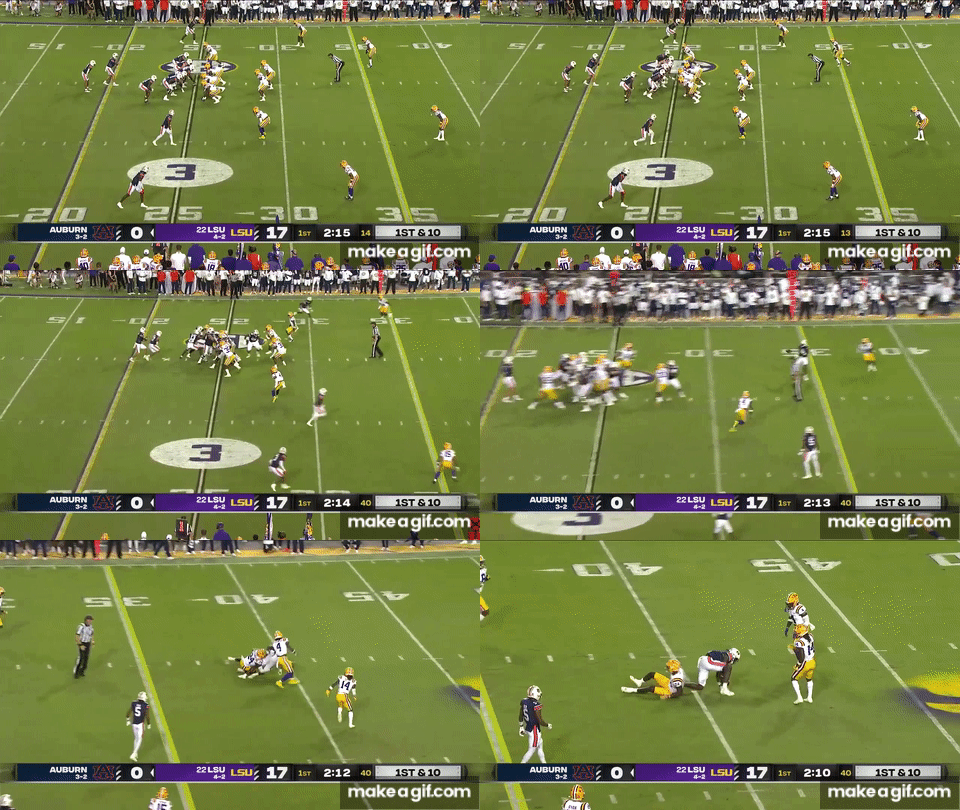
However, while RPOs are great, they do come with a caveat: they really only work against zone coverage. That’s because RPOs rely on putting a defensive player in conflict between pass and run responsibilities. In zone coverage, there will always be players (usually outside linebackers or safeties) who have a dual responsibility for covering a gap in the run game and a zone in the passing game, so the offense can always make them wrong.
Against man coverage, however, all of the defenders are either responsible for covering a particular receiver or filling a gap in the run game. There’s nobody who’s in conflict, so there’s nobody the offense can read. Thus, the defense can cover both phases of the RPO without compromising their coverage scheme or their gap assignments.
Here’s an example where the defense is in man coverage and completely locks down the pass phase, forcing Auburn to run the ball against unfavorable numbers in the box. Auburn is running an inside zone scheme combined with a stick route by the slot receiver. Usually, Thorne would be reading an outside linebacker in zone coverage here, but since LSU is in man, he has no choice but to hand it off, and the run gets stuffed for minimal gain.
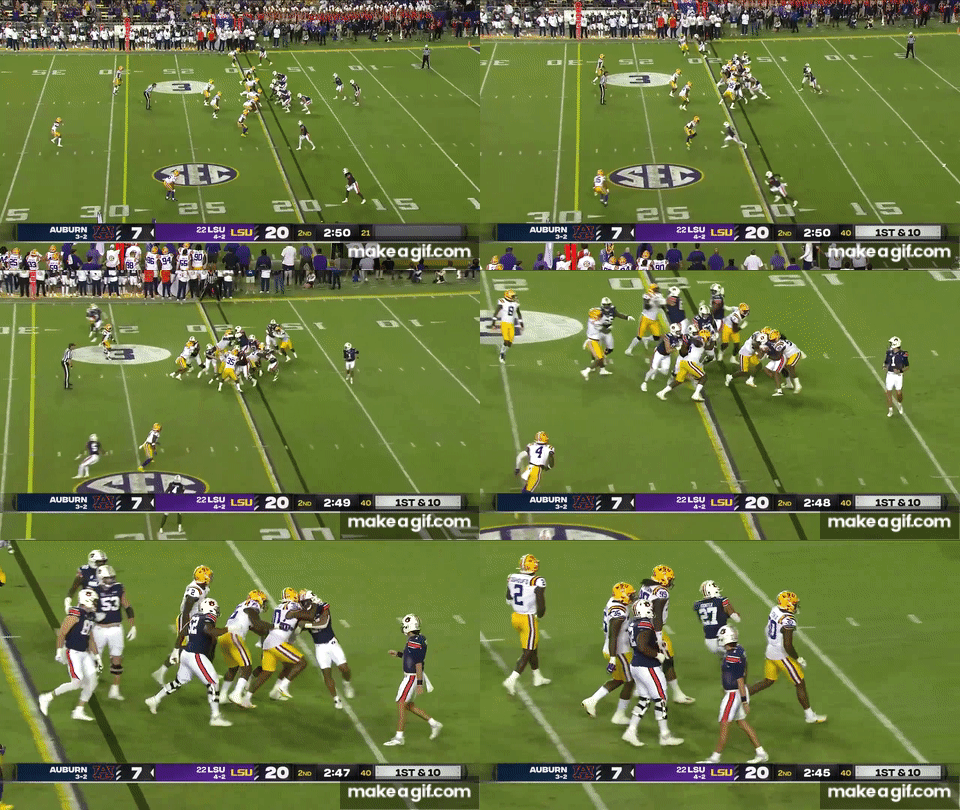
Generally, when there’s man coverage, the QB will hand off, since throwing an RPO against man coverage is asking for trouble unless your receivers can just win one-on-one, which isn’t really the point of an RPO. More on that later. But first, here’s an example of trying to throw against tight coverage. I don’t think LSU is actually in man here, but it’s the same effect. Auburn is running an inside zone read paired with an arrow route by the H-back, creating a form of triple option. Robby correctly reads the DE crashing on the dive and pulls the ball, only to find the H-back locked down and pursuit in his face. He probably does the best thing here and just chucks it away. I want to add that this is also bad play design; as the telestrator so helpfully notes, the DB lined up over the inside receiver on the unbalanced side of the line (who is ineligible to receive a pass) and just chases down the play. Too easy, especially for a talented defensive playmaker like Perkins.
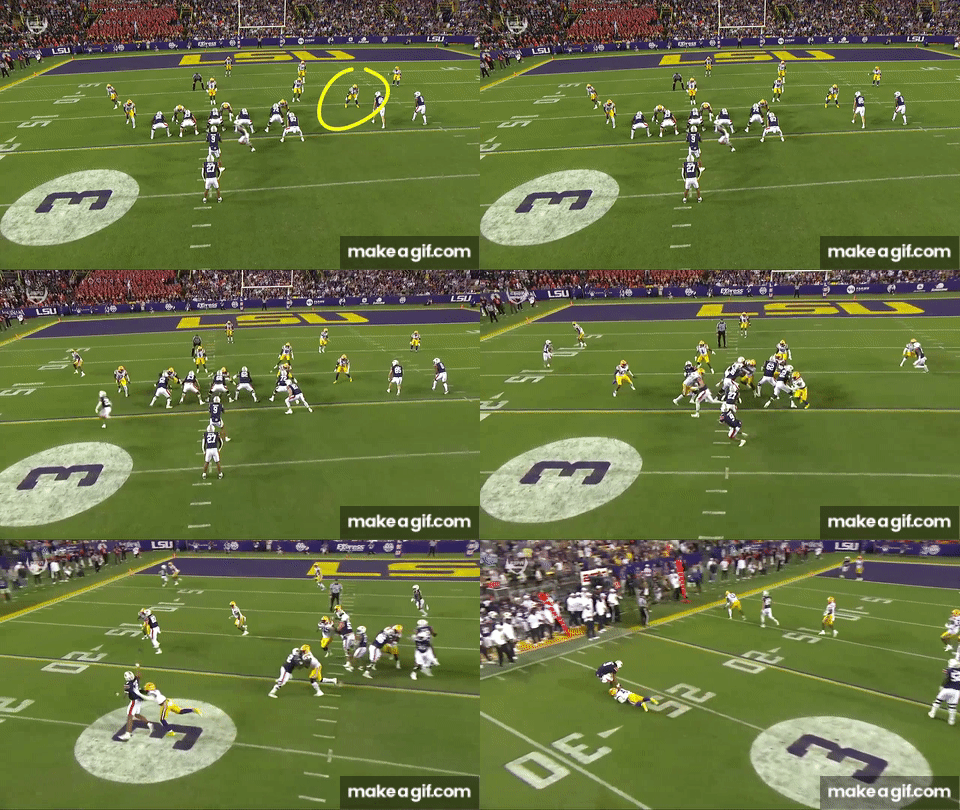
So what do? How does the offense deal with man coverage in the RPO game? A common way is to build a man-beater into the play. This is sometimes referred to as a pre-snap look (PSL), where a receiver on the backside of the play runs some sort of route to take advantage of the leverage of the guy covering him. Usually this is something like running a quick hitch against a soft corner or (in this case) running a fade route against a corner who is pressed up.
Of course, this assumes that the WR can actually win that one-on-one, and as you can see, that’s not the case here. This has been a problem for Auburn all year, and it continued against LSU. Auburn is running a counter play with a stick route paired on the backside. LSU is in man, which Thorne correctly identifies, so he decides to work the PSL. Of course, the receiver isn’t open at all (and Thorne overthrew him so badly the ball probably landed in Lake Pontchartrain anyway).
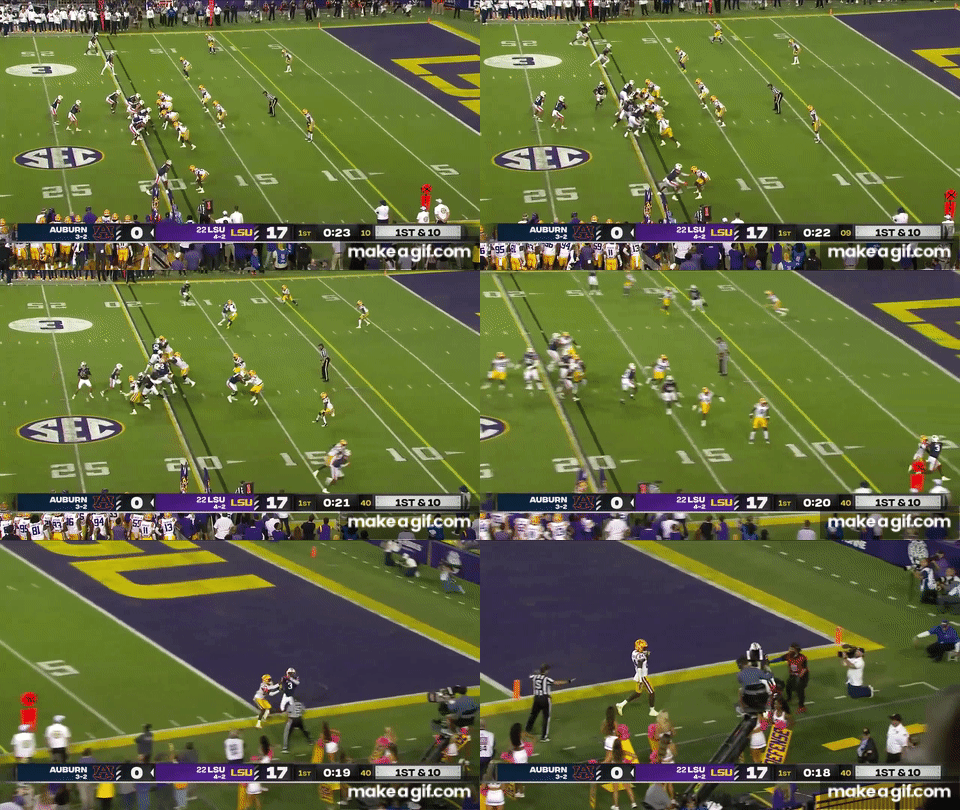
That’s how the defense thwarts all three phases of the RPO game. Man coverage is a perpetual problem for teams that build their offenses around their RPO games, which requires these teams to carry solutions to man coverage (which Brent Dearmon, a former GA under Gus who’s now the head coach at North Alabama, calls “manswers”).
Generally these consist of one of two things. The first is man-beating pass concepts, like the late Mike Leach’s beloved mesh. (For more on that, see the Cal review from a few weeks ago.) Of course, that still requires your receivers to be able to beat defenders if the concept can’t engineer an open receiver, something Auburn obviously can’t do with any consistency.
The other is to involve the QB in the run game, reading the extra defender in the box who would usually be unblockable because the offense doesn’t have enough blockers available. This has been the most consistent source of offense for Auburn all season, but the coaches seem weirdly hesitant to commit to it even though both QBs have proven pretty proficient in it. I think this is because orienting your offense around the read option game requires building the rest of the offense to protect the read option game. In particular, this means having play-action for when the defense inevitably brings additional defenders down to stop the run, something has often struggled with after having some success in the QB run game because teams just don’t fear the Tigers’ downfield threats.
The good news for Auburn is that their conference schedule was heavily front-loaded. They should have a talent advantage over the rest of the teams on the schedule until the Iron Bowl against a Bama team that looks like it could be vulnerable to some Jordan-Hare voodoo. However, we’ve already seen Auburn’s receivers struggle to win consistently against inferior teams before (particularly against Cal). Maybe Auburn can finally get things rolling in the RPO game and establish something of an offensive identity over the final few weeks to create some momentum going into the future. There are still plenty of wins on the table if the offense can just be competent, but more than anything, the new coaching staff needs some proof of concept to get recruits and fans to buy in. Can they manage that? For now, color me skeptical.
-
Auburn @ Texas A&M Film Review: Game of Thornes?
Auburn’s second road trip of the season looked a lot like its first, with an absolutely hideous offensive performance that almost required the Ludovico technique to watch a second time.
I managed to sit through it though, and if you’re reading this, then I guess you’re willing to as well. If you’re not, this is your last chance to click away.
For those lucky enough to have missed it or to have spent Saturday on the golf course the way I wish I could have, Auburn struggled to get anything going on offense for the entire game and put up one of its worst offensive performances in recent memory, even worse than the leanest of the lean during the Potato Famine. I was hoping that rewatching the film would show a clear problem that we could fix and immediately turn things around, but it wasn’t just one thing. Almost everyone shoulders some degree of blame here, suggesting that there are systemic issues that are gonna take more than one season to fix. I think we all knew that going into this season (or I hope we did anyway) but it was still frustrating if not outright dismaying to see it play out in such an extreme fashion on a national stage.This review is going to focus exclusively on the offense because this loss is entirely their fault. Blaming the defense for this loss would be like blaming the bulkheads on the Titanic for failing instead of blaming the crew for driving it into the iceberg. The only thing I can fault the defense for is Eugene Asante deciding to score a meaningless touchdown in a game we were gonna lose anyway instead of sending Jimbo Fisher to the shadow realm and becoming an instant college football legend. I can even picture the Asante-trucking-Jimbo statue on the Jordan-Hare concourse, right between Bo and Cam.
Anyway, enough metaphorical disasters, let’s get into a real one. Auburn won the opening toss, deferred, and held Texas A&M to a field goal after a long, weird, meandering drive. On their opening play of the game, the Tigers offense goes with a variation of counter we’ve seen them use a few times this season, with the center rather than the guard trapping the playside defensive end. The H-back runs to the flat on an arrow route and Thorne is reading the defensive end to either hand off or keep and then the slot defender to keep or throw the arrow. Texas A&M sends the nickel on a blitz, and after Thorne gets a pull read from the DE, the nickel is in his face before he has a chance to throw the arrow. Texas A&M DC D. J. Durkin clearly came into this game with a plan to bring the heat and it paid dividends from the very first play.
After Thorne was tackled for little gain again on second down, the Tigers faced the first of many third and longs in this game. Auburn starts in a trips look before motioning to a 2×2 look. This is a shallow cross concept, where the X receiver runs a shallow crossing route with the Y receiver running a dig route from the opposite side. The idea behind this concept is to either get the LBs to bite down on the shallow, opening up the dig, or to get the LBs to sink on the dig, leaving space for the shallow. It’s coupled with motion and a switch release to combat man coverage, although A&M is in some type of zone here (I think cover 4). Both the shallow and the dig are open here, and either of them probably would’ve gotten the first down. I’m not sure which of them Thorne was actually trying to throw to (I’m not sure he knew either), but either way he misses and it’s a punt.
After another A&M field goal, Auburn’s second possession got off to a much more promising start than the first. On first down, Auburn goes to one of its bread and butter concepts, GH counter with a stick RPO tag. Thorne hands it off and there’s really not much there up the middle, but Jarquez Hunter bounces it to the outside and gets a first down.
Rather than pushing the tempo, Auburn uses a strange tactic they’d return to over and over in this game for reasons that are unclear to me. They align in a 3×2 empty set before shifting to a 3×1 wing alignment. If this was supposed to elicit some type of reaction from the Aggie defense, I’m not sure what it was. To me, it just looked like a waste of time. The actual play goes well though, as Auburn brings the Z receiver in motion and runs a similar concept to their first play of the game, this time pairing a split zone run with the arrow to the motion man. The motion across the formation enhances the split flow action in the backfield and Jarquez has a wide open cutback lane for another first down. Note that A&M brought the nickel blitz again but the H-back is able to take him out of the play. I’m not sure if that was a conscious adjustment to the first drive or if this was still the pregame script, but it made sense.
The Tigers returned to the same concept two plays later and again, they’re able to cancel an Aggie blitz and pick up another first down.
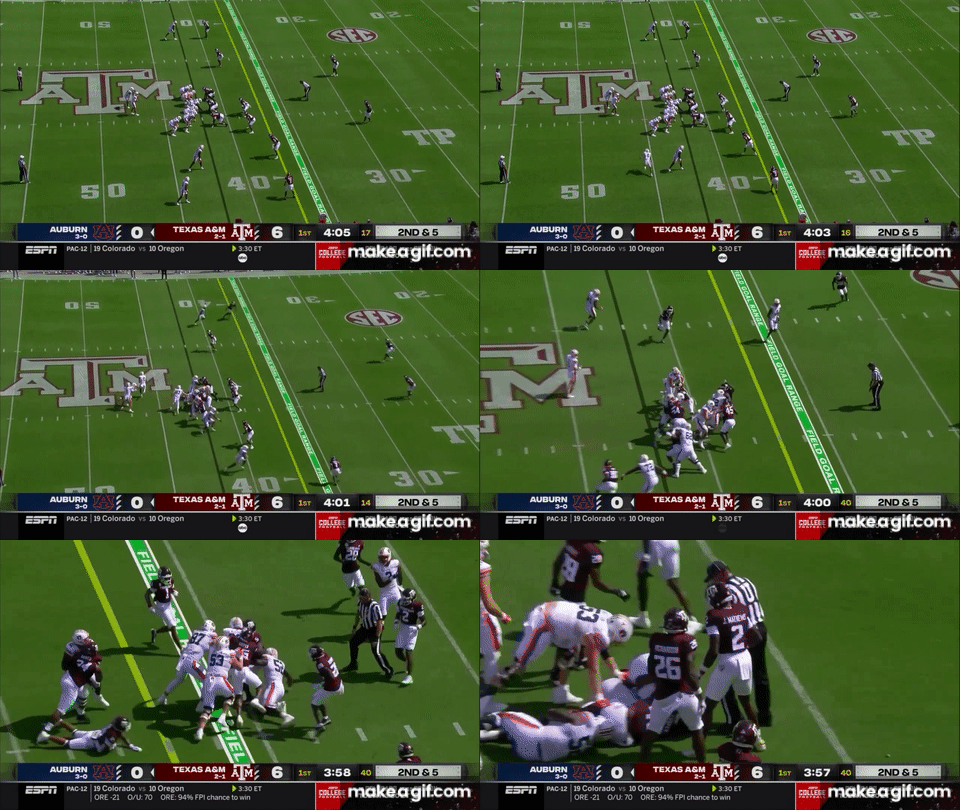
And then we get to this. Auburn runs a play that I honestly hate: a toss read off of GT counter action. I have a long, abiding hatred for shotgun toss sweeps that goes back to a fumble in a high school game 17 years ago that I doubt anyone else remembers, but even when it does work, it looks hideous. This play…does not work. The idea is similar to a standard read option play: the QB reads the DE and will either run the counter or toss the ball to the RB depends on what he does; the H-back is supposed to arc block the corner with the WR cracking the run support player (I assume), but Texas A&M brings the corner on a blitz and Brandon Frazier has no chance of picking him up, allowing him to blow the play up. Thorne makes the correct read and is very, very fortunate that his toss was ever so slightly forward, leading to it being ruled an incompletion rather than a scoop-and-score. I’ll spare you the runback that didn’t count and the interminable review (alas, the NCAA has yet to implement my proposed official review pitch clock).
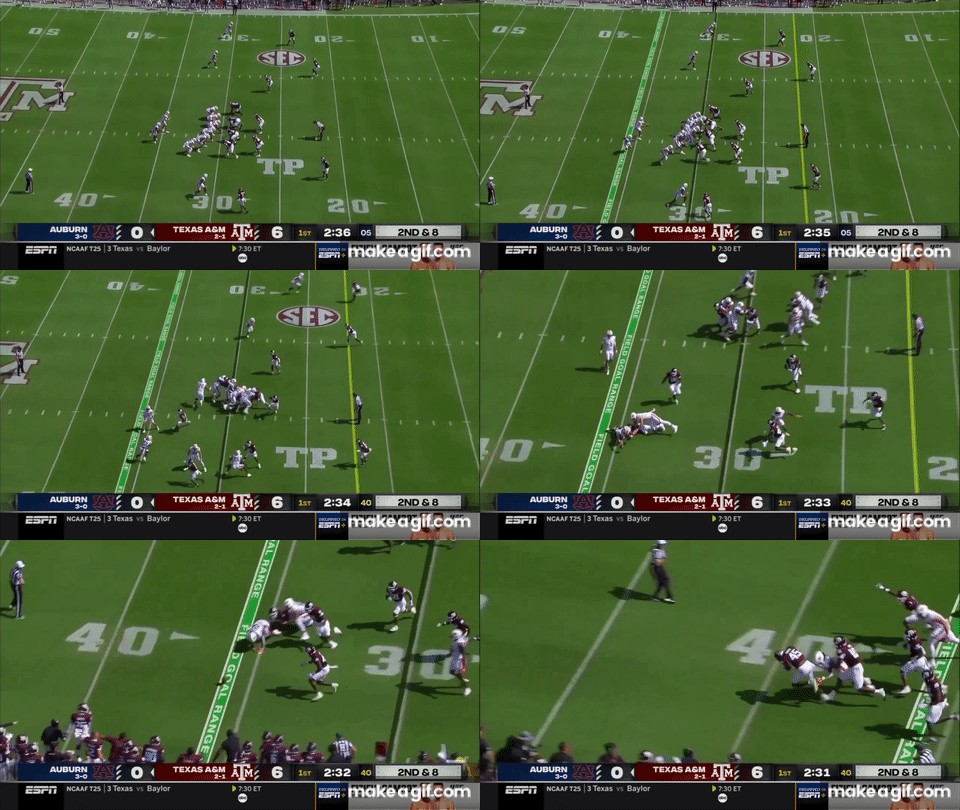
Having been given new life through Auburn Jesus’ first appearance of the day, the Tigers immediately decided to waste the opportunity. I’m honestly not sure what the pass concept is here; it looks like a quick out or stick route, combined with a post-wheel or scissors concept, something Auburn ran a few times out of 3×1 sets in this game. However, it barely matters what the receivers are doing; A&M comes with a six-man pressure, and Auburn is unable to pick it up with six protectors; Jarquez does his best but gets blown up, leading to a sack and a (near disastrous) punt that nets…six yards, despite an incredible effort from Oscar Chapman to even get it off in the first place. Bizarre game management there, especially considering that Alex McPherson was allowed to attempt (and converted) a field goal from roughly similar distance later in the first half.

Auburn came out on the next drive and went back to the air, this time deciding to move Payton Thorne out of the pocket and away from the teeth of the A&M pass rush. This is a simple flood concept: three receivers running at different depths on the same side of the field, hoping to create a three-on-two overload against a zone defense. Thorne isn’t exactly great at throwing on the run and doesn’t deliver the best ball here, but he gets it to Battie in space, which is always a good idea, and he’s able to scamper out to the 40 for a first down.
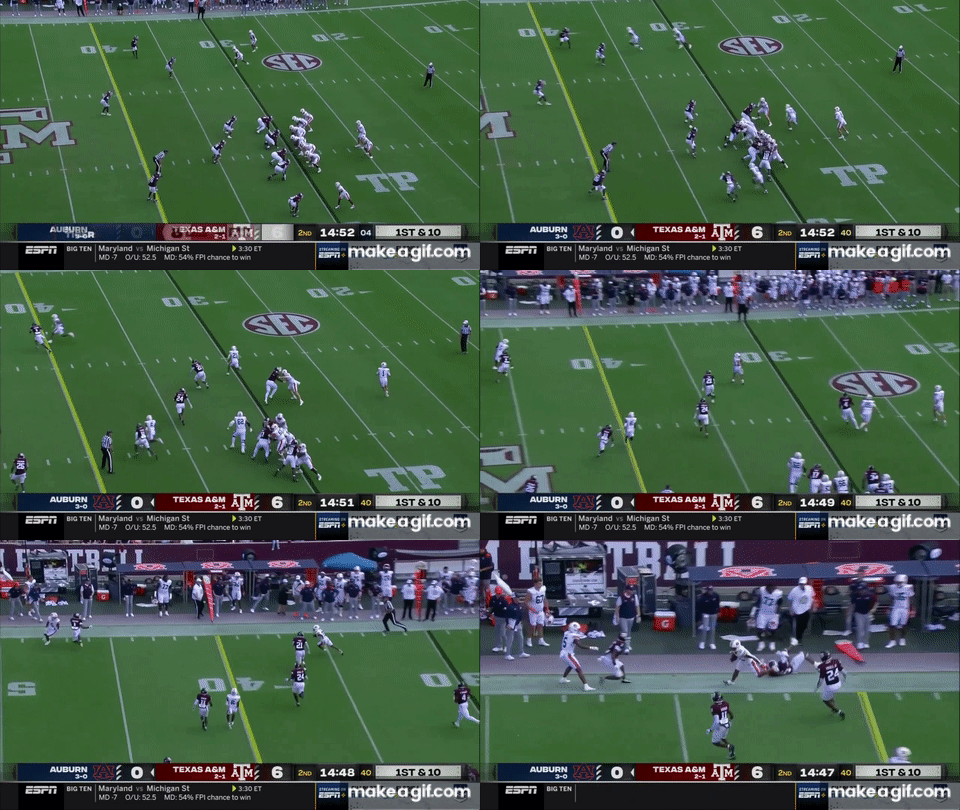
However, on the next snap, Auburn decides to try to use Thorne’s legs directly and it doesn’t go so well. Running a draw when you’re getting pressured makes sense in general terms, but it should have been obvious pre-snap that this wasn’t gonna end well. Auburn motions the H-back out of the backfield and the Aggie nickelback comes down the line to the edge of the box showing blitz. Thorne either doesn’t see it or doesn’t recognize the problem here and goes ahead with the called play, which predictably gets blown up to put Auburn behind the chains yet again.
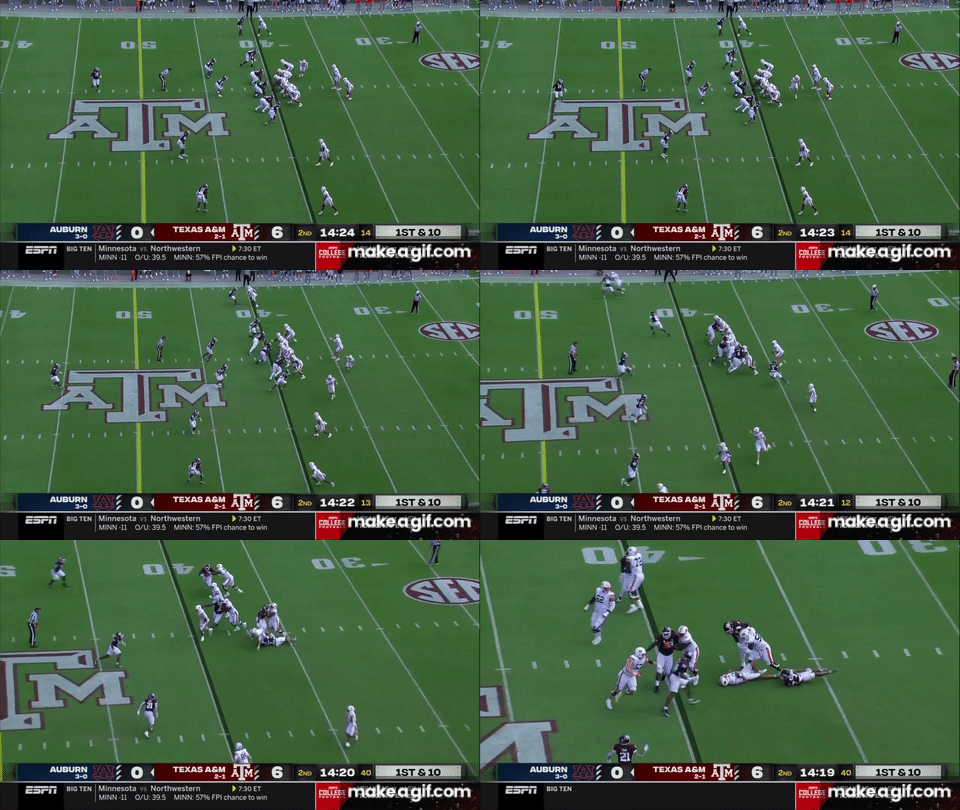
After Thorne overthrew a receiver who wasn’t really open anyway, the Tigers offense was looking at another third and long and a passing situation. I’m not exactly sure what Auburn is running here (thanks TV camera angles). This time, Thorne makes one of the few good decisions he made in this game, seeing and avoiding the pass rush, escaping the pocket, and finding Shane Hooks at the sticks for the first down.
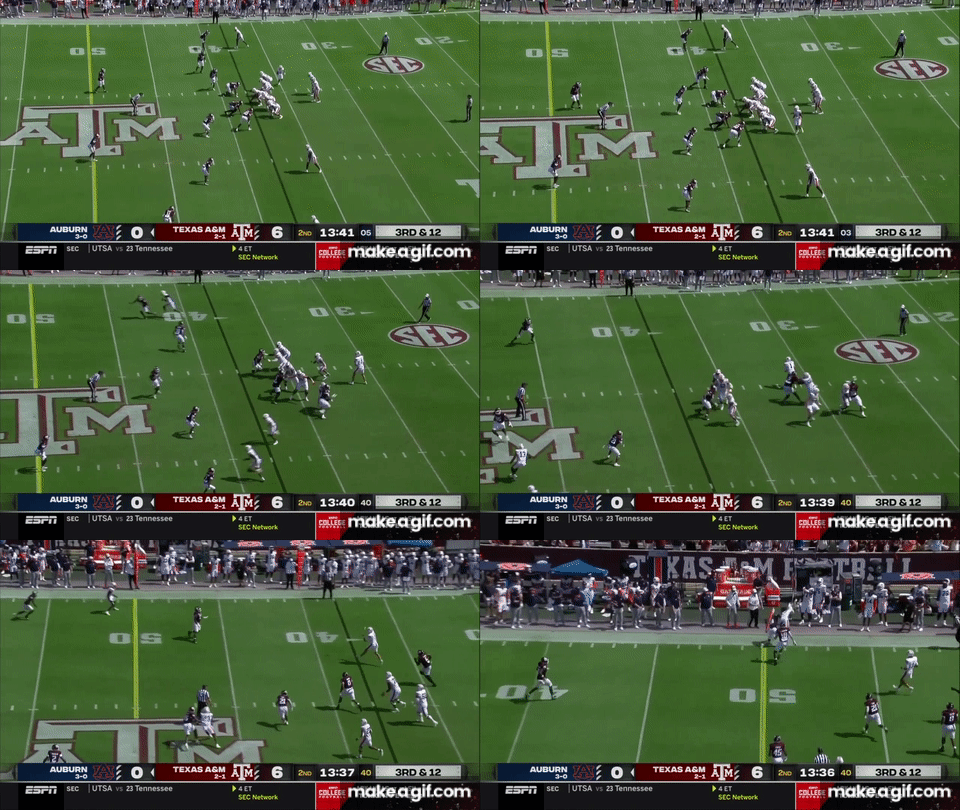
On the ensuing first down, Auburn goes with another tactic that we’ve discussed before here: stacking the outside receivers to create confusion among the defenders about who is responsible for covering whom. In this case, it’s just a simple RPO with Auburn’s base inside zone run and a quick receiver screen; A&M matched the numbers but Thorne likes the leverage of the DBs (I assume) and throws the screen for positive yardage. This was one of the few times during the game where I thought that we were actually doing a decent job of consistently executing our core concepts. It was also one of the last, so don’t get used to it.
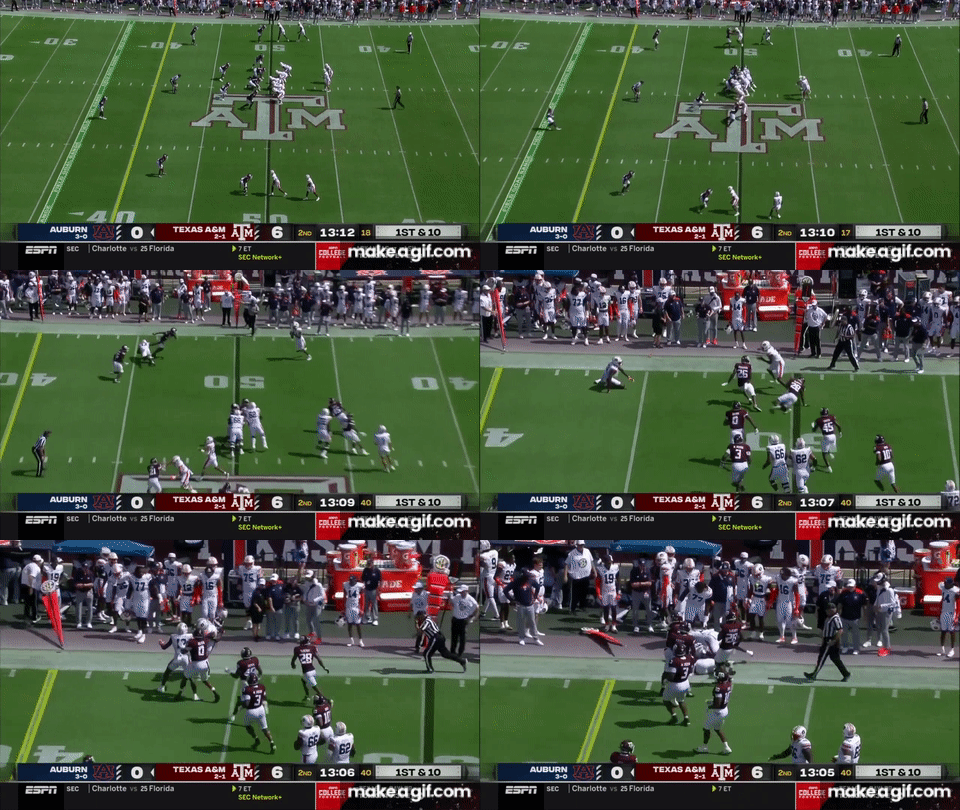
After a good run picked up another first down, Auburn found themselves back in scoring territory. On first down, the Tigers used that weird shift followed by the receiver motion again, but the Jarquez Hunter does a good job of being patient and making a decisive cut for another first down…that was subsequently wiped out by a hold. Longtime readers of the blog (aka people who read the last post) will know that this has been something of a theme for Auburn this season: get a drive going, get to the edge of scoring territory, commit a stupid penalty and kill the scoring opportunity. More to come.

Thorne managed a short completion on the replayed first down, and then on second down, Auburn went back to that post-wheel concept they had run earlier in the game. This looks like the way Mike Leach would run the stick concept out of 3×1 sets, with the #1 and #2 receivers running a post-wheel and the #3 receiver running the stick.
(Shoutout to Millennial Football for the image)
Despite Auburn already having run it a couple of times, A&M completely busts this coverage and leaves the wheel wide open for a walk-in touchdown…but Thorne throws the ball into the next county. The #1 rule of playing QB is that you never overthrow a wide open receiver. If that ball is anywhere near him, it’s an easy touchdown. Maybe the fact that he’d already been under significant pressure much of the game got to Thorne, as it looks like he’s got happy feet here and never really sets to throw, which was a frequent problem early in the career of another Auburn QB who has since gone onto bigger and better things elsewhere. No ambiguity here, this one is 100% on Thorne.
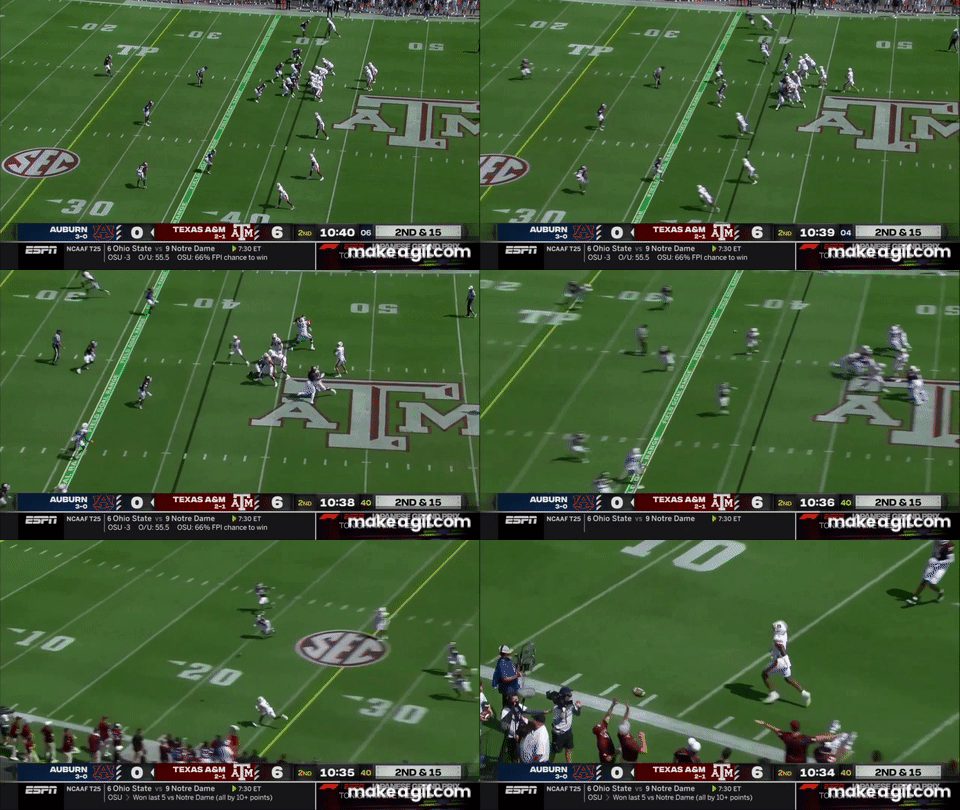
After a false start, Auburn was right back in the same place they’d already spent much of the game: third and long. Here, Auburn opts for some type of double post concept (could be mistaken for outside choice but I’m almost certain it’s not). For once, the pass rush is actually picked up pretty well, Thorne stands in the pocket and delivers a catchable ball to the receiver on the post route that would have been close to the first down and he…drops it. The throw was a bit high, but if you want to be a starting WR in the SEC, you’ve got to catch those types of balls.
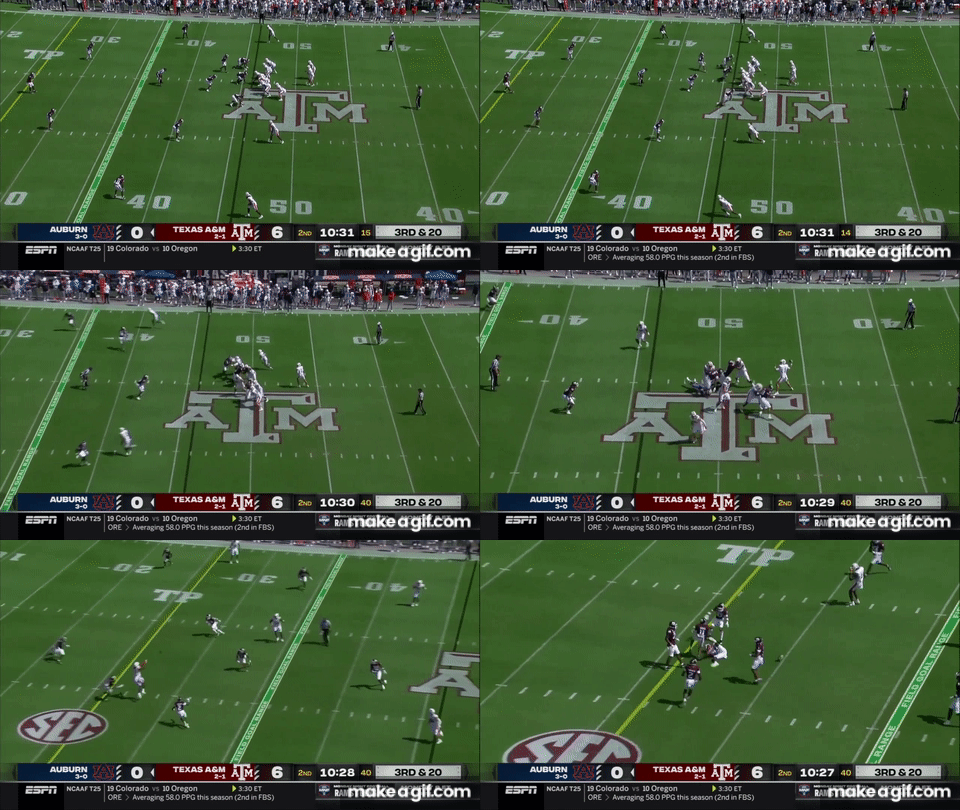
Auburn and Texas A&M exchanged punts again, netting a loss of about 20 yards. On the first play of the next series, Auburn goes with some type of play action concept (not sure what it was, thanks again TV camera angles), Thorne actually gets through his progression, finds his checkdown, and he manages some great yardage after the catch to get the Tigers out to midfield.
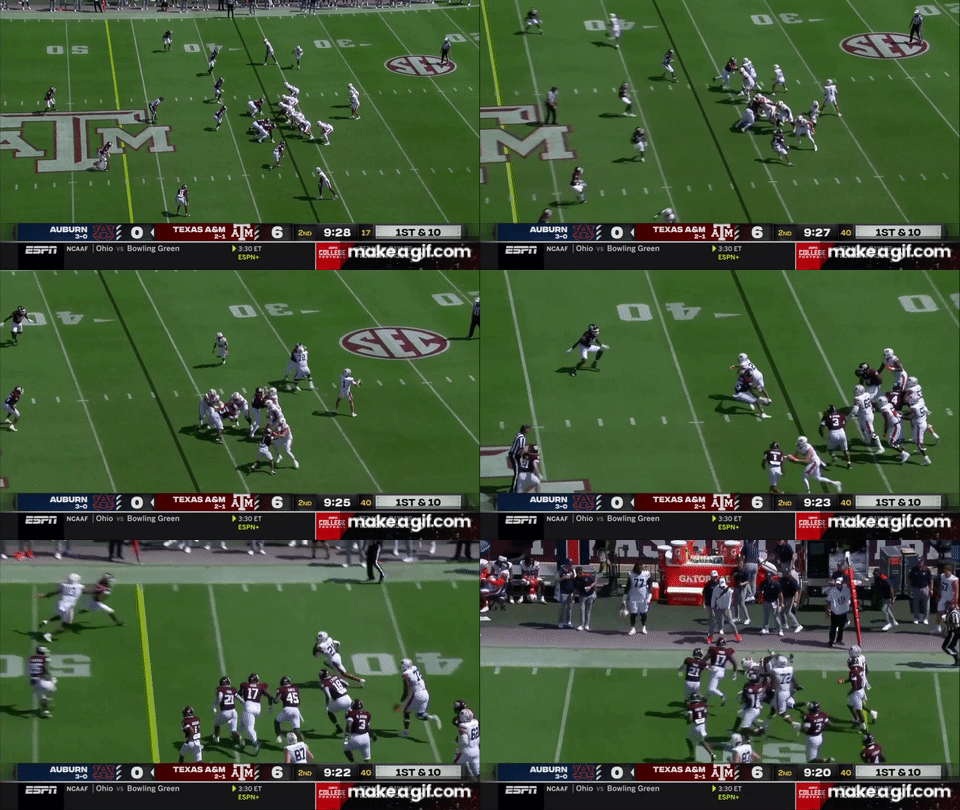
Once again, instead of pushing the tempo and getting the next snap off as quickly as possible, Auburn opts for that weird shift from 3×2 to a 3×1 wing set. This is just baffling to me and I can’t really discern any explanation for it. The playcall is the same as it was on the previous plays where they used that shift, a split zone play with an arrow to the backside. This one is dead in the water though as the TE completely whiffs on his block and the LB stuffs the run for no gain.
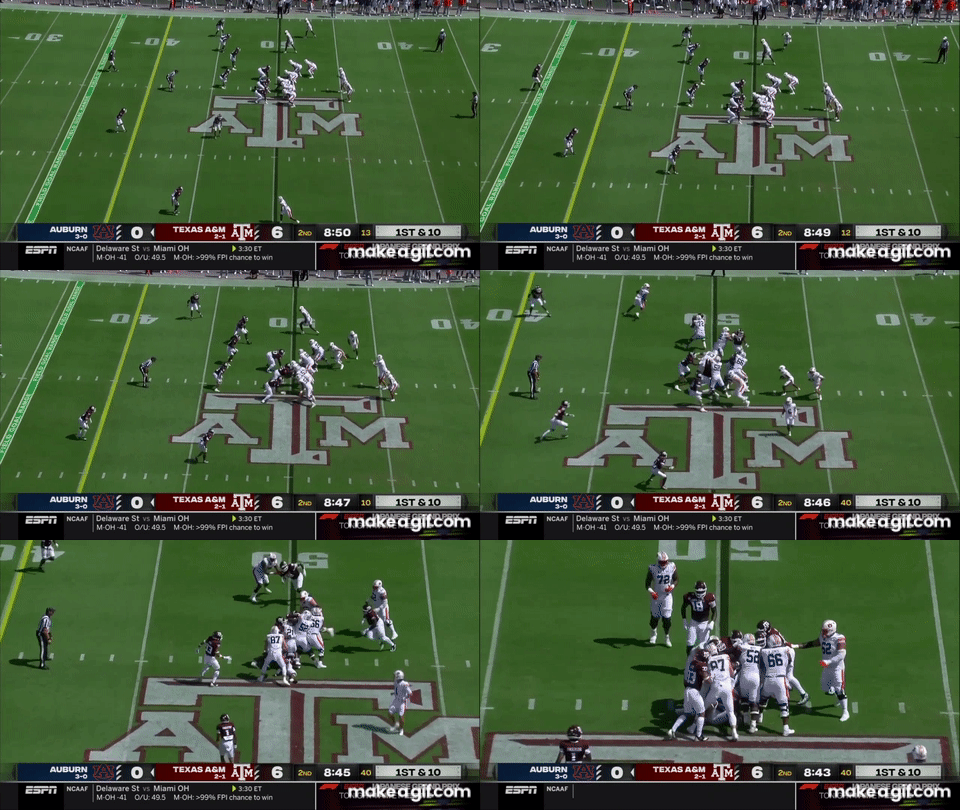
On the next snap, Auburn tries another QB draw and actually finds some success…but it’s wiped out by a holding penalty. This is really a nice microcosm of the game here, because even when the other parts of the offense are working well, someone manages to make a mistake that undoes all of that good work. Sometimes it was bad playcalling from the coaches. Other times, it was Thorne making bad decisions or missing open receivers when he wasn’t under pressure. Still other times, the offensive line missed an assignment in run blocking or pass protection or committed a penalty that negated a good play. The plays where all three of those parts of the offense came together and avoided mistakes went well, but those were few and far between.

Thorne ate a sack on the replayed second down where he stepped right into pressure against a three-man rush even though he had an open receiver and time to hit him, followed by a give-up run call on third down that actually got the Tigers back into A&M territory. Here we have more bad game management from the coaching staff. 4th and 4 at the opponent’s 44 midway through the game is a bit of a gray area, but the math says that you’d increase your win probability by about 2.5% by going for it and converting here. I can understand their lack of faith in the offense to get four yards, but the defense was playing well and the amount of field position you gain from punting there is relatively small. They should have gone for it here. I didn’t end up changing much since they got the ball back in identical field position after the exchange of punts, but it was still the wrong call.
Auburn opened its last possession of the half on the fringes of scoring territory and on the fringes of the #MiddleEight. For the first time in this game, the Tigers offense started under center, shifting from a heavily unbalanced set and then motioning to create a bunch to the right. There’s only one play I’ve ever seen Freeze’s offenses at Ole Miss and Liberty run out of this type of set, and it was a toss sweep (incidentally, that’s about the only thing Gus ever ran from the under center bunch sets he used out of fire alarms). And what do you know, toss sweep. Not much doing there. Kind of predictable. I like the idea of shifting the TEs across the formation to flip the run strength (one of the very very very few good ideas that we saw on offense during the Potato Famine) but it works better if you snap it as soon as they’re set rather than giving the defense time to reset their front.
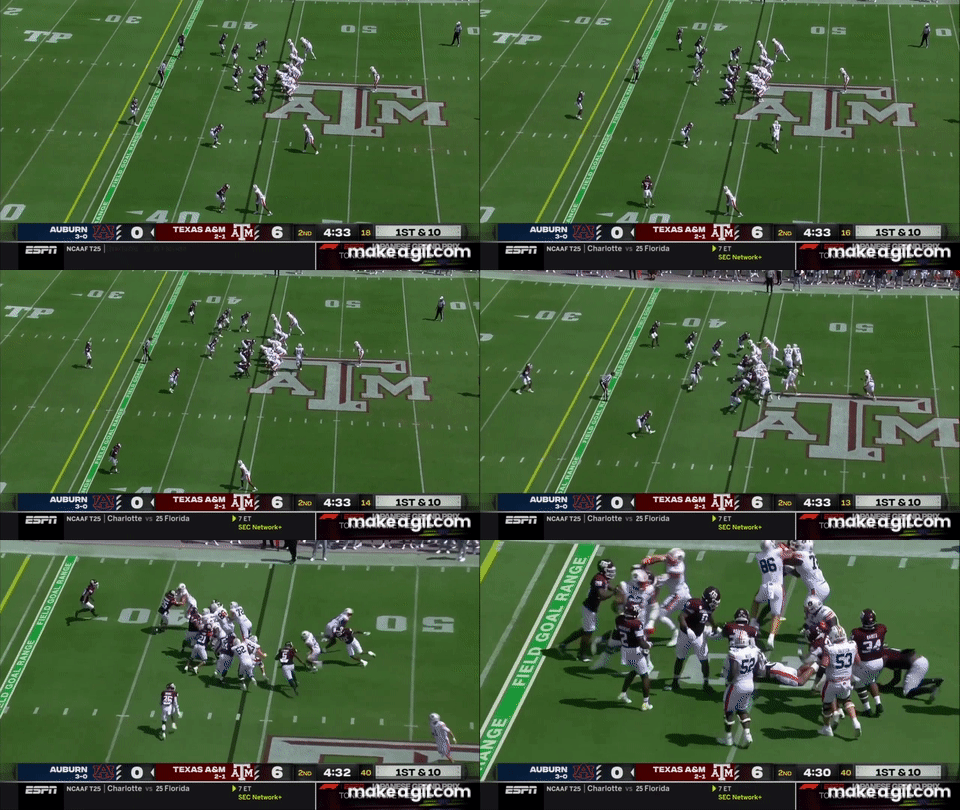
However, that toss sweep did set up an interesting fourth down call. Auburn got a good gain on the ground on second down, followed by getting stuffed on 3rd and 1. On the ensuing fourth and short, Auburn showed that toss sweep and ran a naked bootleg to the backside. If you’re old like me, you might remember another famous naked bootleg in short yardage: Stan White’s game-winning fourth-and-goal touchdown run against Indiana in the 1990 Peach Bowl. Thorne’s relative lack of speed shows on this play, but he manages to helicopter his way to a first down. Good call, maybe not the exact personnel you’d want running it.
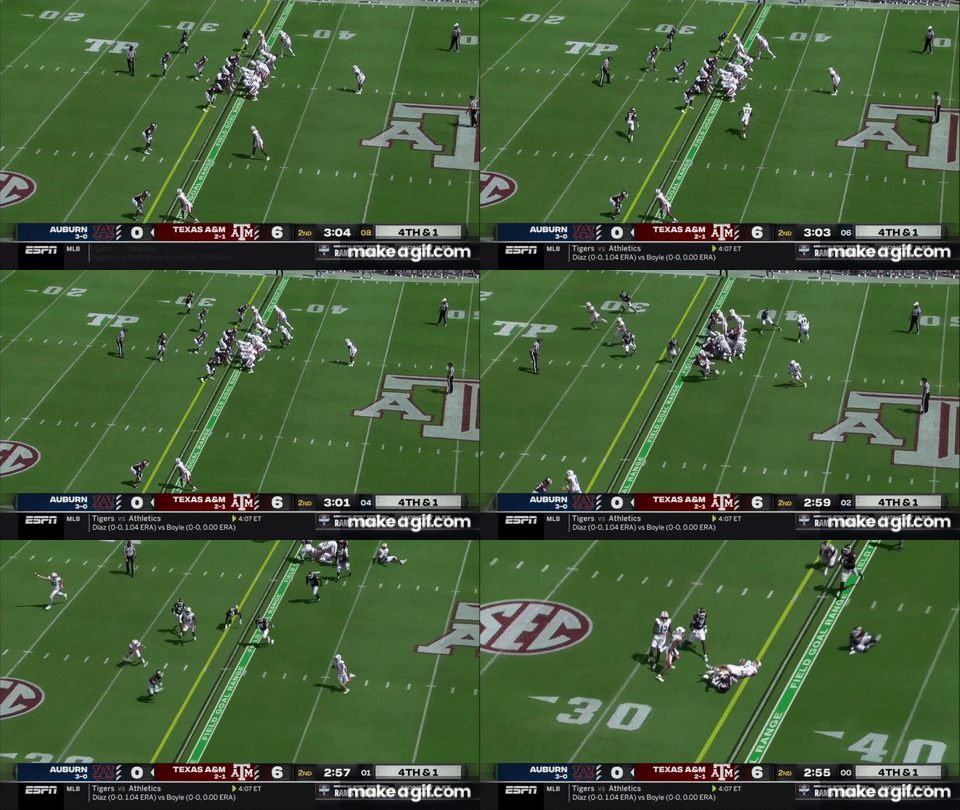
Following that conversion, with about two minutes left (the tempo on this drive was oddly slow given the situation), Auburn went to the air looking for a big chunk. This looks like some kind of dagger concept with a wheel route to the outside and a shallow from the other side, maybe hoping to elicit the same kind of coverage bust Auburn got on that post-wheel concept where Thorne overthrew an easy touchdown earlier in the quarter. It’s actually an interesting design, combining the post-wheel on the frontside with a levels read on the backside and I don’t think Auburn went back to it, which is a shame. However, once again, it hardly matters what the receivers were doing, as the RG whiffs on the DE, forcing Thorne to take evasive action and allowing the fifth rusher to get home.
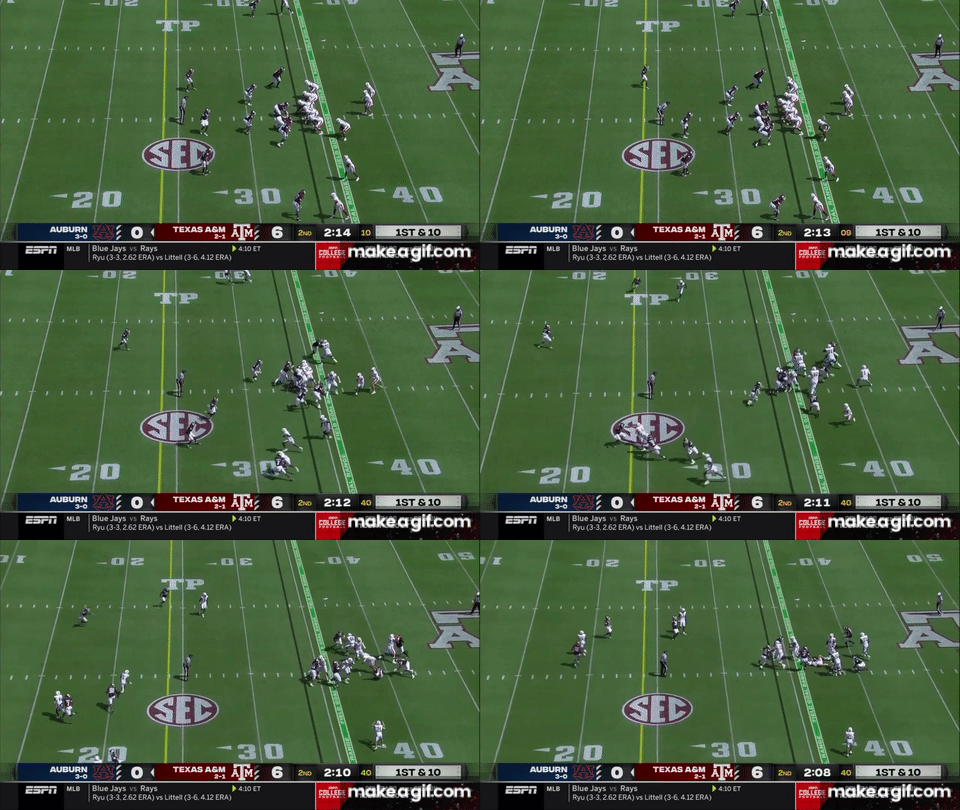
Auburn managed to get a bit of the sack yardage back on a second-down run to set up third and 8. Not ideal, but shorter than the average third down yardage for Auburn in this game if you can believe it. Auburn uses a bunch set for the first time in this game (one of the first times all season I think), with the idea being similar to the two-receiver stack: create confusion about coverage responsibility and create rubs against man coverage. This is a drive concept, which is a variation of the shallow cross concept we discussed earlier; in this case, though, the shallow crossing route and the dig route come from the same side of the formation. However, and stop me if you’ve heard this one before, Auburn fails to pick up a six-man blitz with six pass protectors.
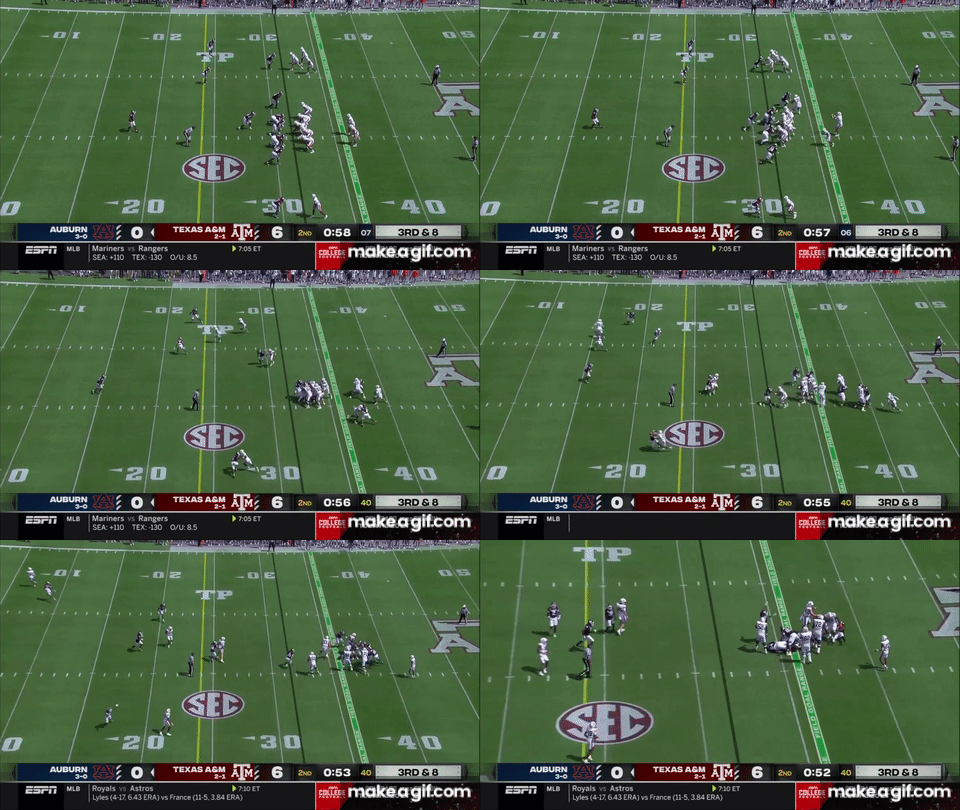
By this point, A&M has realized Auburn’s pass protection is a sieve and they were bringing the house on almost every passing down, knowing that Thorne wasn’t going to make quick enough decisions to punish them. Alex McPherson was nonetheless able to convert the field goal and prevent the Tigers’ offense putting up a bagel in the first half.

For those hoping to see some second-half adjustments, I’m afraid you’re out of luck (although I’m generally not a believer in the idea of second half adjustments and I doubt Auburn’s problems in this game were something you could adjust your way out of). On the first play of the second half, A&M picked right back up where they left off, bringing the heat with impunity and once again creating a negative play, as the backside rush is able to get to the RB from behind.
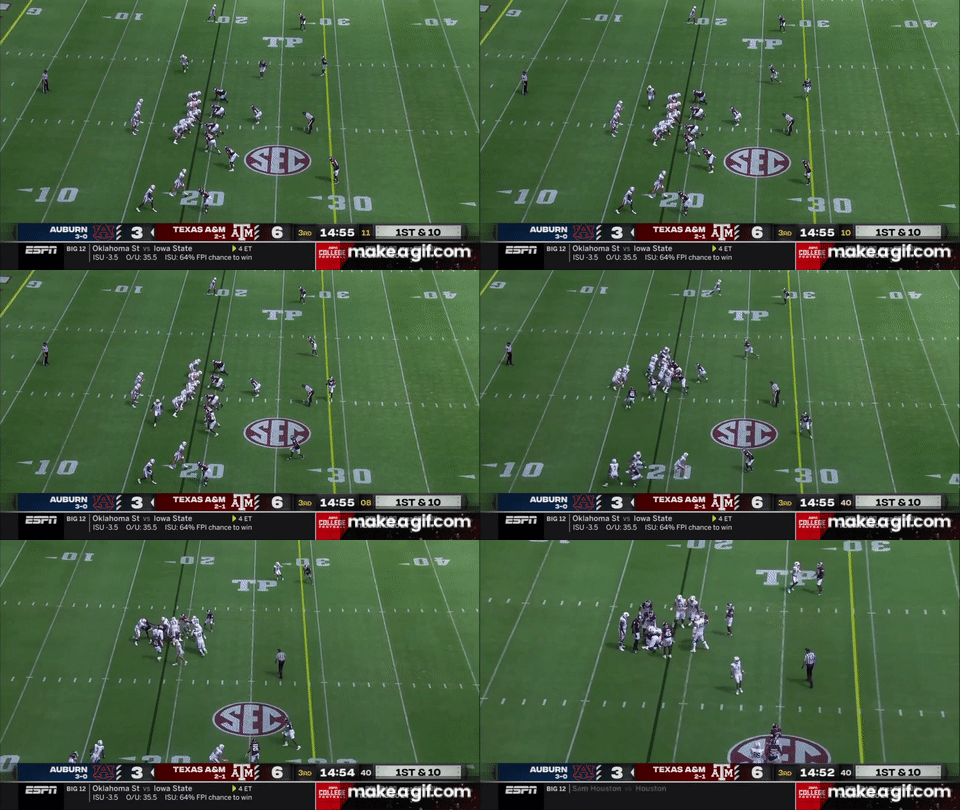
Following a sack and a false start, Auburn was once again in a third and very long situation, backed up against their own end zone. In this situation, A&M was content to drop eight defenders into coverage, figuring that it wasn’t necessary to apply pressure in that situation. They were completely right, as the nose bullies his way right through a double team, forcing Thorne to bail out and try to find his checkdown, which he was unable to do (probably for the best because he would have been tackled for a loss and gotten lit up in the process had he caught the ball). I know I’ve been critical of him, but I feel for Thorne here. It’s hard to play QB when your line can’t even pick up a three man-rush.
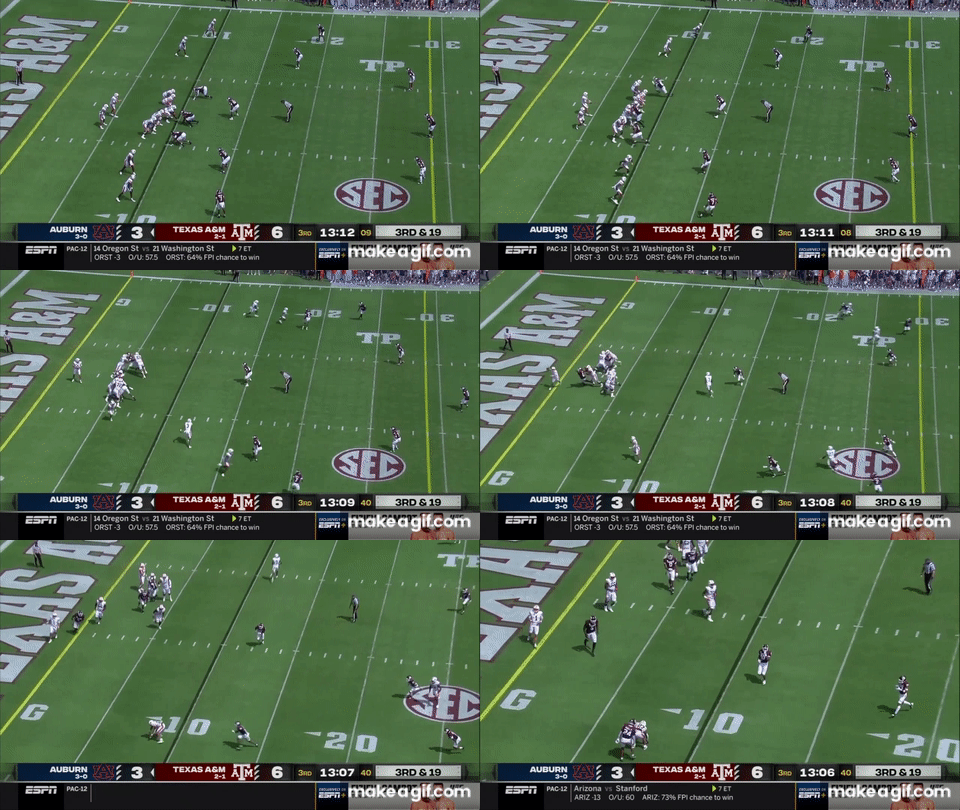
On the next series, now down 13-0, the coaching staff enters the “throw stuff at the wall and see if it sticks” phase of the contest, bringing Robby Ashford off the bench in place of Payton Thorne, presumably hoping his legs could provide enough of a spark to reignite a stagnant offense. Except…they didn’t really use his legs on this series? Very weird sequence here.
On first down, Auburn lines up with two backs and a tight end, which already raises questions since having that many players in the backfield is just inviting more defenders into the box, which makes no sense when you’re struggling to block even against light boxes. I don’t think this counter play even had a read component, which makes it even weirder. The RB doesn’t really give the blocks time to set up on the playside, and it’s stuffed for no gain. (Not sure why the video gets dark there, I assume it’s something like the part of the crucifixion story where the sky turns dark because God has to turn away from the sight of the embodiment of sin.)
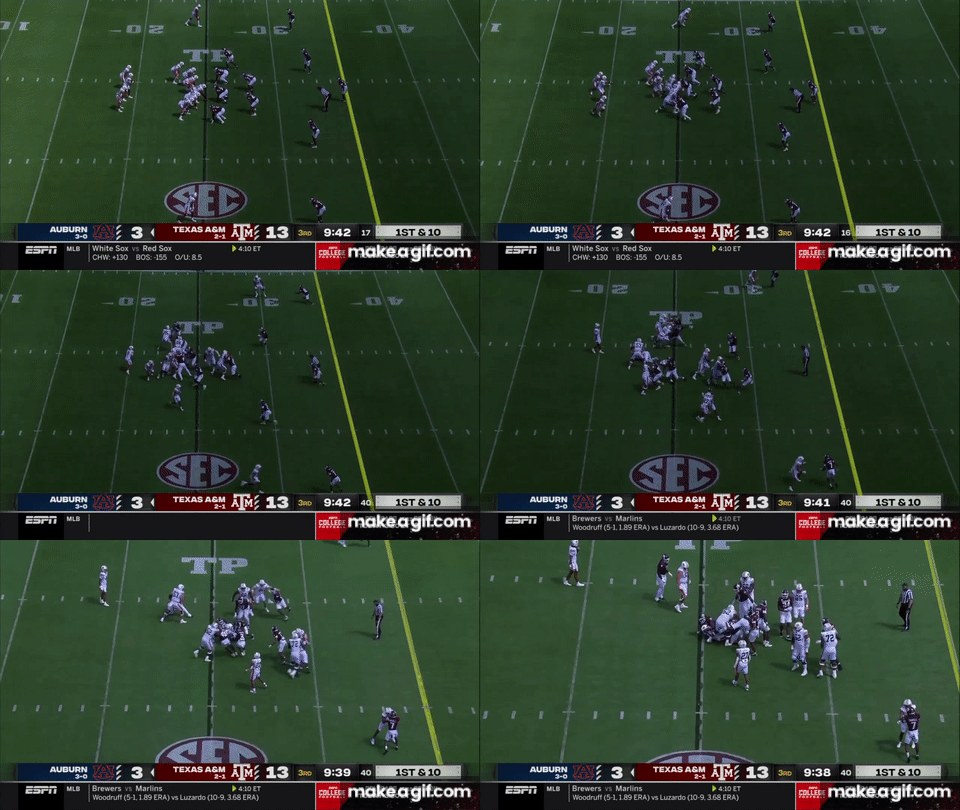
This was followed by an incompletion where Ashford overthrew a receiver who may have had a step on the defender on a deep post route by about 10 yards, followed by another false start and a play that would have been a coverage sack if it weren’t for Robby’s legs, and where it wouldn’t have mattered anyway since Auburn still managed to get called for a hold. Shaky QB play followed by a comedy of errors from the offensive line. The more things change, the more they stay the same. No need to sit through any more of it. Onward.
Auburn went three and out again on the next series, but got the ball back with four seconds left in the quarter. Here, for the first time all game, Auburn goes to a vertical choice concept. I can kind of understand why they hadn’t run it before, given that Auburn could barely protect long enough to throw short passes, but this again calls into question whether Auburn has the personnel to really make vertical choice a significant component of the offense. It should go without saying that even though the receiver managed to stack the corner, the ball was underthrown and incomplete. After a short run by Robby and a debacle of a play by Thorne that nearly ended as the most embarrassing fumble ever, Auburn punted the ball away yet again.
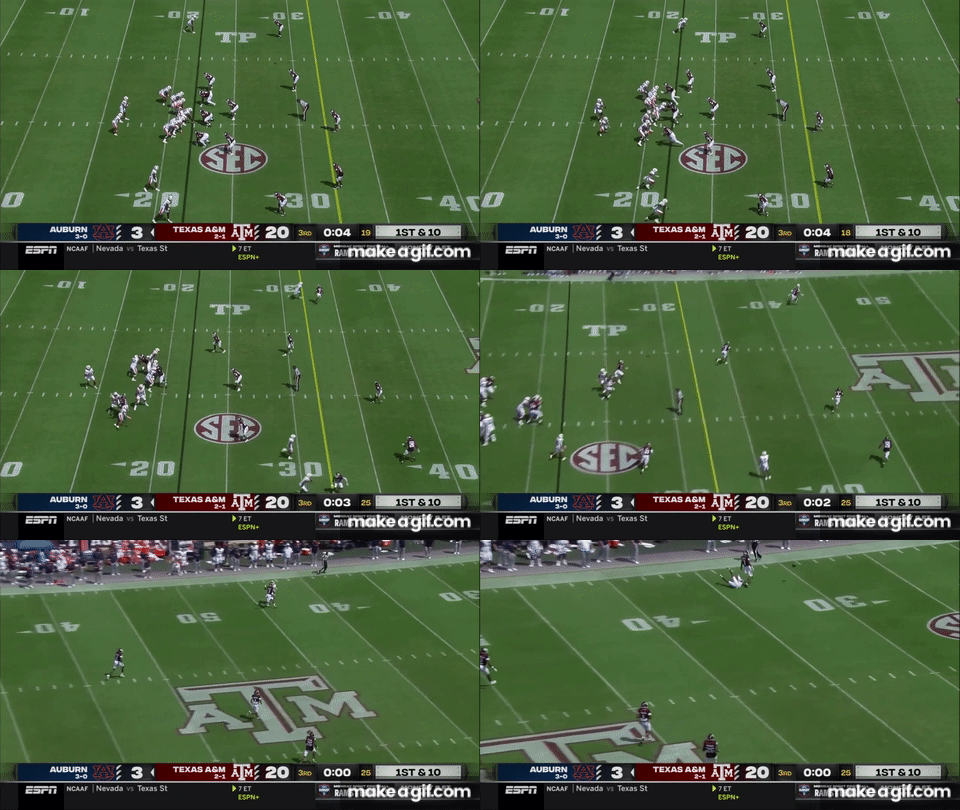
The next Aggie possession gave us the hilarious Asante scoop and score for Auburn’s only touchdown of the game, followed by a punt that left Auburn backed up on their own 10 yard line. On the ensuing series, Auburn was essentially at a make or break point in the game, where they had to score or the game would have been over. Thankfully, the Tigers finally decided to run plays that properly used Robby Ashford’s skill set. On the first play of the series, Auburn brings a receiver in motion to use him as an extra blocker on a zone read play. This is known as arc read, where the extra blocker pulls around the end to care of the run support player on the perimeter (i.e. arc blocks, named for the shape of his path) in case the QB pulls the ball; this was a staple of Gus Malzahn’s offense during the Nick Marshall era and it works well here too.
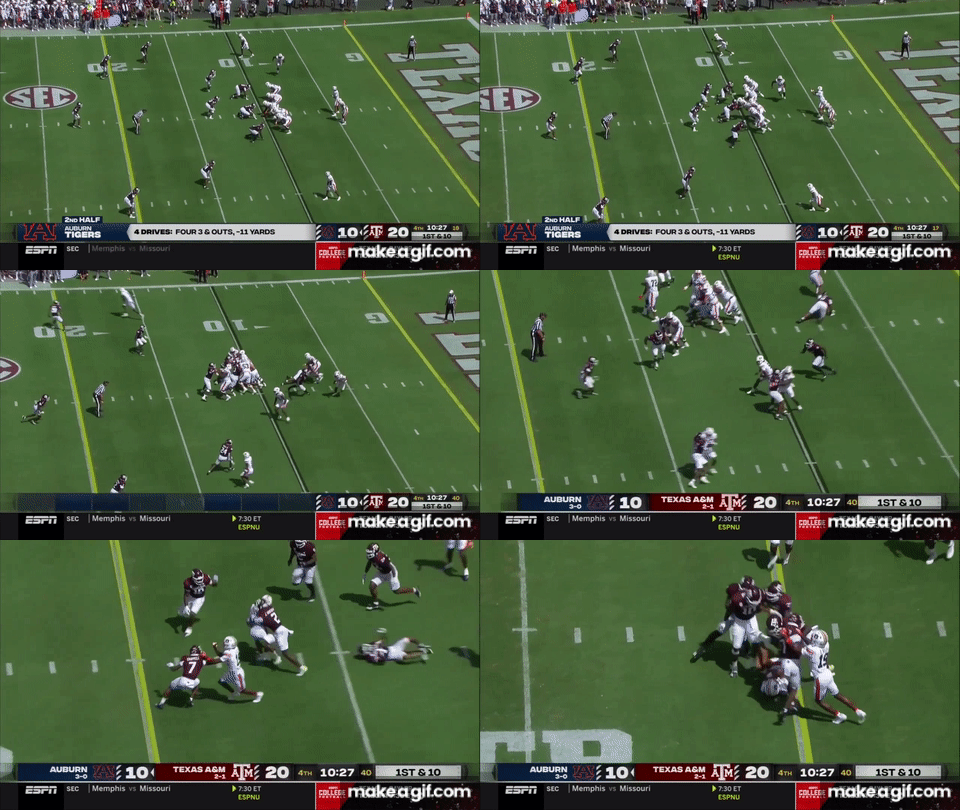
Two plays later, Auburn went to a concept I had been begging the TV for since Robby entered the game. This is what’s known as a bash concept (an abbreviation for “back away”). Many even-front (four-defensive-lineman) defenses will respond to shotgun sets by setting the strength of their defensive line to the side where the back is lined up, usually with a defensive tackle in a 3-technique (on the outside shoulder of the guard) and the defensive end in a 5-tech (on the outside shoulder of the tackle) or a 6-tech (directly over the tight end), since this tends to be a difficult look to run core plays like inside zone and power against. Bash concepts take advantage of that by having the RB show run action across the formation while the QB runs to the side where the defensive line set its strength (i.e. where the angles are favorable for gap runs like power and counter).
Here, you can see A&M has loaded up the left side of the line. Auburn runs its basic GT counter scheme, leaving the defensive end to the wide side of the field unblocked; Robby will either hand it to the RB on the sweep to the right or pull it and run the counter based on what he does. In this case, he crashes down (as defensive ends are usually coached to do in response to the tackle pulling away), opening up space for the sweep and Auburn’s longest run of the game (that probably should’ve had another 15 tacked on but whatever).
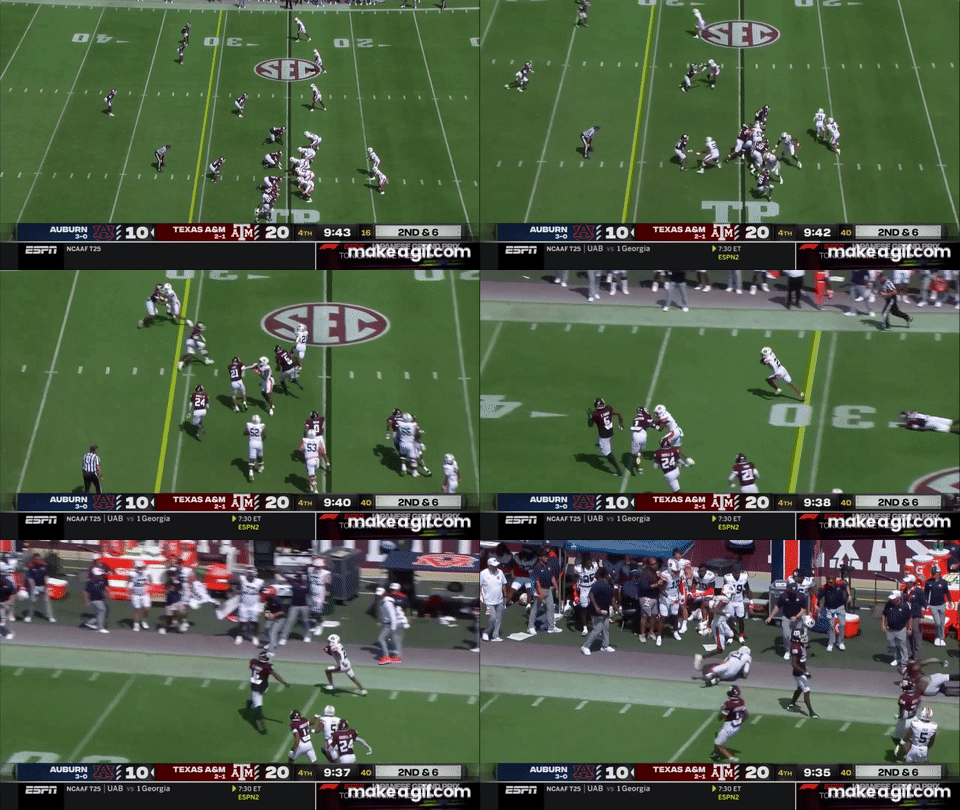
After that big gain, Auburn does something else that I’d been clamoring for: exploiting the defense’s disorganization by pushing the tempo after an explosive play. This is a pretty basic idea in any hurry up offense, but Auburn scarcely did it at all in this game, often stopping to substitute instead (a common source of frustration during the late-stage Gus era as well). Here Auburn goes back to the first play of the series, running an arc read off of WR motion and it’s another successful first down run (and may have gone for six if not for a shoestring tackle). One thing I don’t like is how Robby just stands there after handing off; he should continue his fake past the line of scrimmage to try and hold the second- and third-level defenders as long as possible. Not a huge thing but one of those little details that coaches and players on good teams pay attention to.
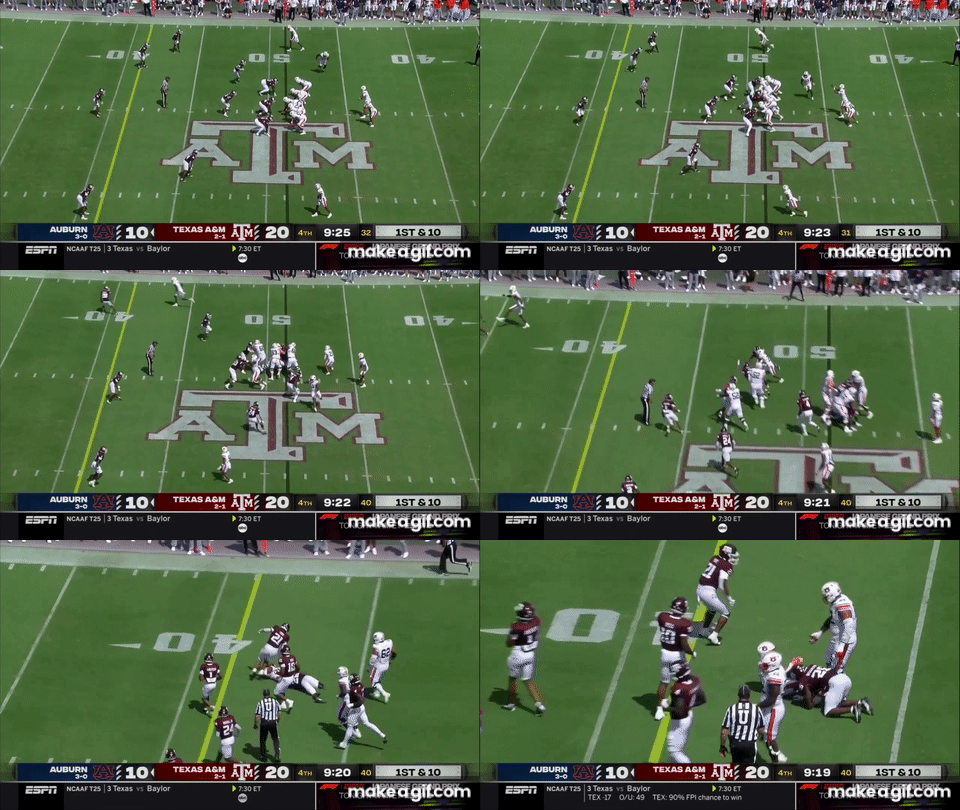
On the next play, the coaching staff keeps the good times rolling, doing yet another good thing. This is really RPO football 101: you use the pass component to punish a defender for playing aggressively to stop one of your base runs by throwing the ball where he came from. Auburn shows outside zone action with an arrow route to the backside; A&M brings a blitz from the field and Robby correctly dishes the ball out to the arrow for a first down. Not exactly great mechanics on the throw but as I often say on the golf course, it’s not how, it’s how many.
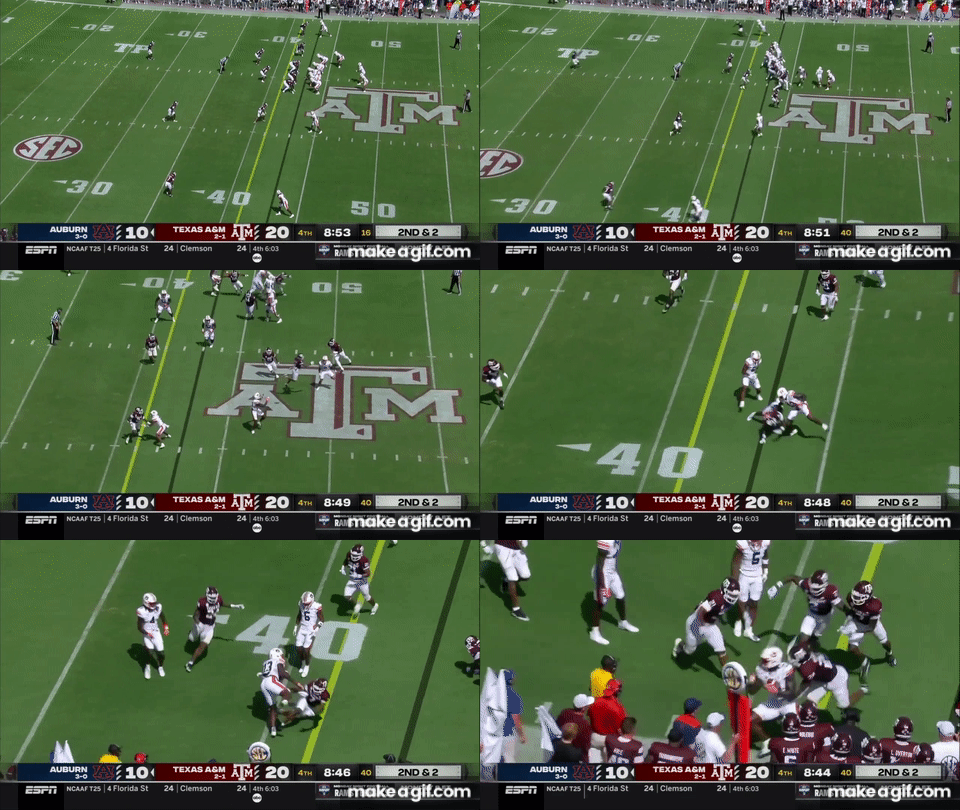
However, for whatever reason, the coaching staff decides to go to the air on the ensuing first down. Yes, I know that the analytics say that passing on first down is almost always optimal, but we were running the ball well at tempo, and the pass they called makes no sense. This looks like a screen-and-go route, which is designed to punish the defense for crashing down aggressively on the ubiquitous quick WR screens that most teams use in their RPO game. But up to this point, I think Auburn had only thrown one receiver screen and it went for a good gain, so there’s no reason to try to run a play that exploits the defense doing something that it wasn’t really doing (i.e. jumping the screen). Robby makes something out of nothing and gets five yards on the scramble, but it was still a weird call.
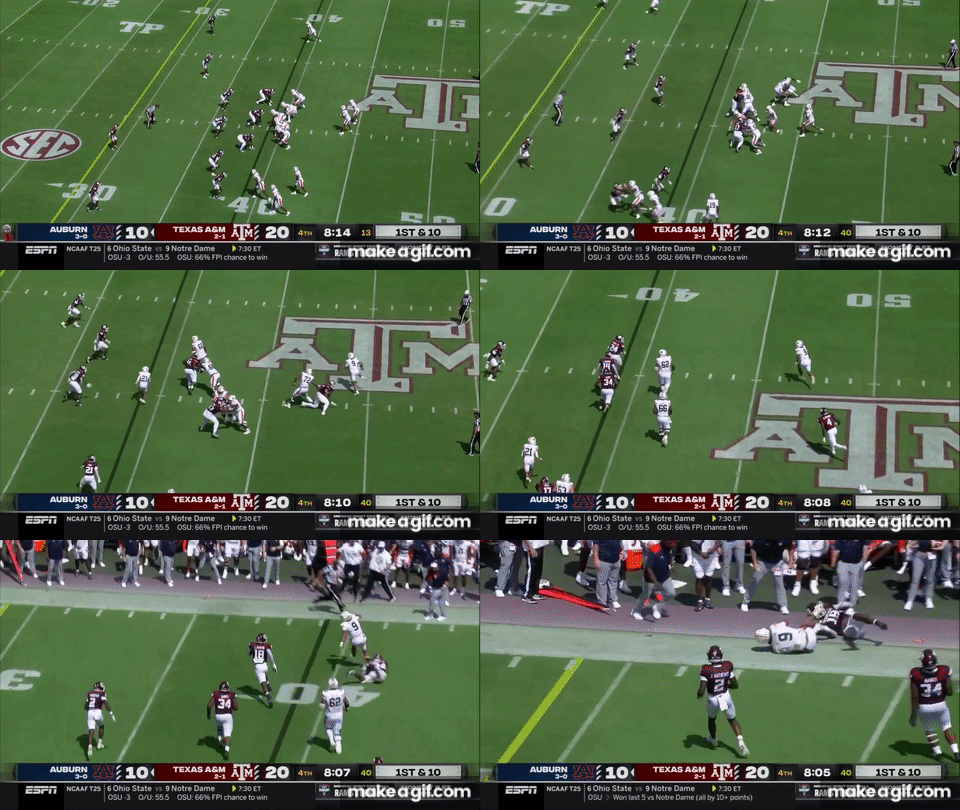
After a successful second down run, Auburn had a first down at the Aggie 28, the farthest Auburn had advanced into Aggie territory all day (with less than seven minutes in the game, yikes). I think this is another vertical choice concept, again a single choice. The receiver looks like he has outside leverage on the defender, but Robby throws it to the inside. Not sure if it’s a bad read or a bad throw, but he’s probably lucky it wasn’t picked off. The receiver nearly manages to manufacture a miraculous catch and make something out of nothing, but it falls incomplete.
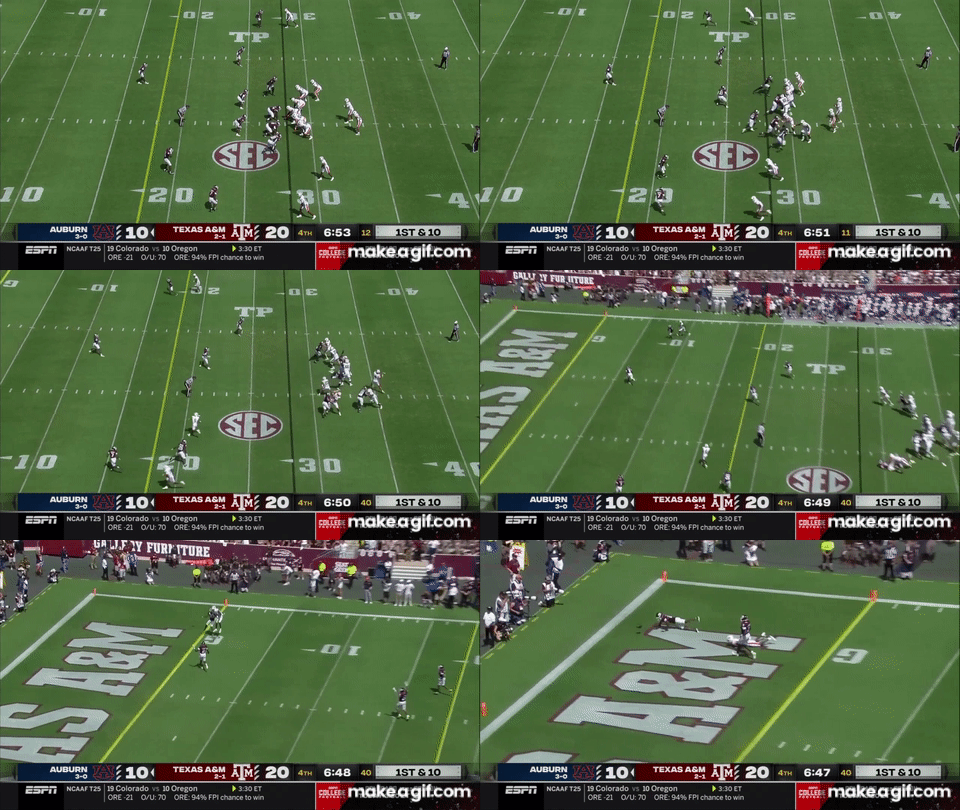
Following a run that was blown up by a heavy blitz and a holding penalty, Auburn was backed way up into third and 25 at the Aggie 43. A decent gain here would give Auburn a shot at a field goal to cut it to a one-score game with more than enough time to get the ball back and score again. I assume this was the coaching staff’s rationale, but the playcall here is just bad. The Tigers bring the X receiver in motion behind the QB to pull the defense to the right so they can throw a slip screen to the RB to the left (with a bit of a statue-of-liberty action, which I assume was Brother Hugh’s way of pouring one out for his departed homie Gus). This play hasn’t worked at any point this season (or any other season), and it doesn’t work here either. Quelle surprise.
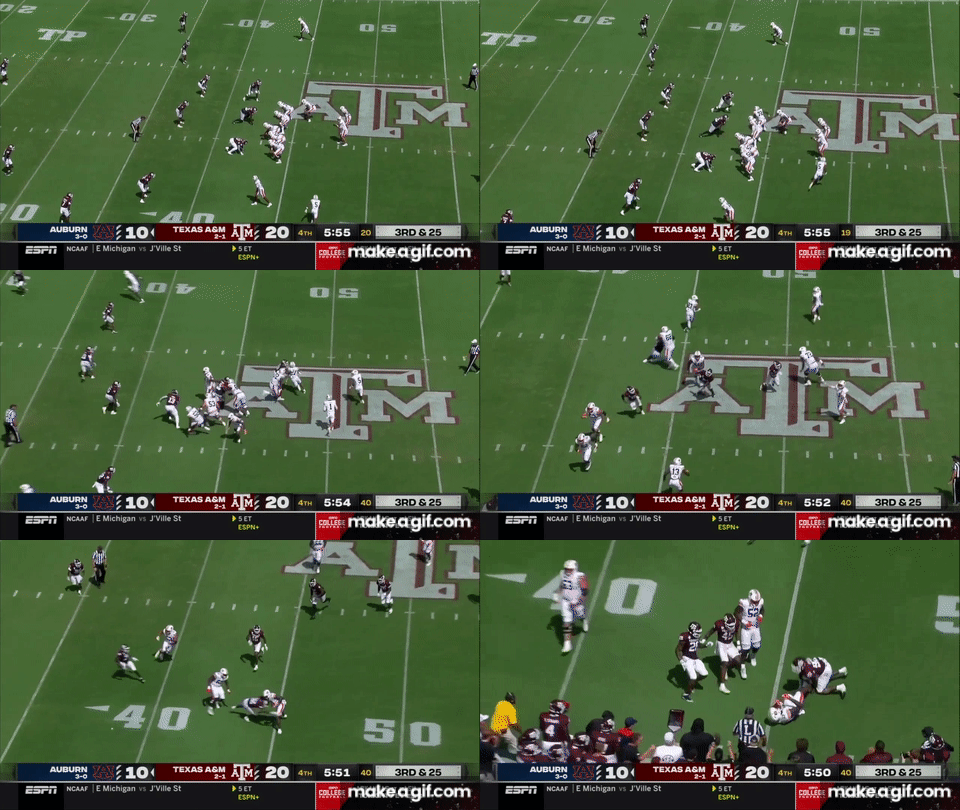
This really felt like a give-up call rather than one that was trying to set up a field goal attempt. Even more baffling, however, is the decision that followed it: Freeze elected to punt the ball back to Texas A&M. Yes, it would be a long shot to convert that fourth down, but you’re probably not getting much more than 20 yards of field position here, which is meaningless when you’re down two scores with just over five minutes left in the game. The folly of this decision was exposed on the second play of the next drive, as the Aggies busted an 80-yard run against an exhausted Auburn defense that finally reached a breaking point after a valiant effort at keeping Auburn in this game to the very end. The Aggies scored a touchdown to make it a 17-point game with four minutes to go and sent Auburn packing with their first loss of the season.
From an offensive perspective, there’s no amount of lipstick that’s gonna pretty up this pig. This was one of the worst offensive performances in the recent history of Auburn football. The Tigers never reached the Aggies’ red zone, much less threatened the end zone. There were a myriad of problems: the offensive line was very poor in pass protection (although surprisingly good in run blocking), giving Payton Thorne very few real opportunities to make plays down the field. When those few opportunities did arise, Thorne overthrew open receivers. The playcalling didn’t do him any real favors either, with a number of inefficient run-run-pass and run-pass-pass sequences; once Robby entered the game, it took the coaches a couple of possessions to reorient the offense to his skill set, which made no sense and allowed Texas A&M to build a three-score lead before they got things figured out. The vacillation in schematic ideas really looked like an offense that was experiencing an identity crisis, with no discernible logic to the playcalling or use of personnel.
So where does Auburn go from here? I don’t think there’s much cause for optimism over the next couple of games, as the Tigers are likely to take two beatings at the hands of Georgia and LSU before a home date with the coach who might be regretting his offseason decisions right now. That game feels like the make or break point, as Auburn has two more winnable games after that, hosting Mississippi State and then traveling to Vanderbilt. Each of the last six games on the schedule looks winnable if Auburn can get its act in gear on offense, but it’s hard to see how that’s going to happen right now. The offense looks every bit like the MacGyvered unit that it is, none of the QBs looks especially confident or competent, nobody has stepped up to become a go-to guy in the receiving corps, and the RBs haven’t been able to pick up the slack because defenses don’t fear Auburn’s passing game at all.
I don’t know if there’s really a schematic quick fix to this. It feels like something of a vicious circle: Auburn (ostensibly) wants to build the offense around vertical choice concepts and RPOs, but both of those struggle against man coverage if your receivers can’t win one-on-ones consistently. With the defenses playing man coverage, they can get +1 in the box to stop the run game and there’s no pass option available to equalize the numbers (as we discussed after the Cal game). The easiest way around that would be to run man-beating pass concepts, but our offensive line struggled to protect even a three-step drop and teams aren’t afraid to bring the heat because they know it’ll get home. Bringing Robby in to run some read option helped alleviate the +1 in the box issue and seemed to be a solution until A&M realized there was little threat of the pass with him in the game and sent 6 and even 7 on blitzes to blow up those runs in the backfield. Every possible solution to our problems is short-circuited by a shortcoming somewhere else.
Whatever optimism the first three games had engendered is gone and we’ve been brought down to earth. There’s not going to be a preposterous 2013-type run here. This really is a year zero, and the real way forward is probably going to come down to improving the roster over the long term and doing whatever we can to keep our heads above water in the meantime. My own thoughts have gone from wondering if we could muster a bit of Jordan-Hare voodoo against Georgia this week to wondering what will be higher: the number of points we give up or the number of passing yards we manage. I’m…not optimistic it’ll be the latter. Eat at AUrby’s.
-
Auburn @ Cal Film Review
Auburn defeated the Cal Golden Bears 14-10 on Saturday night/Sunday morning, because the rules of football state that one team has to win the game even if neither team deserves to. Congratulations to those of y’all who were smart enough not to stay up until 2 a.m. watching that. Before you go any further, you should acquire one of those lead bodysuits the Chernobyl liquidators wore, because otherwise you’ll receive a lethal dose of radiation from this film. It’s already too late for the rest of us.
OFFENSE
After a pretty encouraging performance (with some caveats) against UMass, the flaws in Auburn’s offense were on full display against Cal. The Tigers’ offensive output was a pitiful 230 yards on just 55 snaps, with 5.5 yards per attempt in the passing game and fewer than four yards per carry on the ground. It’s hard to single out any one aspect of Auburn’s performance that was particularly bad when almost none of it was good, but I think I have an idea of what the core problems are with Auburn’s offense at the moment, and I’ll try to elaborate on those more as we go through these clips.
One of the biggest issues for Auburn over the last two years was the total lack of any sort of identity on offense. The hires of Hugh Freeze and Philip Montgomery brought in two coaches with defined offensive styles, and there was some question as to whether those styles could come together to create a cohesive identity. In the UMass game, we saw some of Montgomery’s fingerprints on the offense with the use of vertical choice concepts, but those concepts were almost absent from the Cal game. This wasn’t necessarily an identity crisis for Auburn’s offense, but it did hearken back to some of the questions I raised in my season preview article as to whether Auburn had the personnel at WR and OL to run those concepts effectively.
Cal’s defense is exactly the type of defense that can frustrate an offense that wants to build its identity around vertical choice concepts and RPOs. Justin Wilcox has never been afraid to play man coverage and dare the opposition to beat his secondary one-on-one, even against much more talented teams. If your receivers can’t win one-on-ones, it’s very hard to run vertical choice, because those concepts are premised on beating the opposing DB deep.
Man coverage also poses a problem for RPOs, because RPOs depend on attacking defensive players who are in conflict between run and pass responsibilities; if the defense is playing straight man coverage across the board, then nobody is in conflict because they’re either playing run or pass, so there’s nobody to key for an RPO read.
Cal was generally playing man free coverage, also known as Cover 1, where the defensive backs are all in man coverage, aside from the free safety, who plays deep zone coverage to provide help over the top. By using only one deep safety, the defense allows itself to put an extra defender into the box to stop the run. Thus, for much of the night, Auburn was faced with the prospect of a defense that was +1 in the box and had all of the receivers locked down in man coverage.
So, what do? In this situation, there are a few possible solutions. The first is to just beat them in man coverage, but as we’ll see, Auburn’s receivers struggled to do that. The second is to run pass concepts that are designed to attack man coverage, which we’ll discuss later. Finally, you can involve the QB more in the run game, which will equalize the numbers in the box and allow you to run the ball again.
The conundrum caused by facing a loaded box and man coverage really exposed Auburn’s lack of a clear go-to player on offense. This extended both to the receiving corps (where, thankfully, Rivaldo Fairweather finally stepped up) and the QB position, where Freeze and Montgomery spent much of the second and third quarters re-enacting the 2016 Clemson game, trying to figure out whether either of Auburn’s QBs could make something happen and largely failing.
However, with that criticism of the coaching staff established, I do want to add that a lot of Auburn’s problems on offense were self-inflicted wounds. Four turnovers, three sacks, and seven penalties will sink you, no matter how good your gameplan is. If the Tigers hadn’t shot themselves in the foot several times, they could have made the score much more comfortable (although the same could be said for Cal’s kicker doing his best Cade Foster impression).
Okay, enough rambling, let’s get to the film and see how these problems played out and how Auburn managed to do just enough to survive. The comically bad conclusion to Auburn’s first drive illustrates a lot of what I was talking about above. Auburn lines up in a 3×2 empty formation and Cal sets up to play man free (which is easy to see as they align a defender over every receiver and a single safety deep). Cal only rushes three here, dropping the other two box defenders to spy Payton Thorne or disrupt short routes. I can’t really tell what Auburn is running here concept-wise, but it’s some kind of vertical/curl thing. Thorne has time, but nobody gets open and he’s eventually flushed out of the pocket. He doesn’t switch the ball to his outside arm, and he’s very lucky this play was blown dead because it should have been a touchdown for Cal. Yikes.
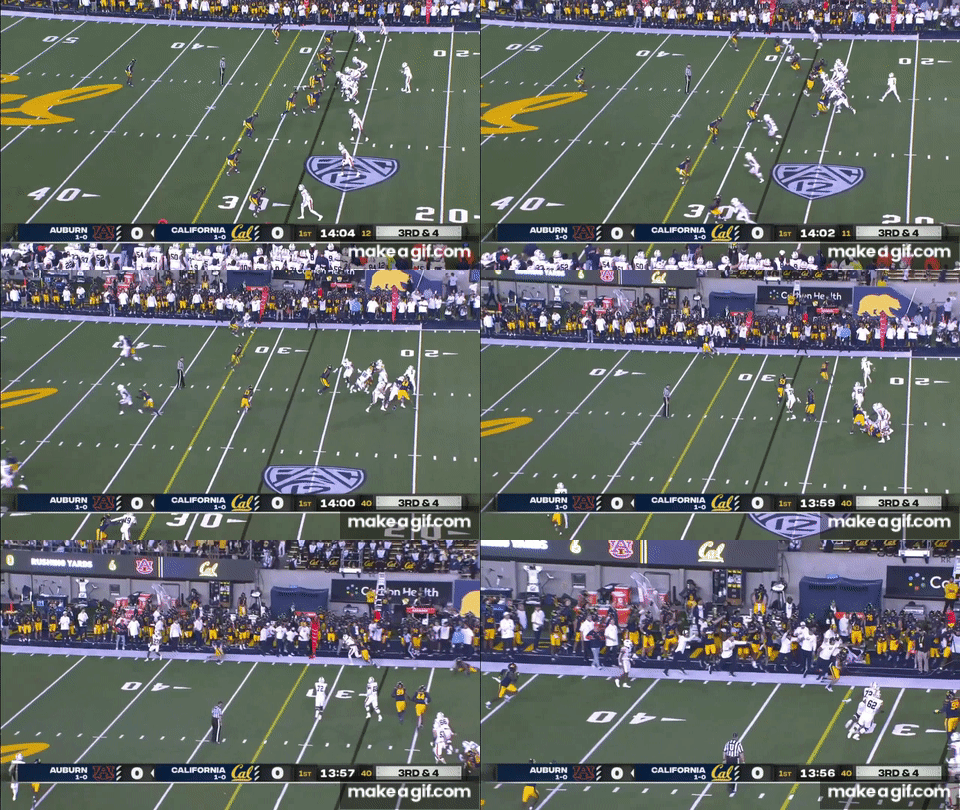
After the first of many heroic efforts by Auburn’s defense to limit Cal to just a field goal, the offense immediately provided another lowlight. Facing a third and 6 from their own 9, Auburn lines up in a 2×2 set and runs what looks like some type of sail route after motioning the Z receiver into a stack alignment. Again, Cal is in man free here, and again, nobody is able to get any separation for Auburn, leading to another coverage sack (that was nearly a safety). Sensing a pattern yet?
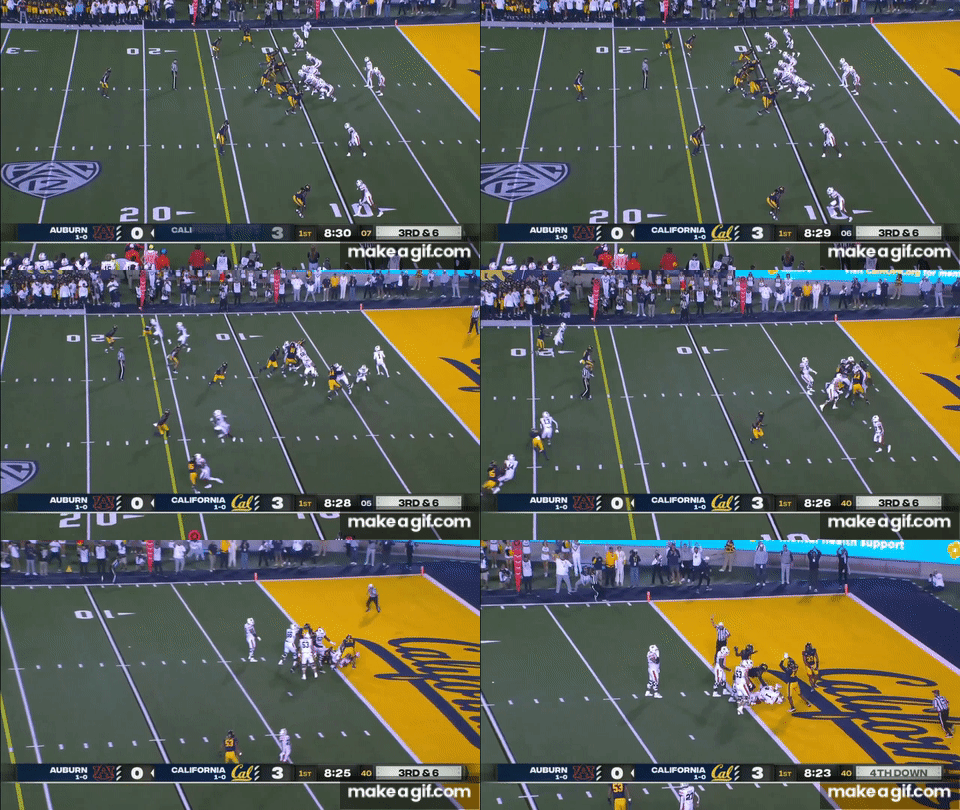
Following another excellent defensive stand and the first of many missed field goals by Cal, Auburn’s offense briefly showed a bit of a pulse on its next possession. On second and 5 from their own 30, Auburn uses one of the options I mentioned above to counteract a defense that’s determined to play man and keep +1 in the box: getting the QB involved in the run game. Obviously Payton Thorne isn’t Robby Ashford, but he’s fast enough to do what you need him to in this situation: pull the ball and get five yards if the defense gives it to you. This is a basic zone read with the TE arc blocking the run support player on the perimeter; the DE pinches, so Thorne pulls it and gets an easy first down. (Note, however, that Cal actually wasn’t in man here; this looks like some type of Cover 3 match.)
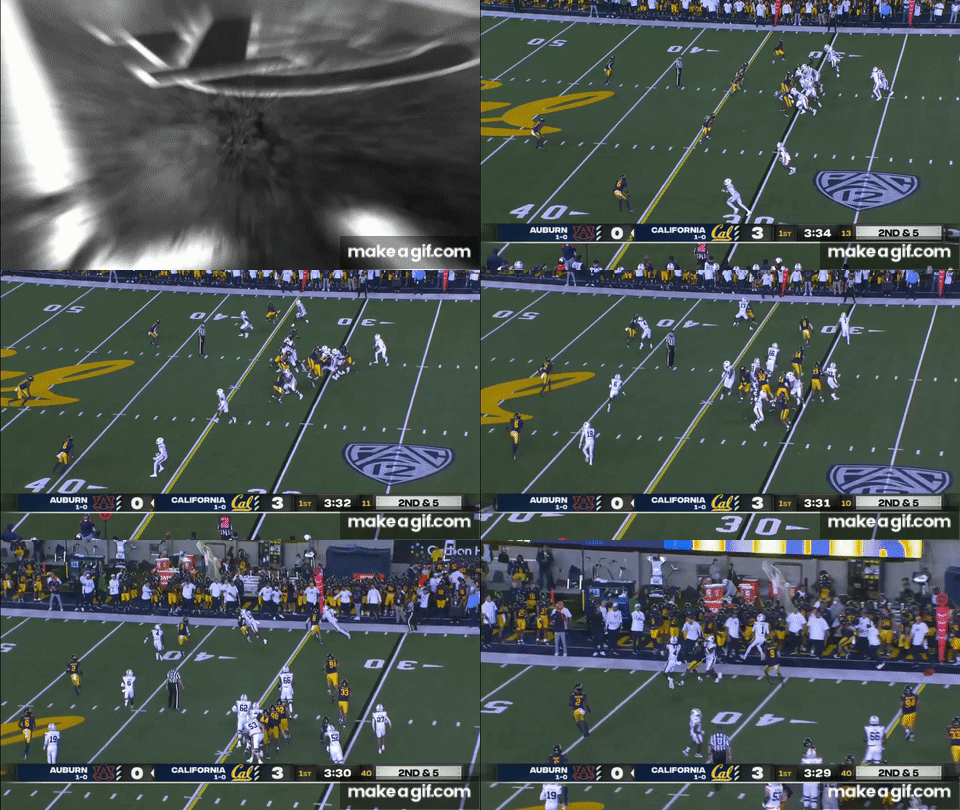
But after that, it’s right back to the same old problems. On third and 8, Auburn goes to the vertical choice concept for the first time this game, in this case running outside choice to the #1 receiver on the right. Cal shows press man, but the corner bails hard at the snap and the receiver can’t win deep. Thorne tries to look elsewhere with the ball, but since the backside receivers on vertical choice are told to do nothing, there’s nowhere for him to go, and he just has to throw it away, leading to another punt.
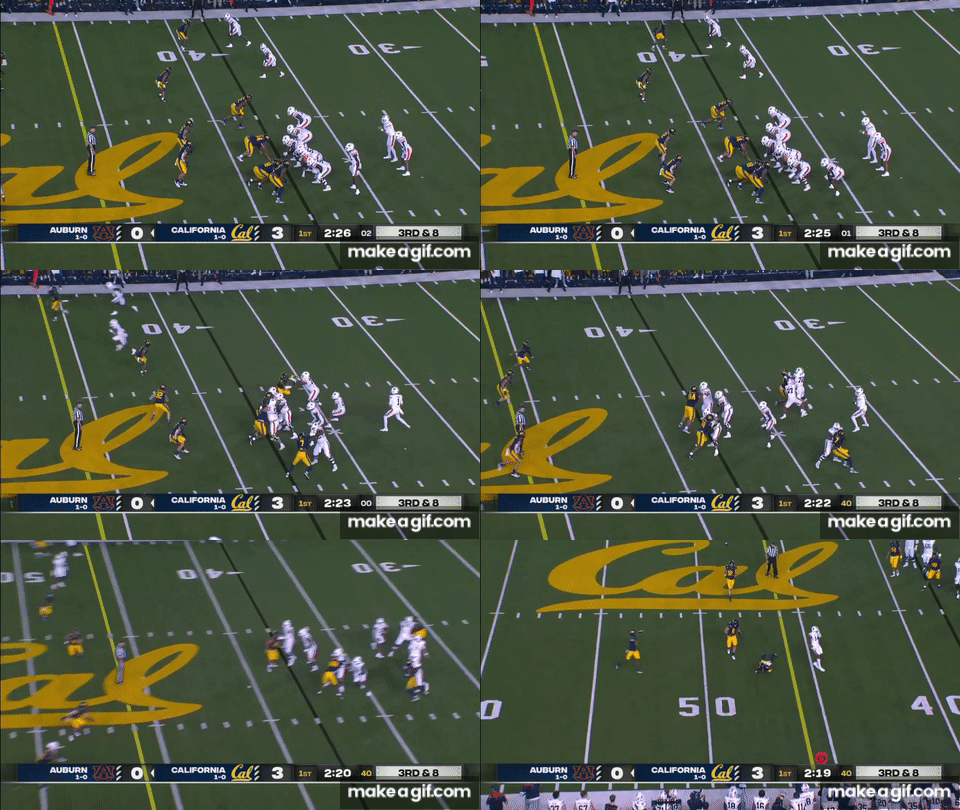
After an exchange of punts, the subsequent Auburn possession brought a rare bright spot: a successful RPO. Auburn lines up in a tight bunch set with three receivers and the RB to the left. This is an outside zone run combined with a bubble screen; it’s a weird-looking design, but it makes sense, because the outside zone scheme allows Auburn’s OL to get leverage on the pinched-in defensive line and the bunched receivers have good angles to seal the other defenders inside, opening up some space for Ja’Varrius Johnson to work on the screen and pick up the first down.
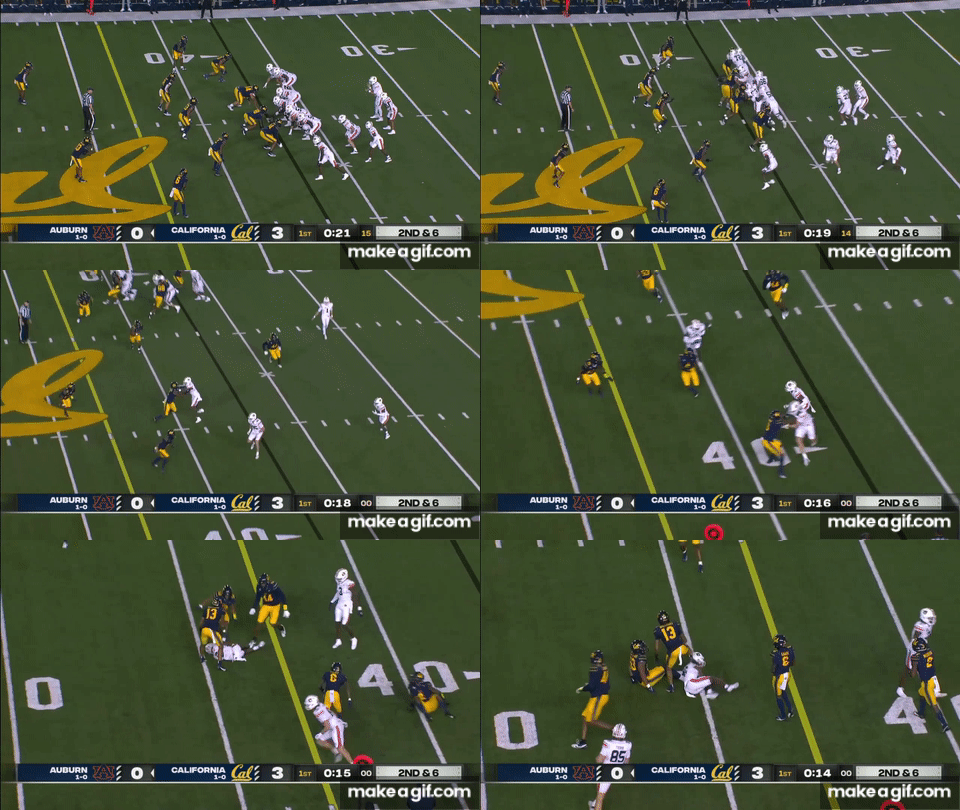
At the start of the second quarter, Robby Ashford made his first appearance, because the offense was getting into too much of a rhythm and we had to put a stop to that. While Robby was effective in the red zone last week, bringing him in like this is too predictable, because the defense knows the QB run is coming. This lands Auburn behind the chains and on third and long, the coaches don’t seem to trust Robby to throw downfield, so Auburn sets up a screen, which is ineffective due to Cal’s man coverage (and some poor blocking by the OL), forcing yet another punt.

Basically the sole bright spot for the Auburn offense in the first three and a half quarters came on the next possession, after Auburn’s defense forced a fumble and recovered it inside the Cal red zone. This is one of the few times Auburn really went to a true man-beater, which is funny because Cal was actually in zone on this snap (some type of quarters it looks like). This is the mesh concept, made (in)famous by the late Dread Pirate.
/cdn.vox-cdn.com/uploads/chorus_asset/file/18939283/mesh.jpg)
The premise is simple: two receivers run crossing routes from opposite directions, hoping to rub off each other’s defenders. If the mesh is tight enough (Leach taught them to slap hands on the way by in practice to make sure they were close enough to one another) it should be impossible for the defenders to stay with the receivers without re-routing, which makes it the ultimate man-beater concept. You can see in this clip that Rivaldo Fairweather is basically just setting a pick on the defender covering Fair (although again, Cal is in zone here and that shouldn’t have mattered).
Auburn combines this with a post-wheel concept on the front side of the play, something Leach also liked to do; Mississippi State scored three touchdowns on Auburn in the second half of the 2021 debacle on this exact play. I’m not really sure what Thorne’s progression was here, but I find it hard to believe he was supposed to read the mesh before the RB on the wheel route, which would have been an easy touchdown; the corner in quarters chased the post even though the safety had it covered and there was nobody to pick up the wheel; Kaylin Moore (#4) kind of tracks the wheel but then sees Fair running into his zone and tries to get back to cover that too, but he ends up not covering either of them and both of them end up wide open. Really strange defensive playcall and uncharacteristically poor execution as well by Cal.
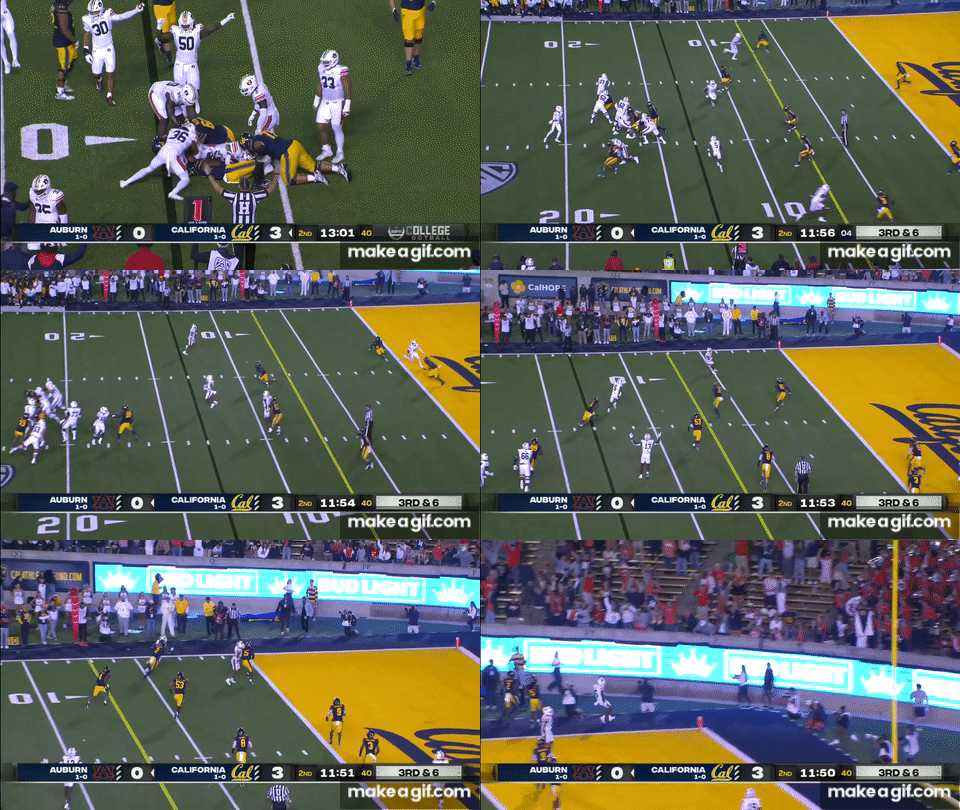
After forcing another Cal punt, Auburn continued to roll with the old Mike Leach staples, in this case the Y Stick concept.
This is actually a very common concept that isn’t unique to the air raid; most teams run it in some form or another. Like mesh, it’s a triangle read, with the #1 receiver running a deep route, the #2 receiver running a 5-yard option route, and the RB releasing to the flat, creating a triangle of receivers on the playside. The QB will peek at the deep route, then throw either the stick or the flat based on what the outside LB does; option football through the air. This is really more of a zone-beater concept, but that’s rendered moot here as the Cal LB on that side blitzes, leaving Damari Alston wide open, as the inside LB has no hope of catching him. Thorne recognizes his hot read and gets the ball out on time for an easy first down.
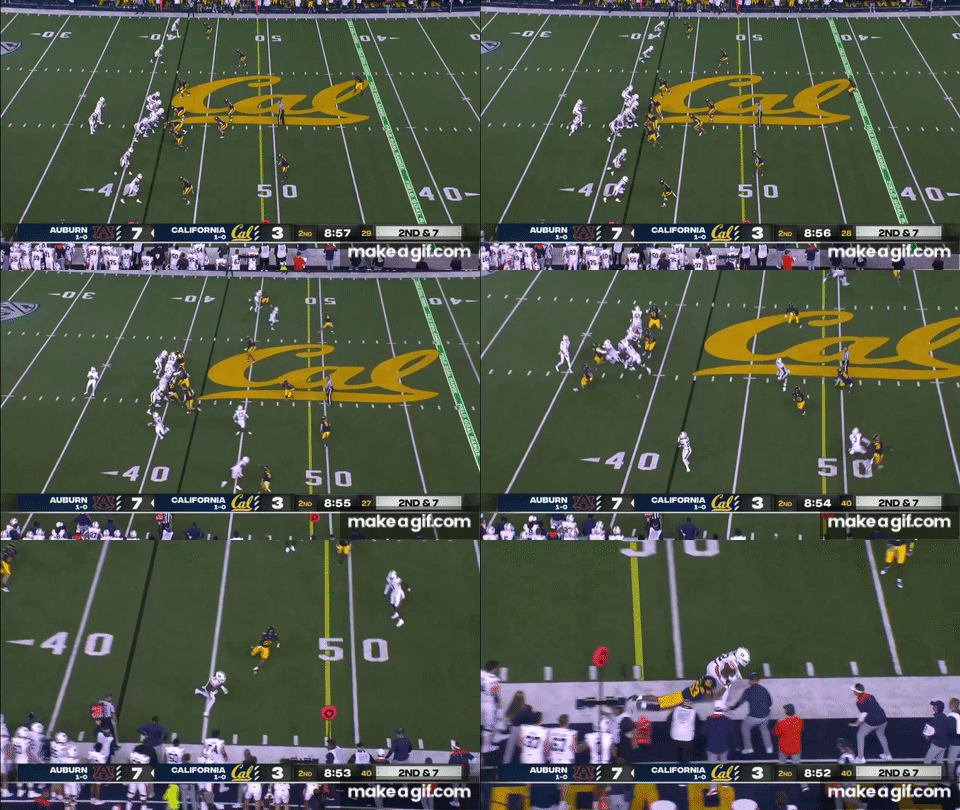
Two plays later, we see a bit of adaptation from the coaching staff to try to get the RPO game rolling. Auburn is again in a 2×2 set, and they’re going to run an outside zone into the boundary tagged with a stick route by the backside receiver. However, they bring Rivaldo Fairweather in motion from the slot to kick the backside DE, creating a split zone look; this has the added benefit of triggering a rotation from the Cal safeties, so the playside safety, who would have been in good position to make the tackle, actually runs himself out of the play and isn’t able to make the stop until Alston has a first down…and then he fumbles the ball. This is why I said earlier that the Tigers’ struggles on offense weren’t solely on the coaches. This was a good design and playcall, from a coaching perspective you won this play…and then you just drop the ball. C’mon, man.
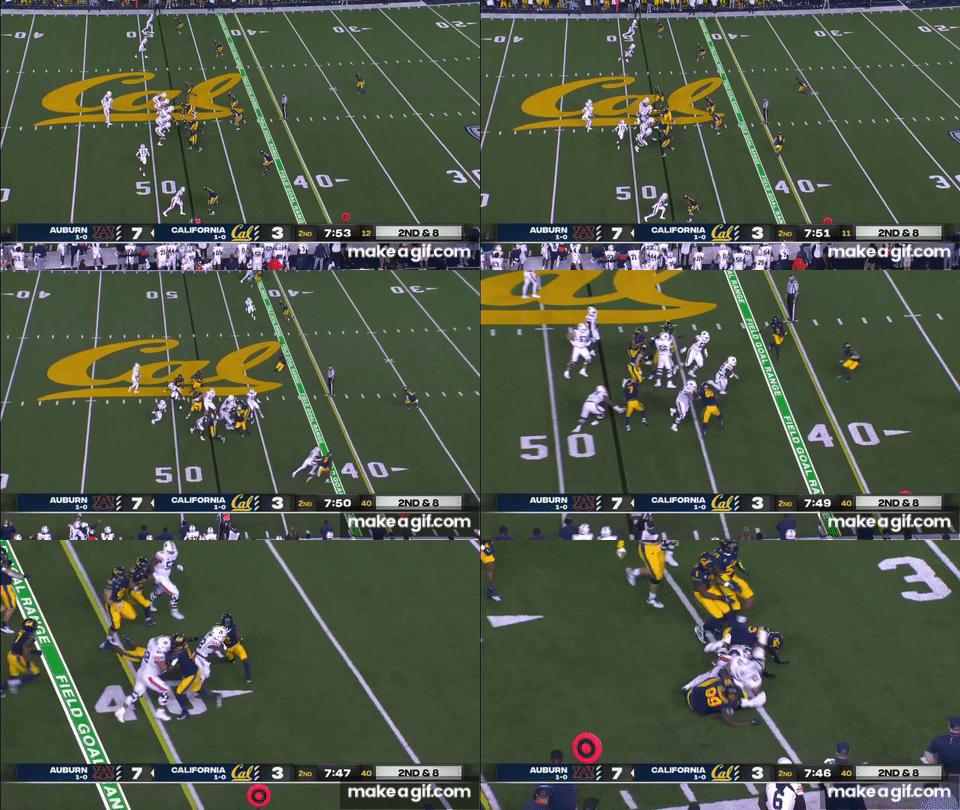
After another interminable review, Cal was awarded the ball, and finally decided to cash in one of Auburn’s gifts, scoring their only touchdown of the game. On the ensuing possession, Auburn faces a manageable third and 2, but this play really encapsulates the issues the Tigers had in the RPO game for most of the night. This is a split zone run (inside zone with the TE kicking out the backside DE to open up the cutback lane), tagged with a stick route on the backside. The single receiver on the playside is running a fade/stop, which was apparently Thorne’s pre-snap read. I guess he liked the leverage of running the fade against press man, but I can’t imagine the coaches were happy with that decision, especially given what an awful throw it was. That said, both of the other phases of the RPO were busted as well; Cal’s man coverage negated the stick and the extra defender in the box would have blown up the run if he’d handed it off. It’s generally not great when the defense is able to take away all three phases of the RPO with no tradeoffs!
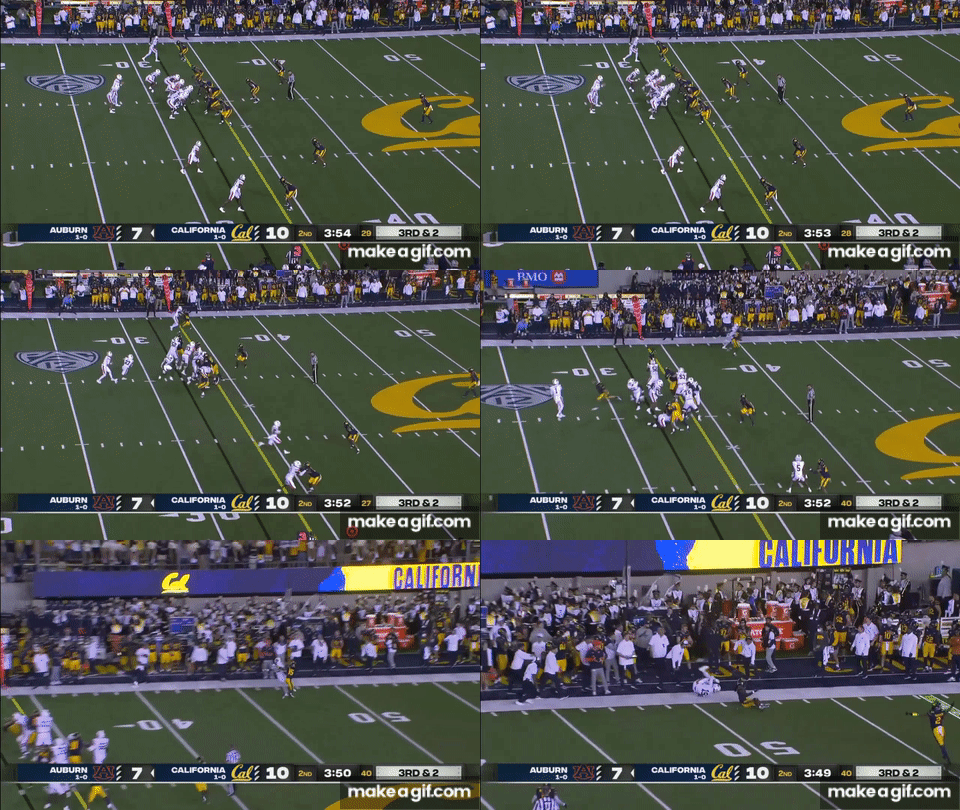
After another exchange of punts, Auburn got the ball back with about a minute and a half left and all of their timeouts, and the coaching staff for whatever reason decided to try to get points before the half when their offense hadn’t done anything for two quarters. The game management was suboptimal, but the failure of this drive is entirely on Thorne. On first and 15 after another dumb penalty, Auburn runs a curl-flat concept from a 3×1 set, anticipating (correctly) that Cal would be in some type of Cover 3. The idea behind this concept, which is as old as the modern passing game, is that you have five receivers underneath and only four zone defenders, so someone should always be open, and indeed, the curl is open to the wide side of the field. Thorne sees the open receiver and…airmails it straight into the arms of the defender. There’s not much to analyze here, this just an awful throw by Thorne. Auburn was once again lucky not be punished for a brutal mistake thanks to Cal’s special teams woes, in this case a penalty wiping out an actual made field goal, and went into the half down three.
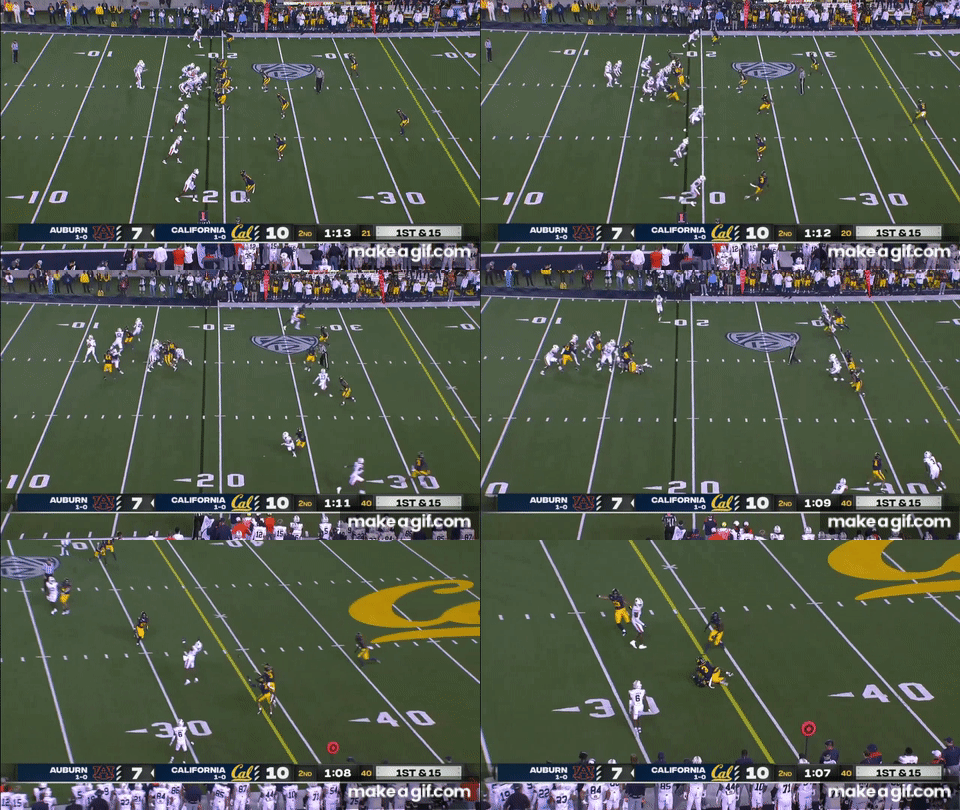
After Cal burned off about half the third quarter on a drive that ended with a turnover on downs, we got a Jarquez Hunter sighting. Hunter was underwhelming in this game and looked pretty rusty, but he gets some good blocking here and is able to pick up a first down. This is a weird counter variation, run with the center and tackle instead of the more common guard-tackle counter. We’ll revisit this concept later.
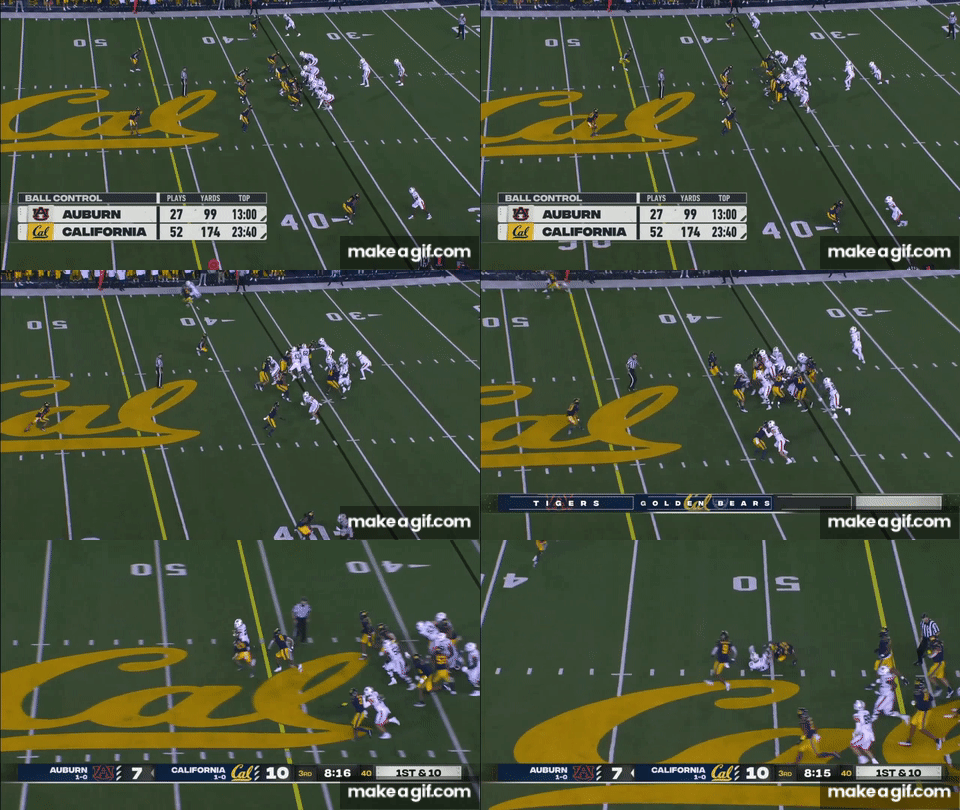
Of course, Auburn’s offense, realizing it was in good field position and had a great chance to retake the lead, immediately set about squandering that opportunity. For whatever reason, the coaching staff decided it was time for another Robby cameo at midfield, and it turned out about as well as it did before. I’m not going to break these two plays down in detail, but note that in both cases, the defense has the line stacked and the offense hopelessly outnumbered in the box because they weren’t afraid of Robby throwing the ball. This was too predictable for the defense, and if the coaching staff wants to keep Robby involved outside of the red zone, they’ve got to get him involved in the downfield passing game or the opposing defenses will just do this all season with the same result.
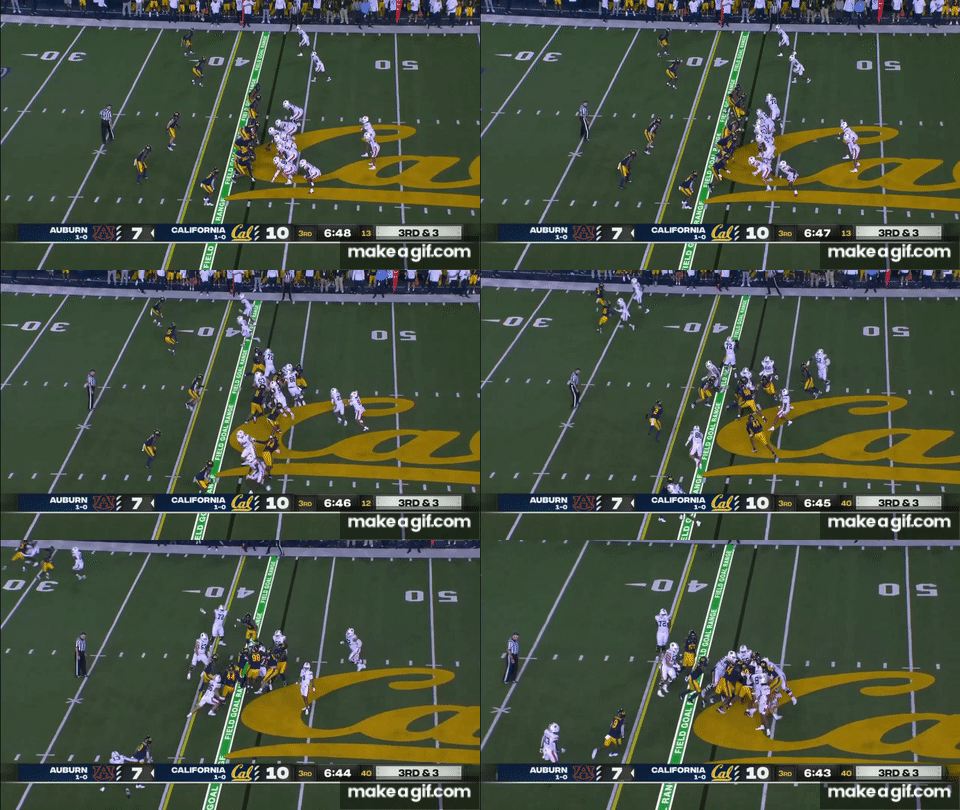
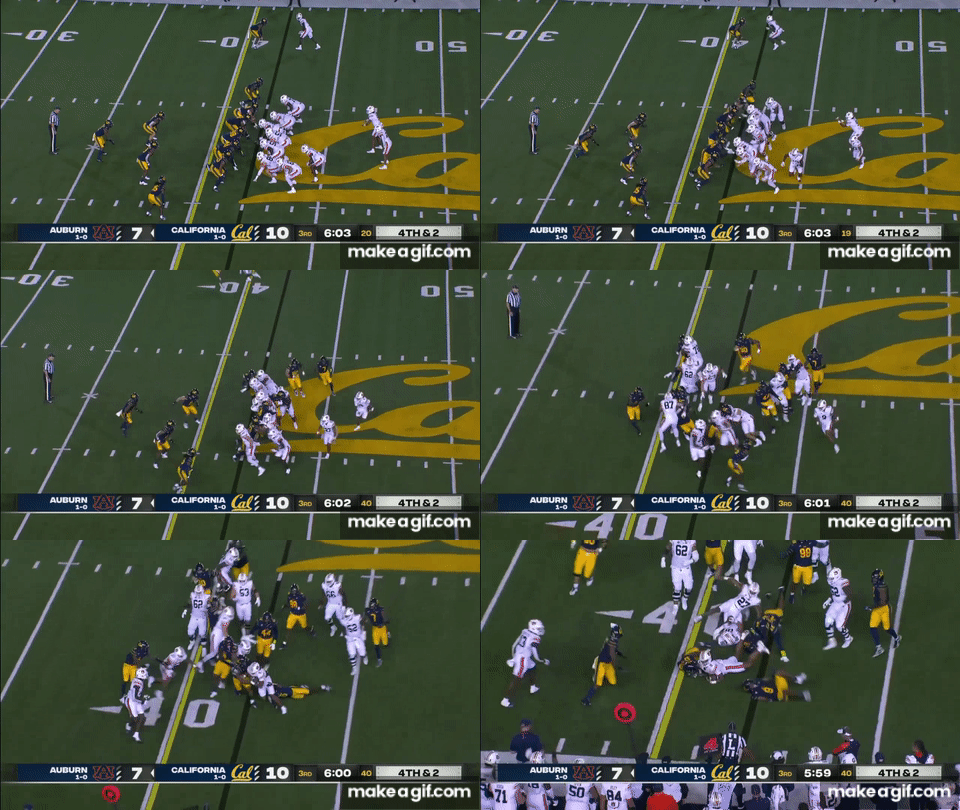
After, and stop me if you’ve heard this one before, a missed Cal field goal attempt, it’s Robby time yet again. In this case, it’s actually a good play design for getting the QB involved in the run game and it works pretty well. Auburn lines up in a pistol set and runs GT counter with what’s known as a bash scheme. “Bash” is derived from the abbreviation “BA” or “back away”, which means that the offense will fake the RB carrying the ball to one side and then run away from that side with the QB. This isn’t really new (it was a staple for Gus Malzahn a decade ago and my high school was running it in the mid-2000s), but it’s a good way to attack a defense that shifts the defensive line over toward the RB. Robby fakes the sweep to Jeremiah Cobb and then runs the counter with Damari Alston leading for him and it’s a successful run on first down.
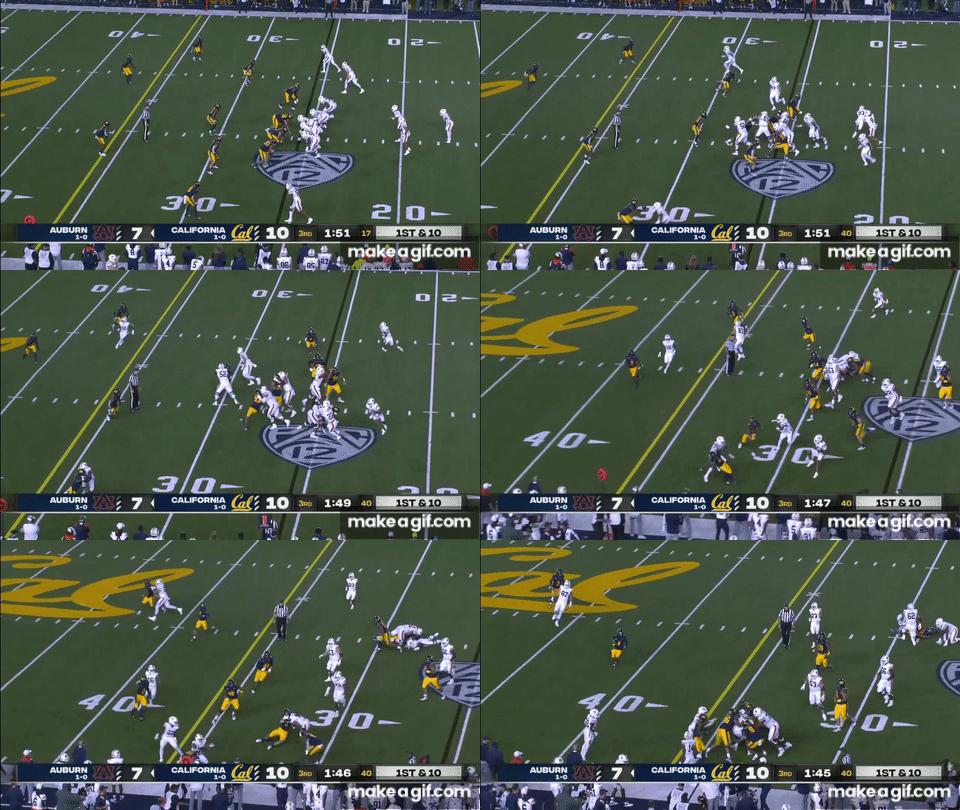
On the first play of the fourth quarter, Auburn finds itself in a familiar spot: third and long. In desperation mode, Auburn lines up in a 3×1 set and goes with another old Mike Leach staple: four verts (“6” in air raid terminology). This is exactly what it sounds like: all four receivers run vertical routes with the back check-releasing. Generally, receivers are told to win deep, and if they can’t, to put their foot in the ground to allow a back-shoulder throw, which happens here.
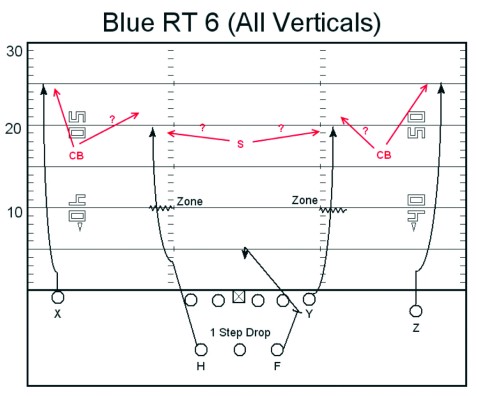
Auburn motions the back out of the backfield for some extra eye candy, but Thorne is looking down the seam to Ja’Varrius Johnson here, but he’s absolutely blanketed by Cal’s man coverage. It’s hard to run verticals when you can’t win those one-on-ones.
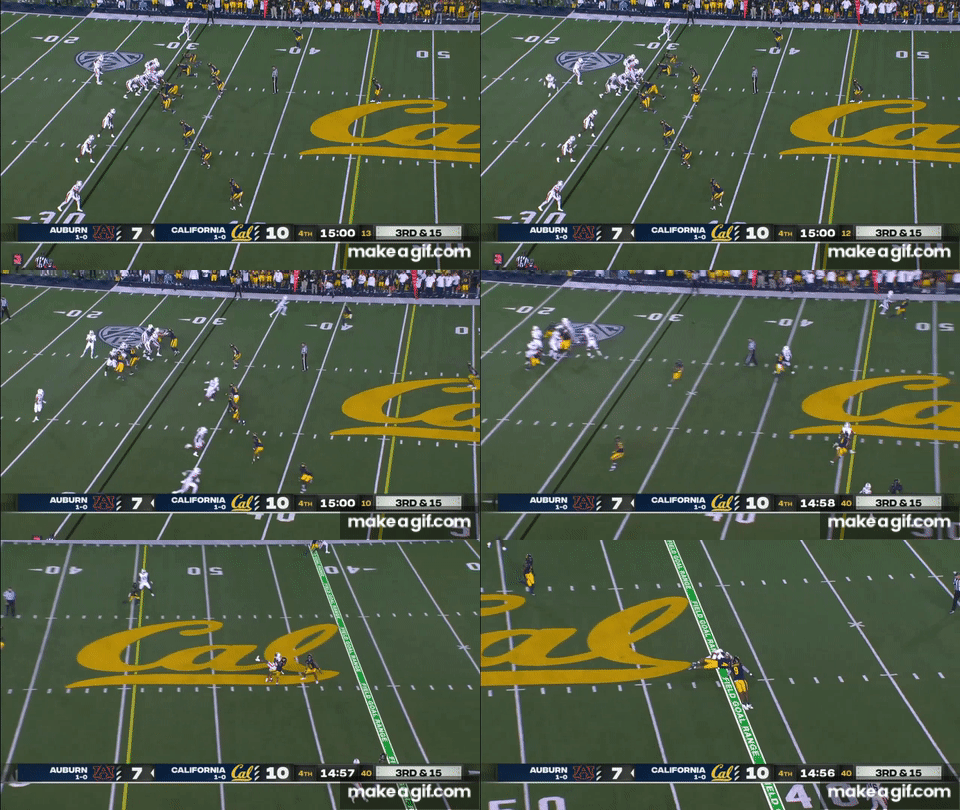
But then….
The only times that an Auburn receiver really, convincingly beat man coverage came on the final drive and they both came from Rivaldo Fairweather. On this play, on 3rd and 17 following a sack, Auburn goes back to the well with the 3×1 four verts concept from before, but with a twist (literally). The #2 and #3 receivers (Fairweather and Ja’Varrius Johnson) take a switch release, which is a common tactic against man coverage, and it looks like Cal is in man free coverage here, so that makes sense. Fairweather isn’t able to get over the top of the defender, but he does a good job of slamming on the brakes and using his big body to shield the ball from the defender and makes the catch (while getting interfered with).
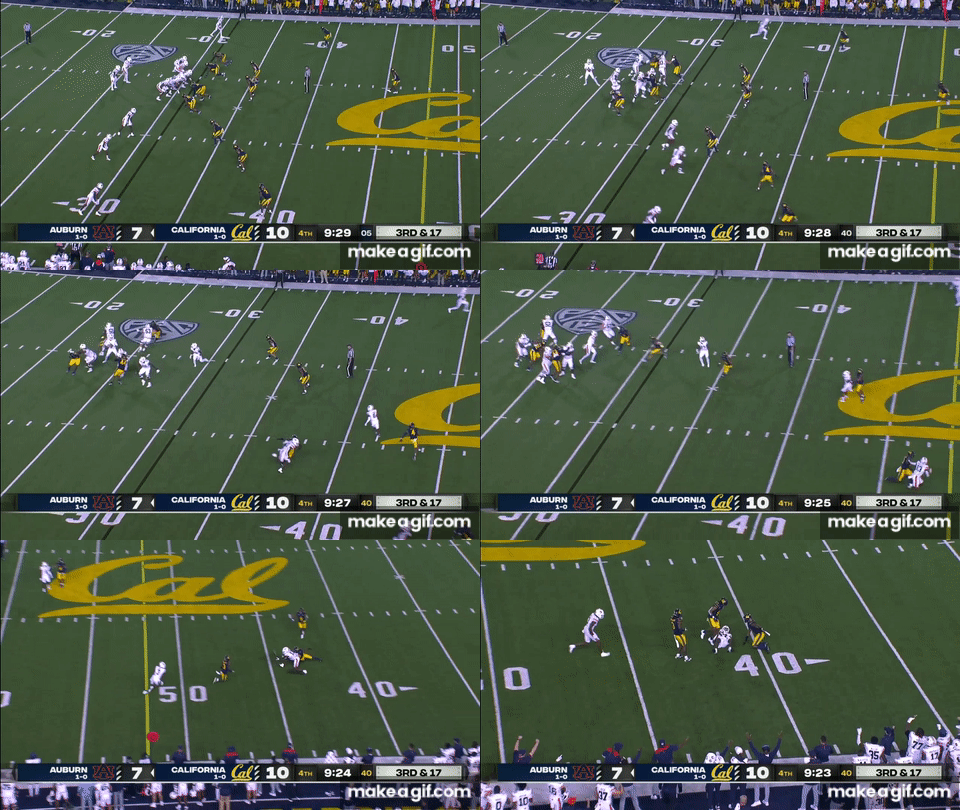
On a critical 3rd and 2 later in the drive, Auburn goes with yet another of the air raid staples: Y corner (which some coaches call snag, Leach called it “8”). This is my favorite pass concept in all of football. It’s a triangle read for the QB. The #1 receiver runs a slant route and settles in the hole in the zone coverage; the #2 receiver runs a corner route, and the back runs a swing, setting up a triangle of receivers, which creates both vertical and horizontal stretches on the defense. In this case, though, the wide receivers basically just picking the interior defenders trying to get outside to cover the swing route and it’s successful since Cal is in man coverage here.
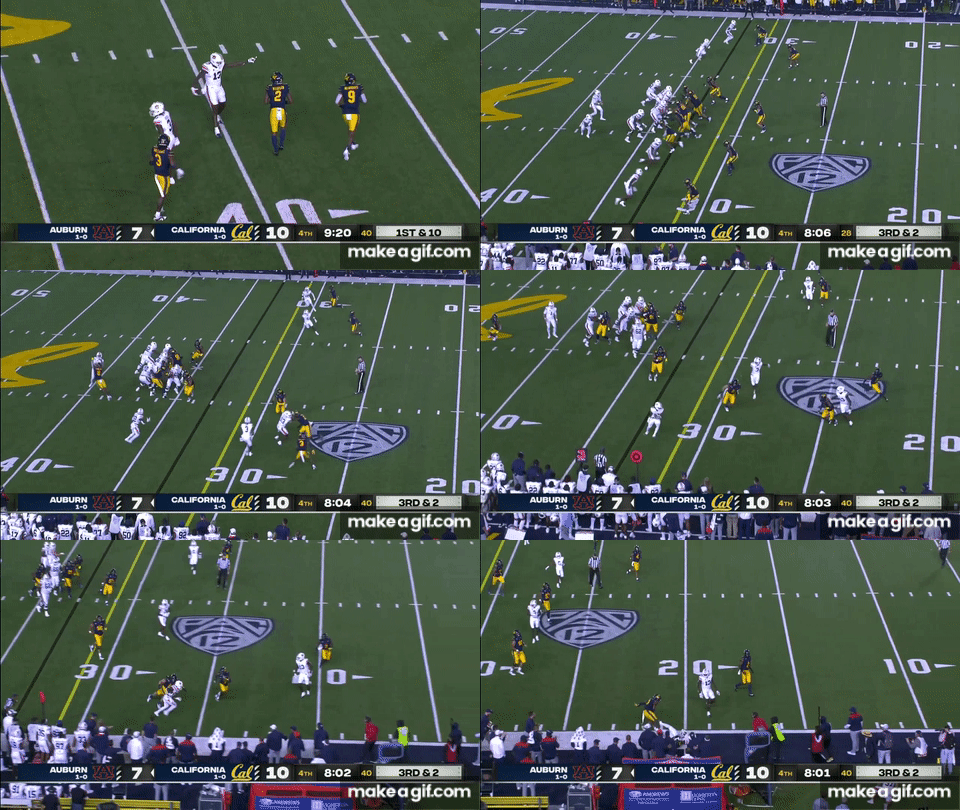
And now we’re going to go from my favorite pass play in all of football to my least favorite: the goal line fade. It looks like this is an RPO, with Auburn running that C/T counter concept they kept running out of the pistol with a fade route tagged to the backside. I really don’t like the goal line fade, and the numbers agree with me; it’s just not a very successful play most of the time. However, it can still work if your dude is better than their dude, which is the case here, as Fairweather just straight up Mosses the Cal DB for the game-winning TD. Can’t scheme hops.
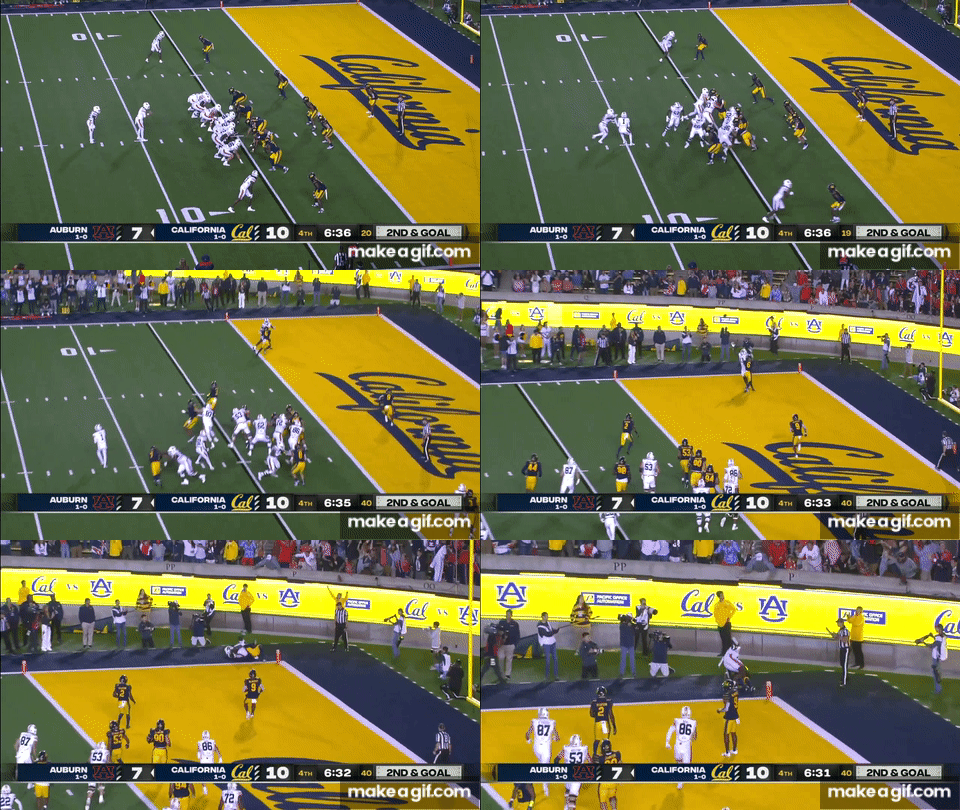
Auburn, of course, couldn’t make this easy, fumbling on the first play of their next possession and forcing a final, dramatic defensive stand, which culminated in a fourth-down interception. After that back-breaking pick, the Tigers’ offense was able to pick up a first down on the ground and ice the game. Now that I’ve subjected you to some truly Tubervillian offensive ineptitude, it’s time to turn our attention to the real star of the show, the defense.
DEFENSE
Going into this game, I was somewhat concerned about how Auburn’s offense would match up with Cal’s man-heavy defense, but I was absolutely terrified thinking about how our defense would hold up against Cal’s ground game. Their passing game was a mixed bag against North Texas (thanks in part to the same kind of QB carousel that hamstrng the Auburn offense), but their run game, led by RB Jaydn Ott, gashed the Mean Green. Ott, of course, decided that he was going to run his mouth in the leadup to the Auburn game, which I personally would not do if my team had gone 4-8 last year, but to each his own.
Cal’s rushing success against North Texas was largely based on their execution of their dart concept, which is essentially a standard one-back power play, but with the tackle pulling and blocking the playside LB instead of the guard. So, of course, being the brilliant offensive mind he is, first-year OC Jake Spavital…barely ran it at all against Auburn. Admittedly, dart is mainly used to attack odd fronts and Auburn spent most of the game showing four down linemen, but still a very weird gameplan.
After the aforementioned Thorne fumble on Auburn’s opening possession, the Golden Bears managed to pick up one first down via a short fourth-down run, but quickly found themselves right back in third and long. They dialed up…a screen to Ott. While Auburn defenses of yesteryear often overplayed these screens, which was a key contributor to the Third and Auburn meme, the Auburn linebackers (particularly Eugene Asante) are very disciplined here and are able to stop Ott for basically no gain with some excellent pursuit. This will be a theme.
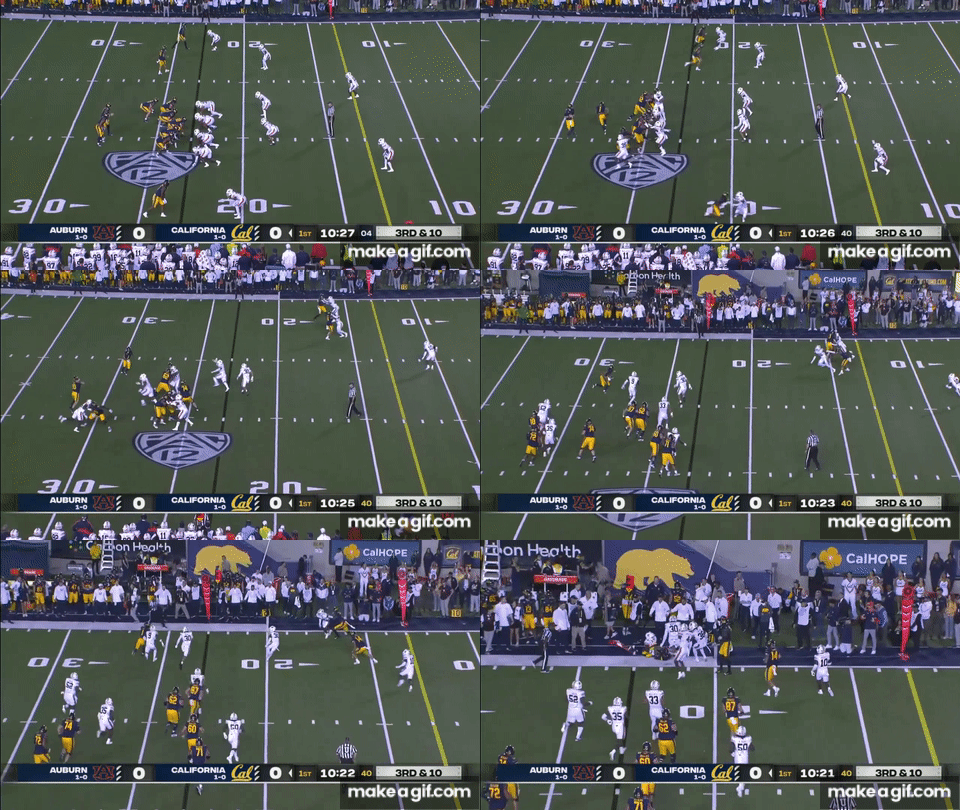
After a made field goal and a bad Auburn punt, Cal once again had great field position to start their second drive, and once again did nothing with it. They picked up one first down, but then found themselves in another third and long and Spavital again opted for a coward’s playcall, this time a QB draw with the not-especially athletic Ben Finley. One of the keys to Auburn’s defensive improvements against UMass was aggressive playcalling, rushing five or more on almost every snap and making life miserable for Taisun Phommachanh. The Tigers channel that same energy here, rushing five and bringing a delayed stunt with DT Marcus Harris, who blows the play up in the backfield, forcing the first of four missed field goal attempts.
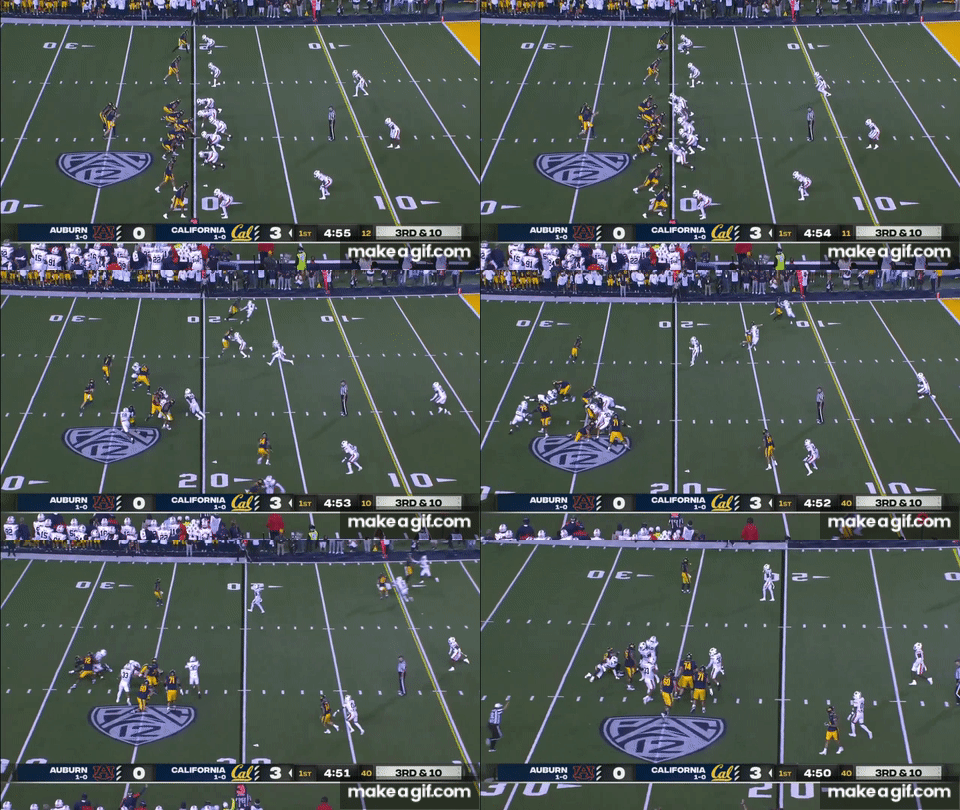
After another Auburn punt, Cal faces another third down, and again, it’s another cowardly playcall from Spavital: a double screen that mirrors the one Auburn would later have blown up on a third and long (see above). They fake the bubble screen to the right and run a slip screen to the left, which is once again read beautifully and blown up by Eugene Asante. If Asante seems to have come out of nowhere, that’s because the Potato Posse had him playing on the scout team last year. Shoutout to
Scientologist Doug BarfieldBryan Harsin, who stole every cent Auburn ever paid him.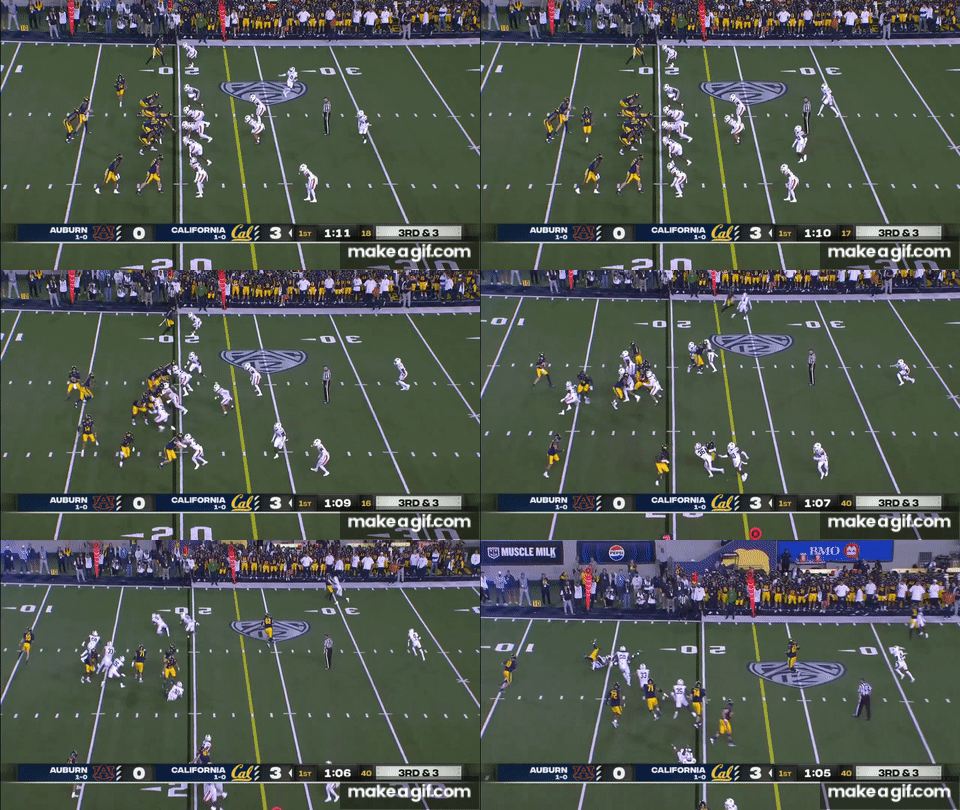
After yet another Auburn punt, Cal finally decided to go to their bread and butter from the North Texas game, the dart concept, but it backfired in a big way. Donovan Kaufman was a big play machine against UMass, and he kept it up in this game. Jalen McLeod, who had an excellent debut in his own right, does a good job of stringing this play out, allowing Kaufman to come flying up from his safety position, rip the ball out, and recover it inside the Cal 20. Thankfully, Auburn’s offense didn’t waste this spectacular effort, cashing in a touchdown two plays later.
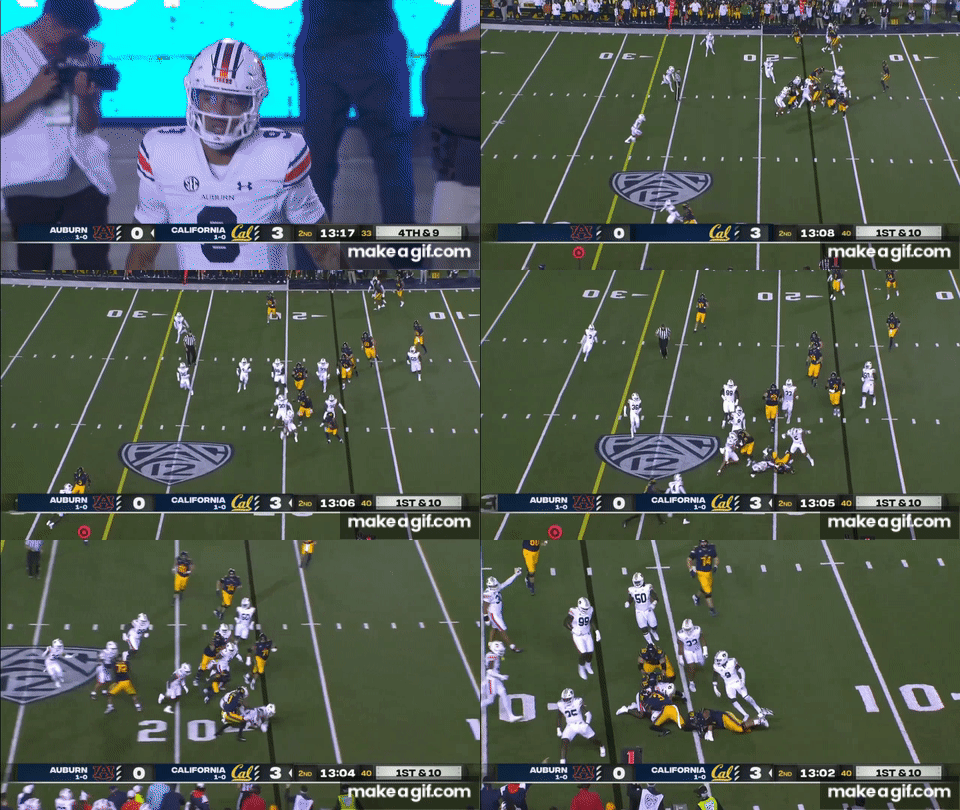
On the ensuing Cal possession, the Golden Bears again got themselves into a third and long. At least this time Spavital tried to get the ball past the sticks, running a post-wheel concept off play-action. Of course, as the great American philosopher Homer Simpson taught us, trying is the first step to failure; the lesson is never try. Auburn’s DBs do a great job of pattern matching and the front six get pressure with a delayed blitz, leaving Finley with nothing to do but throw the ball into the Auburn bench and bring up another punting situation.
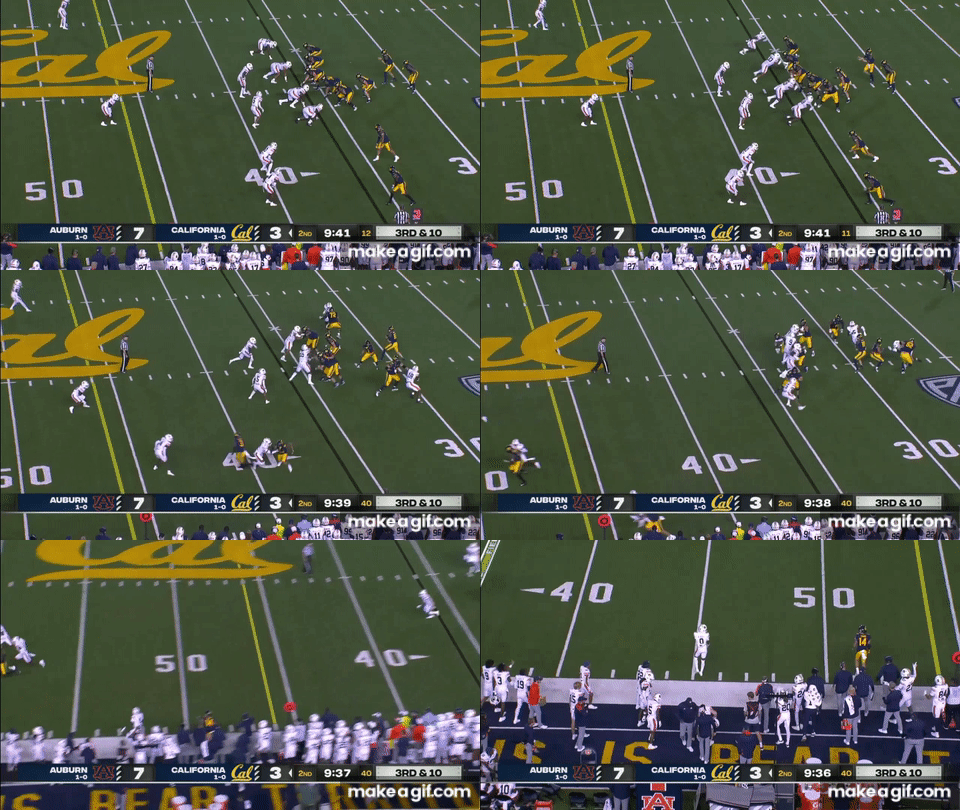
After Damari Alston’s fumble, Cal finally found a way to generate a couple of explosive plays with their second QB, Sam Jackson V. This drive saw some of Auburn’s bad tendencies from the UMass game rear their ugly heads again. On this play, the Tigers only rush four and are unable to get pressure with Cal basically in max protection, leaving Jackson time to find an open receiver downfield.
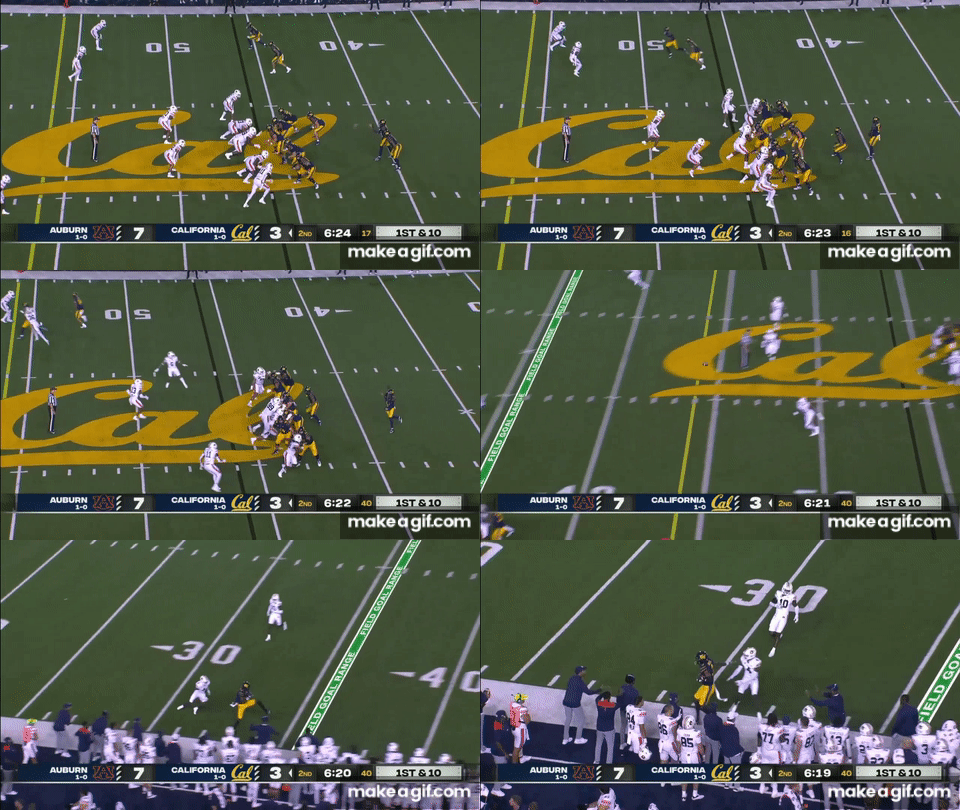
Two plays later, Cal gets its first big play on the ground. This is a zone slice scheme, with the H-back pulling across the formation to lead for the zone run. Wesley Steiner creeps too far inside, allowing himself to get outleveraged and sealed inside by the H-back and leaving lots of space for Ott to scoot around the end. Zion Puckett makes a touchdown-saving tackle, but it’s another first down for the Golden Bears.
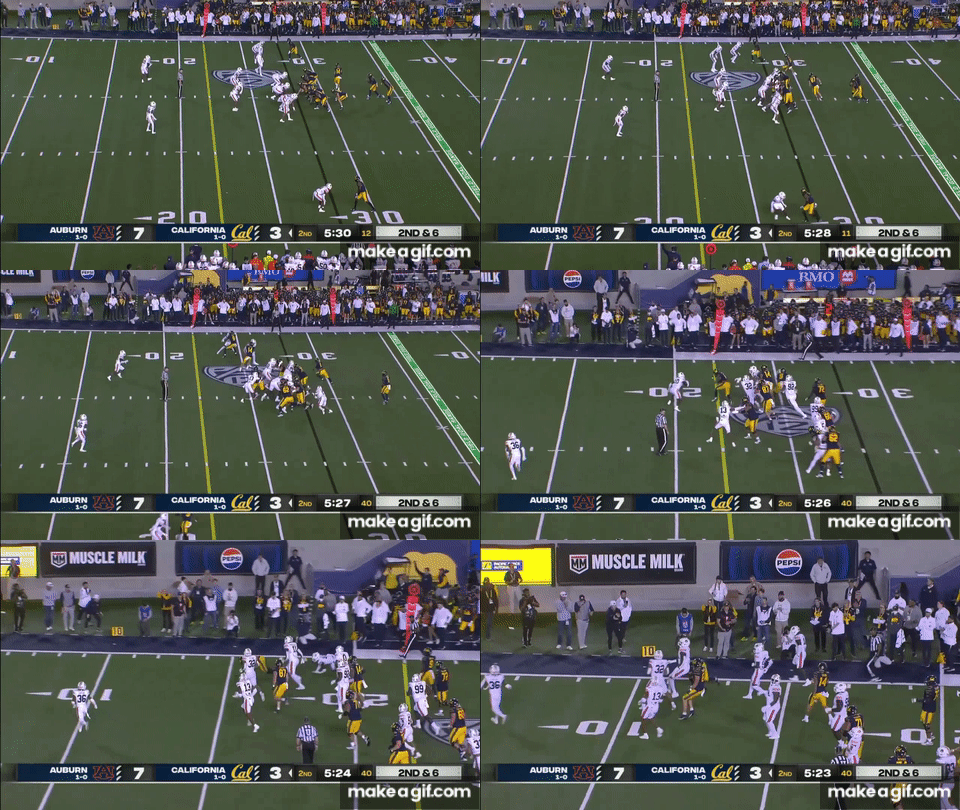
On the next play, Cal gets into the end zone for the only time on the night. This is a basic zone insert play, where the H-back inserts himself into the interior blocking scheme, in this case taking out the playside LB. Auburn brings a blitz off the backside with Puckett, but he doesn’t get there in time, and the backside LB, Cam Riley, is unable to get over the top quickly enough to prevent Ott from bursting through the gap and into the end zone.
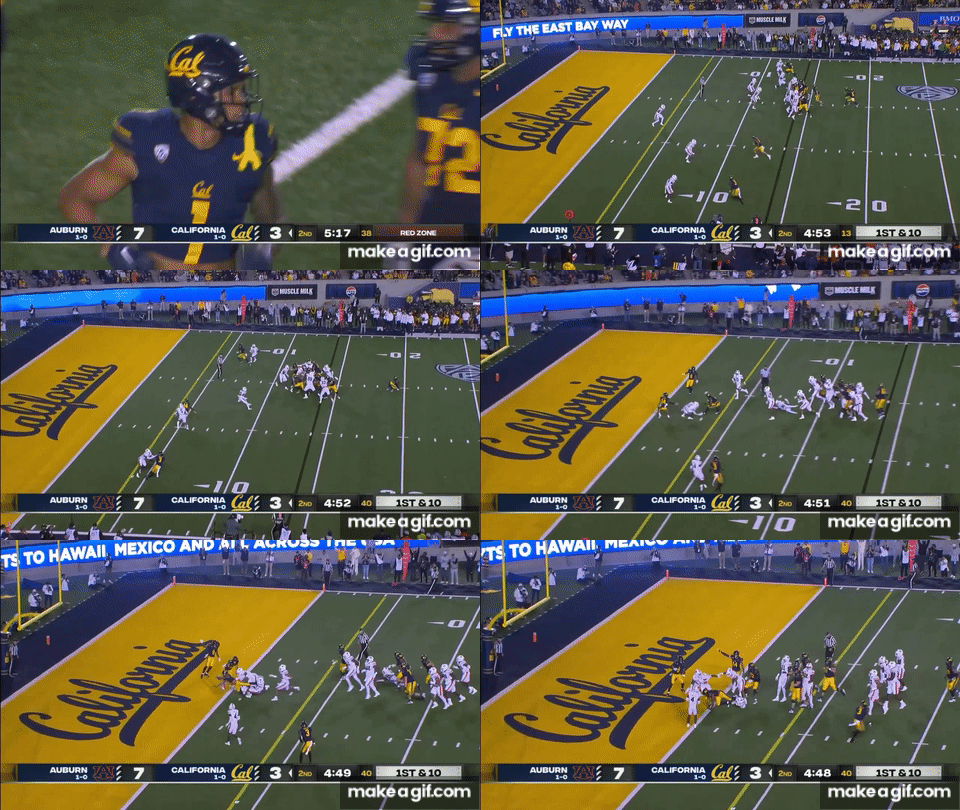
On the ensuing possession, we see once agan the Tigers struggling to get pressure with four rushers. Cal is running some type of curls concept and Jackson has plenty of time for his man to get past the sticks and find him with a back-shoulder throw for a conversion. However…
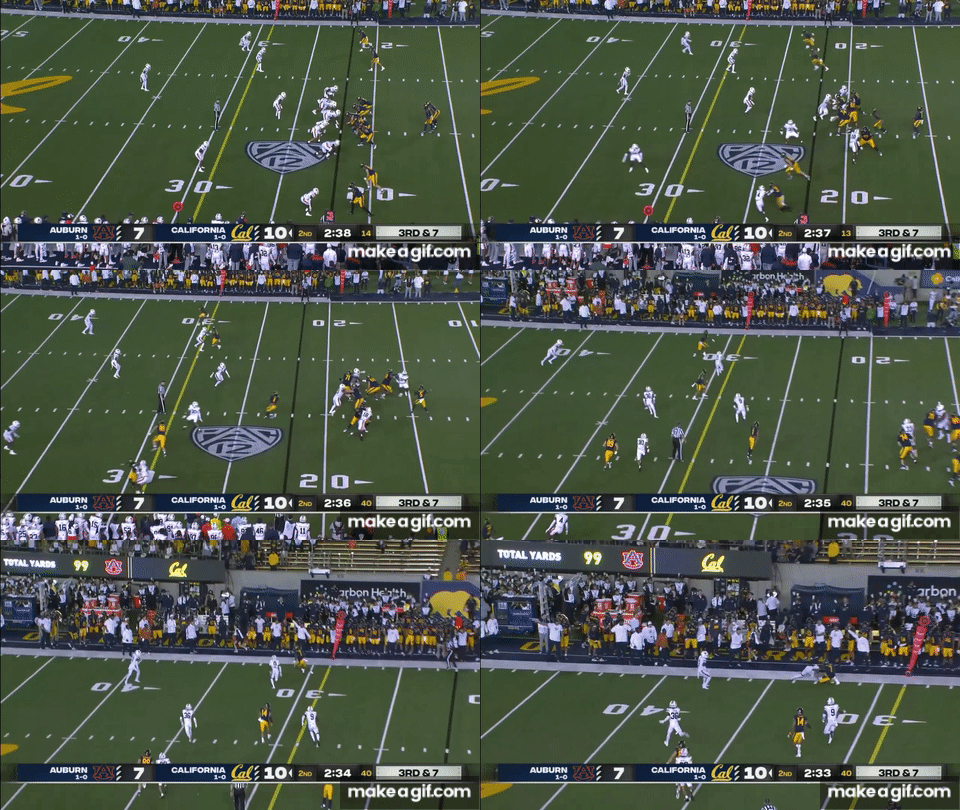
…on the next set of downs, Cal again faced a third and long and went back to the well with the same concept. This time Auburn is able to hurry the throw a bit and has much tighter coverage as well. The Cal sideline tried to beg for a flag but there’s no way they’re getting that call and it the Auric Ursines were forced to punt.
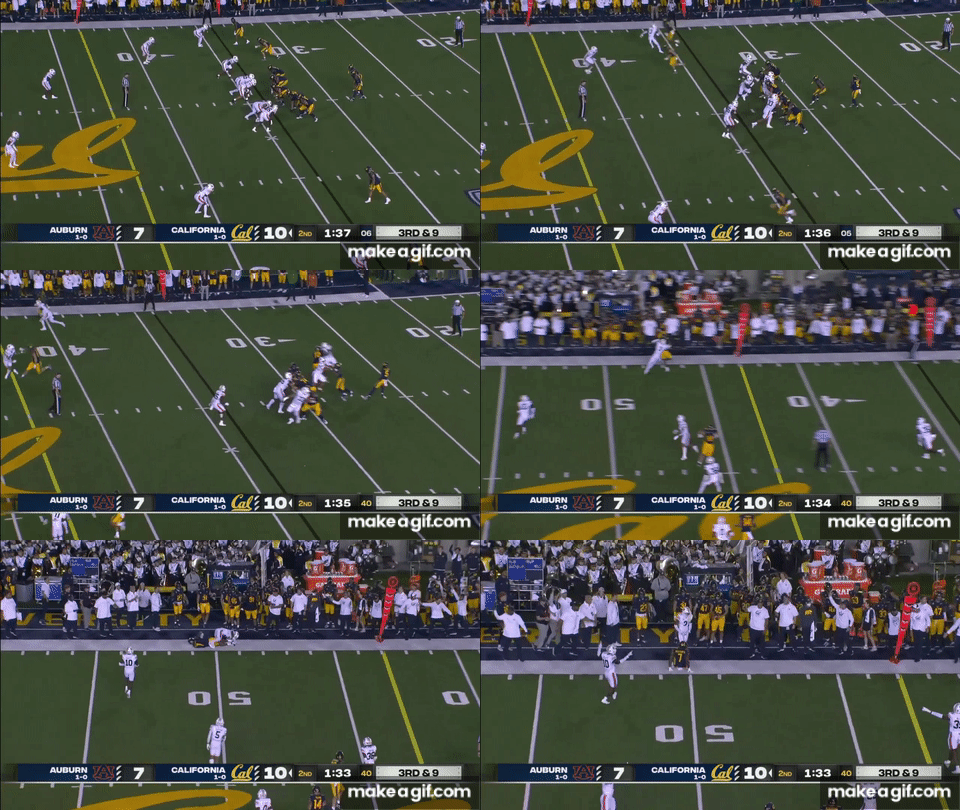
After Payton Thorne’s brutal interception with just over a minute left in the half, the bears once again had great field position, and once again they squandered it completely with a combination of inept offense and shambolic special teams. The Golden Bears line up in an empty set and bring Jaydn Ott in motion from the slot to run a power read concept. This concept should be familiar to Auburn fans as one of the preferred weapons of the Tigers’ 2010 offense. It works a bit better with Cam Newton and Onterrio McCalebb than with Sam Jackson and Jaydn Ott though. Jackson gets a keep read but both of Auburn’s interior linemen, Marcus Harris and Josiah Nakili-Kite are able to get off their blocks and disrupt the play. Cal somehow managed to get called for holding on a field goal, wiping the points off the board and forcing an unsuccessful Hail Mary, totally wasting an opportunity to extend their lead before the half.
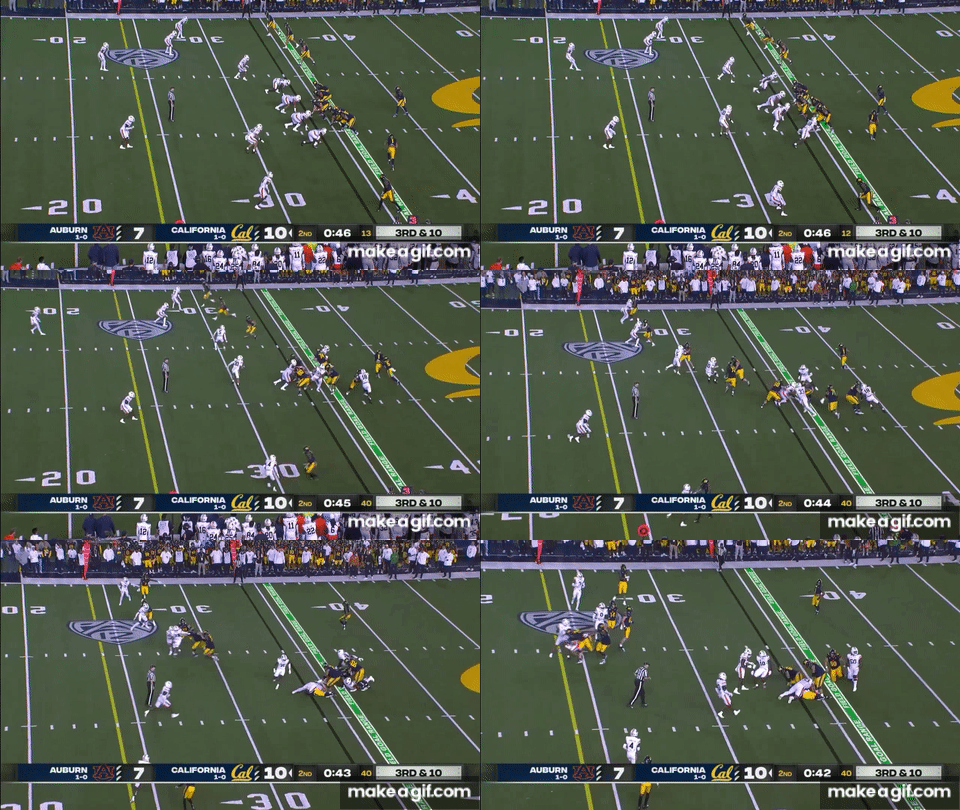
Cal received the second half kickoff and went on a lengthy drive that consumed almost half of the third quarter, converting a fourth down and then a third down to reach Auburn territory, where they faced another fourth down. Spavital continued his trend of oddly passive playcalling with another screen, this time motioning the RB out of the backfield to run an F swing concept. Jalen McLeod, who was dropping into zone coverage, read this play the whole way and was able to get out and make the tackle well short of the marker and get the ball back to the offense.
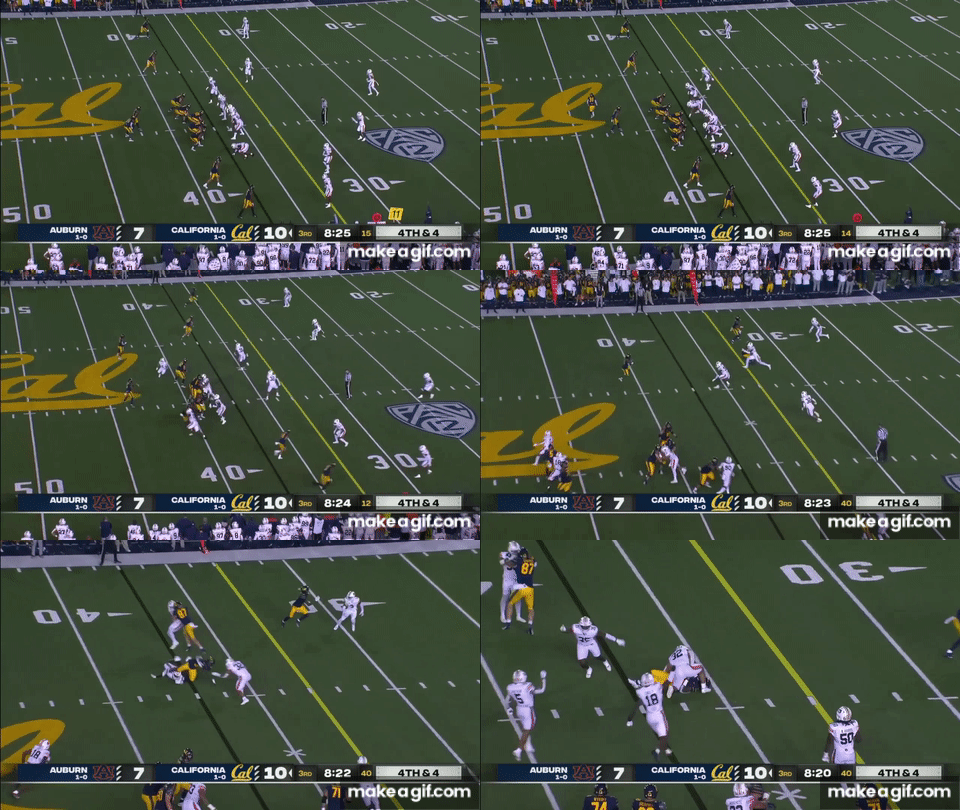
After stopping Auburn on fourth down, Cal got the ball back near midfield. I want to look at two similar plays on this Cal drive and the next one, neither of which, and I know I sound like a broken record at this point, ended with missed field goals. These two plays are basically identical and they’re good examples of Cal exploiting Auburn aggressively blitzing third-level defenders. Both of these are inside zone runs tagged with an arrow route; it looks like split zone, but instead of blocking the end, the H-back releases to the flat, and the QB reads the first defender outside the box for give or throw. In both cases, Auburn brings heat from the secondary (Jaylin Simpson in the first case, Donovan Kaufman in the second) and in both cases, Jackson makes the correct read and gets the ball out to the H-back for a first down (although I will note the refs missed a pretty blatant block in the back on the second play). Auburn’s pressures have generally been a net positive this year, but it’s undoubtedly a double-edged sword.
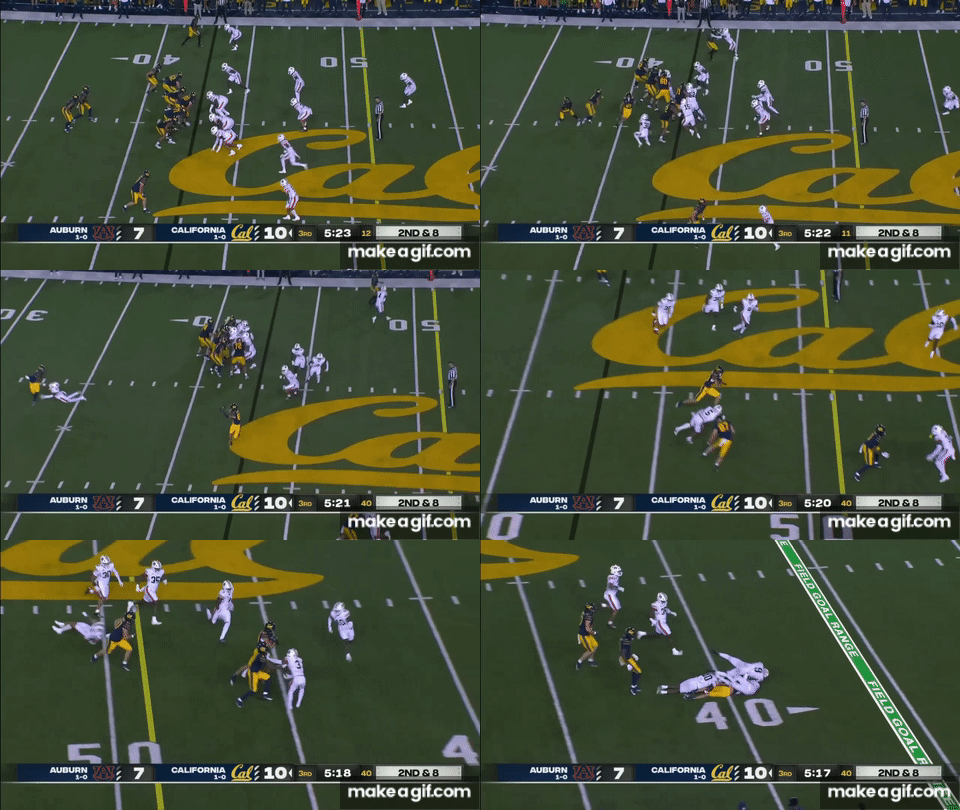
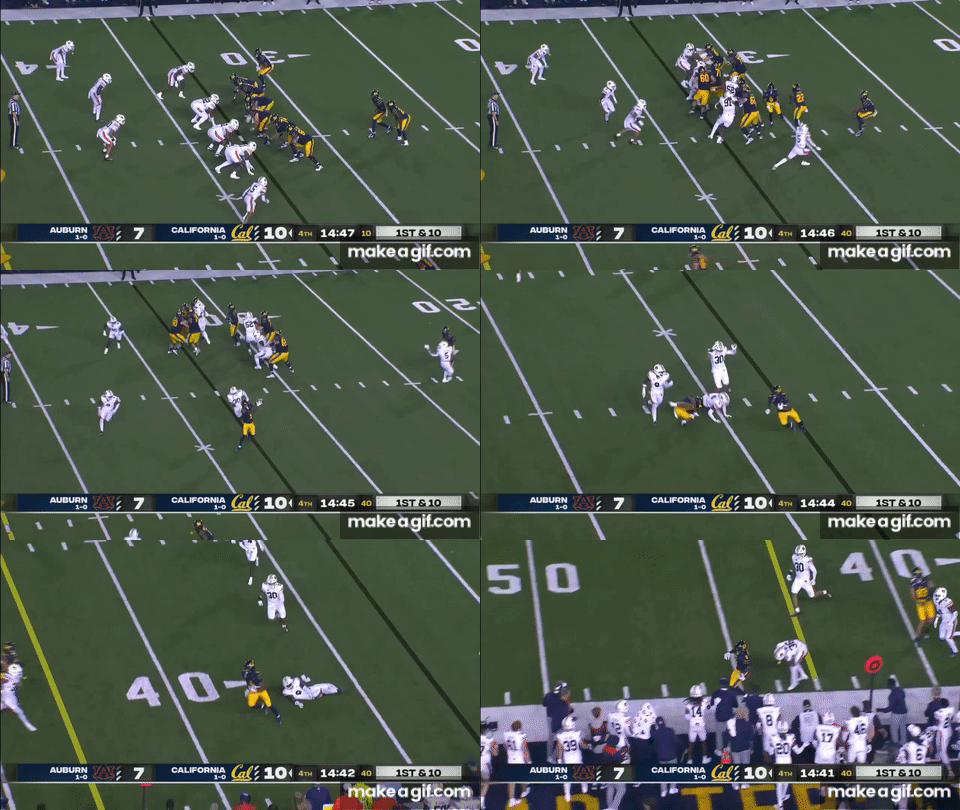
And now we get to see the other side of that sword. On the second of these two drives, Cal made its way down to the Auburn red zone, but found itself in a third and 10. I’m not entirely sure what Cal is running, maybe some type of smash concept with a jerk route in the middle? In any case, it doesn’t really matter. Auburn brings the house, with six rushers; although Cal has six pass blockers, the RB totally whiffs on Eugene Asante coming off the edge, and he takes Jackson down for a huge loss, setting up a field goal which Cal missed.
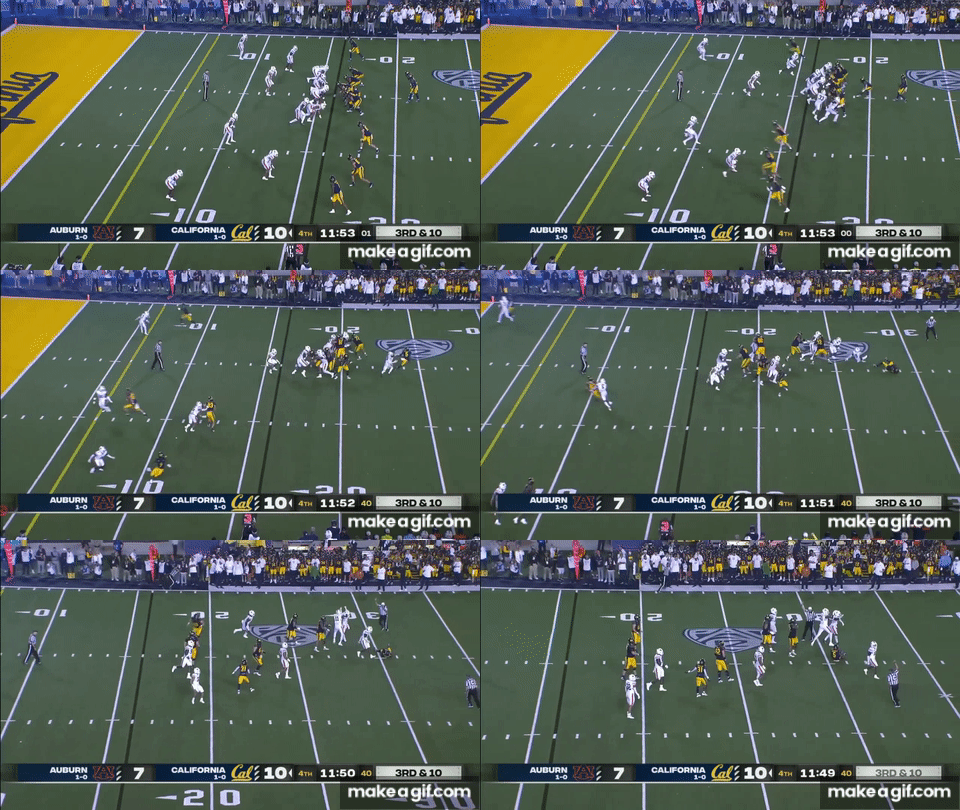
After Auburn finally managed to retake the lead with the touchdown pass to Rivaldo Fairweather, Cal faced a crucial third and 3 on their ensuing possession. They line up in a pistol set with an H-back and the Z receiver in tight to block. There’s little doubt it’s going to be a run play, and there’s little doubt it’s going to be an inside zone, since that’s all Cal ever ran from the pistol, to my knowledge. Auburn has no compunctions about putting seven guys down in the box and bringing in an eight after the snap, overwhelming the offensive line and blowing up the play. Cal decided to punt here for whatever reason, but it ultimately worked out, because, of course, Auburn fumbled again, giving the Golden Bears one last chance to snatch victory from the jaws of defeat.
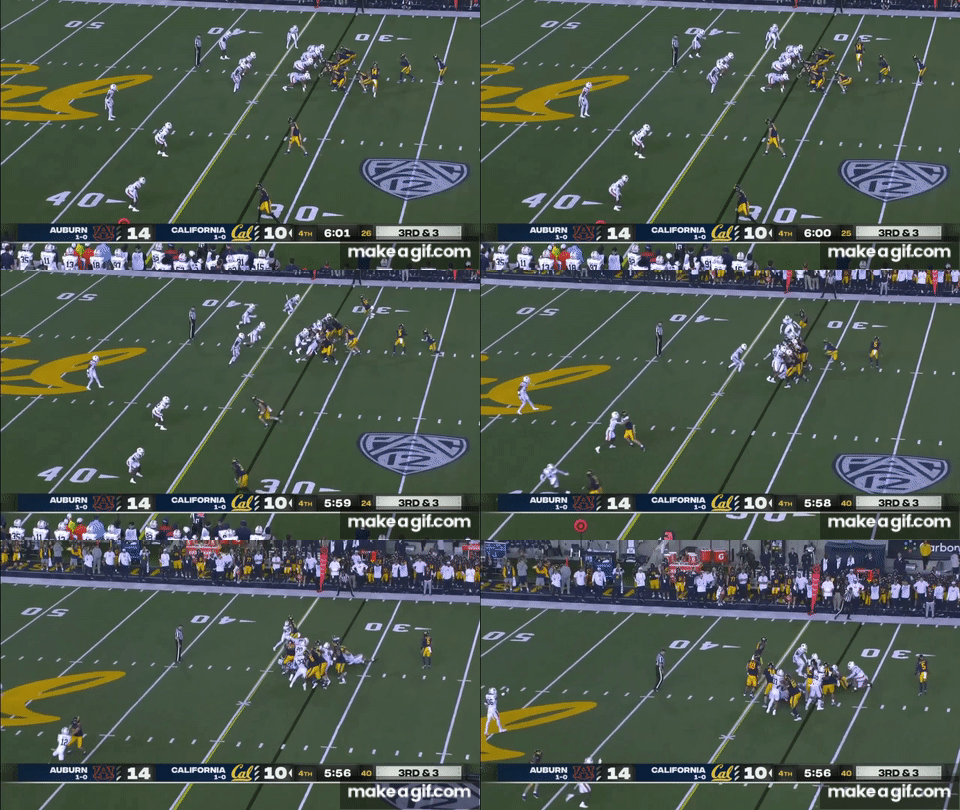
On the first play of that drive, Cal ran some type of flood concept and Jackson was able to get the ball to his receiver on a deep out. The Golden Bears got an extra boost from a dumb penalty by freshman corner Kayin Lee. Yeah, it’s a soft call, but you can’t do that over on the opponent’s sideline and give the ref a chance to be swayed by the opposing coaches’ whining.
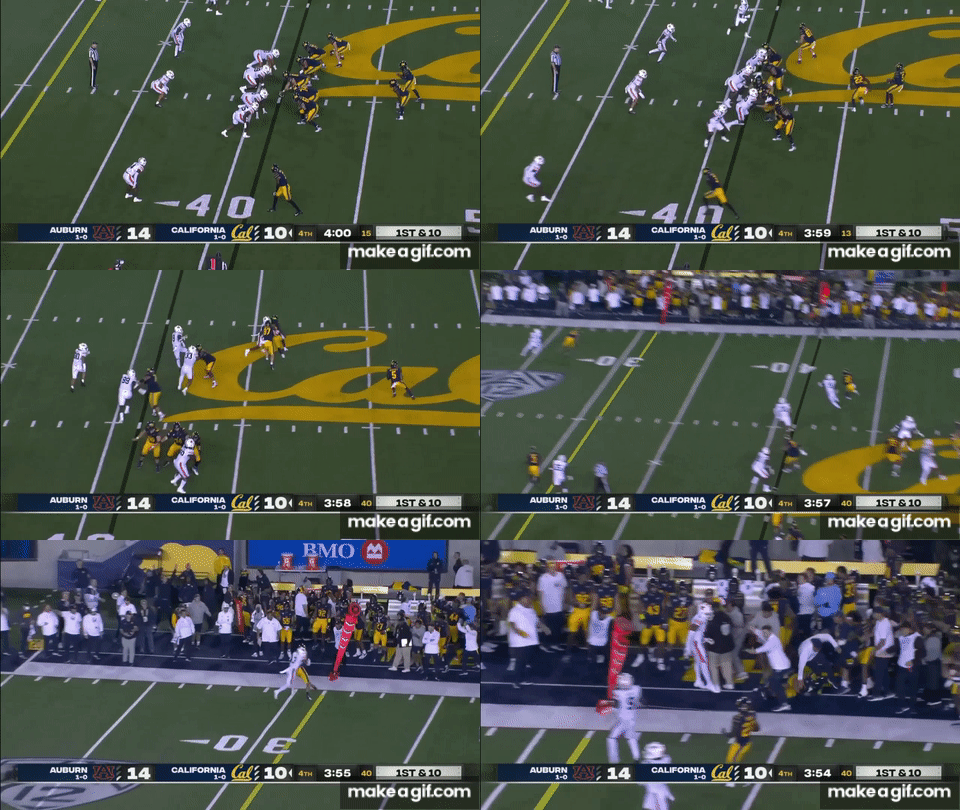
However, after that penalty, Auburn’s defense bowed its back, pushing Cal back into a third and 19 situation. Spavital, with an opportunity to redeem himself for a night of cowardly third down playcalls, instead gets one more for the road. The Golden Bears bring a receiver (or tight end?) in motion behind the QB and run an RPO with a GT counter paired with a swing pass to the motion man. The not-especially-athletic receiver is easily corralled by DJ James and Eugene Asante, setting up a fourth and long. Baffling playcall.
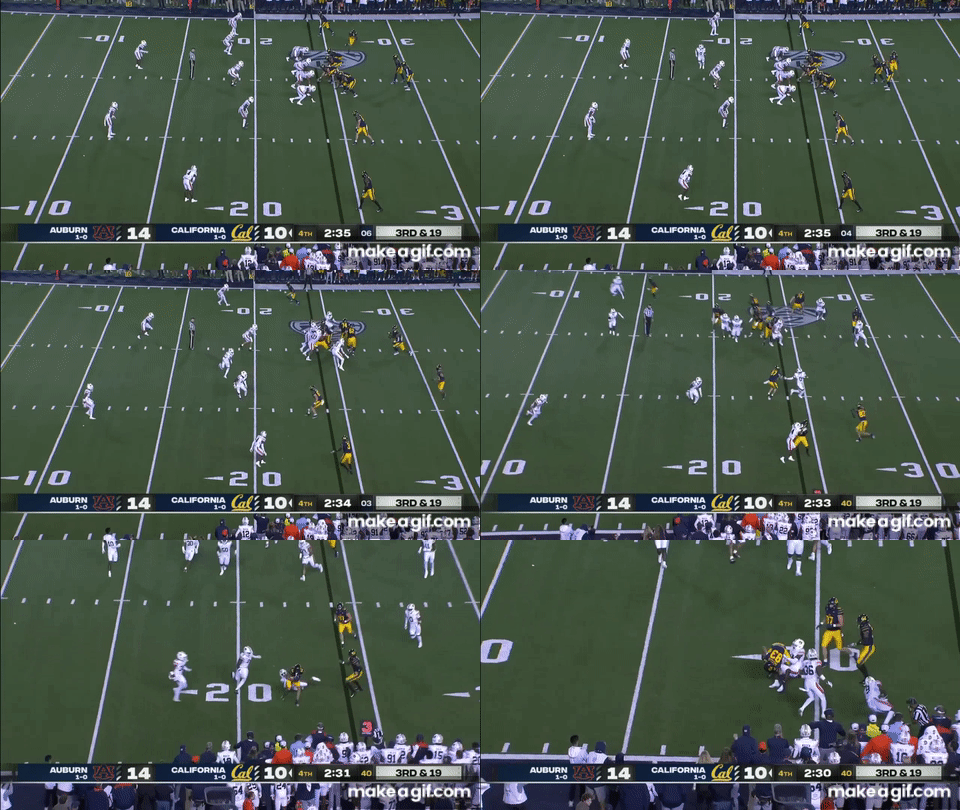
Facing fourth an game, Spavital is again oddly conservative. Cal only sends three receivers out into the pattern, and they run the play into the boundary, giving them limited space to work with and making the task of Auburn’s zone defenders much easier. Despite the max protection, however, Auburn is still able to rush Jackson’s throw a bit. I’m not entirely sure what this is supposed to be, but it looks like a variation of Mike Leach’s old H wheel play, where the #1 receiver runs a deep curl and the #2 receiver runs a wheel. Usually the idea is for the wheel to open up the curl, but here, Jackson throws the wheel into basically triple coverage, and DJ James makes the easiest pick of his life to ice the game.
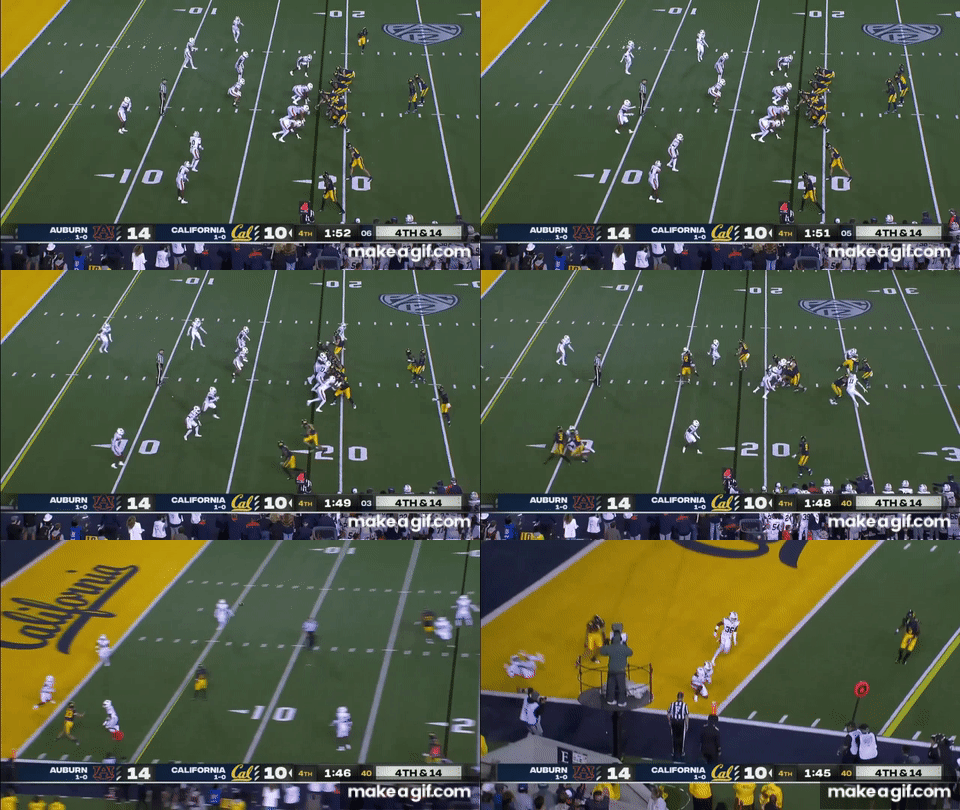
CONCLUDING THOUGHTS
Last week, I came out of the UMass game feeling okay about the offense and concerned about the defense, but after this game, it’s the other way around. There’s no sugar-coating this one: it was an ugly performance for the Auburn offense, which struggled to execute its vertical concepts and RPOs against Cal’s man coverage, and I’m worried that they’ve given Auburn’s SEC opponents the blueprint for how to shut down the Tigers’ offense. Auburn will have to find some answers against man coverage if they’re going to be successful down the stretch. It would really be nice if they’d pick a QB as well, since the series with Robby at QB outside the red zone were a total failure. The turnovers and penalties have to get cleaned up as well, but you didn’t need me to tell you that.
The defense performed admirably given that they were put in several bad situations by the offense. Had Cal’s kicker been even decent, they would have won the game, but that’s more of a product of the great field position the offense repeatedly gifted them than the defense’s performance. They were occasionally burned due to their aggression, but they managed to rattle Cal’s QBs and, apparently, their OC, whose conservative playcalling hampered his team’s ceiling. I’m still not entirely convinced by Auburn’s run defense, but it was much better in this game largely thanks to a significant improvement in the LB corps, which was a big red flag last week.
The Tigers have a body bag game against Samford coming up this week, which won’t tell us much, and I might not even bother to write a review article for it unless the Bulldogs manage to make it more interesting than it should be. Barring disaster, I’ll see y’all in two weeks to recap the aTm game.
-
Auburn vs. UMass Film Review
Auburn opened the 2023 season and the Hugh Freeze era with a mostly-comfortable 59-14 home win over UMass. I think I speak for all of us when I say that it was nice to see Auburn take care of business against an inferior opponent instead of letting them hang around for three quarters and tying all of our stomachs into knots. Obviously the disparity in talent and stature between the two programs makes drawing definitive conclusions about the team’s performance difficult, but let’s take a look at the film anyway and see what we can learn about the new-look Tigers.
OFFENSE
UMass won the opening toss and deferred to the second half. Auburn got a great return from Brian Battie (who I’m told is good at this) and started with decent field position at their own 38. On the opening play of the season, the Tigers demonstrated one of the RPO concepts that I discussed in the preview article I wrote a few weeks ago. Jay Fair, lined up as the Z receiver, comes in motion behind Payton Thorne. The run call is GT counter, where the backside guard will pull and kick out the playside defensive end and the backside tackle will pull and block the playside linebacker, which is paired with a simple swing pass. I’m not entirely sure who Thorne was reading here, but Auburn had the numbers on the perimeter because UMass is in zone coverage and nobody follows the motion man to the left side of the formation, so Thorne pulls the ball and tosses it out to Fair for a solid gain on first down.
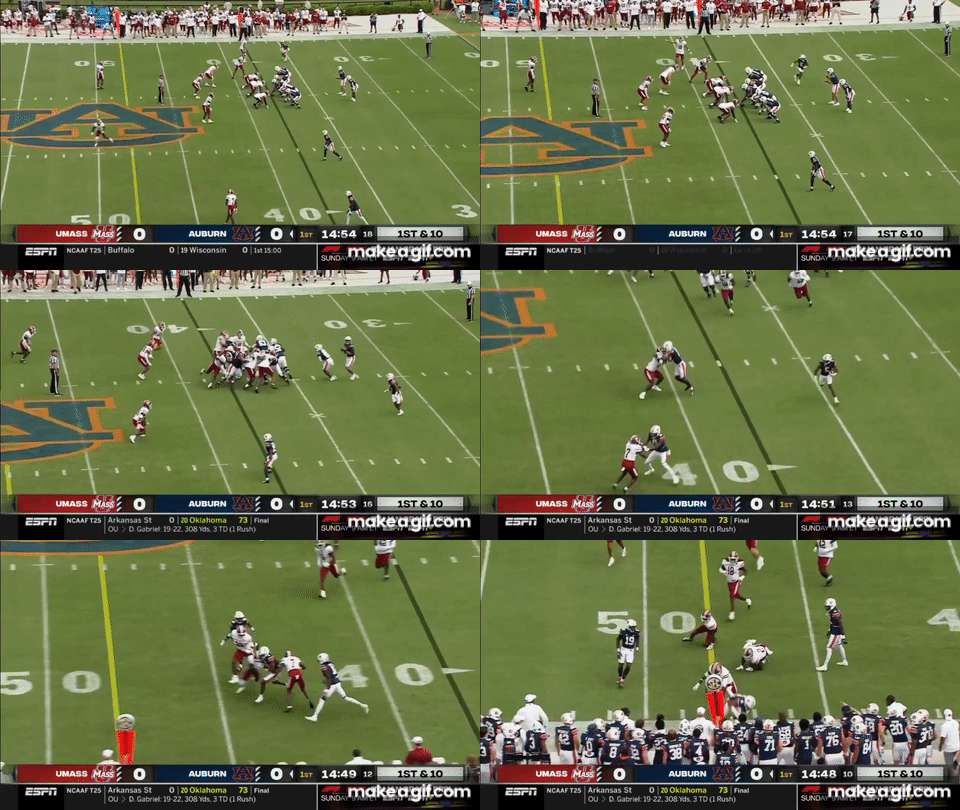
The next play I want to look at from Auburn’s opening possession includes the other key component of the new offense that we discussed in the preview article: the vertical choice series. In this case, Auburn runs slot choice, with the #2 receiver running the choice route, while the #1 receiver runs a curl route. When the defense is in zone coverage, the #1 receiver’s curl is designed to pull the deep zone defender down to open up deep space for the vertical choice runner. However, in this case, UMass is in man coverage; in man coverage, the curl has a similar effect of holding the corner so that the vertical choice receiver has the option to work outside in the vertical space behind the corner. That’s exactly what happens here. UMass actually isn’t lined up correctly because of Auburn’s tempo and if Thorne had gotten the ball out faster, Fair could have walked into the end zone. Nonetheless, Fair makes the correct read and runs a fade, exploiting the fact that he has outside leverage on the defender and following the old Art Briles mantra: “find grass, run fast.” This should have been a touchdown, but Thorne underthrows it and gives the defender time to recover and break up the pass. Auburn actually went back to the well with this exact play on the next possession, which was also incomplete but drew a defensive holding penalty.
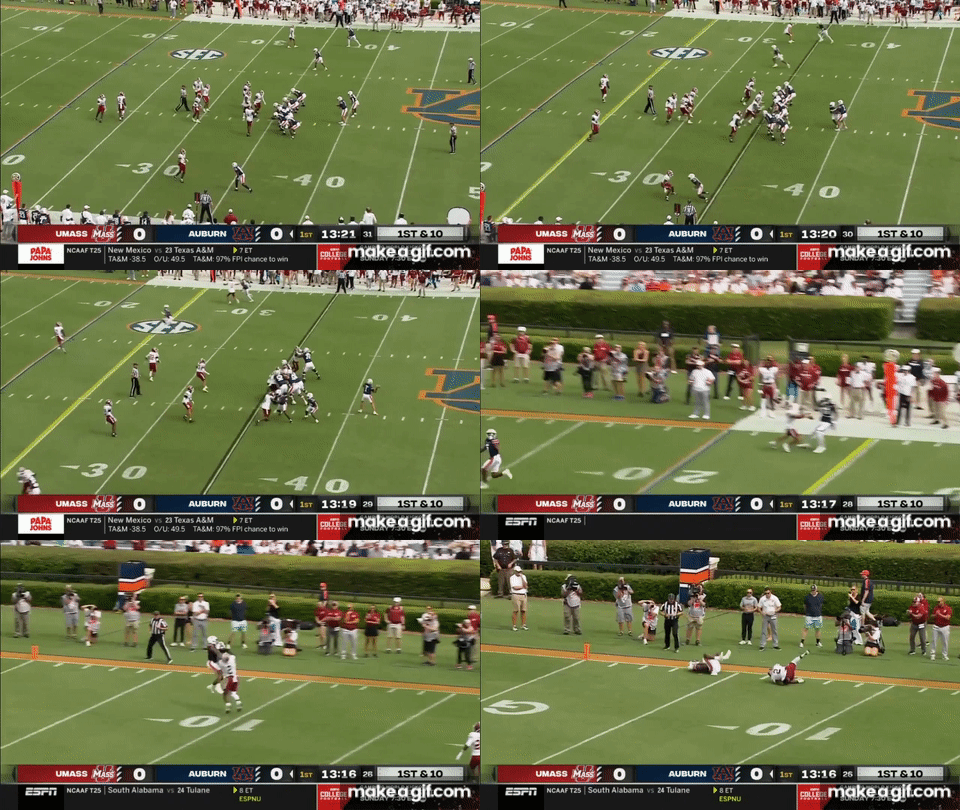
The next play in this series includes another RPO action, but also another subject I didn’t really touch on in my last post (mainly because the QB competition was still ongoing): the QB run game. Of course, when Auburn fans have talked about the QB run game going into this season, they’ve mainly been talking about Robby Ashford, but here Auburn gets Payton Thorne involved in the run game too, just to keep the defense honest. This is basically the simplest RPO there is: the RB motions out of the backfield, and the QB just looks to see if a defender follows him. If nobody follows him, the defense is probably in zone and the offense should have numbers to block the swing route on the perimeter; if a defender follows him, the defense is probably in man and the offense should have the numbers to block the box defenders. The LB follows the motion, so Thorne recognizes the defense is in man and carries up the middle on the draw for a first down.
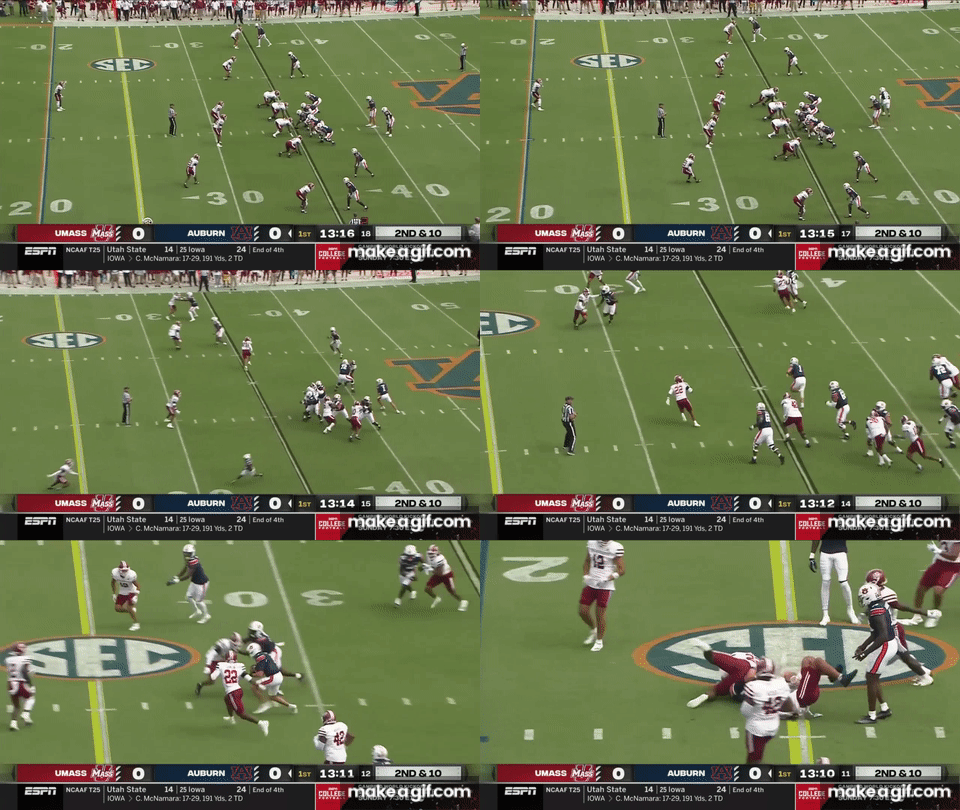
Auburn’s first touchdown isn’t really anything interesting schematically but touchdowns are fun, so let’s watch it anyway. Auburn lines up in the pistol and runs an inside zone read. The edge defender stays home, so Thorne hands the ball to Damari Alston, who does the rest. It’s nice to see Auburn be able to line up and just punch the ball in in the low red zone instead of getting cute or just getting blown off the ball.
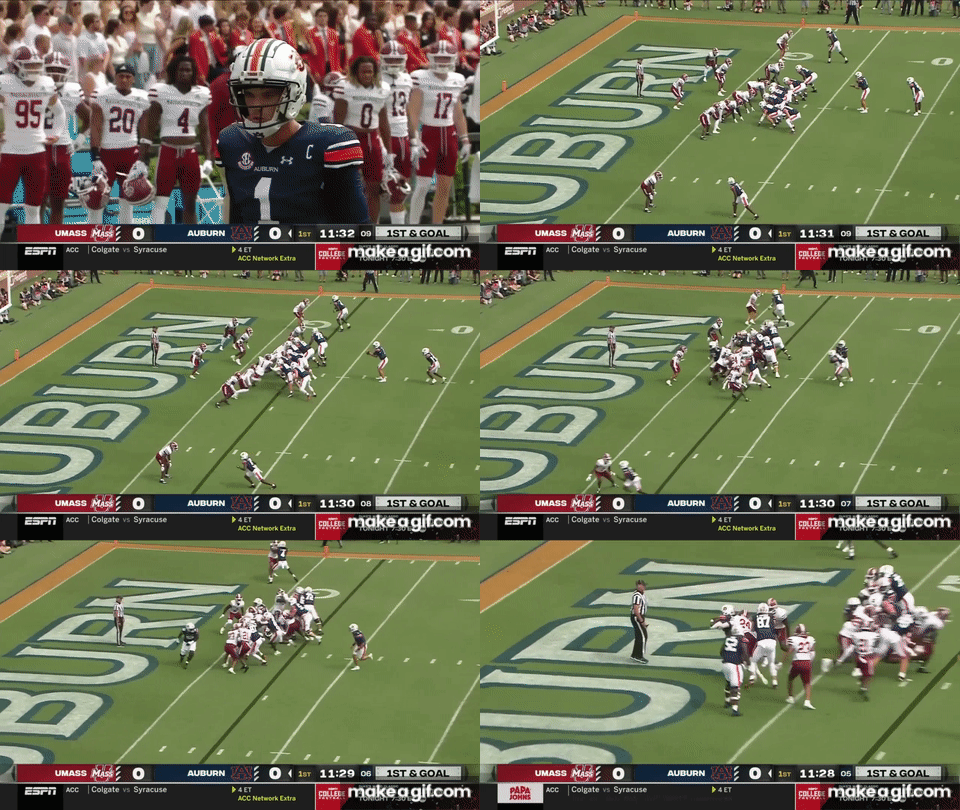
After UMass marched right down the field on Auburn’s defense (more on that later) and another solid return from Brian Battie, the Tigers moved efficiently down the field, reaching the edge of the Minutemen’s red zone in eight plays. On this play, we see the first hint of what was to come for Auburn’s red zone offense with Robby Ashford’s first carry of the game. This is just a basic counter scheme, a staple of Gus Malzahn’s Auburn offenses; it’s blocked the same as the GT counter play I mentioned earlier, but with the H-back replacing the tackle in wrapping to the playside LB. This play adds the RB to the blocking scheme as a lead blocker. Robby shows a quick pass drop (I don’t think there was any pass tagged on the backside), almost like a QB draw, which allows the blocking scheme to set up before he takes off for a big gain. More of this to come.
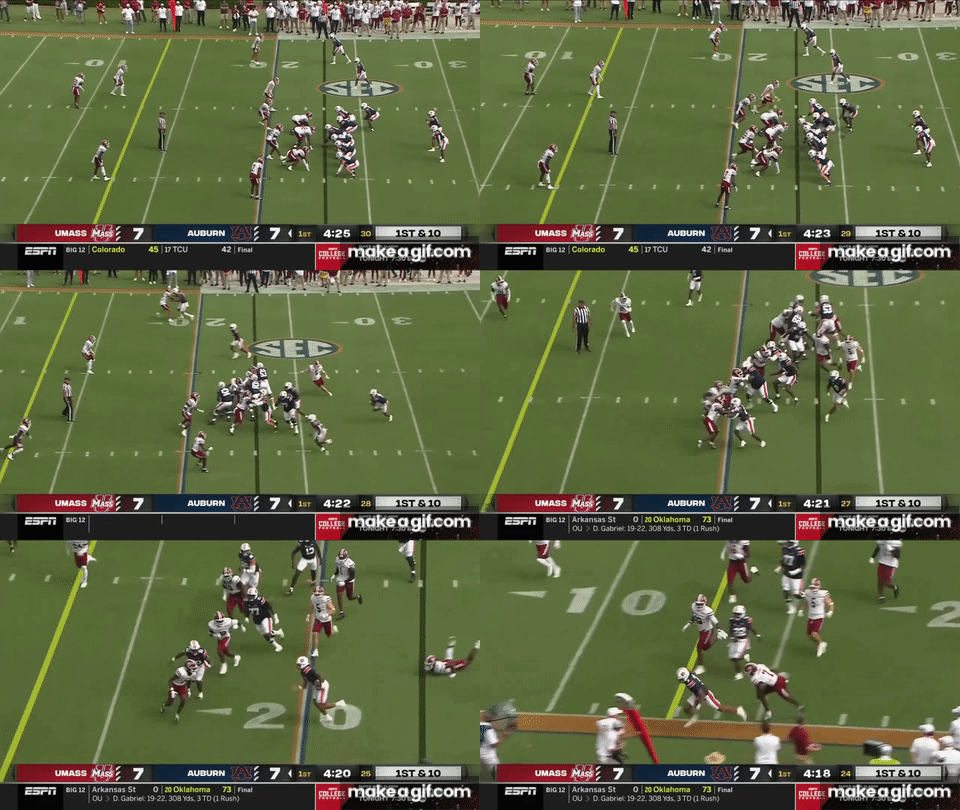
On UMass’ subsequent possession, the Auburn defense forced a three and out, which was followed by a great punt return by Keionte Scott, setting Auburn up with great field position at the UMass 16. After a good gain on first down, Auburn had 2nd and 4 at the 10. Here the Tigers line up in an unbalanced set with two receivers and a tight end to the left. The H-back on the backside of the formation motions over to the strong side as well, giving Auburn a big numbers advantage, which they then used to run a QB sweep with Robby. The Tigers had so many extra blockers, in fact, that the RB doesn’t even have anyone to block, and Robby takes it into the end zone untouched. (Sorry for the gif being not great, blame ESPN not me.)
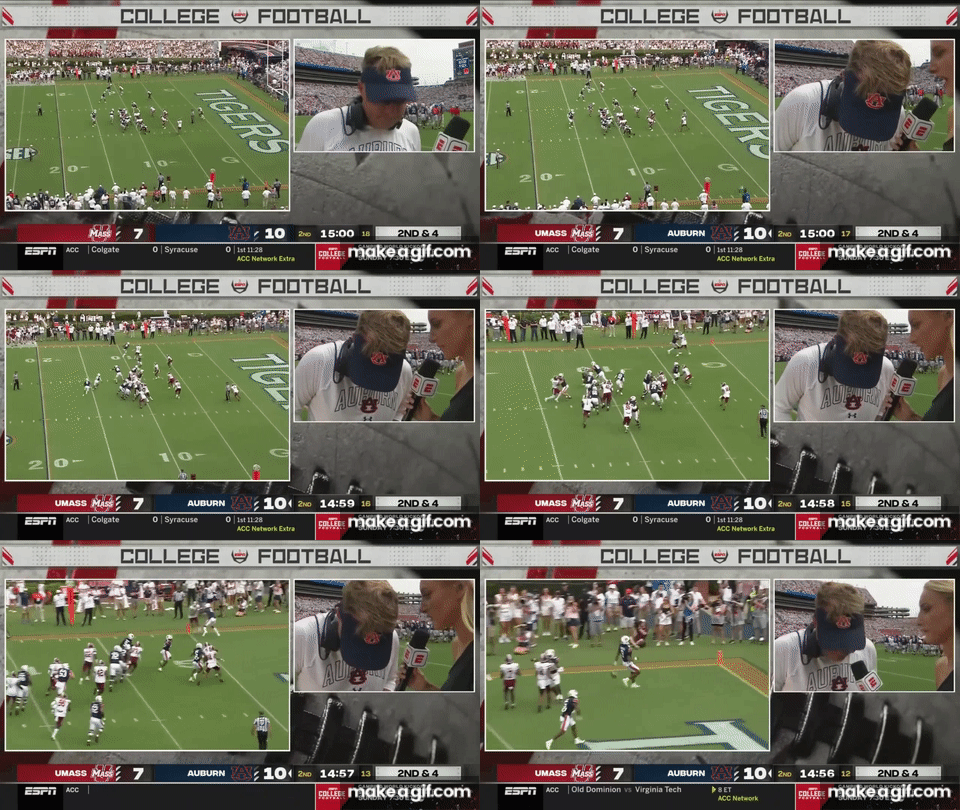
Auburn’s defense forced yet another punt which yielded good starting field position, but the offense was set back by a holding penalty. On the ensuing 1st and 20, Auburn goes to the air, running some type of crossing concept from a trips set (TV camera angles suck for analyzing the passing game but I don’t have an all 22 of this game so it’ll have to suffice). There’s really nothing there for Thorne, but he does a good job of eluding the rush, escaping from the pocket, and keeping his eyes downfield. He delivers a good ball throwing across his body and hits Shane Hooks along the sideline for a first down.

Two plays later, the Tigers faced a 2nd and 8 at the UMass 47. Here they went back to the vertical choice series, but this time it was single choice. Shane Hooks seems like the prototypical X receiver for this type of offense, a big guy with great range and enough speed to take the top off of a defense. This time, he isn’t able to get over the top of the corner in man coverage, but he does a good job of throttling down and using his body to shield the defender and Thorne delivers a good ball to his back shoulder for a first down.
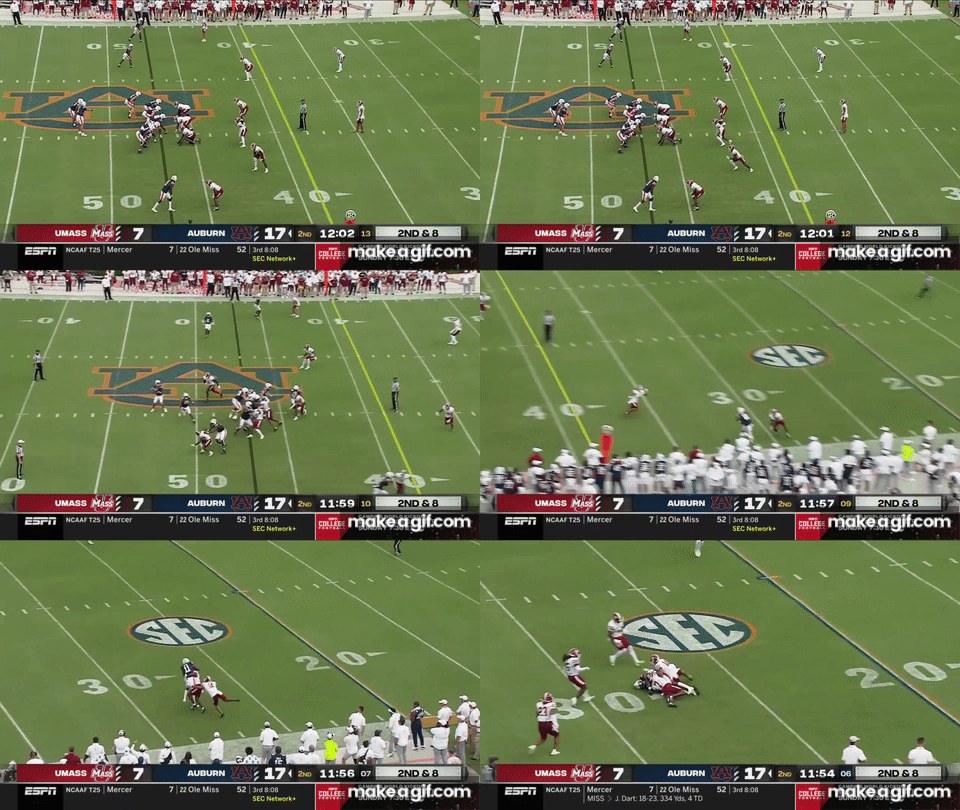
Later in that possession, with Auburn in the low red zone, the Tigers once again turned to Robby Ashford’s legs to get the ball across the goal line. They line up in an unbalanced formation with an extra tackle over on the left side of the line, along with three receivers bunched to the left. This is a zone read play with what basically amounts to a pre-snap RPO. I think the read here was just to count how many defenders they put out on the bunched receivers; if you have numbers, throw the screen, otherwise it’s dead. UMass matches the bunched receivers three for three, so Robby runs the zone read, the edge defender is so far out of position it barely even looks like an option play and he walks in untouched again. It’s also worth noting that Auburn had run this exact same play on the previous play, exploiting UMass’ vulnerability through tempo.

After the Tiger defense got a strip-sack on Minutemen QB Taisun Phommachanh, the offense was set up at the UMass 35. On second down, the Tigers once again go with the slot choice concept, and again because UMass is in man coverage and Ja’Varrius Johnson has outside leverage on the safety, it turns into a slot fade. (It’s possible that this was just a called slot fade concept, I’m not entirely sure since it’s the same result.) Thorne actually delivers a good throw on the fade route for once and Johnson is able to hold on to set the Tigers up with a goal to go situation.
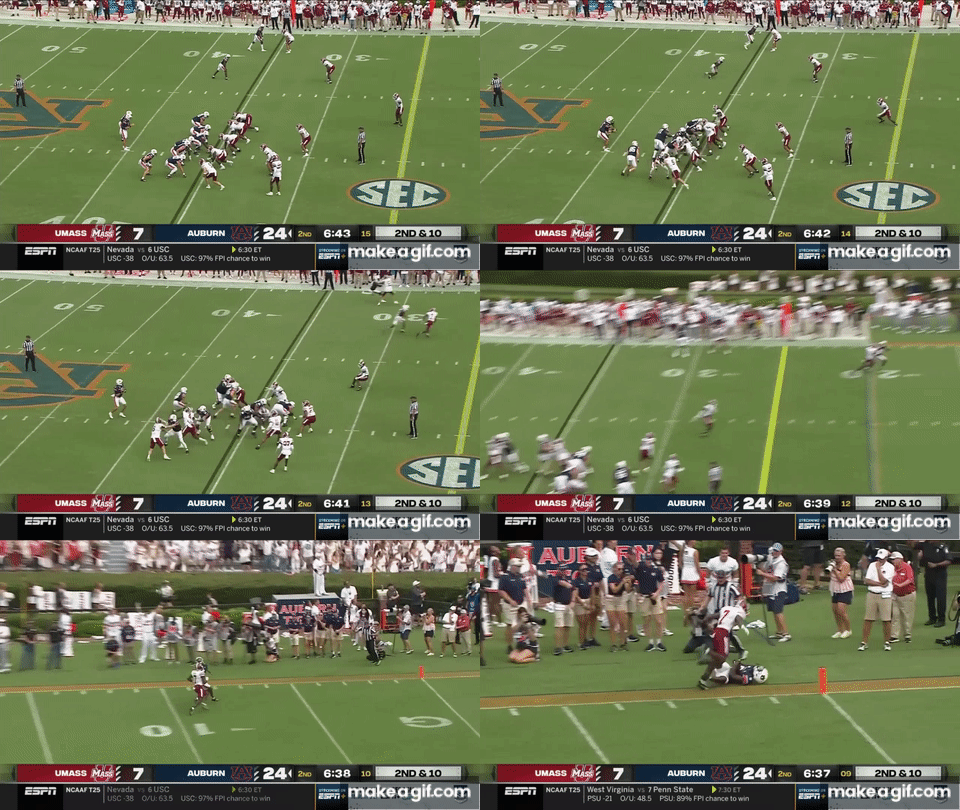
Following a couple of unsuccessful running plays, Auburn found themselves in a 3rd and goal from the 4. Unlike the other situations where Robby was in the game in the low red zone, the Tigers put the ball in the air here, or at least planned to. Working from the pistol, Auburn ran a bootleg off of arc read action using a flood concept, where the goal is, as the name suggests, to flood zone coverage with more receivers than it has defenders; in this case, UMass is in man, so the goal for the receivers is just to beat their man. Nobody is really open, but Robby makes the best of it and is able to sneak inside the pylon for six.
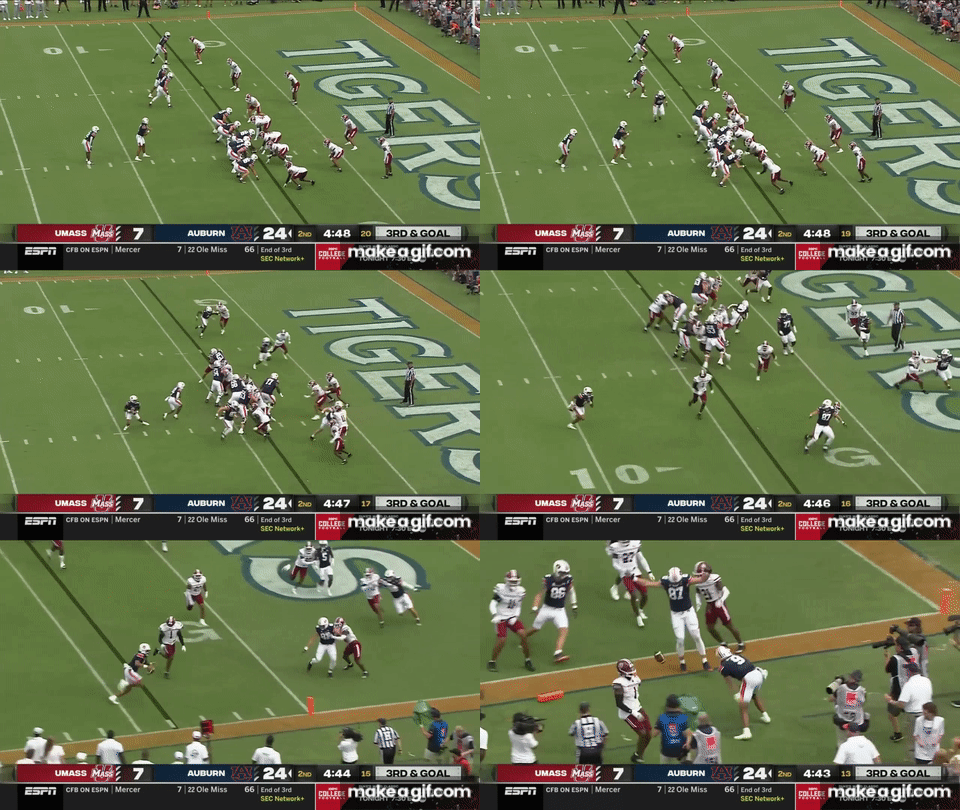
In the second half, UMass threw a pick six on their second play from scrimmage, then committed a penalty on the ensuing kickoff, backing them up against their own goal line. After a three-and-out and a poor punt, Auburn had prime field position at the UMass 30. The Tigers wasted no time taking advantage of their good fortune. The offense is lined up with trips to the left. The call here is a variation on the four verticals concept (in real time I thought this was a vertical choice, but after further review, I don’t think it is). The #2 and #3 receivers, Jay Fair and Jyaire Shorter (I think), take a switch release, which means they cross over one another’s route stems (switching vertical lanes), with Fair on a post route. UMass is in some type of match-quarters coverage, where defensive backs will play quarters by default but with special rules telling them to match particular routes by the receivers near them. The boundary safety decides, for reasons known only to him and God, to close down on Damari Alston checking down underneath, leaving his zone vacant and leaving Jay Fair wide open. A total coverage bust, and Thorne delivers a good ball here and hits Fair in stride for the easiest touchdown toss of his life.

Following an exchange of punts and a UMass turnover on downs, the Tigers took over yet again in UMass territory, and yet again it was a one-play touchdown drive. Jeremiah Cobb got a lot of hype for a freshman fourth-string RB this offseason and this play gives us an idea of why that was the case. The kid has wheels. This is a basic inside zone read. Robby is reading the backside defensive end, while the two tight ends on the backside of the play block the perimeter defenders (known as an arc scheme), lead blocking in the event of a QB keeper. However, the DE stays home, so Robby hands the ball off to Cobb and he does the rest. This wasn’t even a bad run fit by UMass, he just found a small crease and hit it.
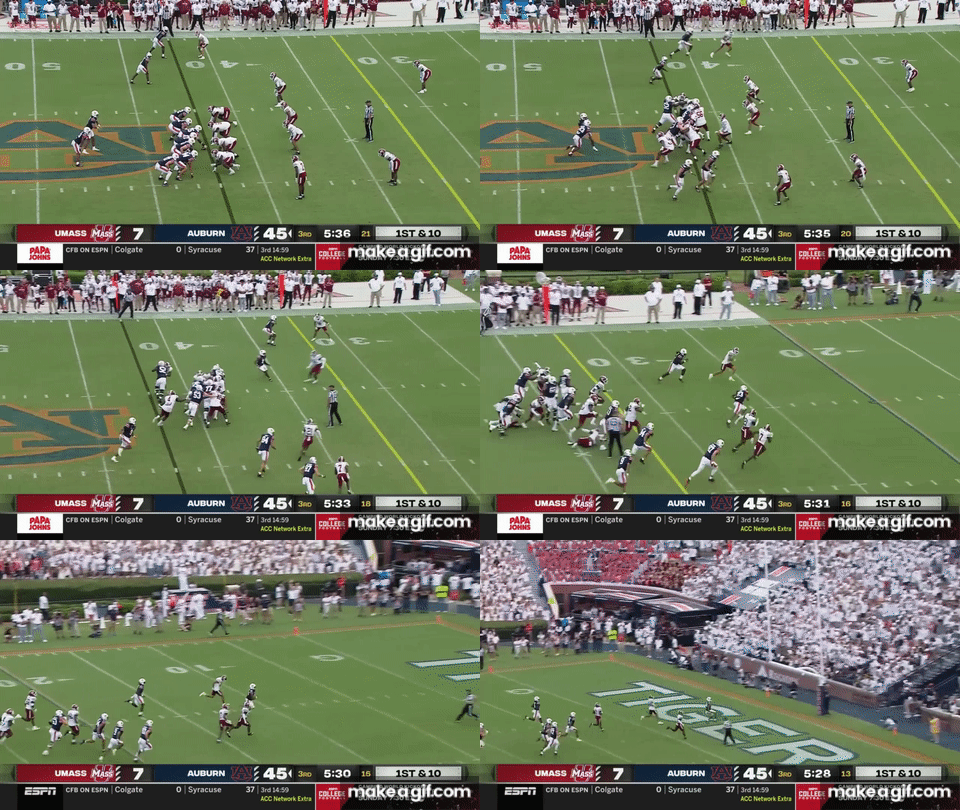
Skipping ahead a bit to the fourth quarter, after UMass found their second touchdown of the day on a one play drive of their own, third-string QB Holden Geriner checks into the game, and he immediately impressed. On 1st and 10 from their own 22, Auburn goes with the third part of the vertical choice series, the outside choice. As we’ve discussed before, this play goes to the two-receiver side of the formation, where the outside receiver will run the choice route and the slot receiver will run a bender to the middle of the field to pull the playside safety away from the choice route. Malcolm Johnson, Jr. isn’t really able to get a lot of separation from the corner in man coverage, but Geriner delivers a perfect ball to his back shoulder, and MJJ uses his body to shield the corner and make the catch for a big gain.
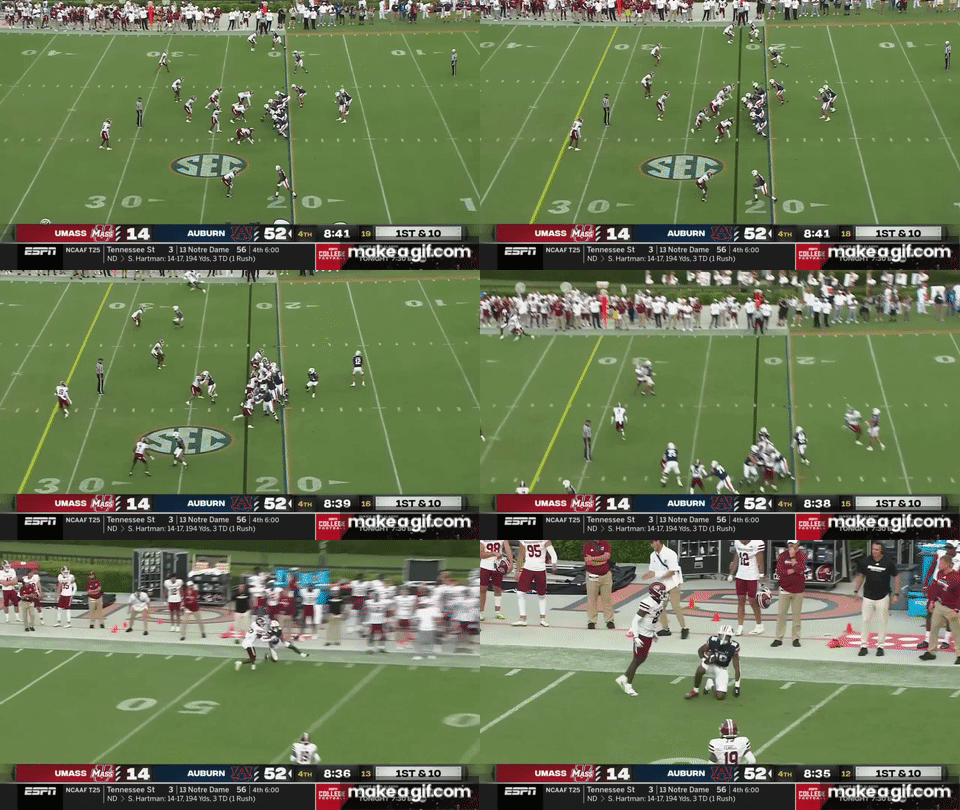
Two plays later, the Tigers cashed in on the ground again for their final touchdown of the game, with Sean Jackson doing the honors this time. Auburn is in a standard 11 personnel set and runs GY counter, one of their most-repped run concepts in this game (unlike Gus, Freeze and Montgomery seem to know that it’s legal to run counter to both the right and left). Jackson follows his blocks through the hole, but then he sees that the LB has overpursued and the strong safety has taken a bad angle, so he cuts it back and finds himself with only the free safety to beat. He whiffs the tackle completely and Jackson is off to the races, becoming the fourth different Tiger to score on the ground in this game.

I don’t want to spend much time looking at garbage time plays, but there’s one more nice Geriner-MJJ connection that’s worth watching. This time, MJJ is lined up as the single receiver, and Auburn runs single choice in his direction. Much like the outside choice they ran on the earlier possession, MJJ can’t beat the corner deep, but again, Geriner delivers a beautiful back shoulder throw for a first down. Interestingly, the backside receivers run a bubble screen here rather than the usual “do nothing” on the backside of vertical choice, but I don’t know if Geriner actually had the option to throw it.

Anyway, that’s enough offense for now, let’s take a quick look at the other side of the ball before we wrap things up.
DEFENSE
On the Tigers’ first defensive rep of the game, we see an indication of some of the problems that were to come for Auburn’s run defense, which surrendered more than 5 YPC in this game. I’m not entirely sure what UMass is running here, as the run blocking looks pretty discombobulated. Auburn gets good penetration at the point of attack, but the defensive linemen overpursue, and Ole Miss transfer Austin Keys does as well, allowing the RB to cut back and comes up just short of a first down.
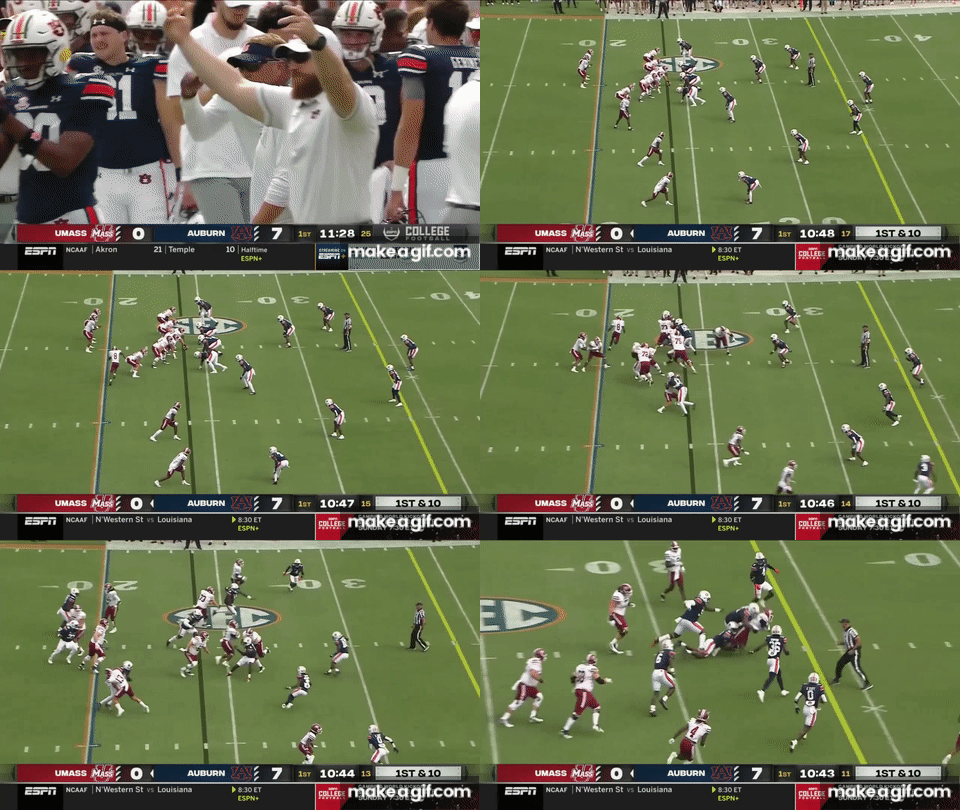
On the next play, Minutemen QB Taisun Phommachanh (who continues the tradition of Clemson transfer QBs with impossible-to-spell names) drops back for his first pass of the game. I can’t tell what concept UMass is running, but Phommachanh sees a lot of open grass in front of him and takes off; Auburn is in man or pattern-matching coverage and leaves the middle of the field wide open. North Texas transfer LB Larry Nixon III, playing the “jack” (overhang) position, has a chance to bring him down, but Phommachanh slips the tackle and gets the first down.

Two plays later, Phommachanh gashes the Tigers on the ground again. UMass lines up in a two-back set and runs the same arc read concept we discussed above. The DE pinches, giving Phommachanh a pull read, and LB Cam Riley, who I assume was supposed to take the QB, gets sucked inside and is an easy target for the arc blocker, allowing Phommachanh to break free for a big gain into Auburn territory.

On the next play, UMass again goes to the arc read concept, this time from a pistol alignment, motioning a receiver to block on the perimeter. This time, however, Phommachanh hands the ball off. The RB bounces the ball to the outside and, stop me if you’ve heard this one before, DJ James overplays it, allowing the RB to bounce to the outside and get down the sideline to set up first and goal. The Minutemen would punch it two plays later on a QB sneak to tie the game (I’m not going to break down a QB sneak because it isn’t really interesting).
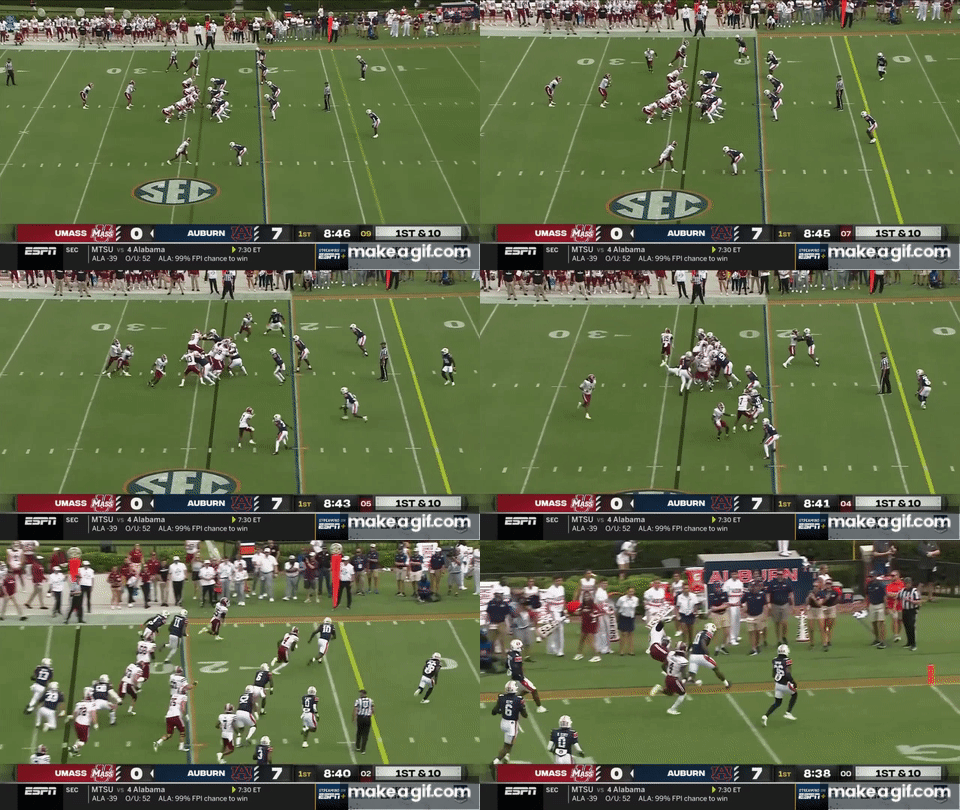
The rest of the first half isn’t really worth going through in a ton of detail. Phommachanh hurt his leg/knee, which limited his mobility and took away the most dangerous part of UMass’ offense up to that point. The first drive illustrates the problems with Auburn’s defense well enough: misfits against the run, poor pursuit angles at the second and third levels. However, I do want to look at a couple of clips that demonstrate Auburn’s solution to the problems that they encountered on the Minutemen’s first drive, which was also my typical solution to defensive struggles in NCAA Football when I was a kid: send the house.
Midway through the second quarter, UMass finally got another drive going, picking up a couple of first downs and getting into Auburn territory. On 1st and 10 on the Tigers’ 46, Phommachannh drops back to pass. I don’t know exactly what this play was, but it looked like some type of curl-flat concept. Nickelback Donovan Kaufman, with his side vacated by the motion man, comes on the blitz off the edge, beating the UMass tackle with pure speed and hitting Phommachanh from his blindside, forcing a fumble which was recovered by Auburn safety Jaylin Simpson.
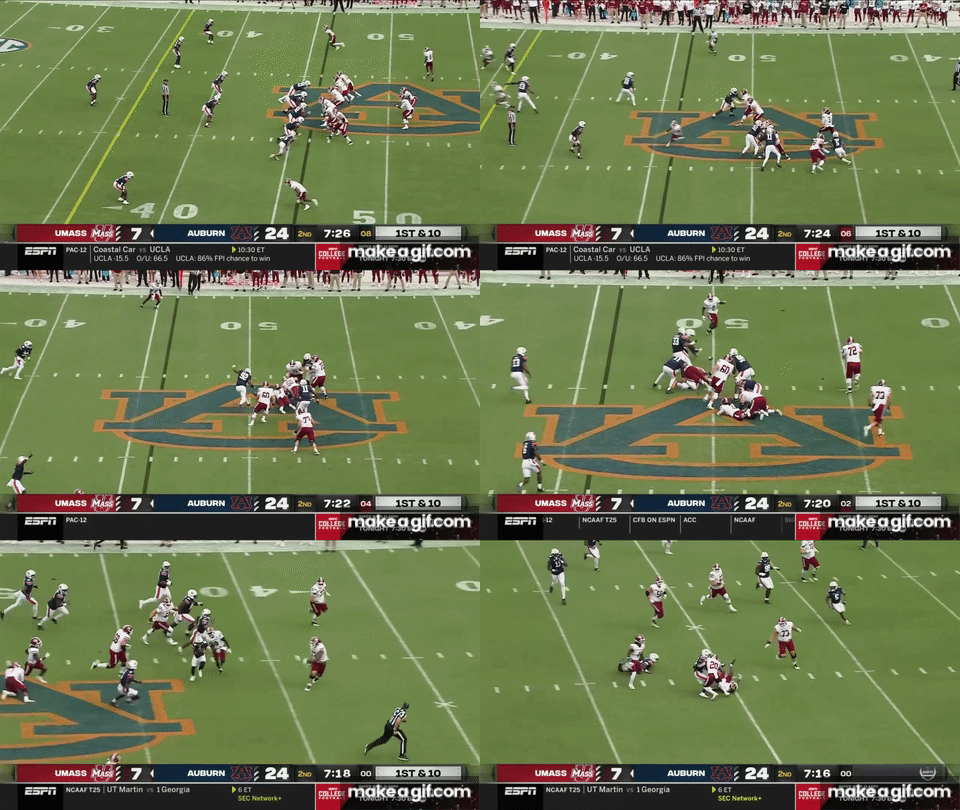
Another good example of the Tigers’ aggression paying off comes on the second play from scrimmage in the second half. UMass had good field position after Auburn kicked the ball out of bounds on the opening kickoff, desperately needing a score to keep any hope of a comeback alive. This is an RPO where UMass combines split zone (an inside zone run where the H-back comes from the backside to kick out the playside end, creating split flow) with a quick out route by the slot receiver. UMass is keying the nickelback, Donovan Kaufman, to decide whether to hand off or throw. Kaufman comes on the blitz here, giving Phommachanh an automatic throw read. However, Kaufman manages to get to Phommachanh, unable to sack him but forcing him to rush the throw enough that it’s behind the receiver, allowing Jaylin Simpson, who had rolled down to cover the slot receiver after Kaufman blitzed, to pick it off, and from there it was taillights.
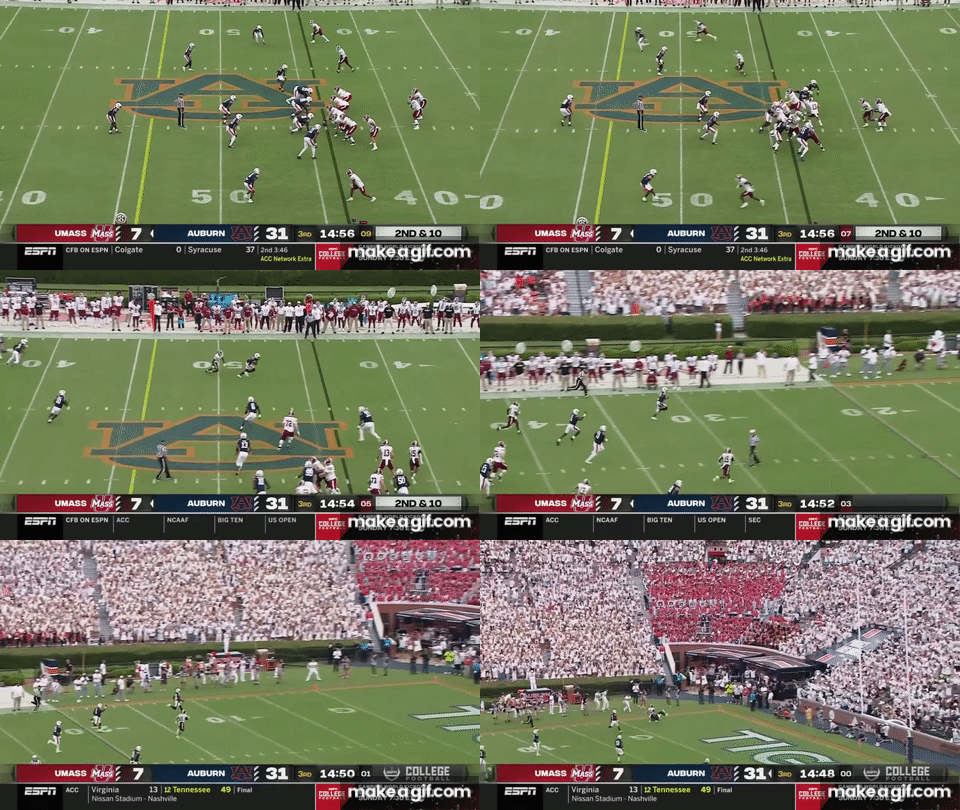
The last defensive play I want to look at is the second UMass touchdown, a one-play drive against a heavily-rotated Auburn defense. This is an RPO with an inside zone run paired with a bubble screen. The H-back goes in motion to the flat to serve as an extra blocker for the bubble screen. Phommachanh sees that he has the numbers on the perimeter, so he throws the screen. Freshman corner Colton Hood overruns the play, so the receiver cuts it back and flies past LB Robert Woodyard, Jr. and Baylor transfer safety Griffin Speaks (who takes a poor pursuit angle) and is off to the races.

Kind of a sour note to end on, but it wasn’t a great performance for the defense overall, at least during the brief window where the game was in the balance.
CONCLUDING THOUGHTS
Obviously, all of this analysis comes with the caveat that this was a season-opening bodybag game against UMass, which was one of the worst teams in the FBS last season. That said, I do think we have some general trends to watch for the rest of this season.
First of all, on the offensive side of the ball, Auburn’s run game was impressive, as was the performance of the Tigers’ offensive line in general, which handled UMass’ pressure-oriented defense well, giving the Tigers’ QBs plenty of time to throw and opening gaps consistently in the run game. We knew that the RB room was a strength of this offense, and this game showcased the depth at that position with Jarquez Hunter unavailable. The Tigers’ QB play was less convincing, with Thorne in particular missing some opportunities and throwing balls that might well have been intercepted by SEC defenders. He’s still learning the ropes of the offense, so I don’t want to rush to judgment, but it wasn’t a sterling debut for the Michigan State transfer. Robby Ashford, on the other hand, did well in his role as the Tigers’ red zone weapon of choice, but Freeze and Montgomery will have to figure out a way from keeping the two-QB system from becoming too predictable.
In terms of scheme, the Tigers’ offense looked much like we anticipated it would. Tempo, primarily 11 personnel with some two-TE and four- and five-WR sets thrown in, RPOs, read option plays, and the occasional vertical choice pass. I would’ve liked to have seen more from the Tigers’ passing game in general, but it sounds like the coaching staff chose to keep things close to the vest and keep running the ball when it was working, which makes sense in a game like this. We’ll see how the gameplan looks against a much better opponent next week.
On the defensive side of the ball, the Tigers’ secondary held up better than expected, although UMass doesn’t have a ton of weapons at WR and Taisun Phommachanh, not known for his arm in the first place, was further limited by injury. Auburn’s front seven, particularly the LB corps, was as much of a work in progress as it was portrayed to be during the offseason. Lots of missed assignments and poor run fits allowed UMass to chew up yards on the ground early in the game, and they may well have continued to do so had Phommachanh been fully healthy. The defensive line struggle to consistently get pressure with four rushers and most of Auburn’s QB pressures and tackles for loss came from plays where Auburn brought five or more rushers, most often from the nickel/”star” position. This worked fine against a QB and receiving corps that couldn’t punish the Tigers’ blitz-happy approach, but that won’t be the case later in the season, and if Auburn doesn’t find a way to pressure the QB and create negative plays with four rushers, it could be a long season for the Tigers’ defense and we could be in for a lot of shootouts.
I’ll have another post up later this week with a preview of Auburn’s next opponent, those noted Atlantic Coast denizens, the Cal Bears.

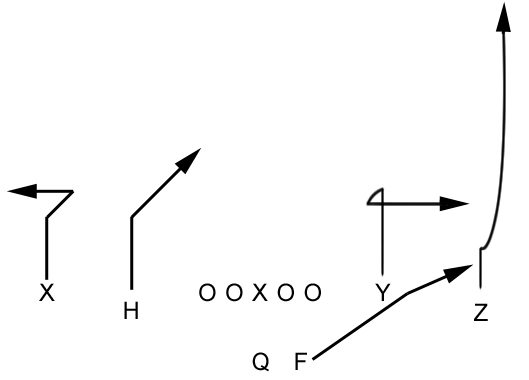
-
Subscribe
Subscribed
Already have a WordPress.com account? Log in now.
 Auburn Analysis