-
What will Auburn’s offense look like in 2023?
Well, it’s a New Era™ on the Plains…again.
Auburn will start the 2023 season with its third head coach in four years and its sixth new offensive coordinator (excluding interims) in the past six years. It should come as no surprise that Auburn’s offense has spent most of that six-year span underperforming, lacking a clear identity and undermanned, particularly in the trenches. There seems to be more optimism among Auburn fans than the last few rounds of coaching turnover have produced, but with so many new faces on both the coaching staff and the roster, there’s a lot of uncertainty for Auburn on the offensive side of the ball going into 2023.
So what will Auburn’s new offense look like? That’s what we’re going to try to figure out today.
HUGH FREEZE AND THE RPO
When asked about the identity of his offense, Hugh Freeze has described his system as an up-tempo, 11 personnel, RPO offense. In other words, a hurry-up, no huddle offense that’s going to have three receivers, a tight end or H-back, and a running back on the field most of the time, and will feature a lot of runs with screens and quick passes attached, along with some deep play-action to keep the defense honest.
Sound familiar? It should! As you may or may not have heard about 500 times by now, Hugh Freeze and Gus Malzahn are friends, and Freeze has acknowledged Malzahn’s influence on his offensive thinking. However, even though their offenses are similar on the surface, they don’t really come from the same place. Freeze’s and Malzahn’s offenses are a case of what biologists would call convergent evolution, where two species that aren’t closely related become similar to one another because they face similar evolutionary pressures. While Gus Malzahn’s offensive roots went back to his time coaching the Delaware Wing-T system as a high school coach in Arkansas, Freeze, from what I can tell, has been a spread guy since the beginning. We’ll get into some of the implications of that difference later on, but I thought it was important to point out because of the parallels between the two.
When these two first entered the SEC (Malzahn in 2006 and Freeze in 2011), their brand of spread, up-tempo football was a novelty in a conference that had been dominated for decades by traditional three-yards-and-a-cloud of dust football (with a few notable exceptions, like Steve Spurrier’s Fun-and-Gun at Florida and Hal Mumme’s Air Raid at Kentucky). Now, as Freeze makes his return to the SEC 12 years later, that’s not the case. That’s not to say Freeze’s offense is outdated, it’s not, it’s just that the offensive meta in college football has converged toward what he and Gus have been doing for a couple of decades.
So what distinguishes Freeze’s offense from your run of the mill college spread offense? Honestly…not that much. You’ll see the standard three- and four-wide receiver shotgun and pistol sets, along with an occasional empty or heavy set. The run game is mainly built around inside zone, with some outside zone and gap schemes like power and counter mixed in. Unlike Gus, whose Wing-T background inculcated him with a love of gap schemes (power, counter, trap, and buck sweep) before working with RichRod protégé Herb Hand at Tulsa introduced him to the zone read, Freeze’s spread background is more zone oriented, with the gap schemes as a secondary part of the offense.
The passing game, although a bit more expansive than Gus Malzahn’s, is fairly standard for the college level as well: quick game concepts like stick, snag, and fade-out, dropback concepts like shallow, smash, and four verticals, and deep shots and bootlegs off play-action. This isn’t a criticism, by the way. These standard concepts are standard concepts because they work. (If you don’t know what these terms mean, I intend to create a “football glossary” post at some point that includes clips of different concepts so that I have something to refer back to when I mention them instead of having to explain them over and over again).
The thing that distinguishes Freeze’s offense from other spread systems is how it’s packaged. The key to this is the run-pass option (RPO). The term is ubiquitous in college football these days (although it’s often misapplied), but what does it mean in practice? Really, it comes down to one basic concept: putting a defender in conflict. This works by identifying defenders who have a dual responsibility, i.e. covering a gap in the run game and a zone in pass coverage, and forcing them to choose between the two by threatening to run the ball or throw it to a receiver in their zone. The defender can’t cover both the run gap and the pass zone (Brent Dearmon, a Gus disciple, makes the apt analogy of “trying to serve God and Mammon”), so he’s got to choose, and whatever he chooses, the offense is going to make him wrong.
So how do you identify the conflict player? The conflict player will vary from game to game based on the opponent’s defense, so part of it is just gameplanning, but as a general rule, it’s usually going to be an outside linebacker, nickelback, or inverted safety, who will often line up over the slot receiver in a three-receiver set (sometimes referred to as the “apex” player).
Perhaps the simplest way to think about it is as a numbers game: the offense is reading the guy who would cause them to be outnumbered in the box. if you have six blockers and six defenders in the box, you have the numbers to run the ball, but you need to keep the defense from getting a seventh guy into the box, so you tag a quick pass that attacks his zone to give him a dual responsibility. The QB will put this guy under pressure by meshing with the RB, giving the appearance of a run play, and either handing it off if he drops into coverage or ripping it out and throwing it if he comes down to fill his gap.
Often, this post-snap read is combined with a pre-snap read on the backside of the play. In a three-receiver set, the defense will often leave the defender over the single receiver on the backside in one-on-one coverage, and the QB is sometimes told that if he likes what he sees there, he can throw it out there; for example, if that corner is playing soft coverage, he can throw a quick hitch to the single receiver.
Here’s a clip of the man himself explaining it in an interview with Trevor Matich back in his Ole Miss days:
In terms of the actual concepts employed, there are almost infinite permutations of the RPO. The most common form of RPO a base run play like zone or power paired with a quick screen or some type of quick-hitting route like a stick or slant. Again, this can come down to gameplanning, and offensive coaches will often mix-and-match the run and pass components of their RPO game based on what type of defense their opponent is using and which defenders they want to attack.
Okay, enough wall of text, let’s get to some film and see how this works in practice. These clips are from Liberty’s 41-13 home win over Middle Tennessee State in 2021 and Liberty’s 36-34 home win over Florida International in 2020.
First, we’ll look at the simplest phase of the RPO, where the QB simply hands the ball off. This is a basic inside zone play with a bubble screen tagged to the backside. The pre-snap read (the single receiver running the fade) is dead because the corner is playing press, so the QB (former Auburn QB Malik Willis) goes directly to his post-snap read, the nickelback lined up over the slot receiver. He takes away the bubble screen so Willis hands the ball off and it’s a successful run on first down to set up a second and short.
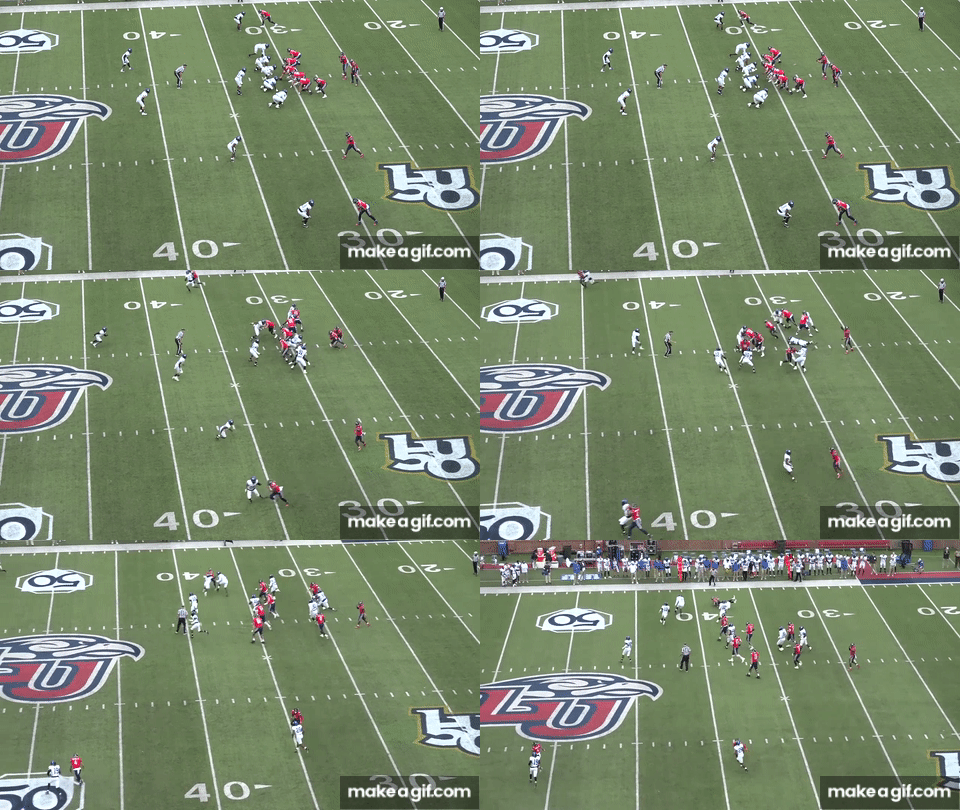
This next clip is another example of using the threat of a quick pass to open up the run, but in this case it’s tagged to the backside of a read option play rather than a simple give-or-throw read. Here Liberty is running some type of pin-and-pull or bucksweep scheme (it’s hard to tell the two apart sometimes) with Willis reading the backside defensive end for give or keep, with the option to throw a bubble screen to the slot receiver should the slot defender crash down on Willis if he keeps. That doesn’t happen here and he’s able to pull the ball and get a decent gain.

An interesting note is the playside tackle pass-setting rather than run blocking the DE to draw him upfield and open up the lane for the RB to bounce the ball into the B gap. It’s an interesting way to run the ball against a bear front, which would usually preclude running inside zone (a problem that Gus never solved in his time at Auburn).
Second, we’ll look at a few examples of the second phase of the RPO, where the QB pulls it and throws the quick pass.
In this first example, Liberty lines up with three receivers bunched to the sideline, and they’ve paired their base inside zone run with a quick screen to the Z receiver. I’m honestly not sure how much of this was a post-snap read and how much of it was just Willis realizing he had 3 on 2 out there and throwing it (you can see the MTSU DB realizing he’s out of position and scrambling to get where he’s supposed to be), but it’s an incredibly “cheap” way for the offense to pick up yards, since they only had to block one defender. Football doesn’t have to be complicated: get there firstest with the mostest.
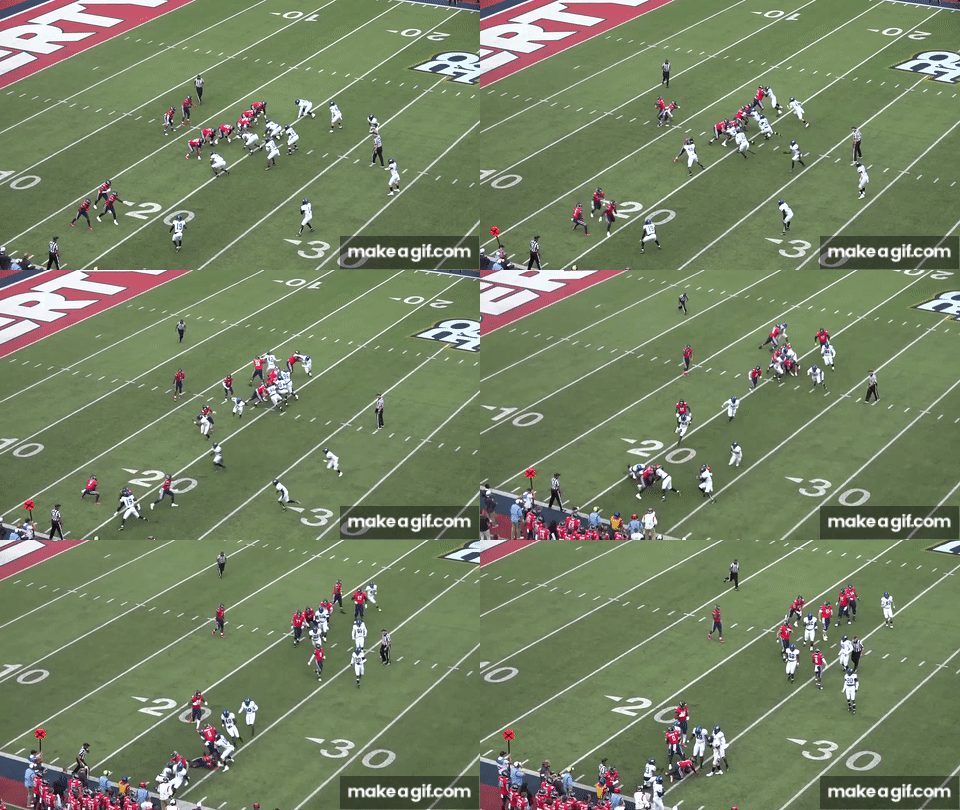
(I won’t post the clip but it’s worth noting that on the very next play, Liberty ran a pop pass off of this action, pump-faking the quick screen and looking to throw a wheel route to the #2 receiver which Willis badly underthrew right into the hands of a defender.)
In this example from the FIU game, Liberty incorporates motion into their RPO game, running a common RPO concept, pairing an inside zone run with an arrow route to the slot receiver motioning into the backfield (something Auburn frequently ran with the trio of Kerryon Johnson, Jarrett Stidham, and Ryan Davis in 2017). Motion pairs great with RPOs because motion puts additional pressure on the defense, forcing the conflict defender to commit more quickly or risk being outleveraged. In this case, the defensive end crashes down on the run, leaving the arrow open, and thanks to some good downfield blocking, they’re able to get a nice gain out of it.
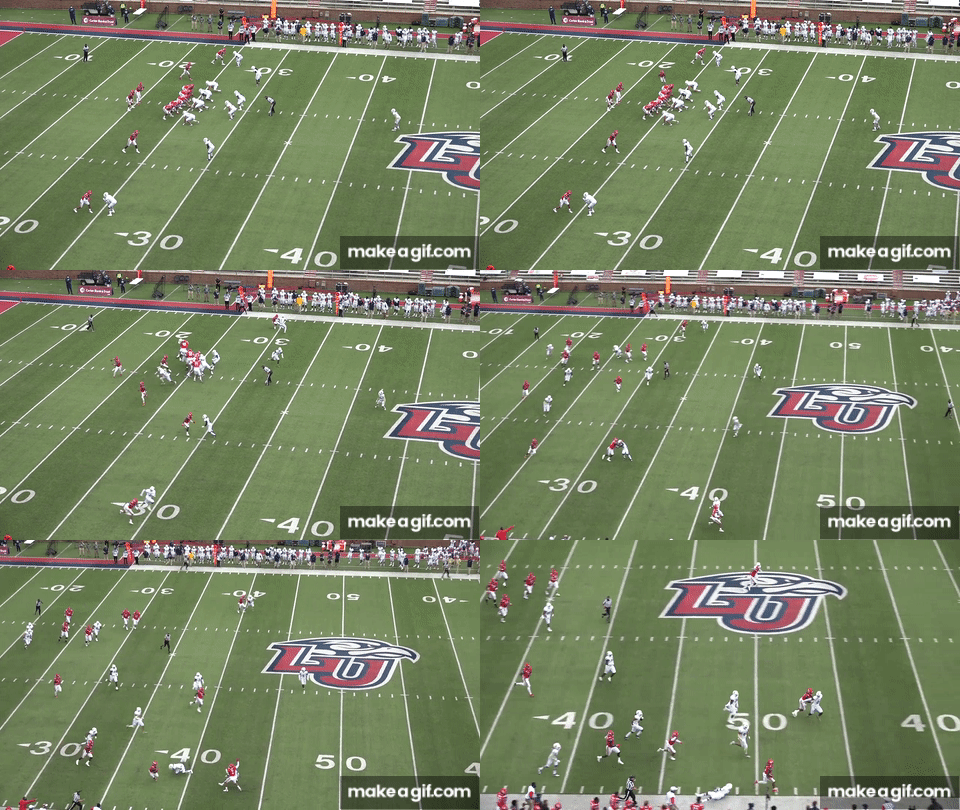
I’ll also include the end zone angle here so that you can really see the read on the conflict defender in action.
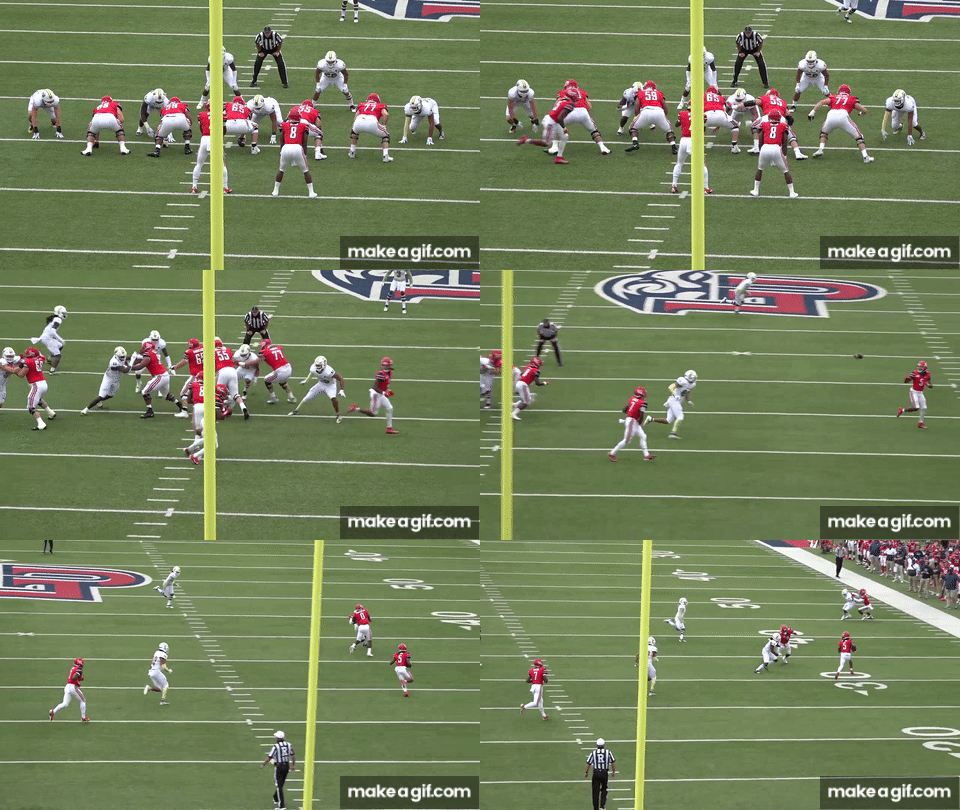
Finally, here’s a case of the QB throwing his pre-snap read. There weren’t many of these in the MTSU game because MTSU played a lot of press coverage, and generally pre-snap reads are going to take advantage of soft coverage with a route like a quick hitch.
This is an unbalanced set with both receivers on the left on the line of scrimmage. The Z receiver comes in motion across the formation pre-snap, probably to get the defense to show what coverage they’re in. The run call is CY counter, a variation on the standard GY counter concept with the center pulling and trapping the defensive end (instead of the guard) and the TE wrapping to the playside LB. The backside receivers run a quick screen, which is presumably the post-snap read. The motion man runs a speed out, taking advantage of the soft corner.
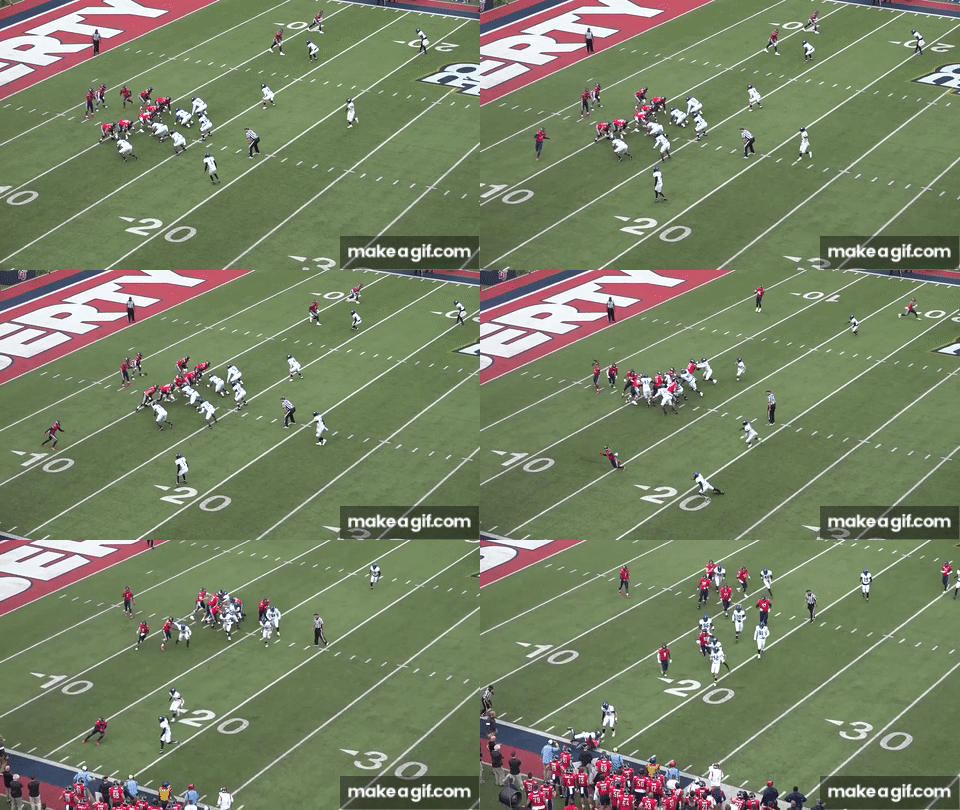
So what does the defense do to stop the RPO? There are two basic options: stay in zone coverage and use another defender to fill the conflict player’s zone, allowing him to play run full time, or just play man coverage so that the receivers are always accounted for. Any team that’s going to make the RPO a mainstay of its offense has to have answers for these two defensive tactics.
The simplest way to address the defense rotating its zone defenders is to run play-action and throw the ball wherever the support player came from. The defense is robbing Peter to pay Paul, so you’re going to go hit Peter up for money. For example, if the defense is going to keep the outside linebacker in the box and rotate the safety down, a deep vertical route that attacks that safety’s deep zone should be open.
Man coverage can also be attacked through play-action, but there are other options. For example, you can use man-beating pass concepts like the late Dread Pirate’s beloved mesh, or run a read option play like zone read or power read, which generally work well against man coverage. Man is a much tougher problem for RPO teams, especially if the other team has better Jimmies than you have Joes and can handle your top receivers one-on-one. This requires the offense to get creative to find solutions to these problems (finding what Brent Dearmon calls “manswers” in the video linked above).
BEGGARS CAN’T BE (DEEP) CHOOSERS?
Of course, Hugh Freeze isn’t the only new face on the offensive side of the ball for Auburn this year. The Tigers also have a new offensive coordinator, Philip Montgomery, who was fired after eight years at the helm of the Tulsa Golden Hurricane. Wait, Auburn hiring an OC from Tulsa? Why does that sound familiar?

Oh, right.
Before his time at Tulsa, Montgomery was the offensive coordinator at Baylor under Art Briles for four years, where he coached a guy you may have heard of named Robert Griffin III. From 2011 to 2014, Briles and Montgomery helmed an offense that put up video game numbers at a school that had been the doormat of the Big XII for two decades. So how did they turn a program that was an afterthought into one of the country’s most feared offenses, and how much of that might Montgomery be bringing to Auburn?
Briles’ offense (sometimes known as the veer and shoot, even though it has nothing to do with the split-back veer or the run and shoot) has a few unique characteristics that set it apart from its contemporaries. The first was its tempo, which was among the fastest in the country, giving Chip Kelly’s Oregon and Gus’ Auburn offenses a run for their money in that respect. However, the real secret sauce is in the receiver splits. Unlike a standard offense where the slot receivers are aligned near the hashes and the outside receivers are aligned near the numbers, the receivers in the veer and shoot take the widest splits possible, with the slot receivers on the numbers and the outside receivers almost touching the sideline. The reason for this is actually quite simple: stretch the defense as wide as possible and isolate defenders, turning zone into man.
This horizontal stretch of the defense was often used to run the ball, since it makes it nearly impossible to get players from outside the box into the box to support the run defense. Baylor’s run game was really simple, consisting almost entirely of inside zone and power, but the wide splits ensured they had equal numbers in the box to run against. However, the real reason for the wide splits was to get their track star receivers one on one with defenders so that Baylor could run their deep choice concepts.
The basic premise of the deep choice is that the offense will tag a single receiver to run a deep route, giving him the option to adjust that route based on what the defense is doing. If the defender is trying to play press and get in his face, he’ll run a go route to get behind him; if the defender is backing off and playing soft, he’ll run a stop route; if the defender is outside of him (or if the safety vacates the middle of the field), he’ll run a post. The basic idea, as Briles summarized it, was “find grass and run fast”.
As for the rest of the play, the offensive line and backs were in max protection with seven pass blockers to allow the deep choice receiver time to get open. The QB will give a play-action fake and then he’s locked on that deep choice guy, looking to throw him open. The QB and receiver have to be on the same page and make the same read of the defense, otherwise the throw won’t go to the right place. Perhaps the most radical part of the play is the other receivers. Their responsibilities differ based on their location: if they’re inside the deep choice runner, they run a post to pull the safety away; if they’re outside the deep choice runner, they’ll run a curl to hold the corner on the outside; and if they’re on the opposite side of the field, they do nothing to conserve their legs. Because the other receivers aren’t doing anything, the deep choice is very much bang-or-bust. Either the deep choice runner gets open and it’s a big play or he doesn’t and the offense has nothing, which a lot of offensive coaches aren’t comfortable with.
Let’s take a look at each component of the deep choice series individually. These clips are from Baylor’s 60-14 home win over Kansas in 2014, Montgomery’s last season as the Bears’ OC. Obviously I would have preferred to use film from his more recent offenses at Tulsa but all 22 film of Tulsa’s offense is much harder to come by. On an unrelated note, I realized that this film was actually posted by one of Kansas’ DBs in this game, which is like willfully uploading a video of your high school bully stuffing you into a locker.
First, the single choice, where the single receiver runs the choice. This is the ideal situation for single choice, because the corner is in press coverage and the safety isn’t really in position to help. The X receiver gets over the top of the corner, and then it’s just “find grass, run fast”:
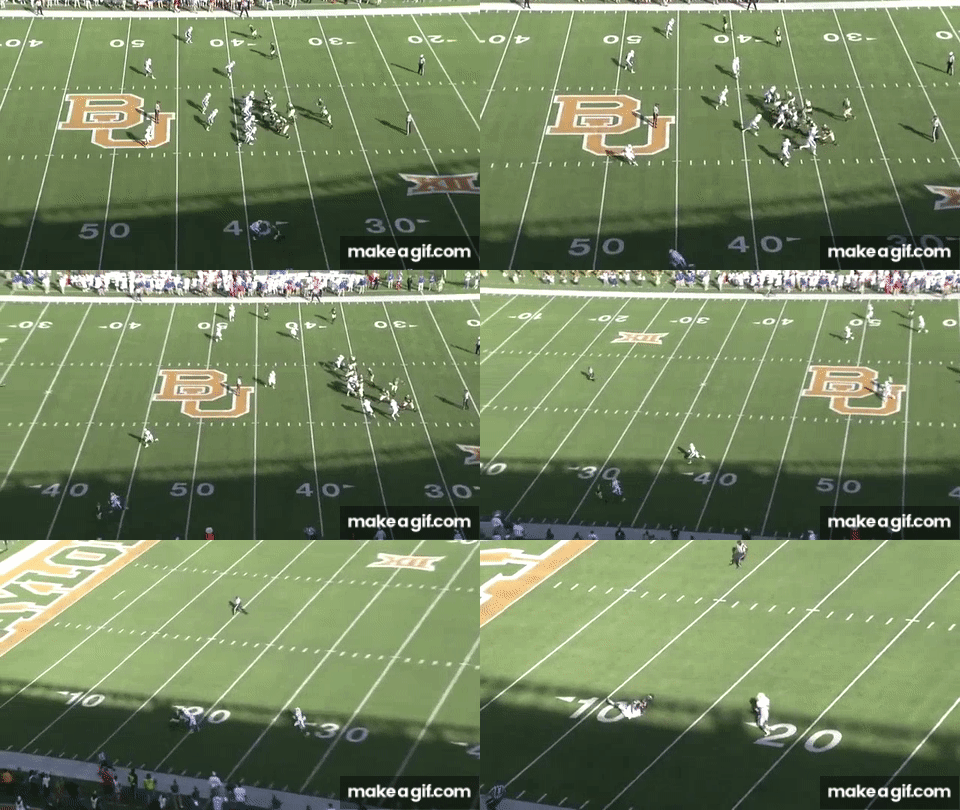
Second, the slot choice, where the inside receiver on the two-receiver side runs the choice. The outside receiver’s stop route holds the corner, leaving the slot receiver plenty of room to the outside that he can use to get separation from the safety. Even with some shenanigans by the safety, he’s able to bring the pass down and score. The only thing more embarrassing than committing DPI is committing DPI and still getting scored on.

I should point out that unlike single choice and outside choice, the QB actually does have a progression to read on slot choice. If the corner bails hard and drifts into the deep space the slot is trying to attack, he can throw the stop route to the outside receiver. That’s what happens here, and it’s open even though the throw is behind him and it’s incomplete. Note that the safety manages to stay over the top of the choice runner here, so he also runs a stop route. Baylor would often use these stop routes to set up double-moves, pump faking the stop and then throwing the go route, one of their most reliable sources of big plays.
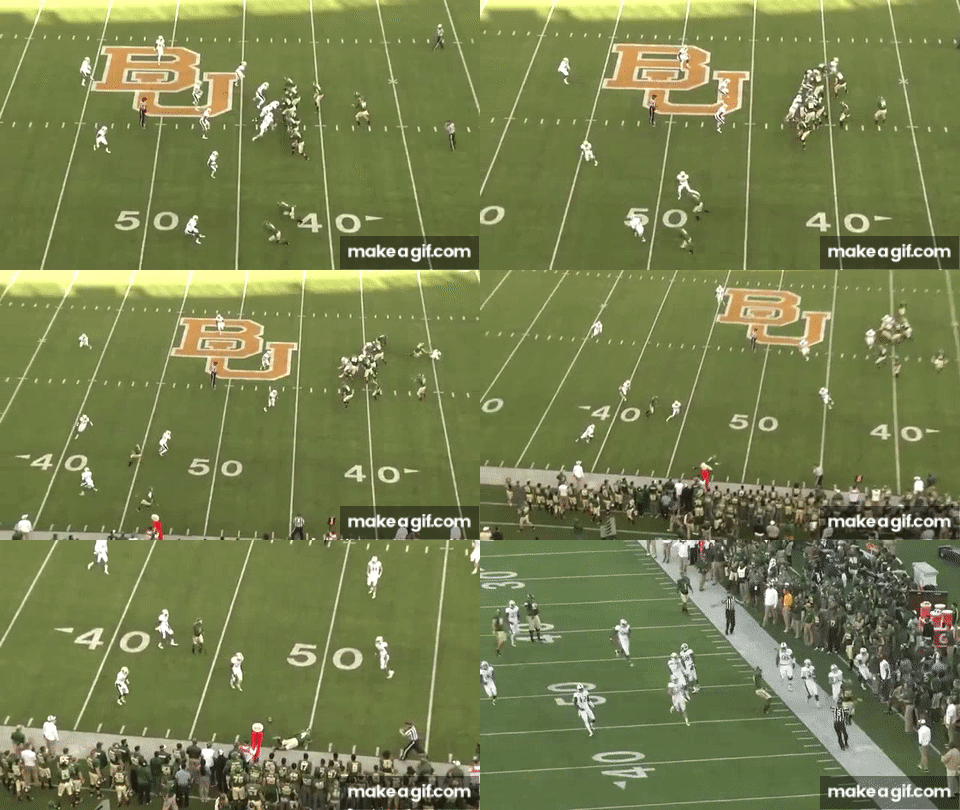
Finally, the outside choice, where the outside receiver on the two-receiver side runs the choice. In this case, Baylor used one of their favorite tactics when running outside choice, combining their extremely wide splits with a stacked formation to further confuse the defenders about their responsibilities. The WR beats the corner deep, but even though the throw is behind him, he succeeds in drawing a pass interference penalty. Monty was a trailblazer in the #AllPIOffense too, I guess.

I’m realizing now that all of these clips (aside from the one where the QB didn’t throw the choice) ended with the choice receiver running a go route rather than a stop/post/bend, but I think these clips capture the nuts and bolts of the play well enough. Hopefully Auburn’s offense will give us a look at the diverse potential of these concepts this season.
PUTTING THE PIECES TOGETHER
So now that we’ve taken a look at what Freeze and Montgomery have done on their own, we come to the big question: how will these two offenses fit together? Discord between offensive coordinators and offensive-minded head coaches has been a frequent issue for Auburn in its tumultuous recent years, and some Auburn fans are surely gun-shy about another unhappy marriage. However, I think there’s some reason to believe this will be different, mainly because of why Freeze hired Montgomery in the first place.
So why did Freeze turn to Philip Montgomery, a guy he’s never worked with who’s never coached in the SEC? I think that this video clip offers some good insight, as Freeze speaks highly of another team that’s applied the veer and shoot principles to spark an offensive turnaround.
It makes sense that he’d go get a guy who has experience running that offense, given his obvious admiration for the schematics of what Josh Heupel and Hendon Hooker (now, now) have done in Knoxville.
I think the Tennessee analogy is apt, since that offense is exactly what you’d expect from the Freeze/Montgomery pairing: a system that combines a bread-and-butter 11 personnel RPO game with the wide splits, breakneck tempo, and deep choice routes of the veer and shoot. It’s a sensible combination, given that the veer and shoot always incorporated the tempo, personnel, and schemes that Freeze made his mainstay, with the addition of the explosive deep choice game. Unfortunately, Auburn’s spring game was played in some truly atrocious weather, which limited the offense to a lot of running and only one deep choice play that I noticed in the abbreviated scrimmage.
In terms of personnel, obviously the Auburn roster has been in a lot of flux this offseason and it’s hard to predict what the first 11 guys on the field are gonna look like in week 1. Freeze and new offensive line coach Jake Thornton gave the trenches a much-needed renovation in the portal, while the receiving corps has also seen a lot of movement in and out. The RB room should be solid as usual, but that’s the least of Auburn’s concerns.
The biggest question mark, of course, is in the QB room. I would be shocked if Michigan State transfer Payton Thorne isn’t the week 1 starter. Robby Ashford did his best to salvage a lost season last year, and his dynamic running ability is obviously a weapon, but he’s too limited as a passer to fill the role Auburn would need him to in the new-look offense, where the QB run game will have a role, but probably won’t be a primary focus. Thorne has the best tools in terms of arm strength and accuracy and I don’t think the QB competition will be all that close. I must note with some chagrin that a perfect QB for this system would’ve been Bo Nix, and I invite all of you to join me in directing the expletives of your choice at Bryan Harsin. His incompetence in both recruiting and interpersonal relationships hamstrung this program and has made an already difficult rebuild that much worse for the new staff.
Which brings us to the final question: will this new arrangement actually work? Unfortunately, I have no idea, and unless someone has access to a crystal ball or time machine, it’s going to be hard to predict. Auburn football is a random number generator under the best of circumstances, and massive coaching and player turnover hardly constitute the best of circumstances. I certainly wouldn’t expect a Tennessee-style renaissance, or at least not overnight; of course, we don’t even know if Tennessee will be able to sustain what they’re doing over the long term, since they’re not gonna pull a Hendon Hooker out of the portal every year.
Realistically, I think it’s going to be less about Xs and Os and more about how quickly the offensive staff can get everyone on the same page, since they’re basically MacGuyvering an offensive roster at this point. I think Auburn will take a significant step forward over the last few years and be a lot more fun to watch (a low bar to clear), but it’s going to take a couple of recruiting classes and a couple of seasons of cooperation among the new offensive brain trust before we see the potential of this offensive scheme.
(For anyone who’s wondering, I don’t really intend on writing an equivalent article about Ron Roberts’ defense. My knowledge of defense is much weaker than my knowledge of offense, and I don’t think I have much value to add. If you’re interested in learning more about the new Auburn defensive scheme, I recommend this breakdown of Roberts’ defense at Baylor, where he was the DC for his protégé, Dave Aranda.)
-
Mercer Bears Scouting Report
Now that we’ve taken a look at Auburn’s offensive and defensive situations going into the season, it’s time to turn our attention to the first opponent of the season, the Mercer Bears. Of course, most people are looking at this as a typical body bag game, but Auburn’s surreal experience with Mercer in 2017 ought to dissuade people from that opinion.
PREVIOUS MEETINGS
Auburn 12-0-0
Mercer and Auburn have played one another a surprising number of times considering that the two teams are in different divisions, with 12 all-time meetings between the schools. Of course, the vast majority of those previous meetings took place over a century ago; Auburn and Mercer met 11 times between 1896 and 1922, with Auburn winning all 11 meetings by at least 22 points, including a gruesome 92-0 bludgeoning administered by Iron Mike Donahue’s Tigers in 1916. Auburn and Mercer have only met once since Mercer restarted its football program in 2013, the aforementioned debacle in which Auburn lost an incredible five fumbles on its way to an uncomfortable 24-10 win, by far the closest margin in the series’ history; Mercer’s 10 points in that game were more than it had scored in its previous 11 matchups against Auburn combined.
MERCER TEAM PROFILE
While I don’t expect that type of truly ludicrous outcome on Saturday, this Mercer team is certainly quite capable. They’re currently ranked #23 in
Division I-AAFCS and thrashed Morehead State 63-13 in Macon last weekend. Obviously it’s impossible to know who’s good and who isn’t at this time of year, but Morehead State had a winning record last season (7-4, 6-2 Pioneer), so they’re probably not totally inept.Third-year head coach Drew Cronic, a former wide receiver at Georgia, has built a solid program that’s one of the better teams in the Southern Conference. They went 7-3 last year (6-2 in conference, 2nd place) with two of their three losses being to Alabama and a narrow 38-35 road loss to eventual SoCon champion East Tennessee State. Their third loss was pretty bizarre, as they got smoked at home (45-7) by a mediocre VMI team that finished 6-5 and well out of contention in the SoCon. Not sure what happened there but props to the Keydets.
STATISTICAL PROFILE
It’s hard to put together a statistical profile of an opponent in week 1, even when they played in week 0, so this section will rely partially on last year’s data. The Bears averaged 31.7 PPG on offense, while allowing 22.7 PPG on defense last year, respectable numbers for a team whose schedule included a body bag game against Alabama.
Last week, Mercer put up 625 yards on just 58 plays against Morehead State, averaging and impressive 10.8 YPP. They were 13/20 through the air for 266 yards (13.3 YPA) and 5 TDs, and ran the ball 38 times for 359 yards (9.4 YPC) and 3 TDs. The only real negative in their performance were the three fumbles, two of which they lost.
The Bears also put up a strong showing on defense, allowing 278 yards on 78 plays (3.6 YPP). Morehead was 24/36 passing for 161 yards (4.5 YPA), with 1 TD and 1 INT, and ran the ball 42 times for just 117 yards (2.8 YPC) and 1 TD. The Bears managed two takeaways, recovering one of Morehead State’s two fumbles, as well as snatching a pick six to blow the game wide open in the first half.
PERSONNEL
On the offensive side of the ball, Mercer’s triggerman is Fred Payton, the senior QB in his second year with the Bears after transferring from Coastal Carolina in 2021. He was an efficient 11/17 in week 0, throwing for 248 yards (almost 15 YPA) and 4 TDs. This is a big improvement over last season, when Payton completed less than 58% of his passes at 8.7 YPA with a mediocre 12-10 TD-INT ratio. He only had 4 carries for 5 yards with a long of 6 (college football still counts sacks as negative rushing attempts by the QB for some reason).
Mercer has a solid one-two punch in the backfield with sophomore RBs Austin Douglas and Al Wooten II, who have moved into bigger roles this season after being lower on the depth chart last year. They combined for 236 yards on just 18 attempts against Morehead State, including a 65-yard touchdown run by Douglas. As we’ve discussed before, RBs are essentially fungible, but Mercer does have some talent there. Mercer doesn’t have great size on the OL, but, like Auburn, they do have a lot of experience returning there.
The Bears’ go-to receiver is sophomore Ty James, who exceeded 500 yards in each of the past two seasons, and scored 3 TDs on just 5 receptions against Morehead State, including a 90-yard catch-and-run. No other receiver caught more than two passes, but Mercer only completed 13 passes against Morehead, so that’s not necessarily a negative indicator for them. Senior Devron Harper is probably their next-best receiver and is also a dangerous weapon in the return game, managing a 93-yard runback against Morehead.
On the defensive side of the ball, Mercer doesn’t necessarily have a ton of true standouts, but they do have a lot of experienced upperclassmen and a good distribution of talent across the defense. It’s worth noting that eight different Bears had five or more tackles against Morehead, showing the balance that they have on that side of the ball.
SCHEME
Let me start the scheme breakdown with a caveat: I didn’t have the film of the full game available to chart, so I had to rely on an extended highlights package rather than the full game, but I think most of my conclusions here will hold up.
Mercer’s offense, led by third-year offensive coordinator Bob Bodine, actually bears some resemblance to Auburn’s. It could be described as “multiple”, in that the Bears used a variety of formations, both from the shotgun and under center. Another similarity to Auburn’s offense was the frequent use of snug receiver alignments, wing alignments, and pre-snap shifts and motions, presenting the defense with a lot of window dressing and attempting to gain advantages in leverage.
Mercer is really a run-first offense, as demonstrated by their 38-20 run-to-pass ratio. They spent the vast majority of the game in 11 personnel, only occasionally venturing into 12 personnel. Most of their run game is zone based, mainly inside zone and mid-zone, with a few gap schemes (notably buck sweep and GH counter) mixed in. They frequently used jet sweep motion to freeze the LBs and constrain perimeter defenders to facilitate their inside zone runs, and ran a fair number of RPOs on their zone runs from the guns (mostly basic RPO concepts like tagging a glance route or key screen on the backside of their runs). They made fairly extensive use of the receiver screen game, including both key screens and tunnel screens, which they were pretty adept at springing for big plays.
One note is that I really didn’t see any QB runs from them, so the RPO and screen game really is vital to their ability to keep the perimeter constrained on their run plays. The whole purpose of a read option (1st level conflict read) or RPO (2nd/3rd level conflict read) is to eliminate a defender from the box by reading him, equalizing the numbers so that the offense has a blocker for every defender. If the read option isn’t available because the QB isn’t much of a runner, the RPO becomes even more essential for maintaining their ability to run from the gun because they don’t have the constraint of the read option. This is harder to do from under center (one of the reasons I think the traditional under center run game on standard downs is mostly obsolete), and as a result, the use of motion, fakes, and other types of misdirection becomes more important.
Mercer’s passing game, aside from their RPO concepts, was relatively simple and straightforward, mostly consisting of two-man half-field concepts like slant-shoot and quick concepts like spacing/all-curl. Their play-action concepts were harder to discern due to the perpetual issue of TV camera angles, but they did show the willingness to take the occasional downfield shot off of play-action. The conventional wisdom is that this is an obvious strategy for a run-first offense, but modern analytics have shown that play-action success is more closely correlated with passing success than running success; i.e. teams are good at throwing play-action because they’re good at throwing the ball in general, not because of their run game, meaning that the idea of “establishing the run” or “running to set up the pass” is a myth. The run game truthers are going to pull out the torches and pitchforks, but numbers don’t lie.
That tangent aside, let’s move to the defensive side of the ball. There’s not as much to say here, both because Mercer’s defense is pretty straightforward structurally and because Morehead State spent most of their game in 10 personnel, which Auburn didn’t use once during the spring game (although there were some four- and five-wide sets using 11 personnel). Third-year DC Joel Taylor has built his defense around a base 4-2-5 look, which they seemed willing to stay in even against a true 10 personnel four-wide look, so it’s safe to say he’ll be comfortable doing the same against Auburn’s heavier personnel groupings. They seemed to mainly use one-high coverages (man free and cover 3) with some quarters mixed in. Another feature I noticed was the frequent use of “sim” (short for “simulated”) pressures, where they would show six or seven defenders at the line of scrimmage, threatening an all-out blitz, only to drop three or four of them into coverage after the snap. They didn’t use a ton of true blitz man, but their primary blitz schemes seemed to be fire (OLB blitzing C gap) and cross dog (both ILBs blitzing the opposite A gaps). They also used some stunts up front on the defensive line, but I didn’t catalog the frequency of those.
KEYS TO THE GAME
It’s hard to really talk about “keys” to winning a body bag game, since the answer is almost always going to come down to “win because you have much better players than your opponent”. However, Mercer is a pretty good team for their level with a reasonable amount of talent to work with, and I don’t think they’re going to be a pushover.
Auburn’s defensive front, and especially the inside LBs, are going to have to be disciplined against the run game and make their fits consistently without getting distracted by the eye candy. If Auburn can get stops against the run on early downs, Mercer might not have the weapons to move the ball consistently in the passing game (most of their pass yards against Morehead State came on explosive plays from play-action or RPOs). I think Auburn can be relatively aggressive here and use press man coverage to counteract Mercer’s RPO and receiver screen game, which is going to make it very hard for Mercer to constrain the perimeter defenders and get favorable boxes to run against, and if they can’t gain those numbers advantages, they’re going to struggle due to the talent differential.
It’s a bit harder to judge the other side of the ball, because I don’t think Mercer is likely to play as much man coverage against Auburn as they did against Morehead State for obvious reasons. If they stick to their base one-high looks, I think Auburn can make use of the flood concepts and two-man quick game they demonstrated in the spring game; three-man flood concepts (the most common type of bootleg concept) are highly effective against cover 3 because there are three receivers at different levels versus only two zone defenders (the deep zone defender and the hook-to-flat defender), and it’s also relatively easy to run two-man games off of that hook to flat defender because you can isolate him by formation and pick on him. Another option is to make use of Auburn’s favorite quick concept, spacing/all curl, which distributes five receivers across the field at shallow depth, flooding the four underneath zone defenders in a basic cover 3 look. I think it’s likely that Mercer will devote a lot of their resources to stopping the run (keeping a six-man box against spread looks and a seven- or eight-man box against tighter formations), which means Auburn will have to be willing to test them deep at some point, whether through play-action shots or concepts like four verticals.
I expect Auburn to keep things relatively close to the vest and focus on the run game, counting on the talent and depth disparity to carry them through. However, I’m not convinced that that’s going to be viable because I’m still highly skeptical of Auburn’s offensive line and their ability to consistently run the ball against anyone. Auburn might be able to bully inferior opponents, but I’ll believe it when I see it. Mercer is certainly capable of keeping this game close, even if it’s unlikely to pull a Jacksonville State on us. I’m not as comfortable as I should be for a body bag game, and this could be a rude awakening for Auburn fans who have expectations for this season.
-
2022 Auburn Football Preview: Defense
Yesterday we started our series of preview articles for the impending Auburn football season by looking at the offense, a post which was mainly filled with ennui and depression. Today, we’re going to take a look at the defense, which will feature some guarded optimism for the upcoming season. Auburn’s defense will almost certainly be the strength of this year’s team (as it has been since 2015). However, the loss of Derek Mason (by far Auburn’s most capable assistant coach) to a lateral-at-best move to Oklahoma State, as well as a few notable departures, is cause for concern that there will be at least some drop-off from last year’s relatively competent unit.
STATISTICAL PROFILE
Unlike Auburn’s relatively mediocre offense last season, the 2021 defense was pretty good, although well short of elite. There were some notable high points (the first 59 minutes of the barely-watchable rock fight against Alabama) as well as some dismal low points (the total collapse in the second half of the Mississippi State game).
Statistically, Auburn’s defense checked out relatively well. Although it was a mediocre 62th in total defense, allowing 374.9 YPG, it ranked much higher in scoring defense at 27th, conceding 21.8 PPG. Auburn’s defense against the run was pretty solid, ranking 29th at 129.3 YPG, but it was a dismal 96th against the pass, allowing 245.6 YPG. The discrepancy between the total defense and scoring defense illustrates the bend-don’t-break nature of Derek Mason’s defense, which was often frustrating to watch between the 20s, but usually impressive in the red zone.
The advanced stats were also relatively favorable to Auburn’s 2021 defense, which comes in in 20th place on FEI’s defensive efficiency metric.
However, Auburn’s defense struggled in a couple of notable areas. One, which has been a perpetual bogeyman since 2017, was the pass rush, which ranked a paltry 47th in the nation in sacks; however, this is partially attributable to schematic factors that we’ll get into later in this article. This issue likely played into Auburn’s relatively poor pass defense, since opposing QBs often had plenty of time in the pocket to find the holes in Auburn’s soft zone coverages.
The more glaring issue was takeaways: Auburn ranked 116th in the country in takeaways, averaging less than one takeaway per game (0.9 TPG). Thankfully, Auburn’s offense was relatively good at avoiding turnovers, as we discussed yesterday, so the impact of this was less severe, but knowing that our offense is going to struggle this season, increasing the number of takeaways will be essential to creating scoring opportunities, and it’s an area where Auburn really has to improve.
PERSONNEL
Auburn returns many of the key players from last year’s defensive unit, including its best pass rusher, Derick Hall, and its best linebacker, Owen Pappoe. However, Zakoby McClain, who was the emotional leader of this unit, and Roger McCreary, its primary shutdown corner, are gone, leaving two major holes to be filled. Thankfully, Auburn’s recruiting on the defensive side of the ball has been more resilient than its offensive recruiting during the late stages of the Gus era and the fits and starts of the Harsin era, and it has more proven contributors and fewer question marks and obvious liabilities than the offense does. Let’s take a look at the preseason depth chart.
Defensive Line
Starter: Derick Hall (Sr.), Colby Wooden (Sr.), Jayson Jones (So.), Marquis Burks (Sr.)
Backup: Dylan Brooks (R-Fr.), Morris Joseph, Jr. (Sr.), Marquis Burks, Jeffrey M’Ba (So.)
Auburn’s defensive line is likely to be the strength of this unit. Hall is obviously the team’s best pass rusher, who will be backed up by Dylan Brooks, a highly touted recruit two years ago. Auburn will have plenty of senior leadership in Colby Wooden and Marquis Burks, supplemented by some important transfers in Jayson Jones and Morris Joseph, Jr.
Linebacker:
Starters: Eku Leota (Sr.), Owen Pappoe (Sr.), Cam Riley (So.)
Backups: Marcus Bragg (Sr.), Wesley Steiner (Jr.), Eugene Asante (Jr.)
The linebackers also feature a strong group of experienced upperclassmen in Leota and Pappoe, along with some promising but inexperienced players in Riley and Steiner, as well as a couple of useful transfers to add some depth. Depth is still a concern at this position, given the relative lack of proven contributors and the loss of one of its key players in Zakoby McClain, but barring any injuries (knock on every bit of wood you can find), the linebacking corps should be solid.
Defensive Backs:
Starters: Nehemiah Pritchett (Sr.), Jaylin Simpson (Jr.), Zion Puckett (Jr.), Donovan Kaufman (So.)
Backups: Keionte Scott (So.), DJ James (Jr.), Craig McDonald (So.)/Marquise Gilbert (So.), Cayden Bridges (R-Fr.)
The defensive backfield has been an area of strength for Auburn for several years, and this unit has consistently produced top-tier players who became high NFL draft picks. Thankfully, there are still a couple of players who fit that bill on campus, and Auburn’s cornerback pairing of Nehemiah Pritchett and Jaylin Simpson could stack up with just about any other team in the country. The safeties are less certain, although Zion Puckett has been solid (albeit something of a liability in man coverage) and Kaufman is promising but relatively unproven. The backups consist primarily of interesting young prospects, who have good potential but little experience. I don’t think this unit will be as good as it was last year (no unit would be after losing a player of Roger McCreary’s caliber), but it looks like it should be next man up, at least at corner.
SCHEME
I’m going to be honest, I know far less about the Xs and Os of defense than I do offense, primarily because offense is just more interesting to me. Creation is inherently more compelling than destruction. However, I’m going to attempt a general overview of Auburn’s scheme for those who are unfamiliar with it, and will include at least some degree of defensive breakdowns during the season (although this is often hard to do without all-22 film since the tight angles of TV cameras make it hard to see what’s going on more than 10 yards past the line of scrimmage).
New DC Jeff Schmedding is expected to carry on with a similar scheme to the one used by Derek Mason last year. At one time, Mason was regarded as a true innovator on the defensive side of the ball, as he was basically the only coach in the PAC-12 who could slow down Oregon’s prolific offenses during the Chip Kelly era. He was underwhelming as Vanderbilt’s head coach, but that’s hard to avoid given that it’s, you know, Vanderbilt (let’s just ignore Auburn’s .500 all time record against the Commodores since most of their wins predate color television).
Mason’s scheme that Schmedding has inherited is generally described as an odd front scheme (i.e. one that uses three defensive linemen in its base package rather than four), although I don’t think that’s a great way of classifying defenses anymore, since the spread offense has forced defenses to largely abandon their base 3-4 or 4-3 packages in favor of a variety of nickel and dime sets, and most defenses will use both even and odd fronts depending on the situation. I think it’s more useful to categorize modern defenses as either one-gap or two-gap systems, which is pretty much what it says on the tin: in a one-gap system, defensive linemen are generally responsible for fitting one gap in the run game, while in a two-gap system, they’re responsible for two.
Since many modern defenses also divorce their coverage from the front (following the example of Gary Patterson’s innovations in the early 2000s), coverage is less dependent on the type of front than it used to be. At one time, it was common to categorize defenses as either one-high or two-high coverages, based on the number of safeties, although this was always more diffuse than the base front and most teams used both one-high and two-high looks. That said, Derek Mason’s defense was primarily a one-high setup, often playing a relatively soft cover three (three deep zone defenders), either with four underneath zone defenders, or five underneath zone defenders (the drop 8 coverage that’s become increasingly popular in college football as a way of countering spread offenses), although he would play man free at times (man coverage with only one deep zone defender, the free safety). Auburn did not blitz heavily and its use of pressure packages was highly situational, often focused on high leverage situations (which is common throughout college football).
Both of these aspects of Mason’s system incurred some significant growing pains because of their dissimilarity to Kevin Steele’s system, which the entire defensive roster was built around. Steele based out of a 4-2-5 front (i.e., an even/one-gap system) and Auburn’s base coverage was quarters (with a four-deep shell), probably the most common base coverage in college football today (along with its close relative, two read, popularized by the aforementioned Gary Patterson) because it facilitates pattern matching coverages to combat the more sophisticated passing offenses of the modern era, as well as the increasingly prevalent RPO schemes. It’s worth noting, however, that Steele did use an odd front at times, most notably against LSU in 2019, playing a reduced 3-2 box with six defensive backs to slow down LSU’s pass-heavy attack (which Auburn did more effectively than most other teams LSU faced that season). Since Auburn was changing both its base coverage and its base front, this required some adaptation of the existing personnel since the types of players you recruit, particularly up front, will differ between the two systems (although this is less true in the spread era than it was 15 to 20 years ago, when most teams spent a significant portion of each game in their nominal base front).
There was a good deal of frustration among fans with Mason’s frequent use of soft zone coverage, which modern spread/RPO schemes are designed to exploit by throwing quick passes to receivers who aren’t closely defended, which increased Auburn’s tendency to give up a lot of third and medium to third and long situations (continuing the “third and Auburn” meme of the Steele era). However, as I noted above, Mason’s philosophy was very much a “bend-don’t-break” one, and its focus was mainly to limit explosive plays and force an offense to execute consistently on a long drive, which, as any offensive coach will tell you, is hard to do at any level, but especially in college and below. However, this approach was subject to exploitation by offenses that are built around that type of dink-and-dunk approach, most notably the air raid systems of Mike Leach and his protégé, Dana Holgorsen. Why teams continue to play drop 8 against the air raid is beyond me, since it’s been demonstrated several times that that’s a very bad idea.
In any case, I wouldn’t expect a ton of change from Auburn’s defense from a scheme perspective. I didn’t chart the entire A-Day game (mainly due to the frustration I noted above with using TV camera angles to study defense), but Auburn showed a variety of even and odd fronts, as well as a number of different defensive looks, although the two-gap system with a one-high base was still evident. Of course, the one offense you’re guaranteed to never face in a competitive game is your own, and the inferences you can draw from a spring game are therefore quite limited. However, I think this will be a case of substantial continuity on the defensive side of the ball. I think the loss of Derek Mason and key contributors like McClain and McCreary are valid cause for concern, but I’m certainly more optimistic about the defense than I am the offense, and suspect that Auburn will rely heavily on the defense to keep them in games where the offense struggles to generate much.
This concludes our season preview series (I’m not writing about special teams because come on, nobody is reading a special teams preview). Tomorrow, we’ll take a look at Auburn’s first opponent, the Mercer Bears. This will be the typical format for most game weeks going forward: a film review of the previous game early in the week (with gifs and illustrations rather than a Great Wall of Text like these last two articles), followed by a scouting report on the next opponent later in the week, with additional articles sprinkled in if something catches my interest (whether it’s Auburn-related or another team that’s doing something noteworthy from a scheme perspective).
-
2022 Auburn Football Preview: Offense
Well, it’s that time of year again. Auburn football season almost upon us. Depending on your perspective, it’s either a time for excitement or a time for dread (or maybe some combination of the two). It’s also time for every sports website to do its obligatory season preview post, and this site is no different. Today we’re going to take a look at the Auburn offense; tomorrow we’ll take a look at the defense, followed by a Mercer scouting report on Thursday. Content won’t be this compressed in the future, this is just a product of my own laziness up to this point.
After Auburn was mediocre to downright bad on the offensive side of the ball, Mike Bobo was canned and replaced by
Zak HillAustin DavisEric Kiesau, who had served as Auburn’s wide receivers coach following the dismissal of Cornelius Williams. The turnover and tumult on that side of the ball and the lack of obvious personnel improvements from last year has filled most Auburn fans (or at least me) with a sense of ennui and relatively little in the way of optimism for this season’s offense, which is probably the correct impression. We’ll take a look at statistics, personnel, and scheme here, which will be the format for future preview/scouting reports as well.STATISTICAL PROFILE
In 2021, Auburn’s offense was emphatically mediocre statistically, both in terms of raw totals and advanced metrics. Auburn averaged 402.5 yards per game, good for 67th in the country, with 240.1 pass YPG (59th) and 162.4 rush YPG (T-64th). Auburn was better than average in terms of penalties, with 5.7 per game (T-52nd). The only raw offensive statistic in which Auburn’s offense was truly good was turnovers; their average of 0.9 turnovers per game was tied for 13th best in the country.
Most of the advanced metrics are similarly unkind to Auburn, with most of its efficiency ratings on Football Outsiders hovering around the middle of the pack, aside from its OFEI, which was actually 30th in the country. I won’t get too deep into the proprietary/advanced stats stuff here since the number of offseason changes makes comparisons between last year’s offense and this year’s less valuable/predictive than they might normally be.
PERSONNEL
Since I’m not an insider of any sort and have no access to what’s going on in practice, I’m not going to go into too much depth on personnel since all I really have to go on is A-Day and last season. However, I will give some general thoughts on each position group.
Tight Ends (H):
Starter: John Samuel Shenker (Sr.)
Backup: Luke Deal (Jr.)
Others: Tyler Fromm (Jr.), Landen King (So.), Brandon Frazier (Jr.)
The best-known quantity for Auburn’s offense this year is the tight ends, ironically, given the complaints about Gus Malzahn’s non-use of tight ends from people who don’t understand the concept of 20 personnel. John Samuel Shenker is the incumbent and will probably be the safety valve for whoever ends up being the QB this season. Many of the other guys are unproven but have strong potential to contribute in the passing game (particularly the versatile Tyler Fromm and Landen King, as well as the physical freak Brandon Frazier, who can line up out wide or as H-backs/inline TEs). Auburn had at least one tight end on the field on every snap in the A-Day game, and more than one on the field on a third of the snaps, which should give a pretty clear indication of their importance in this year’s offense.
Running Backs:
Starter: Tank Bigsby (Jr.)
Backup: Jarquez Hunter (So.)
Others: Damari Alston (Fr.), Jordon Ingram (So.), Sean Jackson (Fr.)
The TEs are probably the best-known quantity, but I would say the RBs are the closest thing to a clear strength in this years Auburn offense. Auburn has a strong one-two punch at the top of the depth chart in Tank Bigsby and Jarquez Hunter, and Damari Alston has been getting strong reviews during fall camp. There’s also Jordon Ingram, perhaps the only person in the world other than me who has attended both Auburn and Central Michigan, and former walk-on Sean Jackson for some additional depth. We didn’t see much of the RBs in the spring game, which isn’t surprising since there really wasn’t a question mark there. It’s good that Auburn has a strong stable of running backs, but it’s also the least important offensive position; running backs are essentially fungible (if you don’t believe me, look at the NFL’s drafting trends over the last two decades) and your RBs are only going to be as good as your offensive line. Speaking of which…
Offensive Line:
Starters: Kilian Zierer (Sr.), Brandon Council (Sr.), Tate Johnson (Jr.), Keiondre Jones (Jr.)/Cameron Strutts (Sr.), Austin Troxell (Sr.)
Backups: Brendan Coffey (Sr.), Jeremiah Wright (Jr.)/Jalil Irvin (Sr.), Jalil Irvin (Sr.)/Avery Johnson (So.), ?, Alec Jackson (Sr.)
Auburn’s offensive line has been its Achilles’ heel for most of the past decade, failing to produce an explosive run game or consistent pass protection for Auburn’s QBs. Gus’ failures in recruiting offensive linemen and both his and Harsin’s failure to develop them have been discussed ad nauseam and there’s no reason to relitigate those problems here. There’s been some hope that this year might be different, given the amount of returning experience on the offensive line (all of the starters are upperclassmen), although I question whether bringing back a group of players who weren’t that good before is really a positive. Those hopes took a big hit yesterday when starting center Nick Brahms announced his retirement due to injuries. This offensive line group has several guys who never had the opportunity to really reach their potential due to injuries (I’d include Austin Troxell and probably Brandon Council in that category as well), which is obviously unfortunate. However, Brahms’ replacement, Tate Johnson has been receiving strong reviews during camp, so perhaps he can prevent too much of a drop-off from Brahms (who, despite his experience, was inconsistent at best over the last couple of years). Overall, I’m not optimistic about this group just because it’s been almost ten years since Auburn has a legitimately good offensive line and there weren’t enough changes this offseason to expect major improvement. Speaking of changes without improvement…
Quarterbacks:
Starter: TJ Finley (Jr.)
Backup: Robby Ashford (R-Fr.)
Others: Zach Calzada (So.), Holden Geriner (Fr.)
I’m just going to say it up front: running off Bo Nix and replacing him with other teams’ discarded backups was horrendous roster management by Harsin, and there’s a good chance it’ll cost him his job. TJ Finley, announced as the week 1 starter, is a known quantity, and not a good one. Auburn’s winless record down the stretch with Finley as the starter was a testament to his limitations. That last stretch of games without the Bo Nix injury is an interesting counterfactual, but not useful here.
As for the other additions to the QB room, I’d give them an emphatic “meh”. Calzada seemed like the obvious choice to be the starter this year, but has apparently been terrible in camp and is third or fourth on the depth chart. Robby Ashford was the most intriguing addition to me, simply because he brought something new to the table in terms of his running ability. That said, I’m not optimistic that Harsin would really be willing to make adequate use of Ashford’s running ability, given his refusal to play Dematrius Davis over an obviously-injured TJ Finley against Alabama last year. Then there’s Holden Geriner, a genuinely promising prospect, and maybe the best pure passer in the QB room, at least based on what we saw from the A-Day game. He’s definitely more consistent and more accurate than Finley and Ashford, even if his deep balls weren’t totally convincing.
Finley is the week 1 starter, and I can say with confidence that if he’s the week 12 starter, it’ll be Bryan Harsin’s last game in charge at Auburn. He offers less than Ashford as a runner, and, in my opinion, less than Geriner as a passer, so I’m not really sure why he’s there. Harsin’s best prospect for saving his job is probably to channel his inner Harry Redknapp and let Ashford JFRAAB, but I doubt Harsin is willing to be flexible enough to accommodate Ashford’s skill set (as we’ll discuss later).
Wide Receivers:
Starters: X: Shedrick Jackson (Sr.), Y: Tar’varish Dawson (R-Fr.), Z: Malcolm Johnson, Jr. (Jr.)
Backups: X: Camden Brown (Fr.), Y: Ja’Varrius Johnson (Jr.), Z: Koy Moore (So.)
Finally, we come to the biggest question mark on Auburn’s offense, the wide receivers. The receivers were…not good last year, despite two coaching changes at that position. As with the QBs, Harsin ran off his best returning option, Kobe Hudson, who immediately became a starter for Gus down in Orlando. Auburn, meanwhile, is left with a likely starting group of Shedrick Jackson (who, like Finley, is a known quantity, and not a good one), slot receivers Tar’varish Dawson or Ja’Varrius Johnson (both good athletes who are not especially polished as receivers but have potential), and Malcolm Johnson, Jr., who I think has potential to be a legitimately good player. Beyond them, there are a lot of question marks. Guys like Camden Brown and Koy Moore have clear upside but aren’t necessarily going to be reliable options in the short term. Ike Hilliard seems to be a competent position coach, so hopefully these guys will develop better than the receivers have under the past few position coaches.
OFFENSIVE SCHEME
Now for my favorite part of any preview post, the Xs and Os. This is going to be the main focus of this article and this blog in general.
I originally intended to do a post this offseason on the Bryan Harsin/Eric Kiesau offenses at Boise during Kiesau’s tenure as OC (2019-2020) but never got around to it because I frankly found much more interesting film to watch instead. The offense they ran was similar to the Boise offenses that preceded it: an incoherent mish-mash of plays that didn’t contain any consistent organizing principles. Okay, fine, that’s a bit terse, but I really do dislike the Boise offensive philosophy (as Chris Petersen put it, “we don’t run an offense, we run plays”), which likely explains why none of the Boise coaches (aside from Petersen, arguably), has been successful in exporting it to other programs.
Harsin’s offense has generally been described as “multiple” or “pro-style”, which are generic descriptors that don’t really mean anything anymore beyond “not spread”. All those terms really mean is that a team lines up under center sometimes and uses heavier personnel groupings (12, 21, 22) more often than other teams.
I’ll go ahead and clarify my biases up front: I think up-tempo spread offense is the optimal way to play offense, particularly coupled with the use of RPOs and SPOs. This is why I found late-stage Gus so frustrating: his offense was really a good fit for Auburn, he just struggled to implement it successfully, which made no sense. Gus is proof positive that the worst thing that can happen to someone is to be told they’re a genius.
Rather than look back at the film from the Mike Bobo Experience™ last year, I’ve chosen to just focus on the A-Day game, since that’s the only film we have with Kiesau in charge of the offense. I’ll acknowledge up front that the amount of information that can be gleaned from a spring game is relatively minimal, since there’s a ton of rotation of players and the offense on display will inevitably be relatively basic. That said, we’ll take a general look at what Auburn was doing and the trends that were apparent for this season’s offense.
Taking a quick look at the box score (which isn’t especially useful), Auburn ran 62 plays (46 passes and 16 runs) for a total of 395 yards, a mediocre 6.4 yards per play.
Auburn was 32/46 through the air for 342 yards, a not-great 7.4 yards per attempt but a nice completion percentage of 69.6%. I didn’t do the math for average yardage of each target or anything, but all of the QBs were unconvincing on their deep balls and Auburn generated few explosive passing plays.
On the ground, Auburn ran for just 51 yards on 16 carries, a paltry clip of 3.2 YPC. That said, I wouldn’t read too much into those numbers. Tank Bigsby got 5 touches and Jarquez Hunter didn’t play at all, while Auburn was also missing several offensive linemen due to injuries. I’m not optimistic about Auburn’s run game this fall, given the perennial question marks on the offensive line.
In terms of play selection, Auburn threw the ball on 60% of its first downs, which is somewhat encouraging since throwing the ball on first down is almost always optimal. Still too many first down runs for my taste, but improvement from last year. The run game truthers will yell at me, but to quote Jay-Z, women lie, men lie, numbers don’t lie. I’ll probably write more about this at some point down the road, but as a general note, analytics have shown us that it’s better to throw on first down, as well as second and third down and 5+, and fourth down and 2+; run vs. pass is neutral on second and third down and 2-4 yards, while running is optimal on third and fourth down and less than 2. 2nd and 1 is a unique case where passing is optimal (primarily because of the high success rate of play-action in those situations).
I’ll also note that Auburn only ran two QB run plays and a handful of RPOs. The former makes sense, since it was a scrimmage where QBs weren’t being tackled to the ground, although the few glimpses we got illustrated that Ashford’s running ability offers more potential for explosive plays than Auburn’s conventional run game. As I mentioned above, I think RPOs are simply the optimal way for an offense to protect its run game; rather than the traditional run, then play-action when the defense overplays the run, the offense can immediately identify the defensive player with dual run/pass responsibility and make the defense wrong every time. This is part of why I think under center running on standard downs is obsolete, because it limits the use of RPOs, and it’s just wasteful to not have something attached to your run plays (a quick pass, a screen, an option read, etc.). Sorry for the tangent, but I thought I’d clarify my biases up front.
As I alluded to above, Auburn used at least one tight end on every single snap of the A-Day game. It used 11 personnel (1 RB, 1 TE) on 41 (66%) of its plays, which is in line with the rest of college (and pro) football, where 11 personnel has become the dominant grouping due to its flexibility and versatility, which also facilitates tempo because it minimizes the need to substitute. Auburn used 12 personnel on 19 (31%) of its snaps, and 13 personnel on the remaining 2 snaps. It’s clear that TEs are going to play a big role in the Auburn offense this season, which is no surprise to anyone. It’s also worth noting that Auburn used a wide variety of formations within these personnel groupings, as well as a number of different motions and shifts; pre-snap movement (especially with the TEs and RBs) is one of the key features of the “Boise offense”, changing run strength and increasing the number of gaps on one side of the line of scrimmage, which is very annoying for defense (and particularly odd front defenses like Auburns, which lack a natural adjuster). Auburn also used a fair amount of jet motion and orbit motion; these were primarily for misdirection, but Auburn did run a couple of jet sweeps and threw a few swings off of orbit motion, and I think these could be useful ways to get the ball to some of our better athletes, like the Johnsons.
In terms of the actual concepts, the offense was, unsurprisingly, very basic. The large majority of Auburn’s run plays were inside zone variations. These variations included split zone, where the HB/FB kicks out the backside DE to open up a cutback lane; wham, where the HB/FB traps an interior linemen, and (when Ashford was in the game), bluff read, which looks like split zone, but instead of blocking the DE, the HB fakes that block and instead blocks the run support player (the person who would be responsible for tackling the QB if he pulled the ball), which was one of the primary plays for Auburn during the Nick Marshall era. Auburn only ran a couple of gap schemes (power/counter), along with a couple of mid-zone runs and jet sweeps. Notably, I didn’t see Auburn run outside zone at all, which I suspect will change during the season, since Tank Bigsby has already shown that he’s really good at finding the lanes and making the cutbacks on outside zone.
The passing concepts on display were also quite basic, mostly consisting of half-field reads like fade-out and three-man flood. Auburn only ran a few concepts that attacked the middle of the field, including a few slants, shallow cross (once), and a deep cross (once, off play-action). I’m not really going to read too much into this in terms of where the QBs are or what we should expect to see in season, just making a general observation. Auburn’s primary concepts for attacking deep down the field were slot fade (which led to Auburn’s first touchdown), the deep routes on three-man flood, and four verticals (which was the call for the final touchdown). One interesting play that Auburn used a couple of times in the red zone was a mesh concept out of 4×1 empty with a RB aligned in a wing position. Auburn used this a couple of times last year, notably against Penn State and Ole Miss.
I would expect to see at least a somewhat expanded playbook against Mercer, but the key elements of what we can expect from this year’s offense are fairly clear: a zone-based running game with a lot of motion/misdirection and a few gap scheme runs thrown in; a relatively simplistic dropback game focused on two-man and half-field concepts; and a play-action game mainly based on flood/bootleg concepts and traditional play-action shots. Probably relatively little in the way of QB runs unless Ashford takes over the starting job, and probably relatively few RPOs (with those RPOs mostly being simple receiver screens tagged to the backside of zone runs). I’m not sure this offense has a clear identity or direction in terms of its concepts, and it really does seem like it will be “running plays instead of running an offense”, which, as I mentioned above, I dislike precisely because it’s prone to incoherent grab-bagging rather than having built-in answers for the problems it might encounter.
Note: in the future, these breakdowns will likely have gifs and diagrams, but I feel like it’s probably unnecessary in this case, since I’m just basing this off the spring game, which doesn’t make for a very interesting film study. There should be some gifs/diagrams in the Mercer scouting report coming out on Thursday.
CONCLUSIONS
As I noted above, the amount you can learn from studying film of a spring game is relatively limited, but it’s clear that there’s going to be a good bit of schematic carryover from last season into this season. I’m hoping that we’ll be closer to this run-pass ratio (75% pass) since passing is almost always the more efficient way to move the ball (sorry, run game truthers), but I suspect Harsin and Kiesau will revert to a more “traditional” (read: suboptimal) run-pass ratio.
On the whole, I’m not optimistic about this unit going into this season. The loss of Bo Nix was a massive blow, and his replacements are underwhelming at best. The wide receivers are a major question mark, and the relative strength of the offense (RBs) is almost entirely dependent on the improvement of the offensive line. Unless TJ Finley and the offensive line have developed significantly from last year (or Harsin realizes that he has better options at QB), this offense doesn’t look like a serious contender in the SEC West. Hopefully tomorrow’s defensive preview will be a bit more encouraging.
One final note: I realize that much of the Xs and Os discussion above is heavy on jargon and light on explanation of those terms. I plan on putting up a glossary of football terminology at some point soon that I’ll be able to refer back to in future posts, but for now just bear with me and pretend like I know what I’m talking about.
-
Welcome to Auburn Analysis!
This is a blog dedicated to Auburn sports analysis, with an emphasis on football; there will also be some basketball sprinkled in since we’re a basketball school now. I am, admittedly, not an expert in any sense of the word, having never played a down of organized football in my life, but I’ve devoted way more of my free time than is reasonable to studying Xs and Os, and I hope to give you some insight into the strategic aspects of the game. If you’re looking for information on off-the-field stuff (news, recruiting, etc.), you won’t find that here, because I’m just a random stranger on the internet, not an insider or reporter of any description. I hope to have some actual #content up soon, but the long-term plan is to post a film review after (almost) every Auburn game, along with other analytical articles. For now, I’ll just be slogging through the offseason doldrums with the rest of y’all.
-
Subscribe
Subscribed
Have a WordPress.com account? Log in now.

