Glory, Glory To Ole Auburn and To Hell With Georgia
For the first time in nine godforsaken years, Auburn gets to play “Glory” after defeating Georgia 27-24 in Athens. There were Auburn seniors who weren’t born the last time Auburn won in Athens. I was a sophomore in high school the last time we did it. I got to see a national championship as a student at Auburn, but never a win in Athens. Like a lot of us who grew up Auburn fans in Georgia, this rivalry means more to me than the Iron Bowl does, and finally getting this monkey off our backs after so long is a huge relief.
It would really be hard to overstate how huge this win is for the program, not just in historical terms but also in terms of recruiting and providing proof of concept for what first-year head coach Alex Golesh is trying to build in Auburn. It’s also led to a palpable vibe shift around the program: people are feeling positive about the direction of the program for the first time this decade, and even if there are still plenty of questions to be answered the rest of this season and offseason, at least Golesh and his staff have something to show the skeptics whose support was wavering after the disappointing home loss to Florida and anemic offensive showings against Vanderbilt and Tennessee.
That said, this didn’t really look like what you’d expect an Alex Golesh team pulling a road upset to look like. If I’d told you beforehand that Auburn won this game, I think most people would’ve expected either a game where both teams turned the ball over five times and the game descended into a rockfight or some kind of crazy shootout, but what we got was neither. The most astonishing thing to me and I think a lot of other observers was that Auburn basically beat Georgia at their own game in their own house: they were more physical up front, ran the ball more consistently (outrushing Georgia 192-113), and won the turnover battle 3-0. Auburn never really hit any explosive plays down the field like you’d expect from a veer-and-shoot offense and didn’t have any lightning-fast scoring onslaughts either, with all three touchdowns coming on fairly lengthy drives.
There’s been a lot of talk about Auburn’s playcalling in this game, including speculation that the coaches somehow changed playcalling duties, but honestly I don’t think the Tigers really did anything that radically different on the offensive side of the ball. The answer was really just better execution, especially from the offensive line in the run game and dropback pass pro, which allowed the offense to do more things than they could if they had been stuck in second and third-and-long like we were for most of our possessions in the last two games.
And yes, the narrative from salty Georgia fans and the national media with a perpetual axe to grind against Auburn has been “oh well Georgia just beat themselves, Stockton was concussed, Auburn was just lucky,” etc. Yes, Georgia won the statistical battle in most categories, but none of that shows up on the scoreboard, and the mistakes and turnovers don’t mean anything unless you’re good enough to make them count, and Auburn did.
I was initially going to organize this review into some kind of thematic structure and try to break down exactly what Auburn did well to pull off the upset, but honestly, I think I just want to let the victory soak in, so I’m just going to go through the game chronologically and break down the key plays and try to highlight the main themes of the game along the way.
At the very start of the game, literally the first play from scrimmage, Georgia QB Gunner Stockton carried the ball on a keeper and landed awkwardly while being tackled, with his head hitting the ground. I’m not going to speculate too much on how this impacted his future performance in the game, but for the moment it meant the most terrifying sight an Auburn fan can imagine: a team’s backup QB trotting onto the field. Backup QBs cooking Auburn has been a meme since even before my time as a student, and I certainly have plenty of PTSD from watching Tyler Wilson carve us up after Ryan Mallett went down in the Arkansas game in 2010.
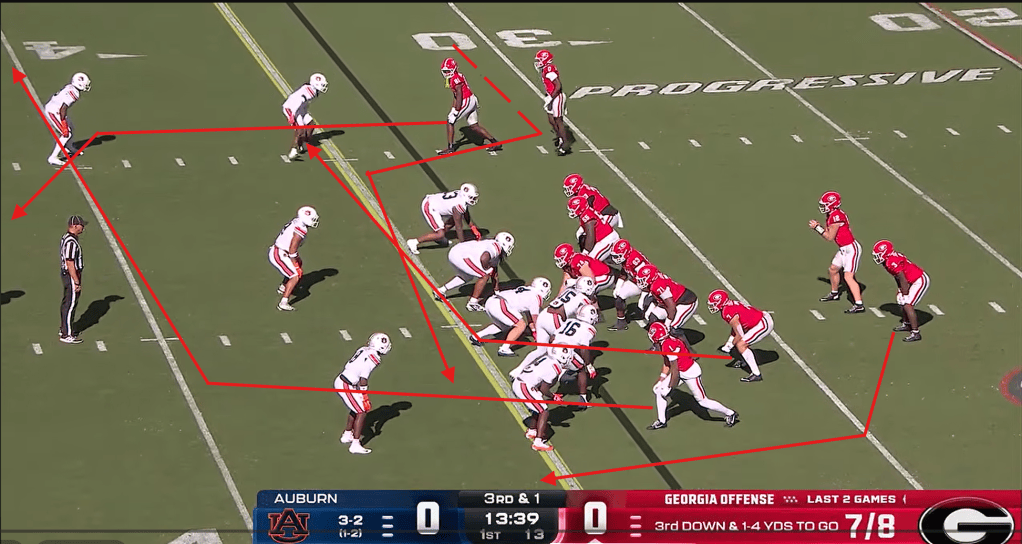
Sure enough, Georgia backup Ryan Puglisi was 3/3 for 55 yards in his brief cameo, most of which came on a third and 1 bomb to set up Georgia’s first score. Correctly anticipating that Auburn would be in man coverage, Georgia lines up in a compressed formation and runs a man-beating staple, a mesh-rail concept. The idea is that the two receivers crossing paths underneath (“meshing”) will create a natural rub, which causes problems for defenders in man coverage. This was of course one of the favorite plays of the Dread Pirate Mike Leach (RIP). In this variation, the RB runs a wheel or rail route out of the backfield, with the idea being that if the DBs bite down on the crosser from that side, the back should be wide open.
Big shoutout to the TV broadcast for being useful for once and showing a great angle of Winters’ mistake. I think his status as an Auburn folk hero is secure after the Baylor game but he’s been a tough watch at times this year and this play was certainly no exception.
It only took Georgia two more plays to cash in their opening drive. In this case, we see one of the other things that’s bedeviled Auburn’s defense this year, a poor run fit by the linebackers. With Xavier Atkins suspended (and soon to be kicked off the team), Bryce Deas got the start in his place, and while he had an excellent game overall, recording 8 tackles, he overplays a basic inside zone run here instead of fitting the backside gap like he should, and Georgia is able to get to the second level, seal him off, and the RB makes a simple cutback for six.
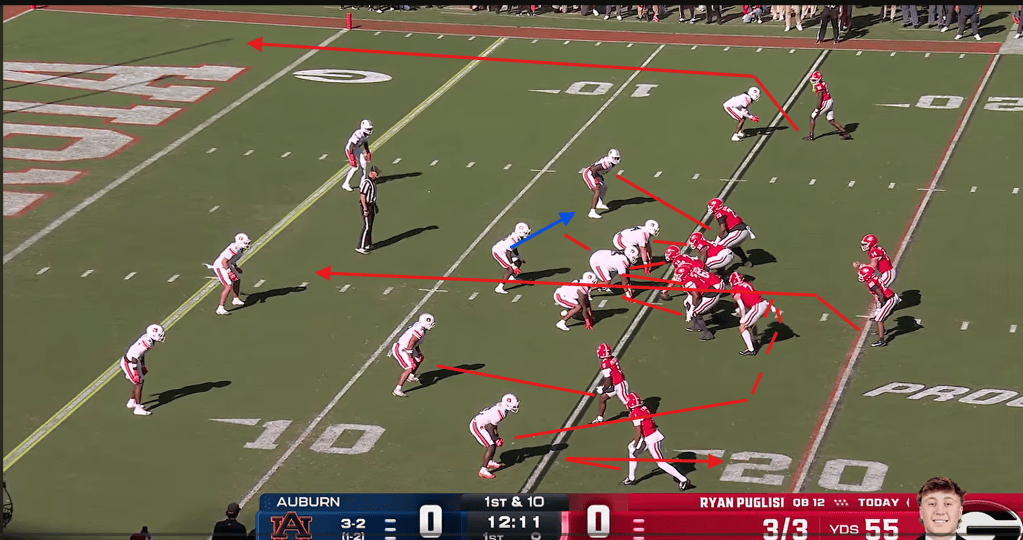
They use a little escort motion with the TE to set up an RPO spot screen to the outside, but it’s 5 vs. 5 in the box and that’s an easy give read for Puglisi, and Dwight Phillips, Jr. does the rest to give Georgia an early lead.
This opening drive surely gave Auburn fans a queasy feeling in their stomach, not just because the Dwags had an early lead and momentum, but because Auburn’s offense has been downright abysmal early in games, particularly on the opening scripted drives, which have yielded zero points and, if I recall correctly, zero first downs coming into this game. Indeed, the Tigers didn’t get any points out of this drive, although they did convert a third down before having to punt it back to Georgia.
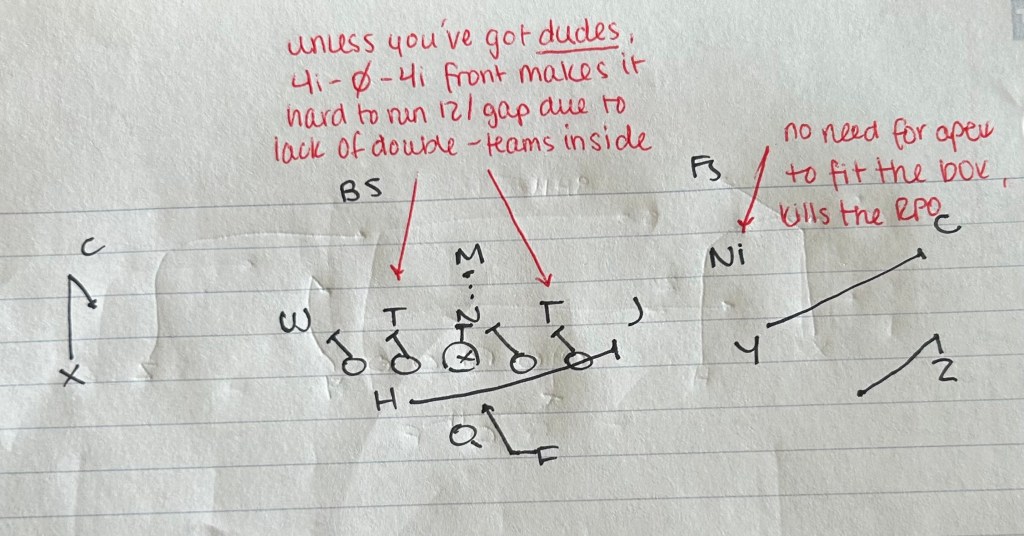
I do want to look at one play from this drive because it sets up an important point that is going to come up again. A big reason why Auburn has struggled against Georgia on offense for more than a decade now has been Georgia’s use of the so-called “tite” or “mint” front. It’s a special type of odd front look, in which the defense lines up with a true noseguard and two defensive tackles in a 4i technique (in other words, lined up directly in the B gap, or the gap between the center and guard). It’s designed to be tough to run inside zone against, which is the base play for most college spread offenses, since it denies the offense the chance to get double teams at the point of attack. It also eliminates conflicts in the B gap, which are the basis of most RPO concepts. Here’s a handy little drawing I made a few weeks ago to illustrate these points:
Conveniently, the broadcast gave us a rear angle shot so I can show you how it looked for this play:
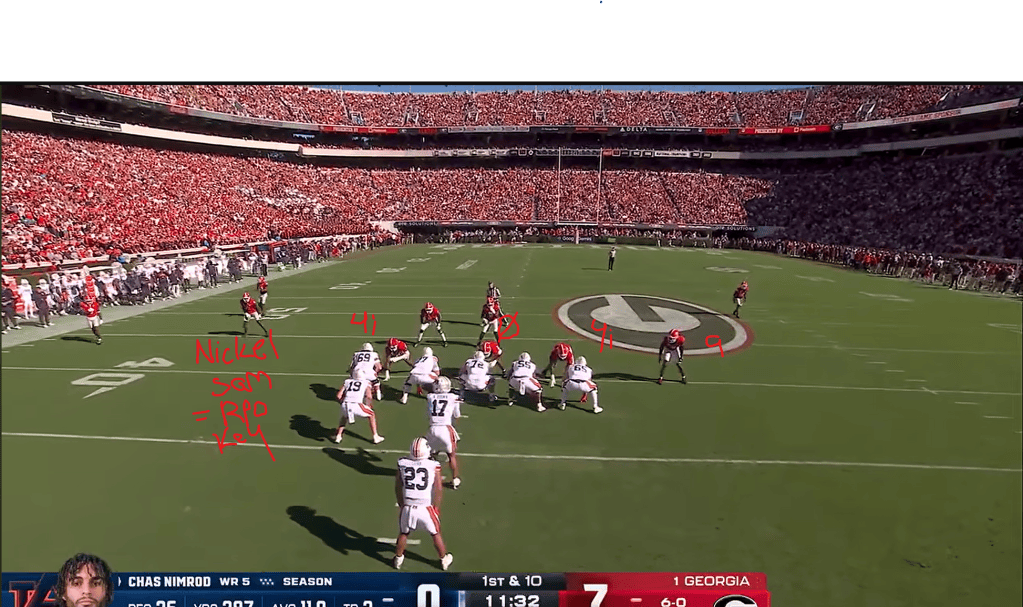
Auburn was going to have to find a solution to this problem if they were going to run the ball effectively, and although this play from the opening drive only yielded three yards, it shows the adjustments Auburn made. First, the Tigers lined up with extremely wide receiver splits. This is, of course, a hallmark of the veer-and-shoot offense, but one the Tigers have wavered on at times this year. This has the effect of pulling support players at the second and third level away from the box and allowing the offense to isolate and block them six-on-six.
The second thing is the use of a gap scheme, in this case counter (with the guard trapping the PSDE and the TE/H-back wrapping to the LB), which is tough to run if you have overhangs on both sides like in my drawing above, but since Auburn’s wide splits pulled one of those guys away to help with the inside receiver, there’s one side with no overhang, which allows the pulling guard on the counter play get out on the edge and the RB is able to bounce it outside.
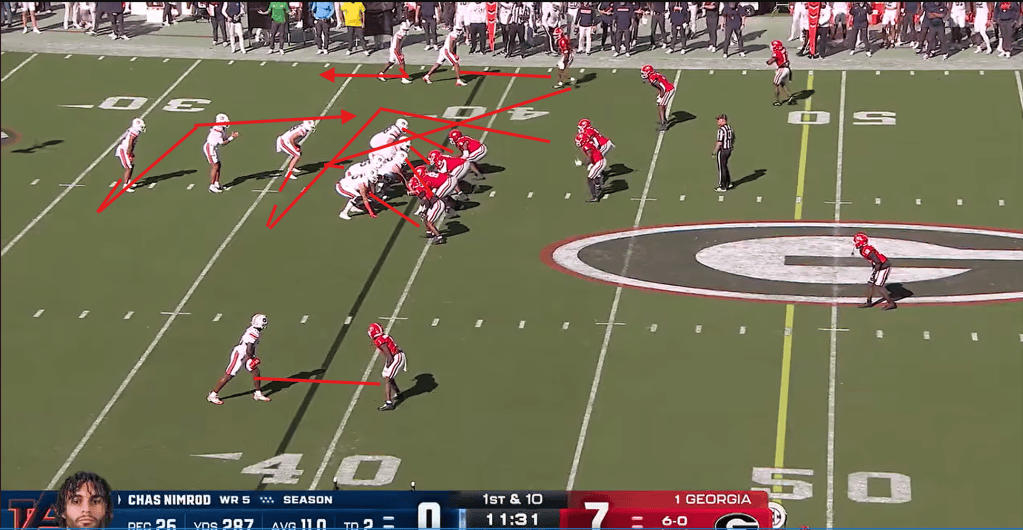
In this case, the pulling guard, Kenneth McManus IV, doesn’t really finish his block well and Georgia does a good job closing and making the open-field tackle, but keep this idea in mind for later.
After Auburn punted the ball away, Georgia again marched right down the field, and once again it was thanks to a couple of big plays through the air. Both of these were the result of Georgia attacking Auburn’s secondary in man coverage off of play action. The first is a pretty simple concept with a deep comeback route by Talyn Taylor working against Champ Anthony in single coverage.
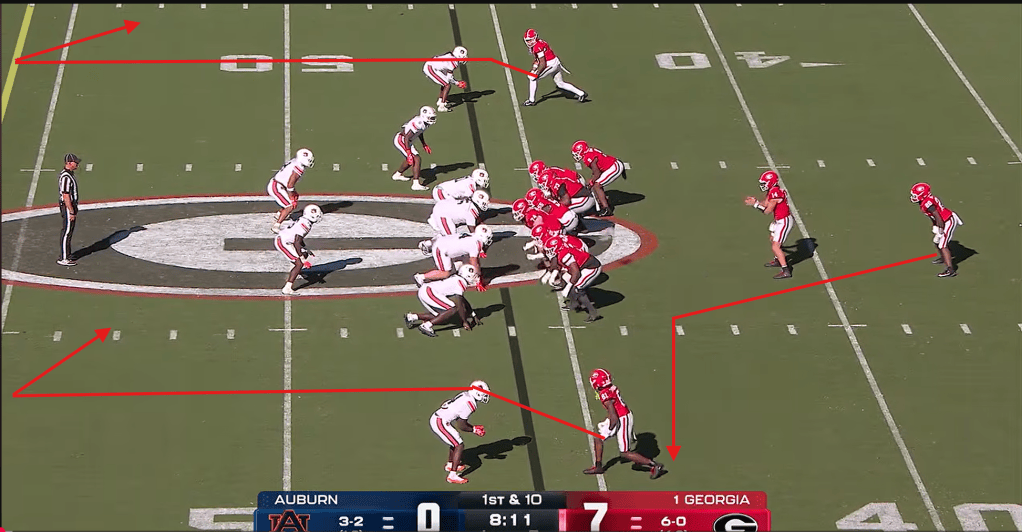
This is only a two-receiver pattern, so there should be safety help deep, allowing Anthony to be more aggressive in stopping the underneath route, but Eric Winters is off in the middle of the field doing God knows what so Anthony has to stay on top of him and it’s an easy completion. Anthony doesn’t exactly acquit himself well here either as he misses the tackle, turning a solid gain into an explosive one. Yet another of the Auburn defense’s consistent weaknesses this season rearing its ugly head to bite them again.
After a solid run on the ensuing first down, Georgia came right back with another play-action shot, this one resulting in a touchdown. This is a nifty little design, a TE leak concept off of a fake toss sweep, where the offense fakes the run one way then runs a bootleg to the other direction, while the TE, who faked blocking for the run, runs a wheel route on the backside after the defense has begun running to the front side to cover the bootleg.
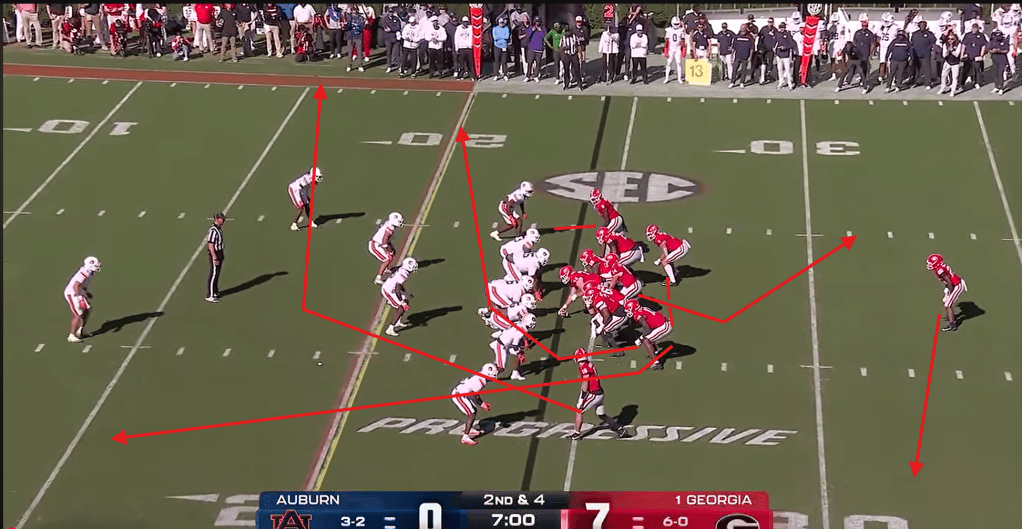
I said above that this was Georgia taking advantage of Auburn being in man coverage off of play-action, but I’m honestly not sure if this was man or some kind of zone that just busted. Either way, Lawson Luckie is, in technical football terminology, wide-ass open for the touchdown.
Alright, now it’s time for the fun part. At this point, with Auburn down 14-0, a lot of us, myself included, were on the verge of giving up and expecting yet another embarrassing shellacking in Athens. I mean, we’ve all seen this play like a dozen times before. But unlike a certain other coach’s teams, this Auburn team answered the bell and was able to stage a dramatic comeback, scoring 24 unanswered points.
Right from the start of the next drive, Alex Golesh and Joel Gordon are in their bag. I mentioned above that I didn’t think Auburn did that much different in terms of playcalling versus the previous five games, and that was mostly true. However, this play (and the plays that would come off of it later) are the exception. Auburn lines up in a standard-looking formation, but with some twists: the RB is lined up as the wing TE, the TE is lined up wide and motions into the slot, and the “RB” is actually punt returner Bryce Cain.
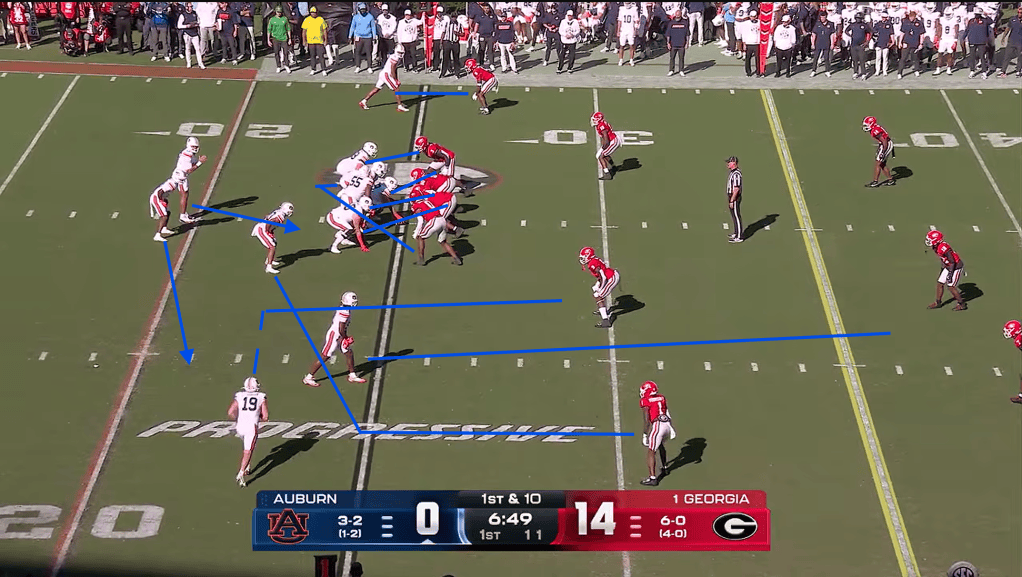
Auburn runs a crack toss sweep from this look, although the offensive line is blocking power here, which makes me wonder if Byrum Brown was actually reading the DE. Either way, he crashes down, so pitching it would’ve been the right call, and it goes for a solid gain on first down to keep the offense on schedule for once.
After converting on second down, Auburn wanted to go to the air on the ensuing first down. This looks like some kind of stick-nod concept, where the TE, Jake Johnson, fakes a three-step stick route before turning and running up the seam. I think they were expecting the safety to bite hard on the stick, leaving the seam open, but that doesn’t really materialize.
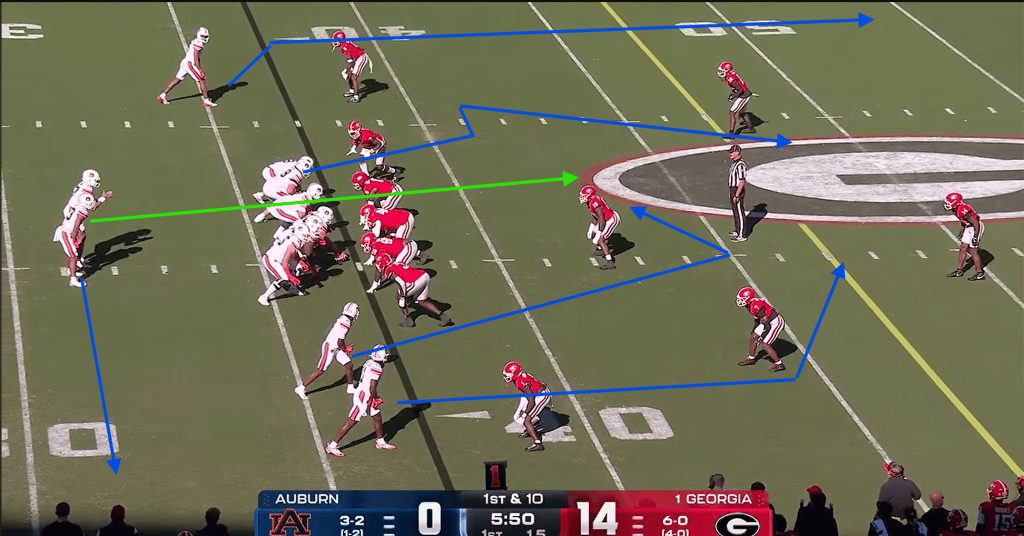
Fortunately, Byrum Brown does a good job staying composed in the pocket and identifies a running lane through the A gap after Georgia ran a loop stunt that didn’t get home. I’m not sure if Georgia is playing true man coverage or a quarters coverage with the corners playing a man-on-demand (or “MOD”) technique, but either way, it means the DBs have their backs turned and are unable to get up to stop the scramble. Brown’s legs would be a huge factor in this game, as he had both more carries and more yards on the ground than all of his other teammates combined.
On the next set of downs, Auburn faced a fourth down and 3, and Golesh opted to go for it because, say it with me boys and girls, you don’t win games with field goals! Auburn uses a play that I have a strong nostalgic attachment to get this conversion, although it’s not actually executed very well. The Tigers run a shovel pass to the RB with a power scheme up front.
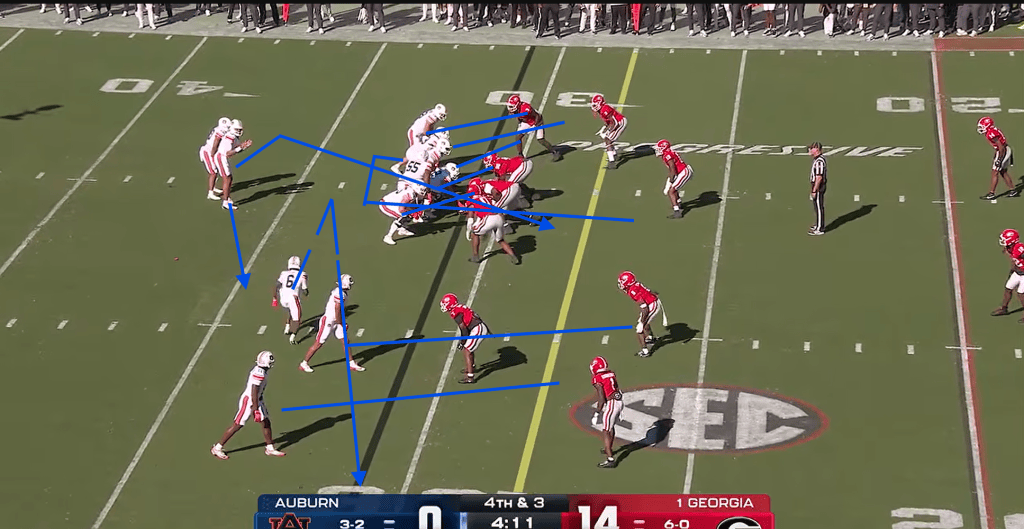
I think the idea here is for Brown to read the DE and either throw the shovel pass or keep it depending on what he does. It’s not blocked very well, as the linemen blocking down from the playside (McManus and Stanton Ramil) don’t do a good job of sealing off their men, and the Tigers only convert due to a fantastic second effort by Jeremiah Cobb.
My nostalgic attachment from this play comes from the fact that it was a staple of my high school’s offense back in our glory days. This was the era of Urban Meyer’s Florida offenses with Tim Tebow, which used to make extensive use of this play with Percy Harvin and Aaron Hernandez (better known for other work). We ran it as a true triple option, with the QB having the shovel/keep read and then a pitch read afterward. I much prefer this version as it gives the QB more options (literally) to make the play work, although it doesn’t really matter if you block it as poorly as Auburn did on the play above.
Here’s a clip of my high school running it (a slightly different variation with the WR as the shovel man and the RB as the pitch man), with yours truly featuring in the video somewhere. If you can find me, you win a cookie. (I do not have any cookies, I am on a diet, allegedly.)
After a timeout for an injury, Auburn decides to try to capitalize on the momentum from the conversion by going back into the bag and pulling out a bizarre trick play where Christian Neptune lines up at RB and throws a pass off of the toss action I described above. This is a one-receiver pattern, with Keshaun Singleton running a corner route, and Georgia, who was in cover 1, has him plastered in man coverage with safety help.
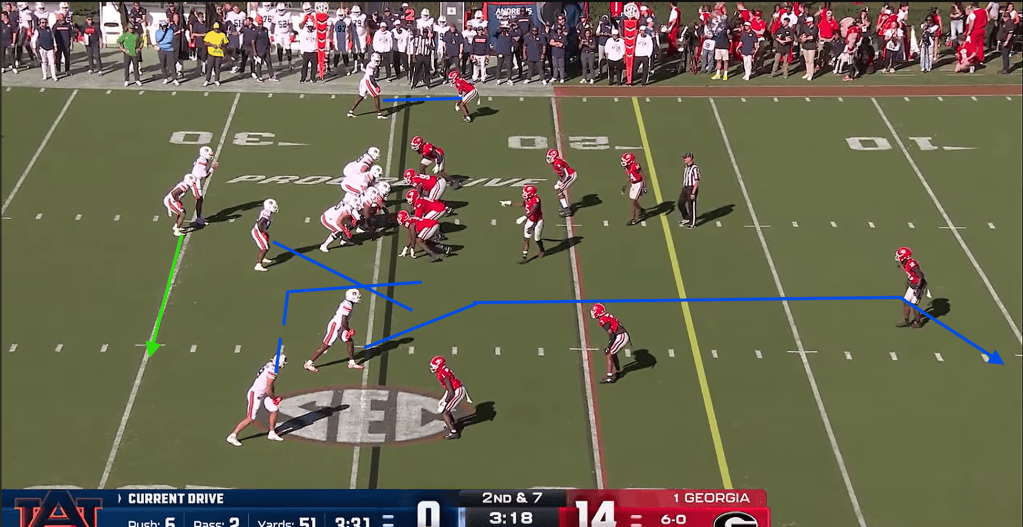
However, much like the Jeremiah Smith score that ended up being the game winner for Ohio State over Indiana earlier in the day, both DBs managed to overplay him on a severely underthrown ball that should’ve been an easy pick, and Singleton was able to catch it for a touchdown while standing practically flat-footed. I can’t even really say it was an especially ingenious playcall, since Georgia sniffed it out and had it so well-covered, but sometimes things just work out. No pictures on the scorecard, as they say.
Following the score, Auburn’s defense finally managed to get its first stop of the game, partially due to cleaning up some of its earlier issues and partially due to some baffling playcalling from Mike Bobo (stop me if you’ve heard this one before).
On 2nd and 8 near midfield, Bobo opts to run the ball, using a scheme I’ve seen referred to as “counter solid”, basically a counter scheme but using a second H-back instead of a pulling guard, so that you have a “solid” blocking surface up front instead of a hole left by a pulling lineman. And praise be to Telestrator Jesus, I have the rear camera angle to show for once.
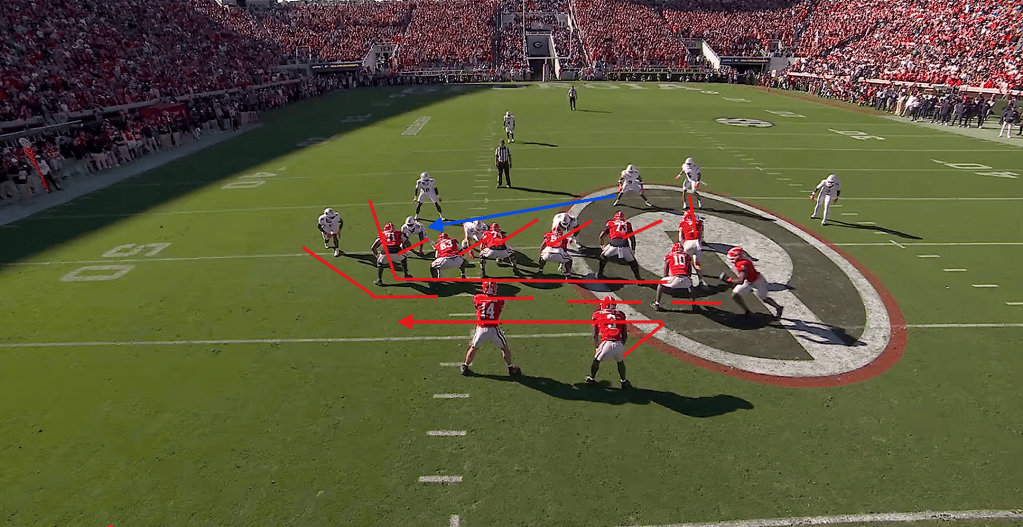
Here’s my first opportunity to shout out Elijah Melendez, who had an absolute legacy game on Saturday. He does a great job of reading his keys, coming over the top, and making the play in the hole. Honestly, this one wasn’t looking great for Georgia anyway given that Auburn was kind of shifted over to that side and fits the run well, but Melendez turned what might’ve been a short gain into a stuff and set up third and long.
On that third and long, we get a playcall from Georgia that I don’t really understand. They’re running a fake bubble screen with a post wheel over the top. I guess they were expecting Auburn to be in zone here and bite down on the fake screen, which is odd enough on third and long, but the Tigers were in man here as they had been for much of the game up to that point.
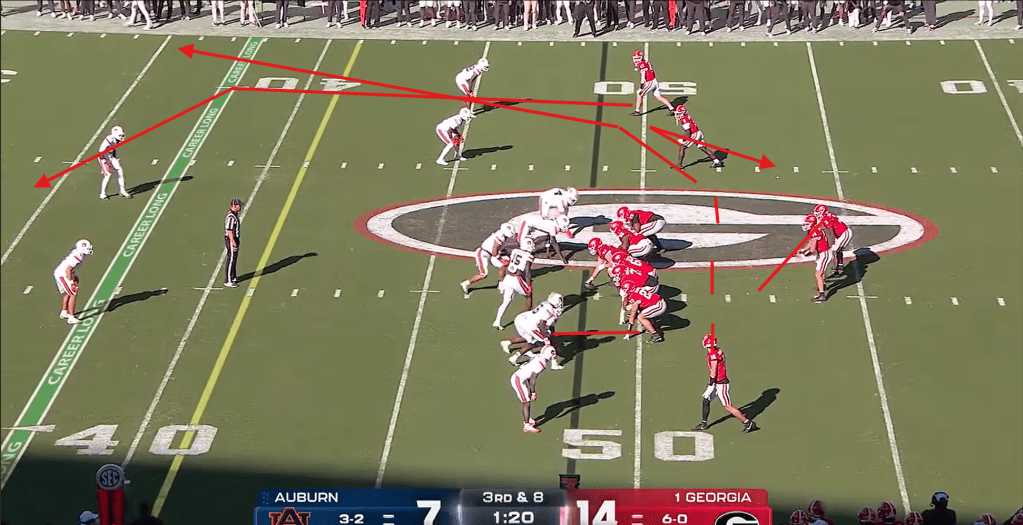
Stockton has nothing downfield and has to check it down to the bubble screen guy, and the Tigers do a good job of rallying to keep him short of the marker.
This seems like the kind of playcall you’d make if you were fine taking the checkdown and then going for it on 4th, right? Well, Kirby Smart then makes one of his patented bizarre game management decisions, opting to punt on 4th and 4 against a defense that hadn’t stopped him all game. Sure man, whatever. We’ll take it.
On the ensuing possession, Auburn gets into a third-and-short situation, and demonstrated some solid playcalling to get a conversion out of a short passing game that’s been a mixed bag at times this year, often due to Byrum Brown’s janky mechanics. In this case, Auburn does a couple of things I really like. First, they use motion to change who the #1 receiver on the playside is. Many defenses are oriented around who the #1 receiver is to determine their coverage responsibilities, so this is a good way to mess with that (in theory, Georgia looks like they’re in man here). Second, they utilize a clever man-beating concept, with the #2 receiver running a curl(?) route to clear out both defenders and set up the #1 receiver running a slant route underneath in the open space.
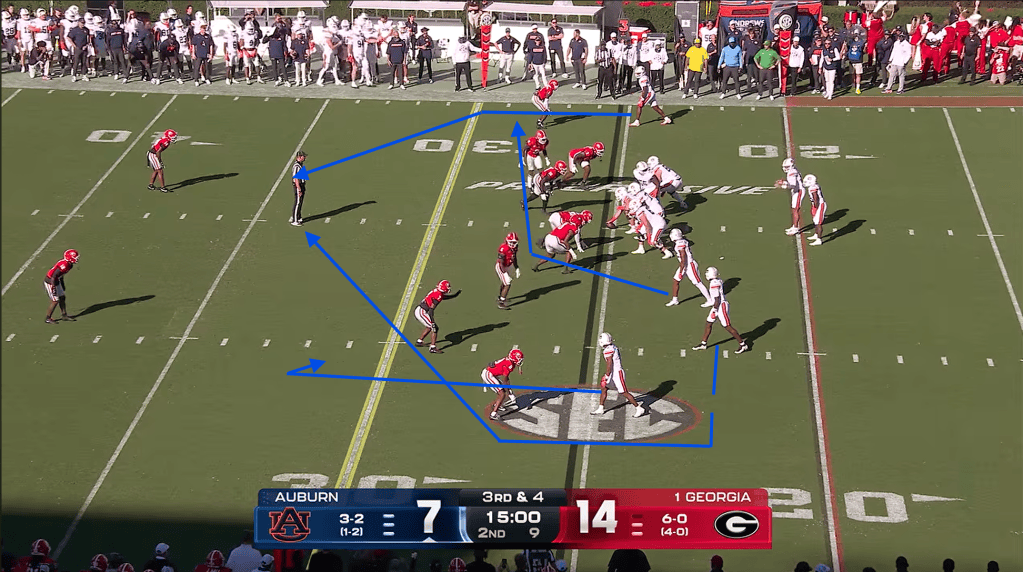
Honestly Auburn is probably lucky to avoid an OPI call here, but I assume Birmingham was still not too worried about the outcome of this game and didn’t feel the need to call in a favor for Georgia just yet. Jeremiah Koger delivers the groceries and Auburn picks up a first down to keep the drive moving.
Now we get to revisit those two themes I told you to keep in the back of your mind: gap schemes and wide splits. On the ensuing first down, Auburn lines up in a four-wide set, showcasing the trademark veer-and-shoot splits; the #2 receiver to the wide side of the field is barely visible, and the #1 receiver to that side isn’t visible at all (thanks ESPN). This causes Georgia to line up in a very light box, with a tite front and two LBs, but no overhangs on either side.
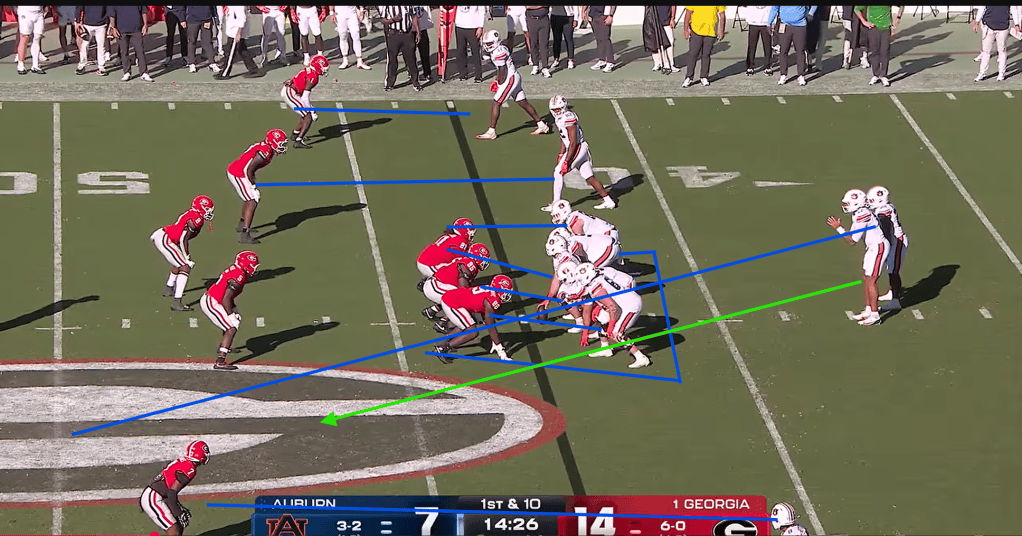
Auburn utilizes a counter scheme here as they did in my earlier example, and with no overhang, the pulling guard (McManus) is able to seal the edge and get Brown a running lane. Omar Mabson (who had a great game as a blocker overall) kinda whiffs his block on the LB, but Byrum Brown jukes the defender in a manner reminiscent of another large, mobile Auburn QB to create some big time running room for himself and take the ball down into Georgia territory.
Auburn would ultimately punt on this drive from the fringes of field goal range, opting not to kick a FG into the wind (although personally I would’ve just gone for it. Fortunately, the defense forced a three-and-out thanks to Mike Bobo deciding to call a pass on 3rd and 1, which got batted down, after which Georgia punted on 4th and 1. Again, seems like the kind of playcall you make expecting to go for it on fourth down, but again, whatever, we’ll take it.
After thUGA lived up to its brand with an incredibly dirty late hit on Byrum Brown, Auburn had the ball in Georgia territory, facing another third and short to medium situation like the one above. Once again, they went to the quick passing game, and once again they managed to convert. Auburn sets up in a tight bunch formation and runs a spacing concept which, as the name suggests, is designed to space the field with receivers setting up on short hitch and flat routes to stretch zone defenders.
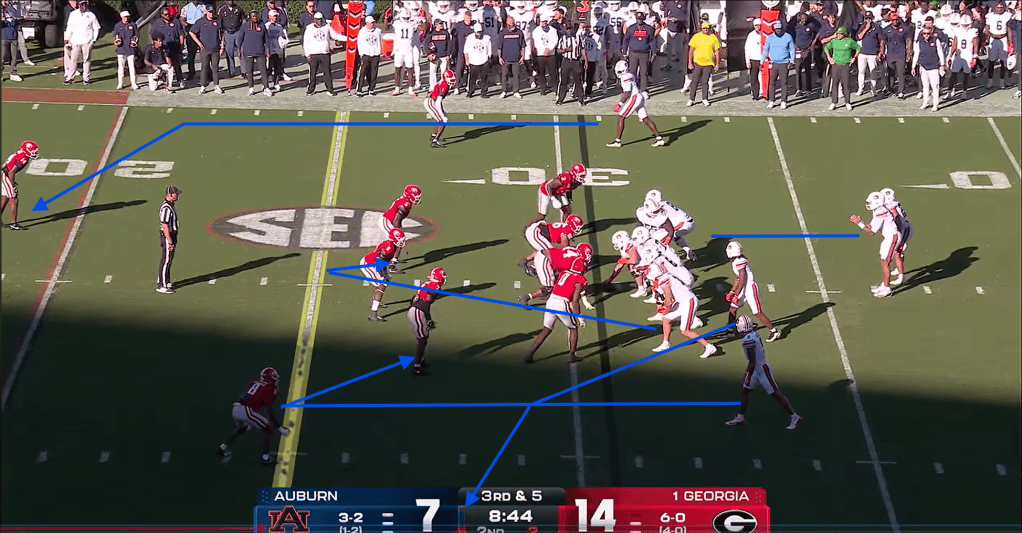
Auburn catches Georgia in a six-man zone pressure here, which leaves wide open gaps in the coverage for the quick routes to exploit. Brown had his choice as all three of the receivers on the bunch side were open, and he hits Jake Johnson for the first down. Also, shoutout to Jeremiah Cobb for the excellent blitz pickup.
After a few short runs, the Tigers had a 2nd and 7 just inside the 10 yard line. With the whole playbook still open, Golesh and Gordon dial up a play that I, as a nerd blogger, am required to hate per the nerd blogger contractual obligations: the red zone fade. I hate this play. Hate it, hate it, hate it. Most of the time it ends up being a waste of a down unless you’ve just got a straight-up mismatch, which isn’t gonna be the case in a game like this. Idk what Auburn is running on the other side here and it doesn’t really matter.
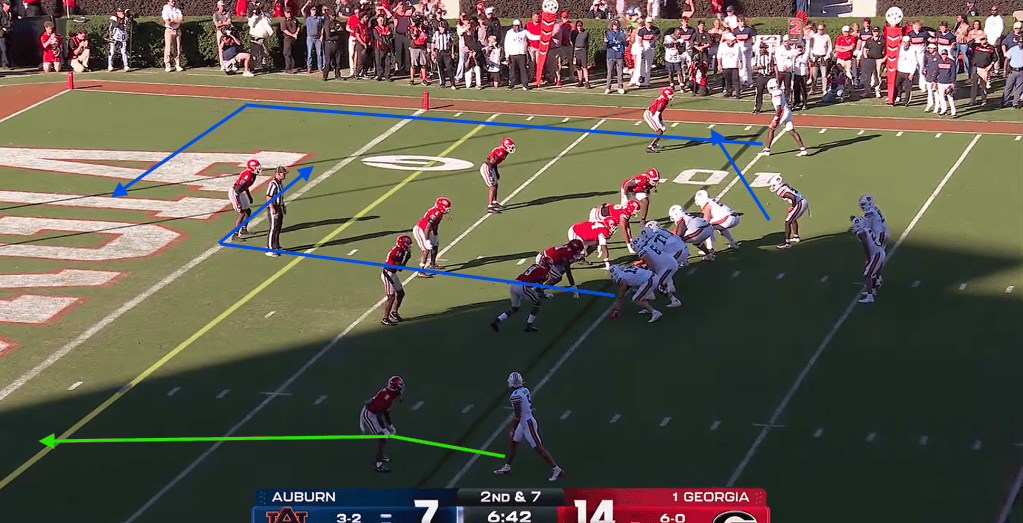
Of course, sometimes, a guy just makes a play and the playcall doesn’t matter too much, and that’s what happens here. It’s not a particularly good throw from brown and the DB gets away with some pretty blatant PI, but Chas Nimrod makes a science fiction catch for the touchdown. In real time, I genuinely thought it was incomplete and only realized he’d caught it when the touchdown graphic popped up on the screen. Again, not much to analyze here, dude just went and made one of the plays of the season and all of a sudden it was a tie game with all of the momentum on Auburn’s side.
The next Georgia possession I think is where the “Stockton concussed narrative” starts to emerge. It certainly didn’t look that way early on, though, as Stockton connected with Georgia’s obligatory white WR with a weird name, London Humphreys, on another deep shot off of play-action to get Georgia into Auburn territory. Georgia is running a post-dig or post-cross concept here with Humphreys’ fellow white WR with a six-letter name starting with “L” and ending with “N”, Landon Roldan, running a deep post and Humphreys coming over on the deep cross.
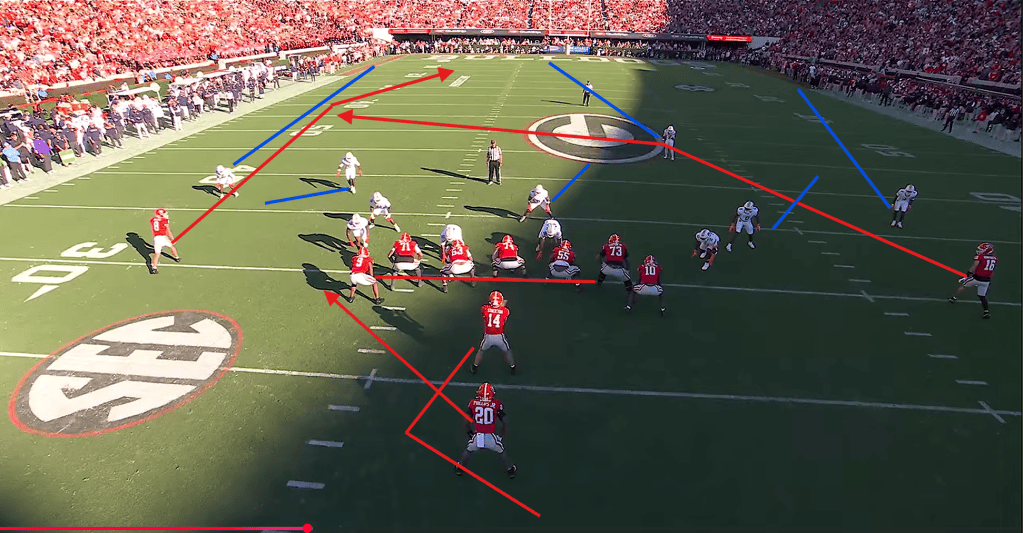
Georgia sets this up using a split zone look to suck in the LBs and create room for the crossers underneath, which is exactly what happens here. This is a staple of most NFL offenses and you’re likely to see this concept a half-dozen times in any NFL game you watch. Here, Auburn gets caught in a zone blitz, and Humphreys ends up perfectly nestled between the second and third-level defenders in the zone coverage and is able to make the catch for a big gain. And once again we have the end zone angle for it, glory hallelujah.
However, after a short run and an incompletion brought up third and long, Stockton gave the concussion truthers some ammo to work with, sailing a pass over the head of an open receiver that would’ve yielded a first down. Mike Bobo dials up another Mike Leach mainstay, Y Cross, a type of flood concept with a deep vertical route, a deep cross, and a flat route, that’s really more of a zone beater but works well against man coverage too as the deep cross is often difficult to cover.
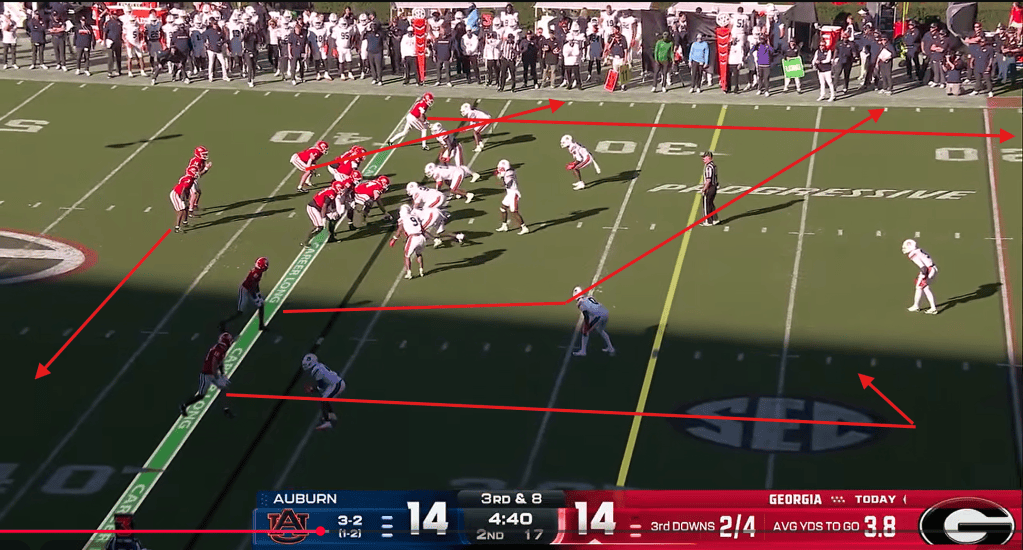
Auburn brings some heat with man behind it and doesn’t get home, leaving Dandridge working what should be an advantageous matchup on safety Sylvester Smith-Reed, but Stockton throws a duck and he can’t haul it in.
Stockton would of course add more fuel to the concussion fire right afterward, not realizing he needed to be on the field to hold for the subsequent field goal attempt, on which Georgia didn’t get the snap off in time, wasn’t called for delay of game, and then got it blocked anyway. Ball don’t lie.
After Auburn dug itself into a hole with a penalty and dug itself back out with a solid run from Brown, Georgia got a bit impatient, maybe even a little bit on tilt with the defensive playcalling, bringing an all-out blitz on second and 10. This is a cross-dog (cross-dawg?) pressure, with both LBs blitzing the A gaps but crossing each other’s paths while doing so to add to the confusion. Auburn is running a drive concept, a variation of the shallow cross where the shallow and the dig route both come from the same side. In other words, just what the doctor ordered against a LB blitz.
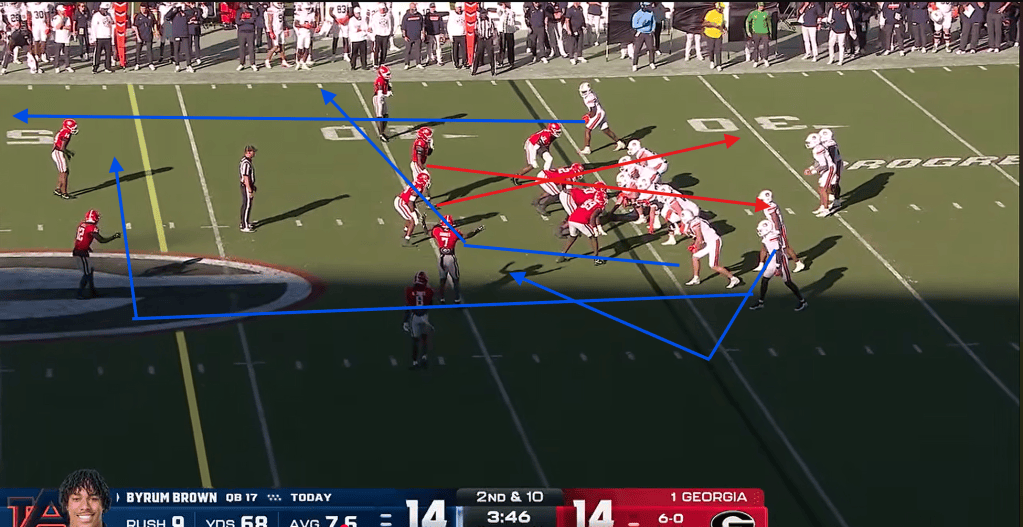
I honestly don’t even know where to begin with Brown’s mechanics on this throw. It looks like he was playing Xbox and accidentally tapped the button instead of fully pressing it to make the throw. Fortunately, thanks to the blitzers vacating the zone, Jake Johnson was so wide open that he could’ve thrown a chest pass and still completed it.
On the next set of downs, Auburn got itself into the dreaded third and medium-to-long. Correctly anticipating a Georgia blitz, Golesh and Gordon called a shallow screen, another variation off of the shallow cross play where the receiver running the shallow stays behind the line of scrimmage and the other receivers come across to block for him. Really its more of a variation on a middle screen than a shallow cross, but either way, it doesn’t really set up that well.
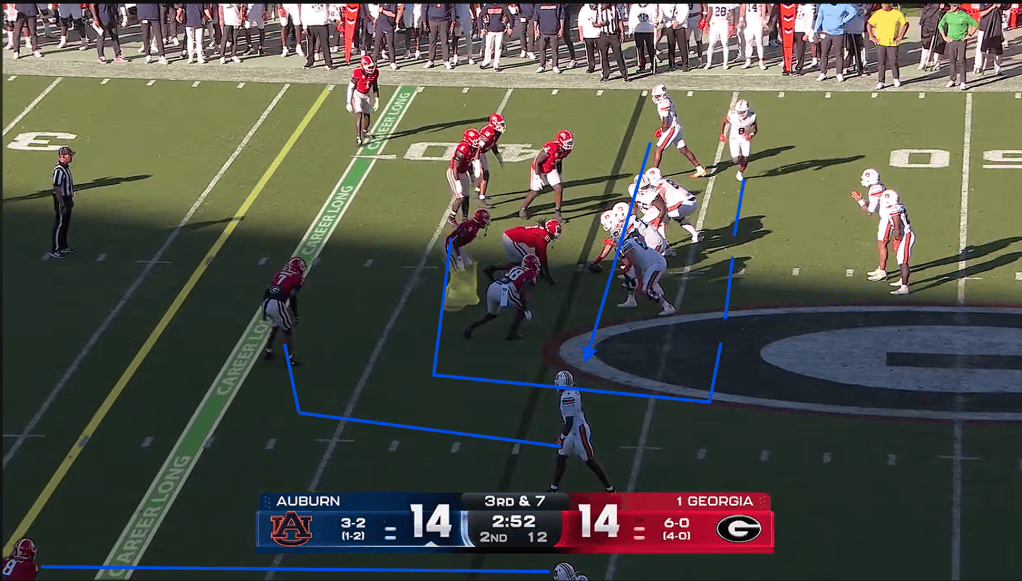
Again though, sometimes playcalling doesn’t matter when dudes make plays for you. A great second, third, fourth, etc. effort by Keshaun Singleton doesn’t quite get the conversion, but it does set Auburn up for a fourth and short…
…which Auburn, correctly, decided to go for, and once again, it was Byrum Brown coming up big with his legs to get the conversion. Auburn ran a play it’s used a few times this year in high-leverage situations, a QB sweep to a bunch formation. Georgia shows a G front here with both tackles head up on the guards, designed to create problems for pullers. However, in this case, Auburn isn’t pulling the guards, but rather the playside tackle, Stanton Ramil. the receivers block down on the DE and PSLB, while Ramil and Jake Johnson pop out to handle the scraping LB and safety, with Omar Mabson to lead on the corner.
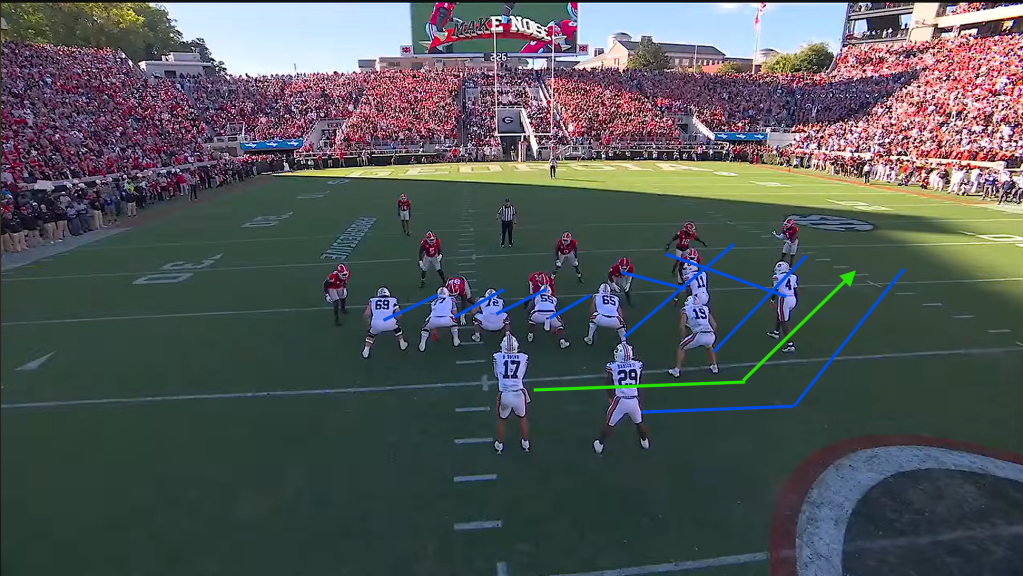
Nobody really gets anything on the safety here, but once again, Brown makes him miss and is able to pick up the conversion. Look, I’m not going to make that analogy given Brown’s less than stellar season up to this point, but on plays like this you can see the resemblance. Auburn would settle for a field goal on this drive, with Alex McPherson drilling a long one despite kicking back into the wind.
On the ensuing Georgia possession, the Stockton truthers got a bit more red meat tossed their way. Either that, or he just made a really dumb decision, you can decide for yourself. Georgia is running four verticals against quarters coverage here, which is never a likely proposition for success (and part of the reason you don’t see many teams just running straight four verts anymore given the prevalence of quarters coverage). You can see Auburn has two safeties firmly over the top of the slots, the slots walled off to the inside, and the outside receivers blanketed with man-on-demand coverage.
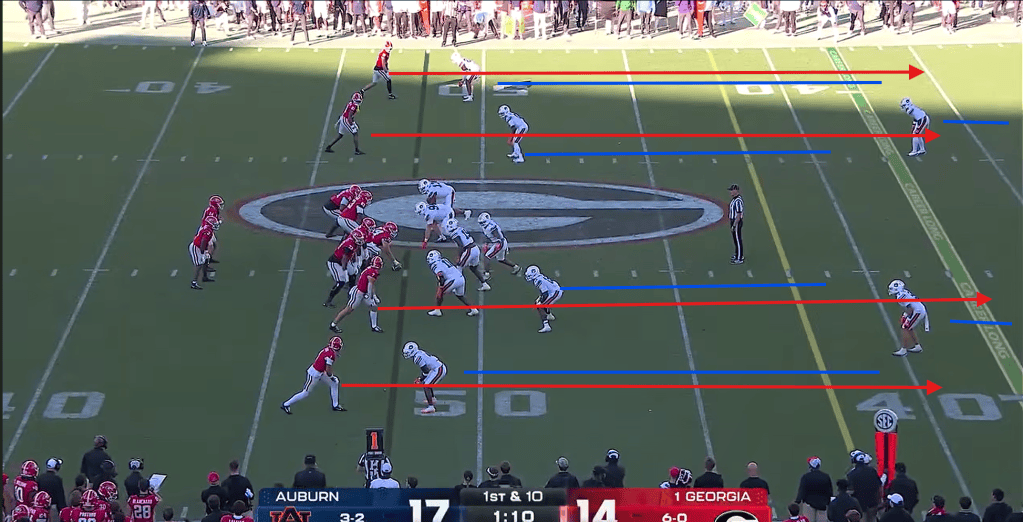
Nobody is open, nobody is close to open, and I think Stockton is trying to find the back shoulder throw to the outside receiver, but he’s a mile behind him and Newboy Fegans does a great job of reading his eyes and comes up with just about the easiest interception he’ll ever make.
Auburn wasn’t able to do anything with the pick and punted the ball back to Georgia, unfortunately. However, a sack by the Tigers (off of a three-man rush, no less) forced the Dawgs to take it to halftime, with the Auburn holding the lead and all the momentum.
Coming out of the break, the Tigers’ offense picked up where they left off. After one of the few presnap penalties this game (another aspect of Auburn’s previous problems that seemingly got cleaned up during the bye week), Golesh and Gordon went back to that power toss series they had been working in the first quarter, this time with a more standard play-action concept.
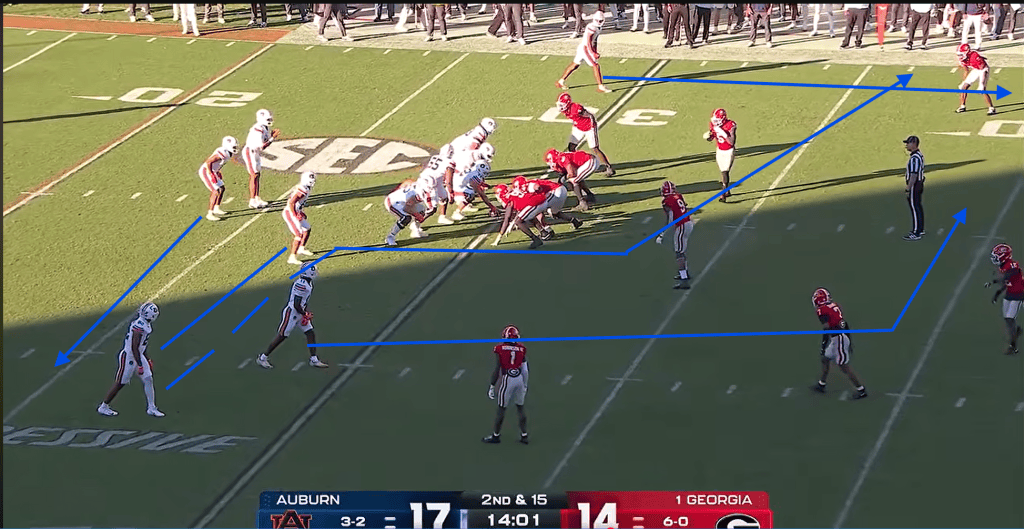
Chas Nimrod works vertical on the far side of the field to take the top off the coverage, while the LBs overreact to the initial fake and keep their eyes in the backfield a split second too long, allowing the motion man, Arlis Boardingham, to slip in behind them for a good gain to set up a third and manageable.
On that third down, Auburn went back to old reliable, the QB sweep with Bryce Brown, and got the conversion and then some. This time, Georgia is lined up in a bear front, rather than the even front they showed the last time Auburn ran this play.
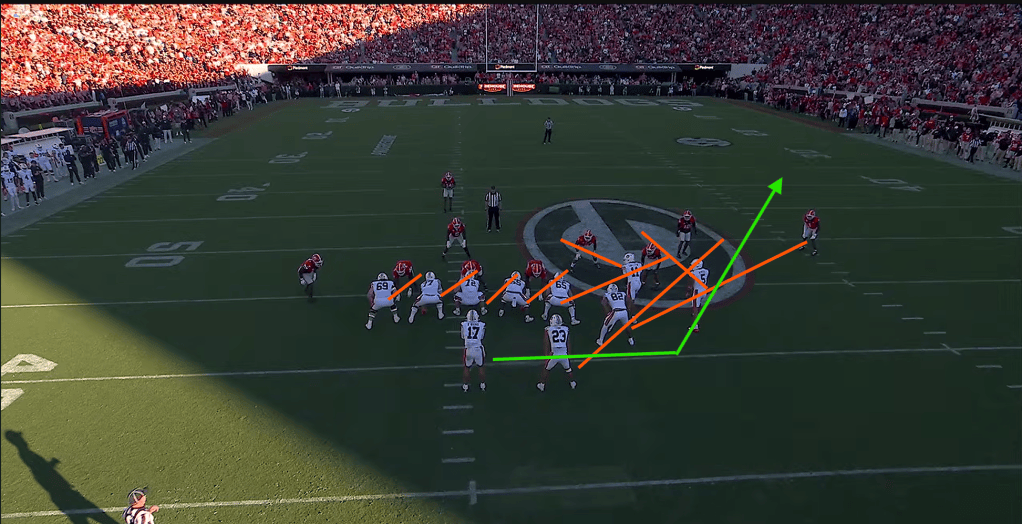
I think the blocking angles worked out better here. Auburn actually doesn’t even get the playside 4i blocked, but he’s not catching Bryce Brown, and the Tigers get the perimeter fully sealed off this time with Boardingham getting a great kickout block on the corner and Jeremiah Cobb getting up to block the safety to spring Brown for a big gain into Georgia territory and get Auburn’s momentum rolling in earnest.
Shortly thereafter, the Georgia defense committed a brain-dead roughing the passer penalty to give Auburn a free first down on the edge of the red zone. Hopefully you’re all familiar with the literary device known as “foreshadowing”. After that penalty, Auburn went back to well on the power toss series, this time running the power itself rather than the toss.
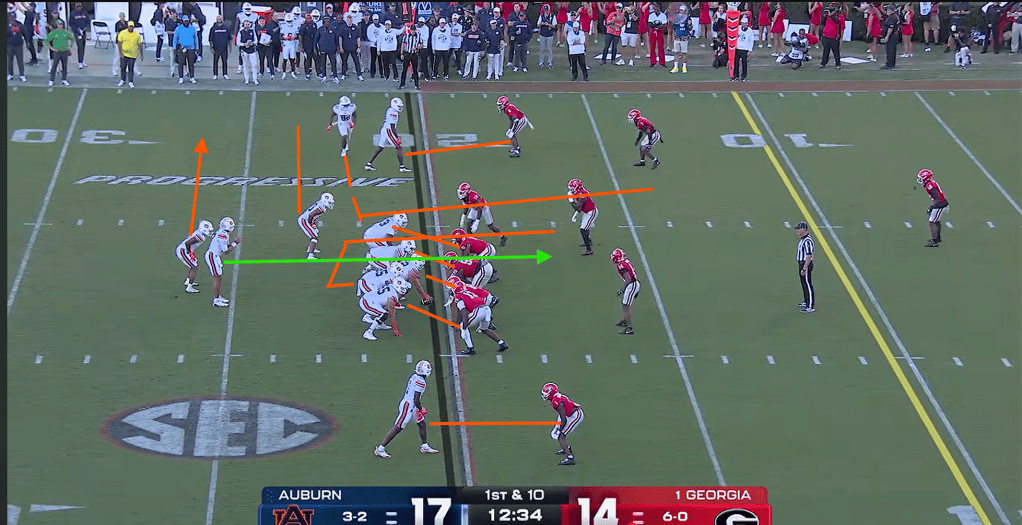
I’m not sure if this is an actual read for Brown or not, because the DE initially looks like he’s gonna chase the toss before coming back to tackle him. This is why I kind of don’t love this play in general; Clemson ran a pretty heavy dose of it back in the Tahj Boyd/DeShaun Watson days and Gus ran it a bit mostly with Sean White before he broke all of his bones. Wasn’t a fan then, not a fan now, didn’t work.
After yet another 15-yard penalty on the Georgia defense, this one a pass interference on a play where they’d already committed a substitution infraction, Auburn was knocking on the door of the goal line and looking to go up by 10. To get that score, they went back to a tried and true staple of Auburn football, the zone read with an arc block by the tight end.
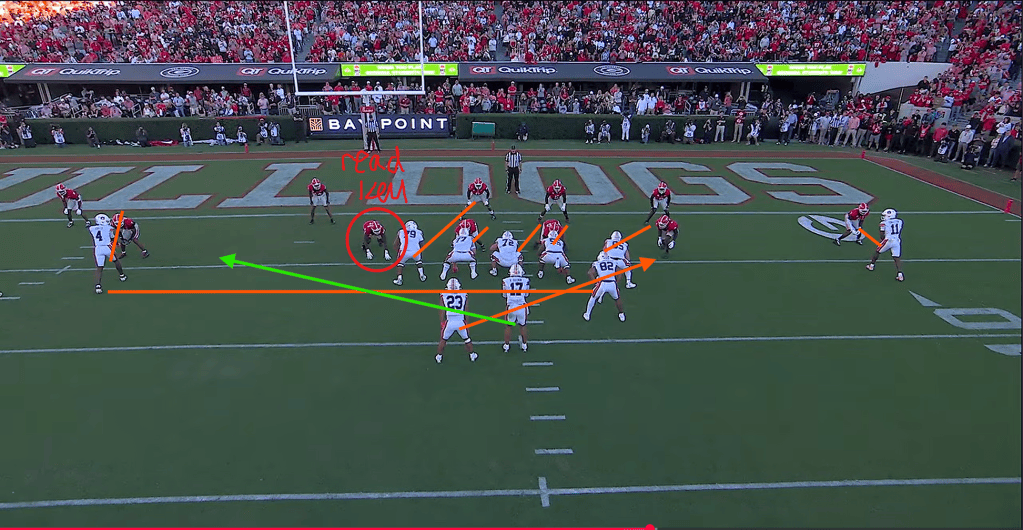
Honestly I think this is a bad read by Brown and he probably should’ve handed the ball to Jeremiah Cobb, as the defensive end just kind of squats and almost chases him down, but he gets some fantastic blocking on the edge from Jeremiah Koger, Christian Neptune (love love love that name), and Arlis Boardingham and he’s able to take it in for the score to put the Tigers up 10.
Say, does this play look familiar to you? Well, if it doesn’t, it should. Let me refresh your memory:
On the ensuing possession, Georgia drove to the edge of the Auburn red zone, in part thanks to some poor open field tackling from Auburn and a defensive holding penalty on 4th and 1. Then we get one more for the Stockton concussion truthers. I have no idea what Stockton was even trying to do on this throw.
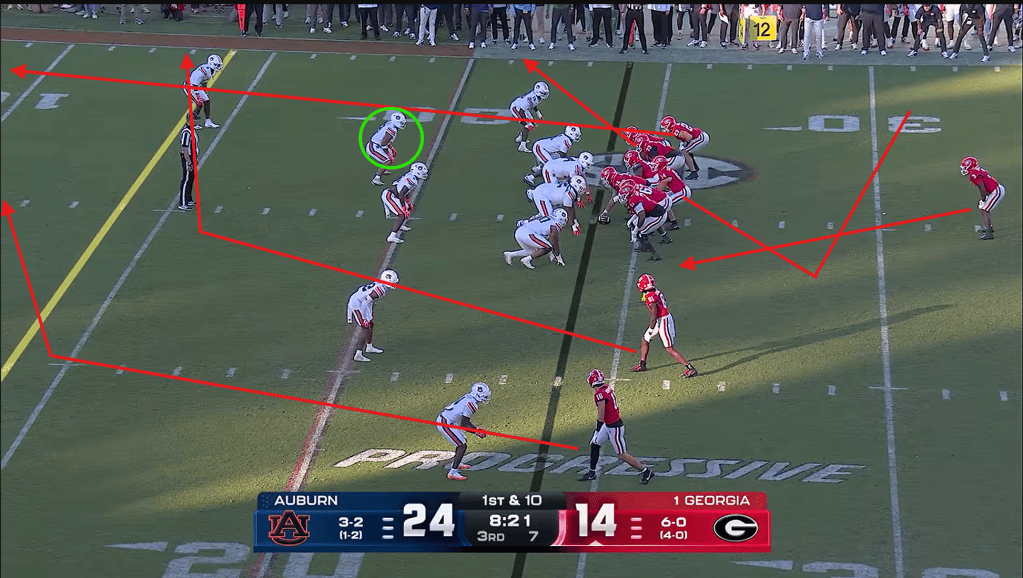
It’s a bootleg concept, where Stockton has the standard high-low read with three receivers running at different levels. At least from the TV angles, you never see his backside receivers come into his vision, and I assume the deep route wasn’t open, so he dumps it off underneath to his safety blanket who probably wouldn’t have gotten much anyway, but airmails the through right to Elijah Melendez, who was just hanging out there in loose man coverage. His return was subsequently negated by a needless block in the back. Concussed or not this is just an awful throw by Stockton, not much to do with Xs and Os.
Auburn didn’t really do much with the ensuing possession and very little happened for the next quarter or so of the game. I could analyze the reasons Auburn’s offense kind of stalled out, but this article is long enough already, so let’s just get to the ending.
Georgia opened what would ultimately be their last scoring drive with a solid completion over the middle to Craig Dandridge, who would end the game as their leading receiver with 88 yards on four catches. Here, Georgia is running a curl-flat concept (sometimes referred to as “Hank”, no idea where that name came from). This is generally used as a cover 3 beater concept since it puts five receivers in the underneath zones against four zone defenders. It’s become less common in the last decade as teams have moved away from cover 3 in favor of quarters and other split-field coverages.
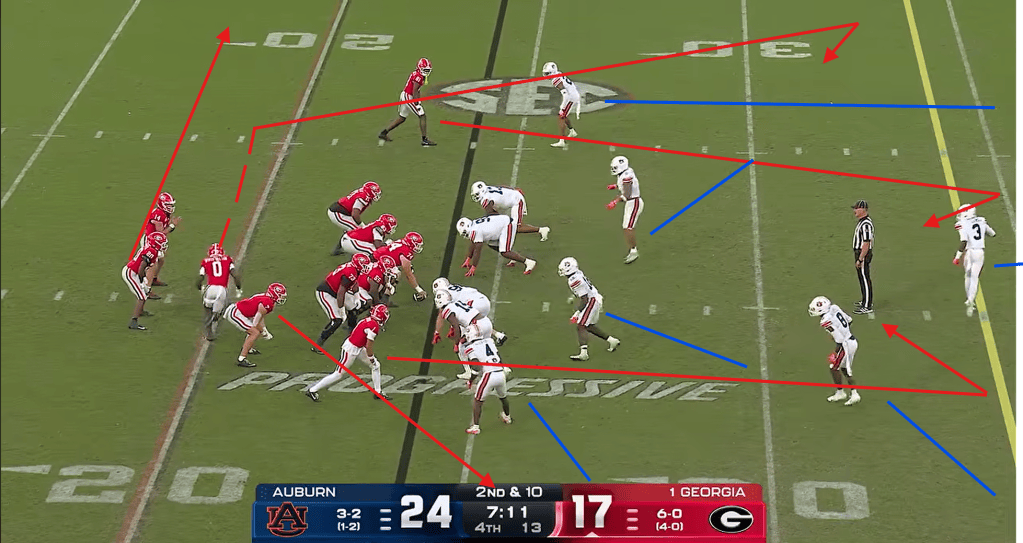
Auburn is…maybe in cover 3 here? Maybe it’s cover 6 or some kind of quarter-quarter-half look? Regardless, Georgia does indeed find the room in the underneath zone for a first-down completion to start the drive.
At this point, DJ Durkin had clearly realized that Stockton was sort of rattled and started really dialing up the pressure. Unfortunately, Stockton was able to step up and beat the blitz repeatedly on this drive. Here, with Georgia well into Auburn territory, the Tigers dial up a seven-man pressure against a six-man protection, but Georgia executes a clean quick pass before it can get home.
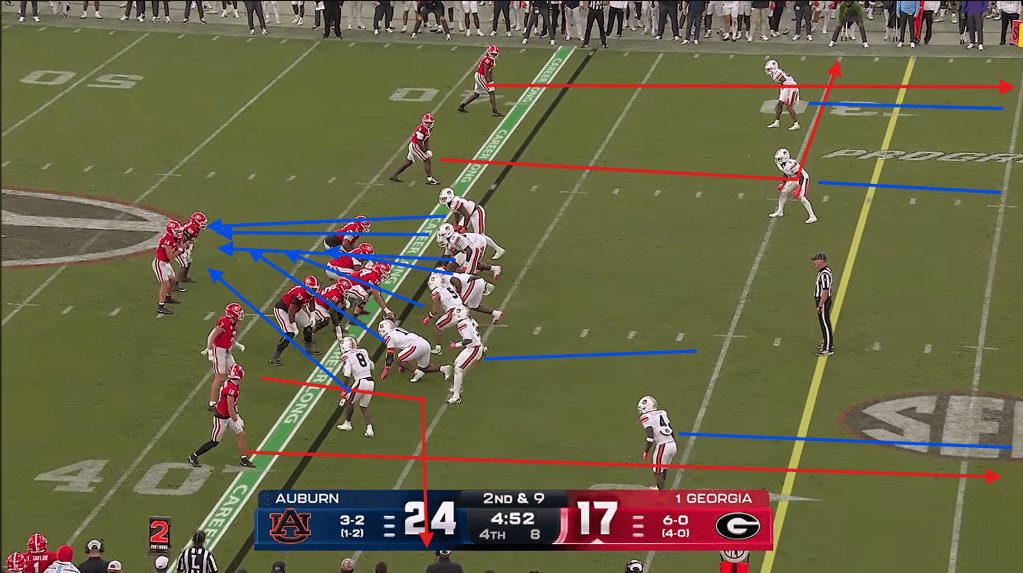
Newboy Fegans is responsible for Lawson Luckie here, but he kind of bails back toward the middle of the field for whatever reason before going to his man responsibility, which is more than enough time for Stockton to connect with his man underneath.
A couple of plays later, with Auburn now dropping back into coverage to avoid being burned but still playing man, Stockton is able to do his best Bryce Brown impression and use his legs to beat a defense playing man.
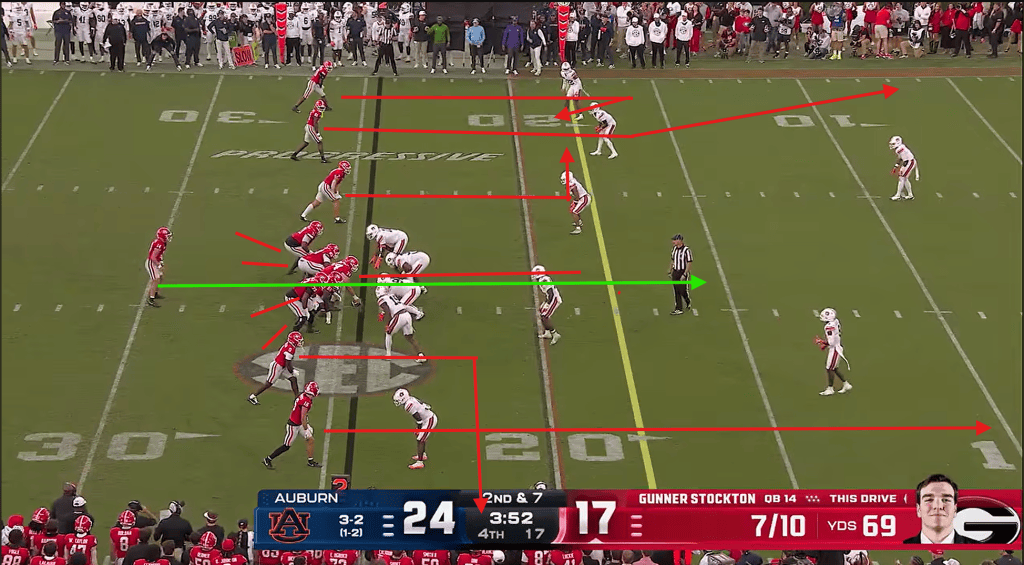
He has pass concepts to each side (a shock concept to the top and a fade/out to the bottom, an old Sean Payton staple) but I think this is a straight draw all the way since center Drew Bobo sets and then quickly releases to block for him. Hmm, Stockton running the ball behind Drew Bobo. Sounds like a great combination, I’m sure nothing bad could ever happen as a result of that.
On the next play, Georgia scored the game-tying touchdown with a nifty little play off of jet sweep action, Stockton gives the jet sweep fake and a token look to the RB, then immediately spins around and delivers the ball to Landon Humphries
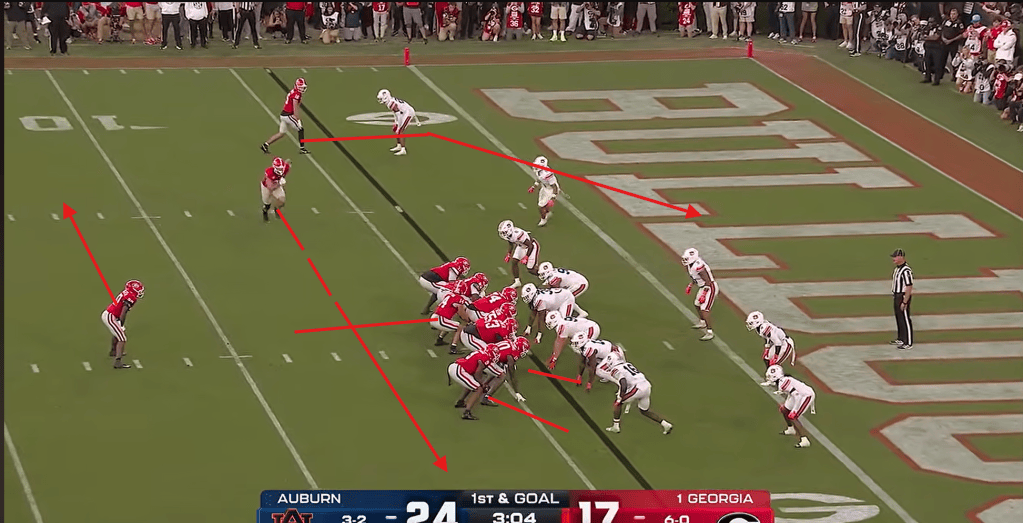
Honestly Auburn defends this pretty well, with Andre Jordan, Jr. draped all over Humphreys in man coverage, but Stockton delivers a great ball and Humphreys makes a great catch to tie the game.
On the ensuing drive, Auburn was backed up by a penalty and a sack, but then got back into third and short via a screen. Once again, Auburn used a shallow cross variation to convert. This time, it’s Chas Nimrod running an angle route in behind Jake Johnson running the shallow.
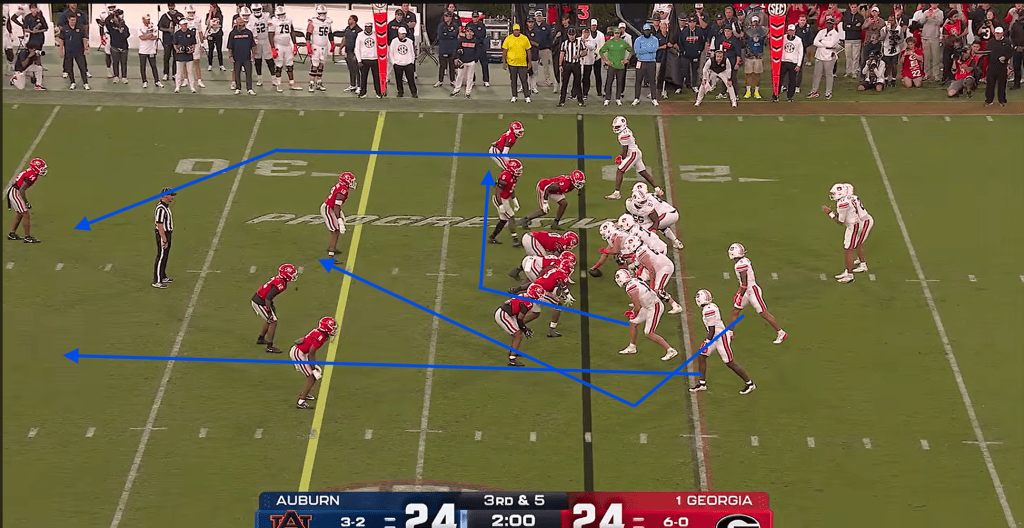
Georgia shows blitz but then doesn’t bring it, but still gets their wires crossed in man coverage and Nimrod gets wide open. Honestly it’s a pretty bad throw from Brown but Nimrod makes his second highlight reel catch of the game to extend the drive.
Unfortunately, Auburn’s drive ended soon after courtesy of another sack and a bad snap that probably brought back some PTSD for those of us old enough to remember the ending of the 2014 Texas A&M game.
After a pretty flaccid punt from Hudson Kaak, Georgia took over with 75 seconds and needing about 30 yards to feel good about a potential game-winning field goal. Following a PBU, they crossed into Auburn territory courtesy of a truly ludicrous pass interference penalty on a ball that was only catchable if the receiver had extendable tentacle-arms like Doctor Octopus.
Fortunately, with the Tigers’ fate hanging in the balance, the ball once again told the truth. This is actually the exact same play as the long Stockton run above, although this one doesn’t look like it was intended as a draw.
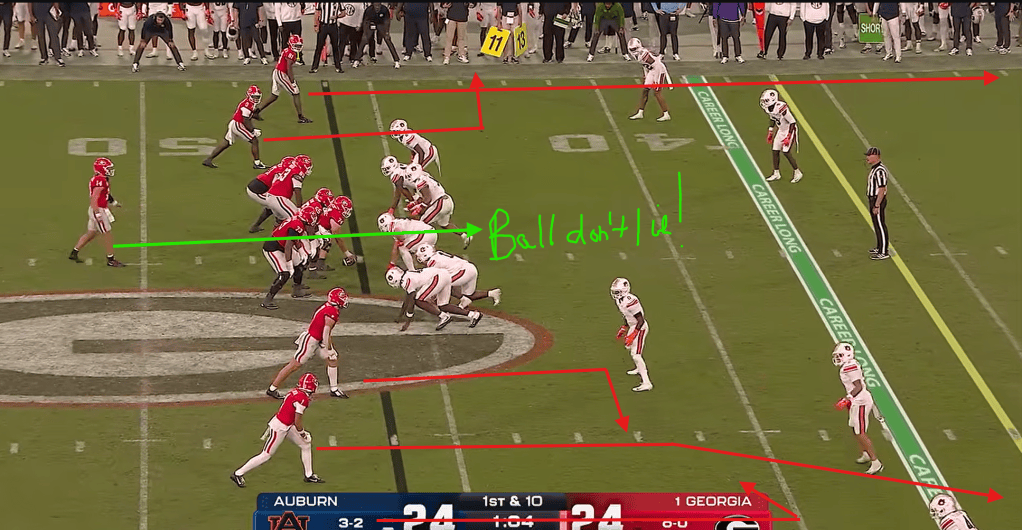
However, unlike the last time, Stockton runs directly into the back of Bobo, and in truly Sanchezian fashion, the impact dislodges the ball, with Sylvester Smith-Reed falling on it for Auburn to set the Tigers up for their date with destiny.
Auburn took over needing about 20 yards to give Alex McPherson a chance to write his name in Auburn history. On first down, they line up four-wide with the classic veer-and-shoot wide splits.
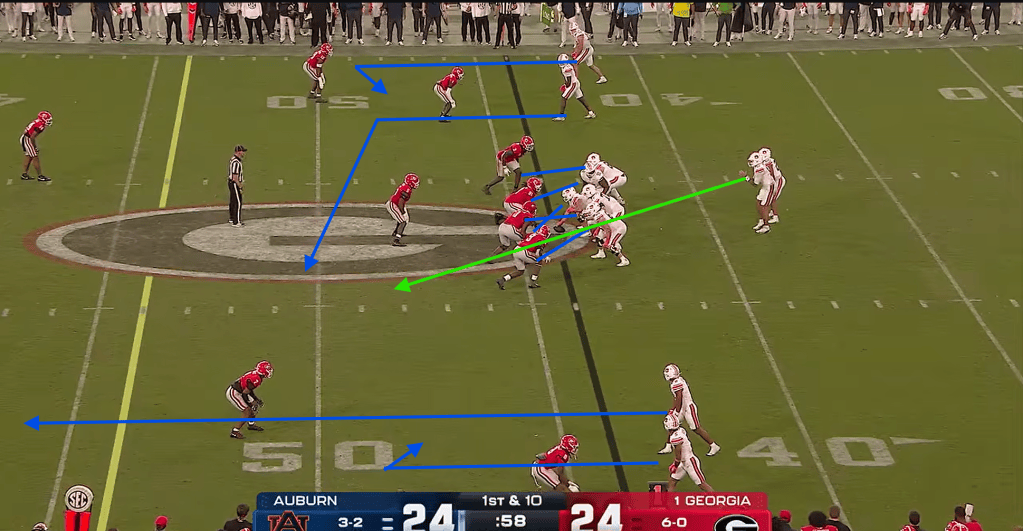
With two timeouts in their pocket, Auburn can run the ball, and Byrum Brown just hands it off on a simple inside zone play. Auburn has 5-on-5 in the box, so this is a good decision anyway, but Georgia’s defensive line seems to be in pass rush mode and they just straight up bust this run fit, with nobody filling the B gap, allowing Jeremiah Cobb to bounce it and pick up a huge gain to get the Tigers close to field goal range right off the rip. Just inexplicably poor discipline by Georgia’s defensive line.
On the next play, Auburn goes back to the well with the power toss, and this time it gets a much better result. This time, they run it from a four-wide set, with Georgia showing a six-man pressure, which they did bring. I’m kind of surprised Byrum Brown didn’t kill this play given the cushion Georgia was giving Auburn’s receivers, but it ends up working out.
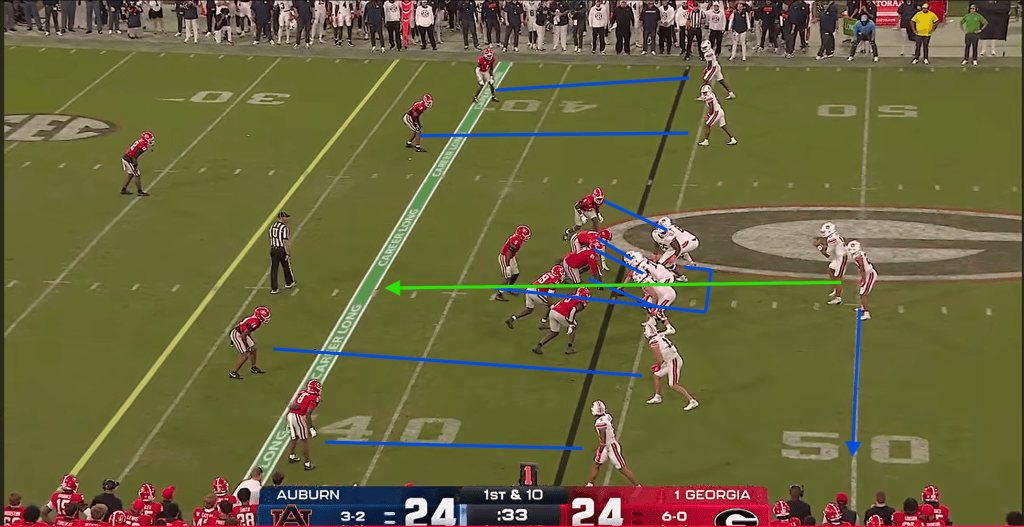
The defensive end fully bites on the toss fake, Georgia’s other blitzer overpursues and gets sealed off, and Byrum is able to carry the ball down to the edges of McPherson’s range with time to spare before Auburn takes a timeout. At this point, I’m starting to really feel it, my wife is paying attention, and my cats have no idea what’s about to happen.
And now for the payoff of that earlier foreshadowing, the piece de resistance of Georgia’s self-inflicted wounds in this game, one of the dumbest personal foul penalties I’ve ever seen in my life. After Byrum Brown picked up another first down with his legs, the Tigers set up to run a quick screen for reasons that are not really clear to me. This playcall doesn’t make any sense honestly, but of course the play itself isn’t what matters.
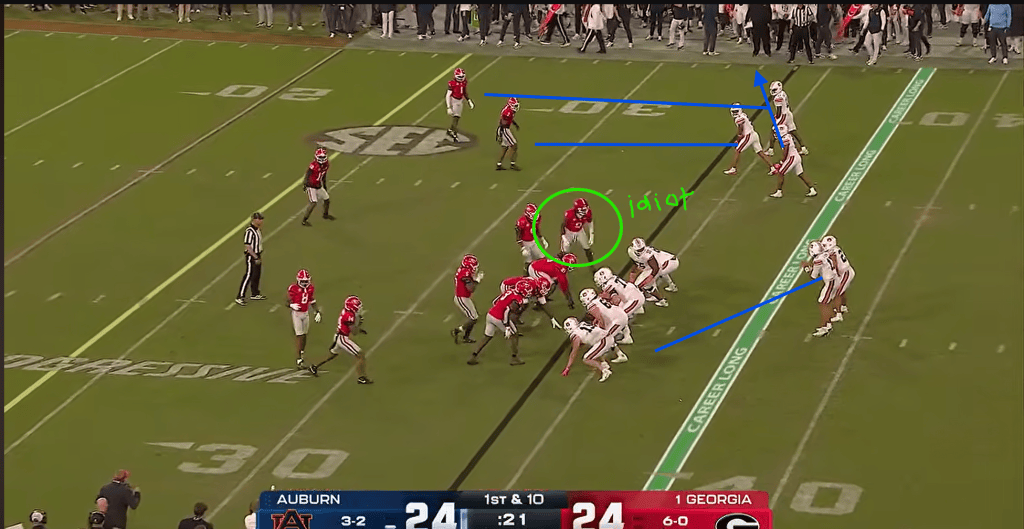
After an incompletion on a short-armed throw, Georgia DE Gabe Harris, Jr. comes in and takes a cheap shot on Brown for no discernible reason. I don’t know if it was frustration getting the better of him or what, but you just can’t do that in this situation (or any situation for that matter). Even if you want to complain about soft roughing calls, you know that’s going to get called every time and you can’t give the ref the chance to call it. It’s just idiotic any way you slice it. I give this 9.5 shoe tosses out of 10.
At that point, it was all over but the crying. Brown centered the ball, Georgia made a fruitless attempt to ice one of the country’s best kickers, and Alex McPherson wrote his name in Auburn lore alongside clutch legends like Damon Duval and Wes Byrum. There’s no Xs and Os to discuss here but we’re gonna watch it again anyway. War Damn Eagle.
So, to summarize, I don’t think Auburn really did anything all that different from what they were doing in the first five games Xs and Os wise. There were a few new concepts like that power toss series, which was a creative way to get the ball to some of your playmakers, but it was mostly just executing better than they had. The potential had been there all season, and they finally cut out the mistakes and lived up to it.
Like I said in the intro, it wasn’t really a typical Golesh win with a ton of offensive fireworks. All of Auburn’s drives were lengthy and deliberate without a ton of explosive plays. If anything, though, I think that makes the win even more convincing as proof of concept. We went in there and beat Georgia at their own game: running the damn ball, stopping the run, forcing turnovers, taking advantage of mistakes, and finishing when we had the chance.
To paraphrase Jay G. Tate on the Brain Drain after the game, now when Golesh goes in to talk to a recruit, the pitch is “I went and beat the #1 team in the country in their house with the least talented team I’m ever going to have at Auburn”. This is the kind of turning-point, vibe-shifting, hang-your-hat-on-it win that neither Bryan Harsin nor Hugh Freeze ever managed in their five total years on the Plains.
For the first time in many, many years, there’s real reason to have hope for Auburn football again. Enjoy it. To Hell With Georgia and War Damn Eagle.


Leave a Reply