Hugh Freeze is running out of people to blame for Auburn’s failures.
Them superpowers gettin’ neutralized, I can only watch in silence. The famous coach we once knew is lookin’ paranoid and now spiralin’.
If there’s one thing that’s always impressed me about Hugh Freeze, it’s his ability to avoid accepting responsibility for anything at all costs. After an embarrassing 6-6 season last year, Freeze fired both of his coordinators and brought in two people who were ostensibly his guys. After the Cal game, we were told it was Payton Thorne’s fault and that the coaching staff had only called one bad play. Last week, Freeze followed through on his scapegoating on sent out Hank Brown as Auburn sleepwalked through a win against New Mexico that was close for way longer than it should’ve been. Then at halftime of this week’s embarrassing home loss against Arkansas, Freeze promptly threw his erstwhile savior of the program under the bus, saying we needed a QB who wouldn’t turn the ball over before pulling him and going back to Thorne as Auburn failed to mount a comeback against the Hogs, and then saying he had no idea where we should go next at QB after the game.
We’ve cycled through coordinators, position coaches, quarterbacks, receivers, and offensive lines over the last seventeen games, but Auburn has still struggled to perform, and it’s time that we start looking at the one constant throughout those games: the head coach. Bill Parcells famously said that if you’re a head coach, “you’re either coaching it or allowing it to happen,” meaning, of course, that everything that happens within your program is ultimately the head coach’s responsibility. Freeze seems to have embraced the exact opposite of that philosophy; any success is a credit to his coaching, while any failure is someone else’s fault.
Well, too bad Hugh, I’m not letting you off the hook. Let’s take a look at the film from Auburn’s last three games and see how Freeze’s Tigers have underachieved so horribly to start the 2024 season.
It’s always been about love and hate, now let me say I’m the biggest hater
Cal
Let me say straight away that Auburn losing any of its first four games this season would have been a disaster, but to lose two of them, in the way that they did, is a damning indictment of Freeze as a coach and a program leader. The worst part of the Cal game was how much it resembled the New Mexico State debacle last year: a team came into our house more motivated, more prepared, and better-coached and just straight up beat us. That just should not happen, regardless of the stature of the opponent, but especially not against teams with clearly inferior talent, and it’s an unambiguous sign of a fish that’s rotting from the head down.
Auburn’s first drive brought one of the only positives of this entire game, with the Tigers taking the ball down the field for a score to open the game, their only touchdown until the closing minutes when it was too late to matter. Of course, even this wasn’t an unalloyed success, as Auburn was fortunate to avoid disaster on the second play of the game.
I don’t really even know where to begin on this utterly bizarre play. Auburn is running some type of play-action bootleg with what looks like a flood concept on the play side, where the offense sends three or more receivers to the same side of the field to overload (“flood”) the zone defense. Thorne fakes to Hunter and then rolls to the same side he fakes to, which doesn’t make much sense, then tries to shovel the ball to Hunter(?) and is very lucky that on review, the referees decided that the ball hit the ground during the course of this weird little pinball game. By the way, big shoutout to the homie DoABarrowRoll on Youtube, give the man a follow if you like watching film.
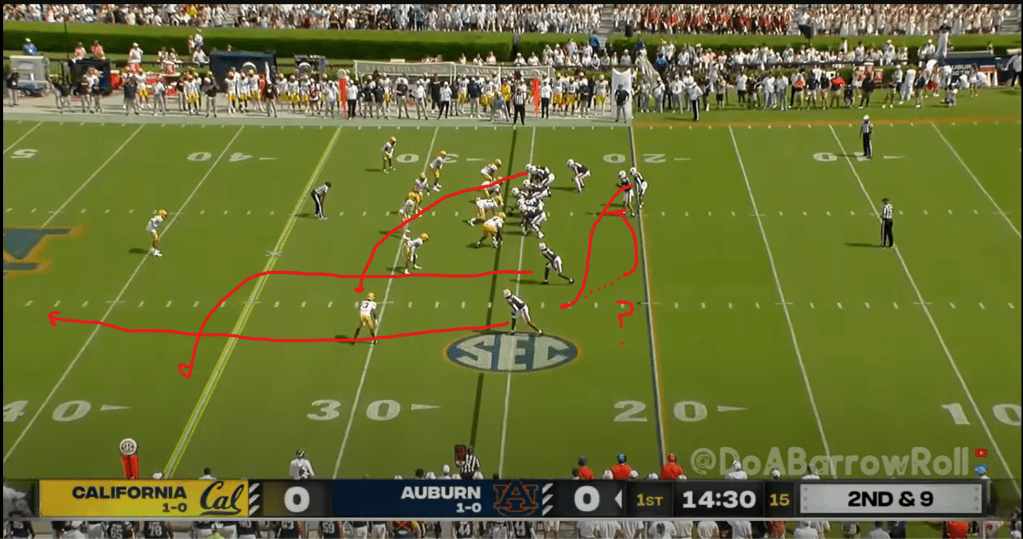
A couple of plays later, Auburn is able to generate one of its few explosive plays of the game. After a first down handoff where Payton Thorne missed the read on an RPO, Auburn took a deep shot off play-action down the sideline. Cal is playing man here and the safety lets himself get sucked too far into the center of the field to help the corner up the sideline, allowing Cam Coleman to get free, and Thorne (who throws off his back foot a bit here) finds him for a big gain.

Three plays later, Auburn manages to get in the end zone, albeit with Thorne and KLS creating outside the confines of the offense. I’m not entirely sure what Auburn is running to the three-receiver side of the field due to the TV angle (maybe a shock concept? put a pin in this), but KLS is running a curl route into the boundary, then gets into the scramble drill and he and Thorne are able to connect for the touchdown. Not the best throw by Thorne, but he put it where only KLS could get it, and KLS makes an outstanding catch. Enjoy it while it lasts, because Thorne is gonna spend most of the rest of the game putting the ball where only Cal defenders can get it.
Cal responded to this score converted their first drive into a touchdown by carving up DJ Durkin’s defense. While the defense certainly had its issues in these three games, I’m going to be primarily focusing on the offense because this is a takedown of Hugh Freeze and the offense is his responsibility. Freeze would infamously say after this game that the coaches only made one bad playcall and that the rest of the problems were bad execution.
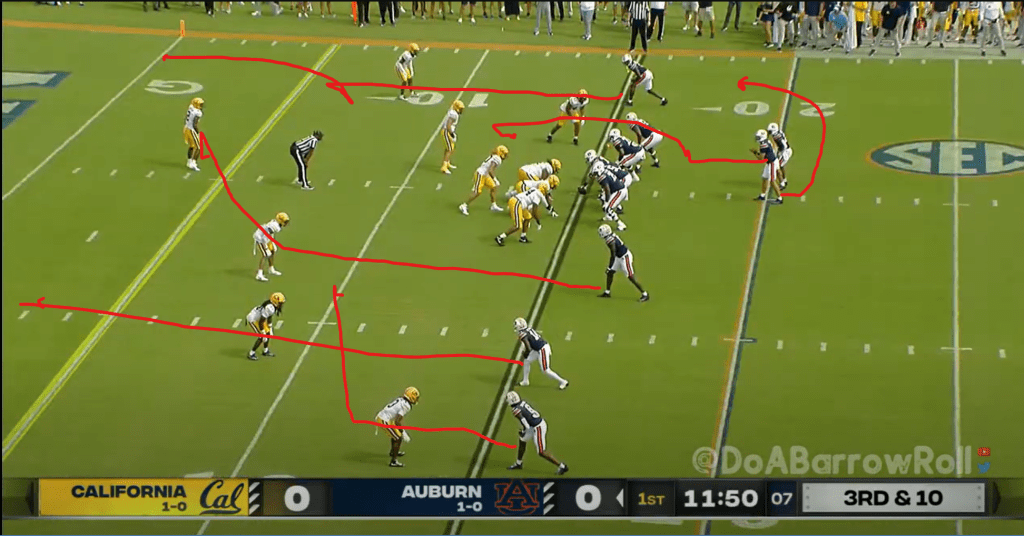
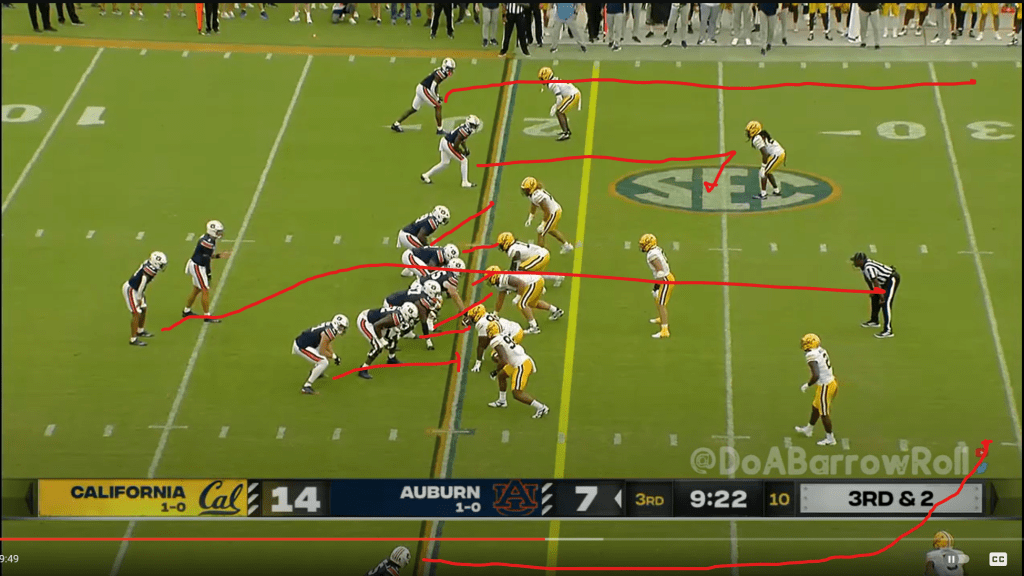
I’m going to debunk this lie right out of the gate by showing you two back-to-back bad playcalls. Here, Auburn is facing 3rd and 2 just across midfield. Again, it’s 3rd and 2. Jarquez Hunter, one of the country’s best RBs, is in the game. He’s right there, you can just hand him the ball. Instead, Auburn goes with another rollout flood concept like the play we just looked at above, and Rivaldo Fairweather drops the ball. It’s worth noting that nobody was really open here because Cal was in man coverage and Auburn was running a primarily zone-beating concept. Cal consistently played man in high-leverage situation, so calling a zone beater here is, by definition, a bad playcall, to say nothing of throwing the ball at all in this situation.

On the very next play, Freeze, again, goes to the air. Once again, Jarquez Hunter is right there. He’s there. Hand him the ball and let him get two yards. It’s that simple. Instead, Thorne tries a deep shot on 4th and 2 and it falls incomplete, giving Cal great field position. This is some type of shock concept, a trips concept where the #2 receiver runs a fade route while the other two receivers run underneath routes. It’s a good concept against man coverage since the slot fade route is maybe the hardest thing for a man coverage defender to deal with without safety help. The QB is supposed to peek the deep route and then get back to the underneath routes, especially in a situation where you, again, need two yards. Instead, Thorne never gets off that first read, launches it deep, and misses his receiver. But he never should’ve been put in that position. Back-to-back bad playcalls.
Back to back? I like that record. I’m gonna come back to that for the record.

On Auburn’s very next offensive play, Payton Thorne throws the first of his four* interceptions in this game. Honestly, though, this one really isn’t on him. Auburn is in a bunch set running either inside zone or duo (insert meme here) with the single receiver into the boundary running a glance route. Thorne is reading the boundary safety here, much like the way Auburn exploited Alabama A&Ms boundary safeties in the previous game. Thorne makes the correct read here; the safety comes sneaking down into the box before the snap and Thorne pulls it and throws the glance. It’s not a perfect throw, but it hits Cam Coleman in the hands, only for it to bounce off his hands and right into the waiting arms of a Cal defender.

The last two Auburn possessions of the half ended with a couple of key game management decisions from Hugh Freeze that one might generously call strange, but I’m not feeling generous, so I’m gonna call them bad. First, Auburn faced a 3rd and 4 and actually ran the ball for once. This is actually a pretty interesting design. Auburn lines up in a bunch set to the left and then motions a receiver across the formation to run a sort of crack/arc blocking scheme on the perimeter, with the WR blocking down on the safety and the motion man arc blocking the corner. This is essentially a triple option play, with a standard zone read on the defensive end and a secondary read on the linebacker with Rivaldo Fairweather coming across on an arrow route. Here, the first defender crashes down with the RB, while the LB goes to cover Fairweather, so Thorne correctly keeps and picks up as much as he can. All well and good, right?
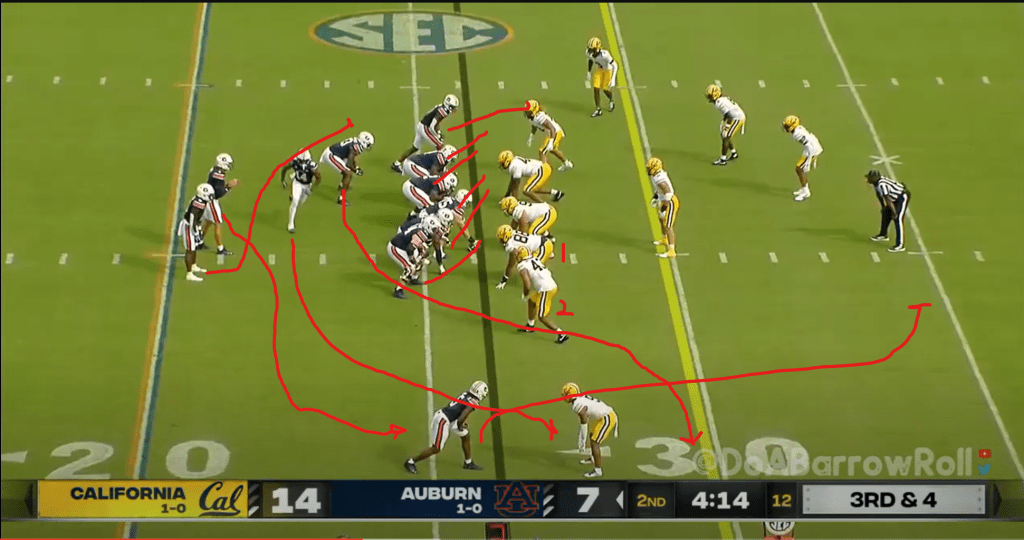
Well, no. The ref marked Thorne short here. For the record, I think the ref got the call wrong here; it looks like Thorne got the first down. Which makes what Hugh Freeze did all the more baffling: instead of challenging the call, he sent out the punt team. Not challenging the call is one thing; a mistake, in my view, but maybe he didn’t want to risk losing it this early in the game. Fine, but then its fourth and inches. You don’t trust your offense to get that inch against Cal? You really have that little faith in your offense? To be clear, the numbers are unambiguous about this: you always go for it on 4th and 1, even at your own 9 yard line.
Auburn got the ball back with 58 seconds left deep in their own territory, but got themselves into good field position thanks to a heady play from Payton Thorne. Here, Auburn is running a simple four verts concept. For the uninitiated, this is exactly what it sounds like: all four receivers running vertical routes. I’m not going to get into the nuances here because nothing comes of the route concept, but Thorne does a good job of stepping up in the pocket, seeing space downfield, and taking off for a good gain. This got Auburn down to the fringes of field goal range with about 18 seconds left.
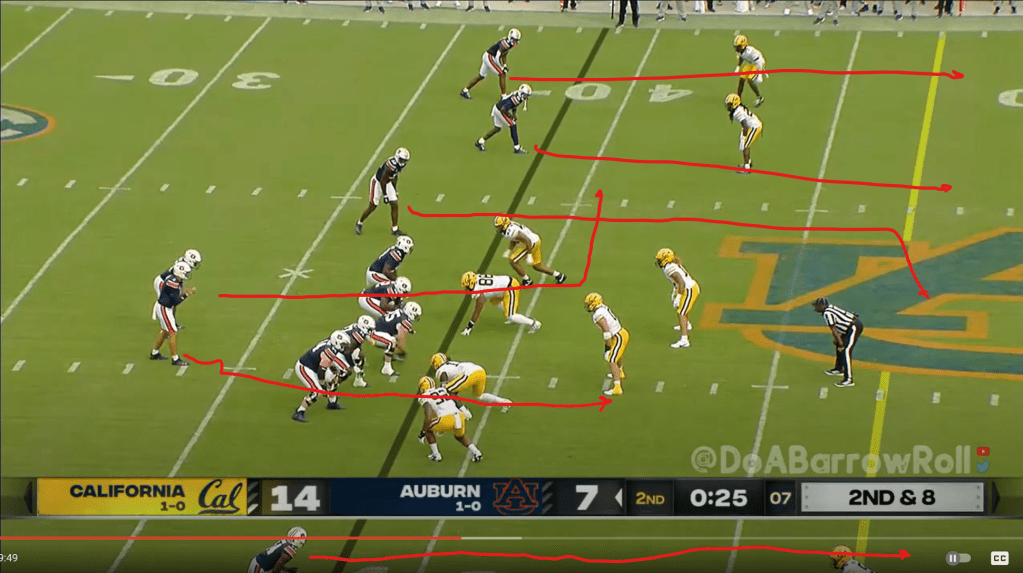
Here’s where Freeze makes another baffling decision. Rather than getting up and spiking the ball and then trying to maybe get a bit closer for the field goal attempt, he opts to send his true freshman kicker out to try a 60-yard field goal. I mean they put the dang line right there on the screen, Hugh. Unsurprisingly, Towns McGough couldn’t convert from 60 yards out and probably had to be at least a little resentful of his head coach for setting him up to fail like that.
Field goal, punt y’all, they punk y’all
Auburn got a stop coming out of the half and, in what would become a familiar story, had terrible field position to start their next drive. However, something amazing happens: Hugh decides to RTBD. And what do you know, it worked. Here, Auburn has a 3rd and 2 at their own 20. This is a variation of the RPO we saw on the interception earlier, with an inside zone concept paired with a glance route by the single receiver into the boundary (who you can barely see here, thanks TV camera angles). Here, however, the safety stays home on the hash and Thorne correctly hands it off to Jarquez Hunter, who rips off a big gain.
Here I want you to think back to the halcyon days of 2013 with me for a minute. When Auburn had an explosive run in 2013, the vast majority of the time, Gus Malzahn’s response was to immediately get the team to the line and run that play again to exploit whatever weakness they had found in the defense, often leading to another big play as the discombobulated defenders were unable to react correctly. Good times.
So, back in our 2024 dystopian hellscape, how does Hugh Freeze take advantage of the same situation? By calling three straight passes, of course. I want to look at the first of these three plays, because if this was executed correctly, it’s one of the most nonsensical play designs I’ve ever seen. I honestly can’t tell what’s supposed to be happening here. The offensive line is blocking a counter scheme; the playside linemen block down, while the backside guard pulls and kicks out the playside defensive end and the TE or H-back pulls and blocks the playside LB. The way the offensive line blocks here, it looks like they might actually be faking a counter scheme and running play action. I can’t tell exactly what the receivers are doing, but it looks like the single receiver is running a glance while the other side is running a slot fade concept. However, what the receivers are doing doesn’t really matter, because both the pulling guard and the TE completely whiff on the blitzing Cal defenders and Thorne is dead to rights before he could even get into his progression.
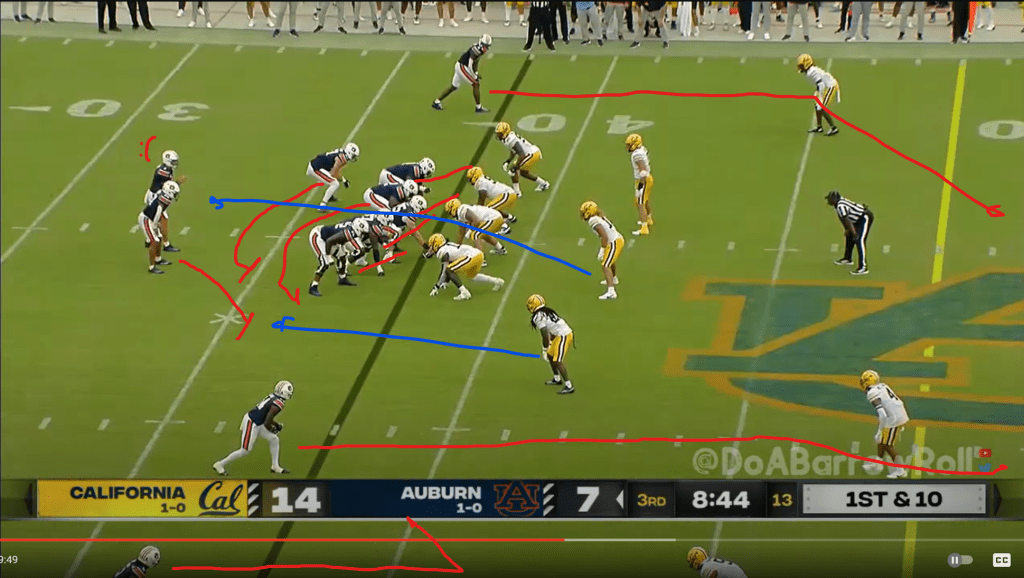
That’s how you follow up your best running play of the day? Really, Hugh? Auburn was forced to go back to the air on the next two plays as well, resulting in another short completion and a sack after another breakdown in protection, followed by a punt. The offensive genius at work, ladies and gentlemen.
For much of this discussion, I’ve gone easy on Payton Thorne, since most of what’s happened up to this point isn’t really his fault. I say that because most of what’s going to happen after this point is gonna be his fault. Let’s start with the first of his three* second-half INTs. Auburn had just gotten a stop against Cal’s offense and gotten the ball back to the offense in decent field position for once. This is some type of crossing pattern; I can’t tell what’s going on the two-receiver side, but they seem to be running clearouts to open space for the crossing route from the backside. At the time, people seemed to think that Thorne got hit here, resulting in the ball being deflected into the defender’s hands, but if you watch closely, the defender actually doesn’t touch him. Thorne just throws off balance and can’t get any power on the ball, and throws a wounded duck right to the defender. Absolutely hideous.

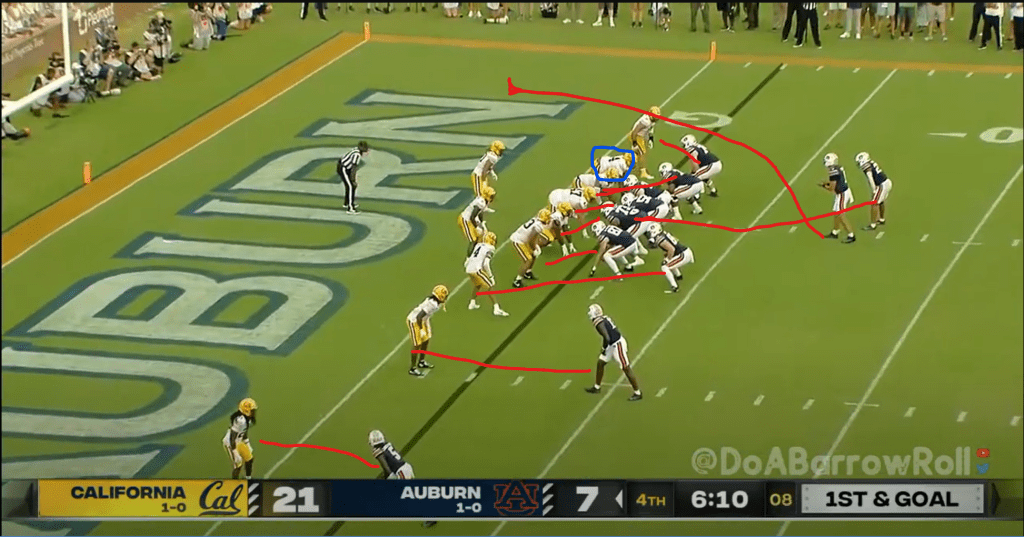
Auburn’s next drive ended with a fumble by Jarquez Hunter, which Cal cashed in for a touchdown after refusing to take advantage of the many gifts Auburn had given them for most of the game. Now down by two touchdowns in the fourth quarter, Auburn was in a desperate position and had to throw the ball, which is never a good thing. Auburn actually managed to get the ball downfield after a good drive, and, after what should have been Thorne’s second pick of the second half was wiped away by a dubious DPI, was able to cash in with a short touchdown run. This is just a basic zone read. It’s a clever little design, using an unbalanced set and then attacking the short side after the Cal defense overloaded the unbalanced side. Thorne is reading the DE (circled in blue) and makes the right decision to keep it and runs in untouched to keep Auburn in the game. Thorne probably pimped this TD a bit too much considering we were still losing to Cal at home but whatever.
That was a nice play right? Fun stuff. Anyway, hope you enjoyed it because it’s all garbage from here on out. Auburn’s defense got a stop and gave the offense an opportunity to get the ball down the field and tie the game. After a completion on the official favorite pass concept of this blog, three man snag (which I’d be diagraming if this were a happy post), Thorne threw his second* interception of the second half. This is just a boneheaded throw that’s completely inexcusable from a sixth-year player. Auburn is running the same play-action concept that I diagrammed above, with the single receiver on a vertical route and the backside slot receiver running a post. Cal is in some kind of pattern-matching quarters coverage here, and the corner has this route absolutely blanketed. I have no idea why Thorne threw this ball. You’d lose your mind at a ninth-grader who made this throw in a JV football game. I know this article is supposed to be a takedown of Hugh Freeze, but Payton Thorne made himself hard to defend here.
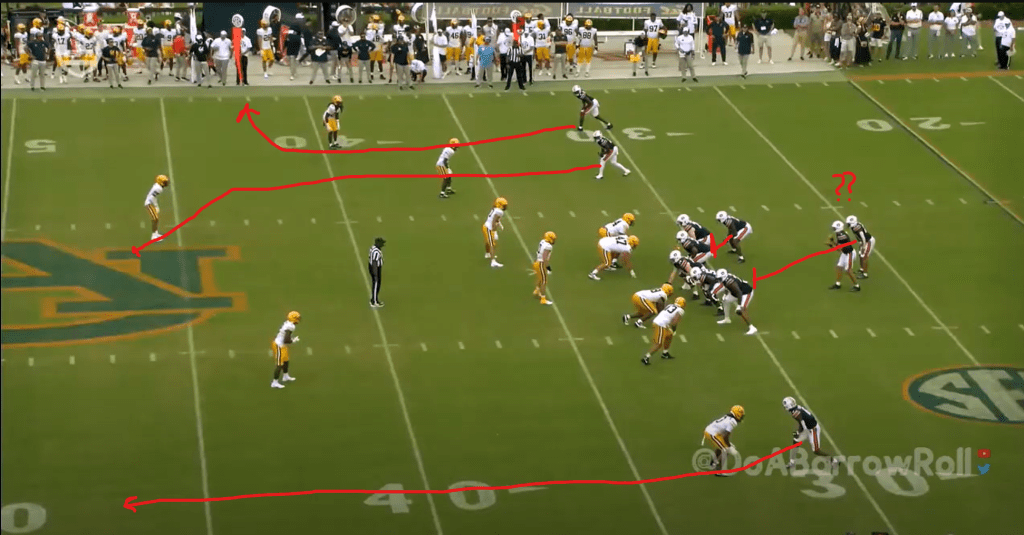
Auburn’s defense actually was able to get the ball back to the offense for a long-shot last-second drive. I had honestly already turned the game off, but I’m sure some of y’all were naïvely hoping for some Jordan-Hare voodoo. False hope is a fate worse than death, however, and Thorne immediately threw his third* pick of the second half. This looks like some type of Y Cross variation with a curl route on the backside. I don’t really know what Thorne is looking at here or really even who he’s throwing the ball to. I think he’s trying to hit the curl route, but it’s an awful throw that put a cherry on top of a truly humiliating defeat. Hugh Freeze was wrong to throw Thorne under the bus publicly rather than taking responsibility for the defeat himself, but I can’t defend either of these last two throws by Thorne. Brutal.
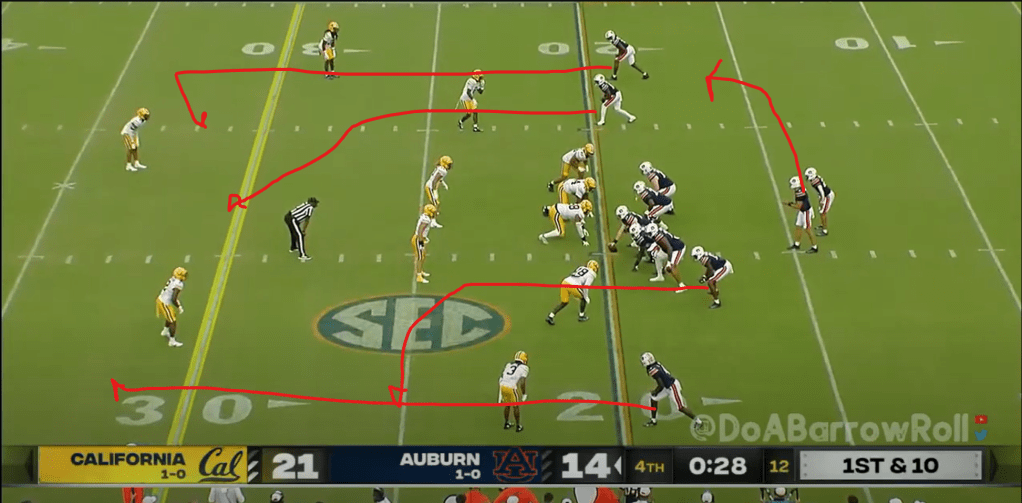
And I’m fine with it, I’ll push the line with it
Pick Thorne off one at a time with it
We can be on a three-hour time difference
New Mexico
I’m not going to get that deep into the film of the New Mexico State film because it’s really not that interesting from an Xs and Os perspective due to the talent difference and the Xs and Os are really tangential to the purpose of this article. Coming into this game, New Mexico was arguably the worst defensive team in the country. They had been roasted alive by their first two opponents, giving up 35 points in a loss to FCS Montana State and then 61 in a loss to Arizona. Freeze used what should’ve been an easy game to give RS freshman Hank Brown his first collegiate start, I guess hoping that would be enough to get him up to speed before SEC play. Of course, this really exposes the major flaw in all of this, which is that if Payton Thorne was bad enough to get benched after game two, why did Freeze roll with him as a starter to start with instead of getting a better QB in the portal? I saw some people praising him for making the move, but in reality, it’s an indictment of Freeze’s program management.
Anyway, on to the game. New Mexico started the game with the ball and promptly marched right down the field on DJ Durkin’s defense and kicked a field goal. I focused on the offense in the first review since Auburn’s problems were almost exclusively on that side of the ball. In this game, though, the defense bears a large amount of responsibility, largely due to Durkin’s insistence on playing light boxes (6 players or fewer) while New Mexico spent most of the game in 11 or 12 personnel (1 RB and 1 or 2 TEs), meaning they had an equal or even greater number of blockers than we had potential run defenders. This early big play from New Mexico illustrates that quite well. Auburn is in what Mike Elko calls a “split” front, with a defensive lineman lined up in a 0 technique (directly over the center) and two linemen in 5 techniques (on the outside shoulder of the tackles). The inside linebackers are lined up over the guards, with the buck (edge player) lined up outside the 5 tech. This is a very easy front to run the ball against because three of the four players on the line are outside of the tackles, leaving only the two linebackers to control the B gaps.
Here, New Mexico is running a zone read concept, reading the backside 5 tech with the TE coming across to kick out the buck. The QB makes the correct read and hands the ball to the RB, who cuts back through the wide open B gap for a huge gain. But why was that B gap so open? With two defensive linemen set up outside the tackle, the only available defender to step up and fill the B gap is the backside LB, who…goes flying into the A gap for some reason I can’t explain, leaving the B gap wide open.

After Auburn’s defense managed to bow up and hold the Lobos to a field goal and a great return from Jeremiah Cobb, the Tigers took over for the first drive of the Hank Brown era in great field position. The offense wasn’t super efficient here, taking nine plays to punch the ball in from 32 yards out. Here Auburn runs a familiar concept, an RPO pairing a counter scheme with a glance from the single receiver, reading the inverted safety. He creeps down into the box pre-snap, making the read easy for Brown, who makes the right read and hits Camden Brown in stride for a touchdown.
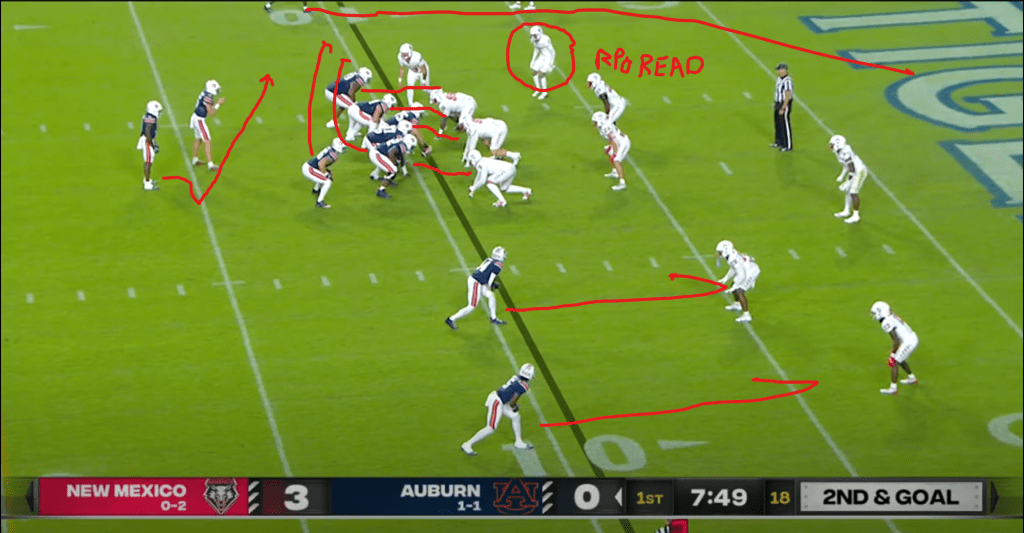
New Mexico managed to score late in the first to take a 10-7 lead, arousing the attention of the Twitter sicko demographic. I’m not gonna get into this drive too much since it was mainly an Auburn defender getting cooked in man coverage on a go route, but I’ll add that Auburn being behind in this game is a great indication of how Hugh Freeze’s Tigers trailing in this game is a sign of the team once again showing up mentally unprepared to play against an inferior opponent.
On the ensuing drive, Auburn once again moved the ball well, with the bulk of the yardage coming from a Hank Brown bomb to KLS. This is just a straight-up shot play off play-action, although I do want to point out a couple of things. One, at the top of the screen, you see two receivers stacked on top of one another near the sideline. I think this is an inheritance from Philip Montgomery and the veer-and-shoot, which loves these types of stack alignments to confuse defenders about their pass coverage responsibilities. Second, I do want to praise Brown here for doing a good job of looking off the safety here before getting back to KLS on the deep route, making sure the overmatched corner has no help over the top. It’s a nicely-placed ball and a big gain for the Tigers, who would punch the ball in shortly afterward on a Jarquez Hunter run.
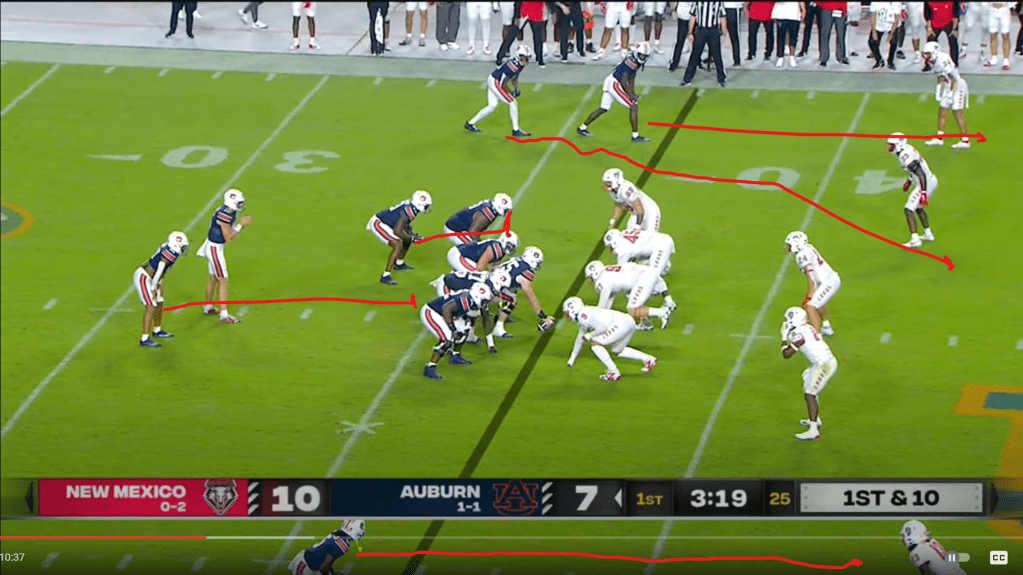
The next New Mexico possession ended with a bizarre interception by Jeremiah Thompson, setting the Tigers offense up with good field position. Auburn got the ball down into a goal to go situation, but couldn’t punch the ball in and had to kick a field goal. This failure illustrates two things: Freeze’s insistence on getting overly cute in short yardage situations and Auburn’s weakness up front on the offensive line. Both Montana State and Arizona ran for nearly 8 YPC on New Mexico, but Auburn couldn’t punch it in in a goal-to-go situation with three tries. The last of these was a farce of a play where Brown and Alston were apparently not on the same page. This looks like a zone read play very similar to the New Mexico play I diagrammed above, with Thorne reading the backside defensive end and the TE (Rivaldo Fairweather) coming across to block the backside LB. This kind of error really shouldn’t be happening in the third game of the season, and it especially shouldn’t be happening in the low red zone. The low red zone is the place to man up and punch the ball in, not show everyone how clever you are, but Hugh Freeze opted for the latter and ended up leaving four points on the field.
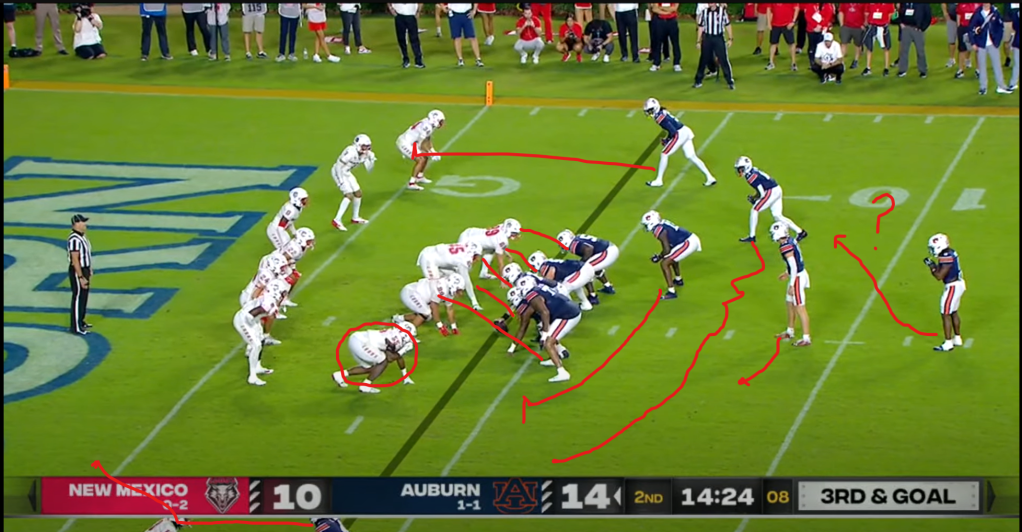
New Mexico managed a couple more big plays in the first half, largely due to busted coverages by Auburn’s defensive backs, but only managed a field goal from it because they kept killing drives with stupid penalties and turnovers. This is the thing that people might overlook if they just look at the final score: New Mexico State would easily have been closer, if not ahead at this point if they hadn’t wasted their forays into Auburn territory due to self-inflicted wounds. Auburn’s defense didn’t really do that much to stop them, and seeing those field goals as victories for the defense isn’t really accurate.
After the half, Auburn came out and did something they had refused to do for most of the previous six quarters and ran the damn ball. I want to note some specifics of the scheme here. This is a wide zone run scheme (sometimes referred to as outside zone, although they’re different things); here’s another article where I discussed this concept in detail in a different context a couple of years ago in a piece that frankly didn’t age well. Unlike inside zone, where the offense is trying to double-team defensive linemen and displace them vertically, wide zone attempts to get the defenders moving laterally and then use their own motion against them by having the RB read the defenders and find an open cutback lane. Most of Auburn’s successful runs in this game came on wide zone plays, while the results of their efforts to run inside zone were mixed at best, suggesting that the offensive line just doesn’t have the dudes to push around a defensive front that, again, gave up 8 YPC to an FCS team two weeks before. I was hoping that this would at least be a lesson to Hugh Freeze to focus on wide zone runs as the base of the offense going forward, but that hasn’t been the case.
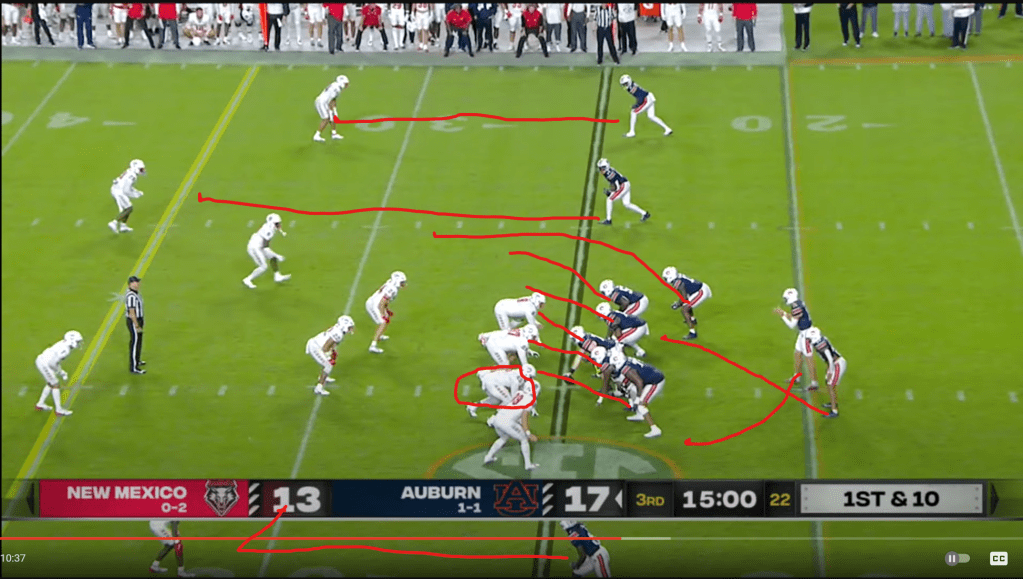
To finish off this drive, Auburn presented kind of the yin to the wide zone play’s yang: the bootleg pass. Auburn isn’t actually faking wide zone here, but this is commonly done off of a wide zone fake. The pass concept is actually a variation of the much-ballyhooed Spider 2 Y Banana, which is basically just a bootleg flood concept with one of the playside receivers running a crossing route to disrupt the defenders. Here, Rivaldo Fairweather comes in motion and runs a spot route to try to keep the LBs from getting outside to cover the flats. The playside TE (Micah Riley) runs a corner route, while the backside TE (Luke Deal) crosses the formation into the flat. Brown rolls to the right, and is just making a simple high-low read off the playside cornerback. If he drops to cover the corner route, Brown will dump it off to Deal, and if he comes down to cover the flat, the corner route should be open. Here, that isn’t really even necessary, since the cornerback gets caught in the wash and the defenders are unable to get back outside to cover Riley, who’s wide open for an easy touchdown pass.
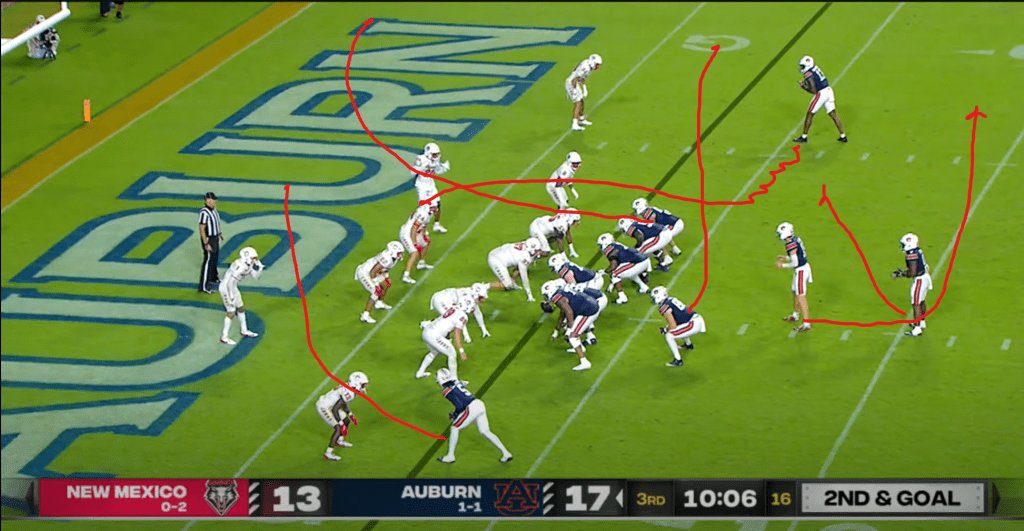
While the tone of this article is obviously overwhelmingly negative, I do want to praise the good things Brown did during this game, because this really isn’t the players’ fault and I don’t want it to seem like I’m blaming them for our problems right now. Hank did a good job of standing in the pocket and getting through his progressions, rather than getting stuck on the first receiver as Payton Thorne has often tended to do, and they’ve led to good results. The next Auburn touchdown was a good illustration of this, with Brown going through his entire progression before finding Jarquez Hunter on the checkdown, leading to an easy score. Not much to say about the actual play design here, looks like some kind of switch concept into the boundary (hard to tell because of the TV camera angles), but I did want to give credit where it was due in terms of Brown’s performance.
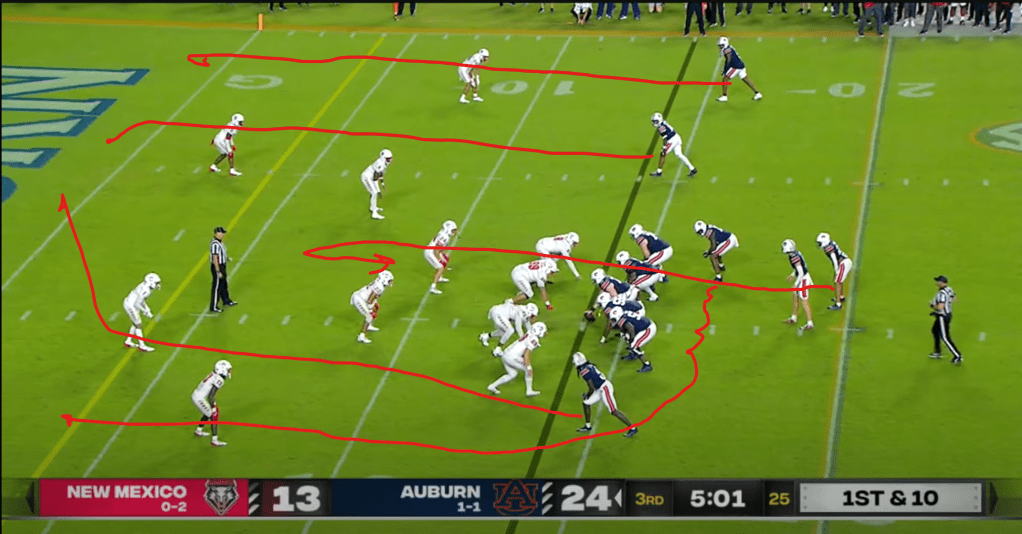
New Mexico’s next drive ended with their final score of the game, which came on a 4th and goal from the 4. For context, Auburn had just blown up New Mexico’s previous play by sending heavy pressure in the QB’s face and forcing an incompletion. Inexplicably, however, Durkin refused to learn from that success and immediately went back to dropping eight guys into coverage and only rushing three, giving New Mexico’s QB basically unlimited time to find an open receiver, who was somehow matched up one-on-one in the end zone. It’s made even more inexcusable by the fact that they were in a seven-man protection here, meaning there were only three receivers out in the pattern, and yet they somehow managed to get a one-on-one. Yeah, I know, he gets away with some pretty blatant offensive pass interference, but that’s beside the point here. You’d think after the 4th and 31 we’d have learned our lesson about playing soft coverage and only rushing three in high leverage situations, but nope. More on this later.

I don’t have that much else to say about this game, as Auburn did manage two more touchdowns to pull away late and make the win look more comfortable than it actually was. I do want to go back to my point about wide zone above though by taking a look about Auburn’s last touchdown. Auburn is in a 10 personnel set here, with four receivers and no tight ends. Wide zone is hard to run without a tight end, since he’s generally the RB’s aiming point for his first few steps. From 10 personnel, wide zone teams will often run what’s known as mid-zone, which is identical to wide zone in terms of the blocking scheme, but the back is now aiming for the playside tackle rather than the TE. This is just a straight mid-zone handoff with no RPO or QB run read, which was executed perfectly, and Damari Alston takes it to the house.

As I noted several times during the course of this review, the final score of this game was pretty flattering to Auburn. New Mexico was able to hang around for most of the first three quarters and was undone as much by their own mistakes as they were Auburn’s efforts at stopping them. Auburn was unable to establish its dominance on the line of scrimmage on either side of the ball, which is the key to controlling games. While a win is a win, I wasn’t celebrating in the way a lot of people were after this game, mostly because I still saw most of the fundamental flaws of this team on display in this game.
If I can wax philosophical for a moment, one of my core beliefs about football is that your ability to run the ball and throw play-action sets your floor and your dropback passing game sets your ceiling. If you can run the ball consistently and protect your run game with play-action, you’re never going to be a bad team; you might not be elite, but you’re not going to be bad. So much of Auburn’s issues in the losses to New Mexico State and Cal and the tense first three quarters of the New Mexico game were down to Auburn’s inability to run the ball consistently and inability to stop the run and get off the field on defense. To paraphrase Vince Lombardi, offensive and defensive schemes come and go, but the fundamentals of blocking and tackling will always be the foundation of the game. Even in a win, Auburn was unimpressive in those areas, and those deep fundamental flaws would come back to bite them almost immediately.
And I might do a show a day, once a lame, always a lame
Oh, you thought the money, the power or fame would make you go away?
Arkansas
And now we’ve come to the pièce de résistance of this awful season so far, the big fat egg Auburn laid this week against Arkansas. Arkansas started with the ball, and Auburn’s defense came out looking sharp, forcing the Razorbacks into a third-and-long passing situation. The third-and-Auburn meme has been around for years across several defensive coordinators, and it’s still alive and well with Durkin’s unit in 2024. Auburn rushes six here but fails to maintain gap discipline, allowing Taylen Green to escape and run for the first down. Not gonna talk about the route concept too much since 1. the secondary had it covered pretty well and 2. I can’t tell what it is because of the camera angles anyway.
On the next series, Auburn’s defensive front continued to demonstrate poor discipline. The Tigers’ defense is in a mint front here, with a noseguard lined up over the center and two defensive linemen playing 4-techniques (lined up on the inside shoulder of the offensive tackles. This front is designed to clog up the A and B gaps, a common strategy to counteract spread offenses, which often want to run the ball in those gaps on inside zone or gap schemes. In this case, Arkansas is running an inside zone read, reading the backside 4-tech lineman; this is a bit of a changeup, since the normal way of doing this would be to block the three lineman and read the overhang (outside LB), but here they have the backside tackle leave the 4-tech and block that overhang. This is a clever little tactic to confuse Auburn’s option rules, and it works well, as the 4-tech chases the RB and Green has a huge lane to run through. I also want to point out some poor gap discipline here from Eugene Asante (9), who goes to fill one of the interior gaps rather than scraping over the top to tackle the QB as he was presumably supposed to, turning what should’ve been a modest gain into an explosive play.
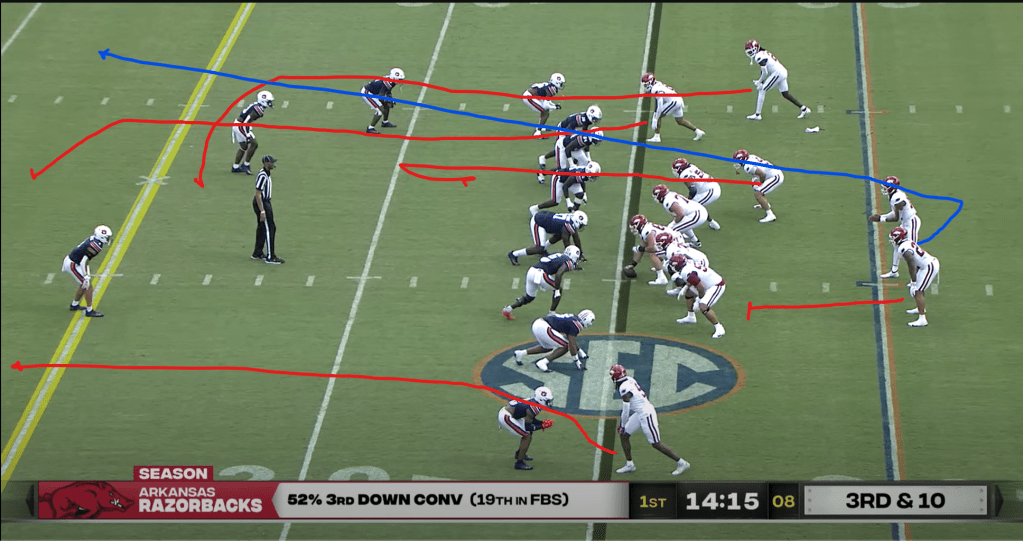
After giving up a couple more first downs, Auburn’s defense was able to bow up and get a third down stop to hold Arkansas to a field goal attempt, which they missed. On that third down, Auburn brought some heat, using the split front we discussed above in the New Mexico game. I don’t know if this is really a scheme win as much as it is just a whiff by the Arkansas RG (72), but it results in a big sack to kill the Arkansas drive.

Auburn was able to channel the momentum from this big stop into a pretty good opening drive, which included some solid work on the ground. Amazing what happens when you RTDB, isn’t it, Hugh? Anyway, this predictably all falls apart when Auburn goes to the air. This is a sort of strange looking play, with Auburn running play-action off of power read action from an empty formation with jet sweep motion, a play that I don’t think they’d ever run with Hank Brown, who has about as much business carrying the ball on a power read play as I do. On the front side of the play, Auburn looks like it’s running some type of post-wheel concept, a common thing to do off of jet sweep motion, where the perimeter blocking scheme often involves the wide receiver blocking down on the safety and a tight end or running back arc blocking the corner. This sets up the wheel route if the corner gets used to seeing and avoiding that block.
This is part of why I think this play doesn’t really work and the playcall doesn’t make much sense. It’s reliant on the defender biting on a play that you haven’t shown them yet. It’s putting the cart before the horse in playcalling terms. I can’t really tell what coverage Arkansas is in here, some type of man or man-match, but the seam route to Rivaldo Fairweather that Hank Brown tries to throw isn’t open. It’s also just a bad throw from Brown, both because he’s forcing the ball into coverage and because he’s throwing off-balance, and it ends up well behind the receiver. He’s probably a bit unlucky that it was tipped directly to another defender, but if you put the ball into dangerous situations, you don’t have much right to complain about the result. Dumb decision that killed a chance for Auburn to take control of the game early on.

Unlike Auburn, Arkansas took advantage of their next opportunity to seize the upper hand in the game. The Razorbacks’ offense methodically moved the ball downfield and found themselves on the edge of the Auburn red zone. That’s when the coverage bust bug that had plagued Auburn in the New Mexico game reared its ugly head again. Arkansas is running some type of crossing pattern here, possibly a drive concept, a variation of shallow cross where the crossing route and the dig route come from the same side of the formation, while the receiver on the opposite side runs vertical to clear out the defenders. I think Auburn is playing some type of match quarters coverage here; this is similar to traditional quarters, where each of the four DBs is responsible for a quarter of the deep area of the field, but with special rules built in where defenders will abandon their deep zone based on what the receivers do. This type of coverage is dependent on good communication and a good knowledge by the players of when they’re supposed to stay in their zone and when they’re supposed to go cover a receiver elsewhere. Clearly Auburn’s young and depleted secondary didn’t do that very well here, as the crossing route comes wide open and Arkansas is able to get the ball down inside the ten. They would punch it in three plays later to take a 7-0 lead at the start of the second quarter.

On the second play of the ensuing possession, Auburn comes out with a play I’m not sure I’ve seen them run before. At first glance I thought this was just a wide zone concept, but it’s actually a variation on the old wing-T down G play. The basic premise is that the playside tackle and tight end are going to block down and seal defenders inside, while the playside guard will pull and trap the defensive end to open up the off-tackle gap. I’m not sure exactly where this came from or why Auburn ran it here, but it works pretty well. The playside OT and TE don’t actually do a great job of sealing their guys (which is why this initially looked like wide zone to me), but the RG delivers a good kick-out block and Jarquez Hunter is able to find the gap for a big gain.
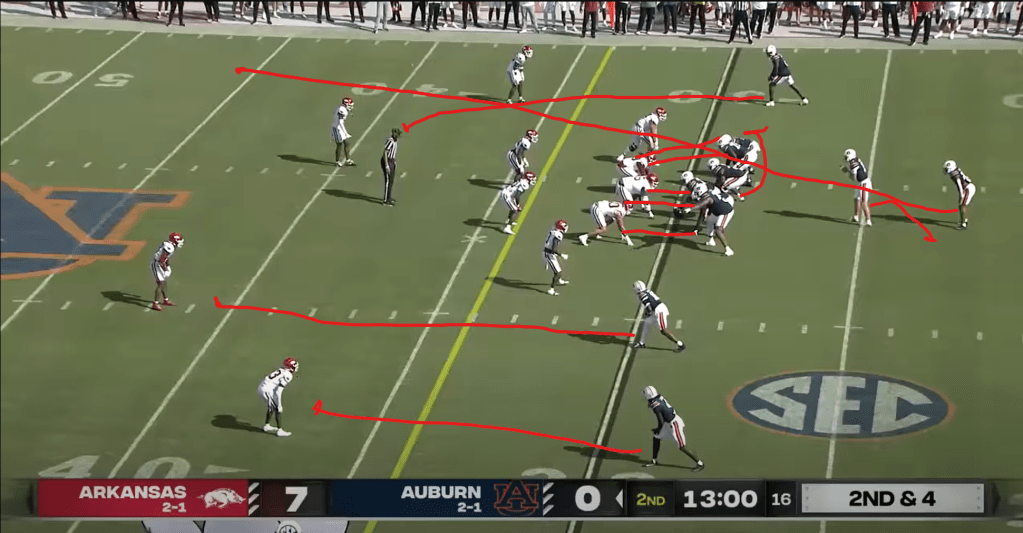
Auburn was unable to do much else on that drive, and the teams exchanged three punts before another Arkansas moved the ball to midfield. Facing a 4th and 1, Arkansas correctly decided to go for it, but Petrino got way too cute with the playcall and instead of running the ball against Auburn’s questionable run defense, he tried to run some kind of rollout pass, which Jalen McLeod blew up to set the Tigers’ offense with great field position and more than two minutes to work with to try and get a score before the half.
Of course, this is the 2024 Auburn Tigers we’re talking about, so they didn’t take advantage of it. Auburn actually did come back to the power read concept I mentioned above. The idea of this play is like a combination of a power scheme with a zone read: the running back runs a sweep path while the backside guard pulls to block the playside linebacker, but instead of kicking the defensive end with the fullback like a normal power play, the offense leaves him unblocked and the QB reads him to either hand off on the sweep or run the power. Like I mentioned above, I can’t imagine Auburn would actually want Hank Brown carrying the ball, but Arkansas kindly obliges as the DE pinches down allowing Brown to just hand the ball to Damari Alston, who rips off a big gain…before fumbling the ball away to Arkansas. He’s correctly carrying the ball in his outside hand, but he isn’t protecting the ball with both hands like he should be going into contact and gets punished for it. Auburn’s RB’s have been severely fumble-prone this year to the point that it has to be a coaching issue rather than being on the players, especially since Auburn’s RB room really didn’t have this issue last year under Cadillac Williams. Huh, weird.

Auburn’s defense managed to get yet another stop, giving the offense another opportunity to get points before the half. You’ll never guess what happens next (you’ll totally guess). On the second play of the drive, Auburn lines up in an empty set. I actually really like using empty sets with 11 personnel, since you can often get good matchups for the RB and TE by lining them up out wide and forcing the linebackers into pass coverage. Auburn runs a variation of the shock concept I described above, with what looks like a slant and a curl on the other side. Arkansas looks to be in some type of cover 3 look here, with three deep zone defenders and four underneath zone defenders. It looks like Brown is working the backside of the concept the whole way, even though it’s into the boundary, leaving less space for the receivers to get open. I don’t know what his progression is here, but whatever he was supposed to be reading, he completely screws it up and throws the ball directly to the zone defender, killing the drive. He kind of stares down the receiver, but he was never open in the first place and I have no idea why Brown made this throw. Big ol’ yikes.

Fortunately for the Tigers, Arkansas decided to join in on the pick party, as Taylen Green threw the ball right back to Auburn on the very next play. With an opportunity to redeem himself, Hank Brown immediately connects with Rivaldo Fairweather for a big gain into Arkansas territory. This looks like some type of flood or sail concept. I explained the way this concept works earlier in the Cal segment, but I will note that Arkansas just straight up busts this coverage, with two defenders covering Camden Brown on the vertical route and nobody covering Fairweather on the sail route. It’s honestly not a great throw from Brown, who kind of throws this one off his back foot, but Fairweather was so wide open that it didn’t really matter.
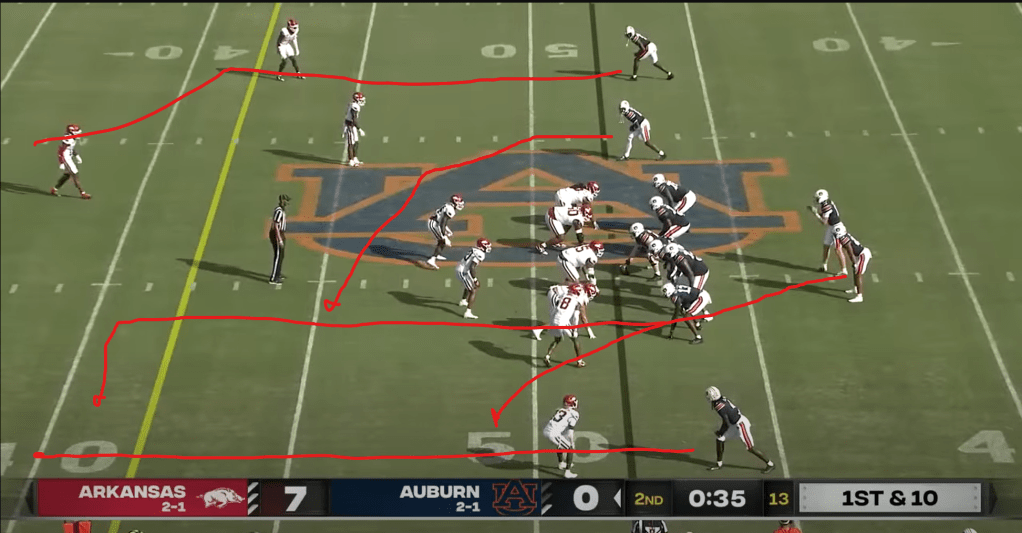
Of course, you already know how this story ends. On the next play, Auburn goes back to the air, running the author’s beloved snag concept into the boundary paired with double slant routes to the backside. Brown decides to work the slants on the backside of the play for some reason (I assume it has to do with either Arkansas’ pre-snap alignment or the drop of the linebackers) and Sam Jackson V manages to get leverage on the safety; however, Brown doesn’t really get his full body behind the throw and it sails on him, straight into the hands of the Arkansas safety. I still can’t tell if he actually caught this or not, but the booth said it was a pick. This was the second straight throw where Brown demonstrated poor technique, and this time it bit him. This raises serious questions about Auburn’s QB development at the moment, since these are mistakes that ought to be worked out of a QB’s mechanics very early in his career. It’s really disappointing to see this happen to Brown after he had such a good start to his career last week.

Never one to look past the surface level or consider his own role in things, Hugh Freeze told the ESPN reporter that Auburn needed to find someone who could hold onto the ball in the second half, and by that he apparently meant going back to Payton Thorne, who, you’ll recall, was benched for throwing four* picks against Cal just two weeks before. This constant shuffling of QBs is reminiscent of other times when Auburn was lacking clear direction on the offensive side of the ball (the 2016 Clemson debacle, Harsin’s QB hokey-pokey with Bo Nix and TJ Finley, and Auburn’s offense last year) and is a sign that Freeze doesn’t really have a clear idea of where things are going with his offense. I want to point this out specifically to counteract a common argument that I’ve seen by his defenders, that we need to give him time to build something. If you’re building something, you have to have a clear idea of what you’re building, otherwise you’re just going to end up as the football coaching version of the IKEA confused man diagram.
Auburn’s first drive of the second half went nowhere and the Tigers had to punt, but with Arkansas threatening to score and go up by what would feel like an insurmountable two scores, Auburn’s defense stepped up and made a huge play. This is a much better execution of the match quarters concept I discussed above and an illustration of why it’s become so popular at all levels of football. I think this is also the exact same drive concept that I discussed in that earlier example, but here Green tries to throw the deep out route on the front side of the play. Kaylin Lee is all over it and is able to undercut it because he knows he has safety help over the top to protect him, and he comes away with a desperately-needed takeaway.
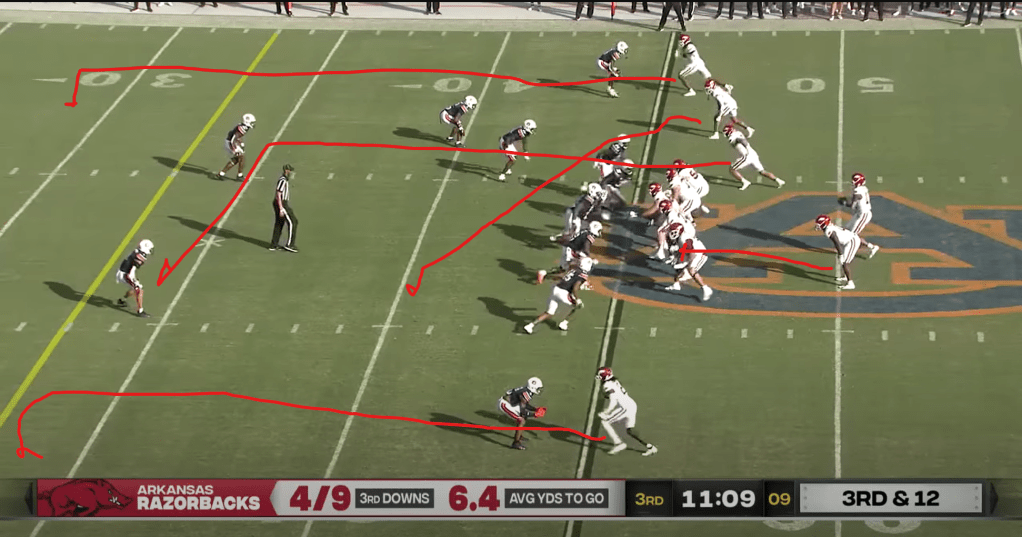
After a good run from Jarquez Hunter allowed the Tigers to pick up an initial first down, Auburn went to the air with a play-action shot. This is very similar to the shot play they were running against Cal, although here KLS is running what I’ve always called a shake route, a vertical route where the receiver initially releases inside before breaking back outside and up the sideline. This is just another coverage bust for Arkansas, as the boundary corner sinks to the flat to cover the RB, who was already covered by the linebacker, and the safety can’t get over the top in time to make the play. It’s not the best throw by Thorne, but KLS continues his stellar early-season form with a great one-handed catch for Auburn’s biggest play of the game up to that point.

For the first time all day, Auburn was able to take advantage of some positive momentum. I can’t quite tell whether this is an RPO or just true play-action attacking the inverted safety, but either way, Thorne pulls the ball out and throws the now-familiar glance route to KLS for the Tigers’ first touchdown of the game.

And now we get to this part. Yeah, sorry, we’ve got to do it. After a disastrous trick play gone wrong resulted in an intentional grounding penalty, Arkansas was facing third and 19 in their own territory, staring down the possibility of giving the ball back to an Auburn offense that had finally found a spark. Of course, that’s not what happened. Auburn’s DCs are apparently never going to learn their lesson about rushing three and dropping eight in these situations, and with all day to throw, Taylen Green is able to roll out of the pocket and uncork a deep ball to a wide open receiver for a touchdown that destroyed whatever momentum Auburn had managed to build up to that point. I honestly can’t really tell what’s going on at that back end of this due to the TV camera angles, but this is less about the breakdown in coverage than it is about the fact that Green had all day to make this throw. If Auburn had brought more than three, he wouldn’t have had time to make that deep throw and this whole thing would have been avoided. How many times do we have to teach you this lesson, old man?
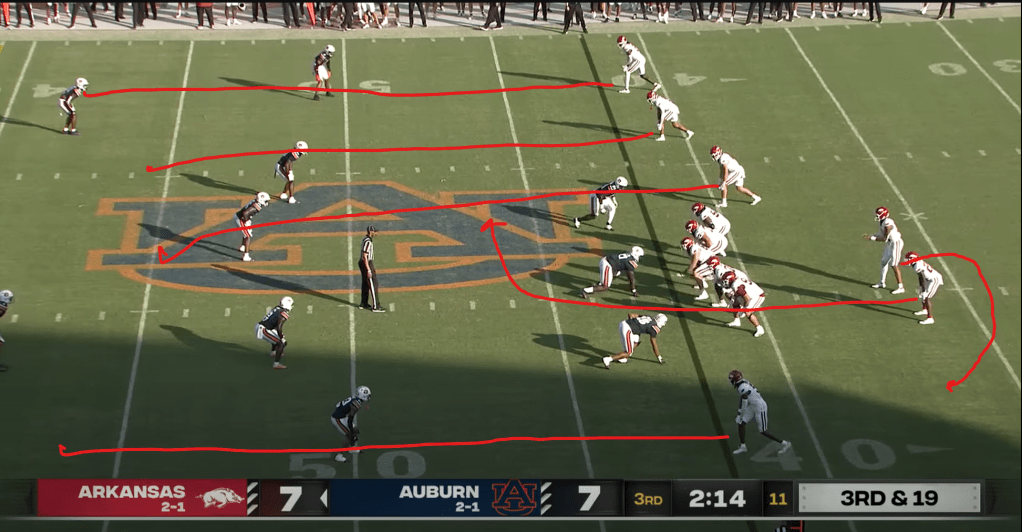
With their backs against the wall, Auburn’s offense responded on the next drive to keep themselves in the game. Nah, I’m just kidding, they turned the ball over again. This is some type of crossing pattern off of play-action, and it’s set up pretty well, as Thorne is able to find Cam Coleman wide open, only to see the ball bounce straight off his hands and right into the breadbasket of the Arkansas defender, surely triggering some PTSD from when Coleman did the same thing against Cal. For as much hate as Auburn’s QBs have gotten for all of the turnovers, their receivers haven’t been doing them any favors either, and this was a prime example.

Arkansas was able to turn that pick into three more points, amassing a ten-point lead that felt more like fifty, given Auburn’s anemic offensive performance up to that point. This time though, Auburn’s offense actually did respond. Facing a 4th and 3, Auburn goes back to a similar play play to the one one which Hank Brown threw an interception on late in the second quarter, running a snag concept from an empty formation. This play is mostly made by the great route from KLS though. He hits a perfect stutter step, convincing the safety that he’s running a hitch, which makes sense given the situation, but after the safety comes crashing down, he bursts out on a slant and there’s nothing but green grass in front of him. He gets a high-five from Rivaldo Fairweather on the way into the end zone, which is one of those things that would be funny if you weren’t losing by two scores at home against freaking Arkansas.
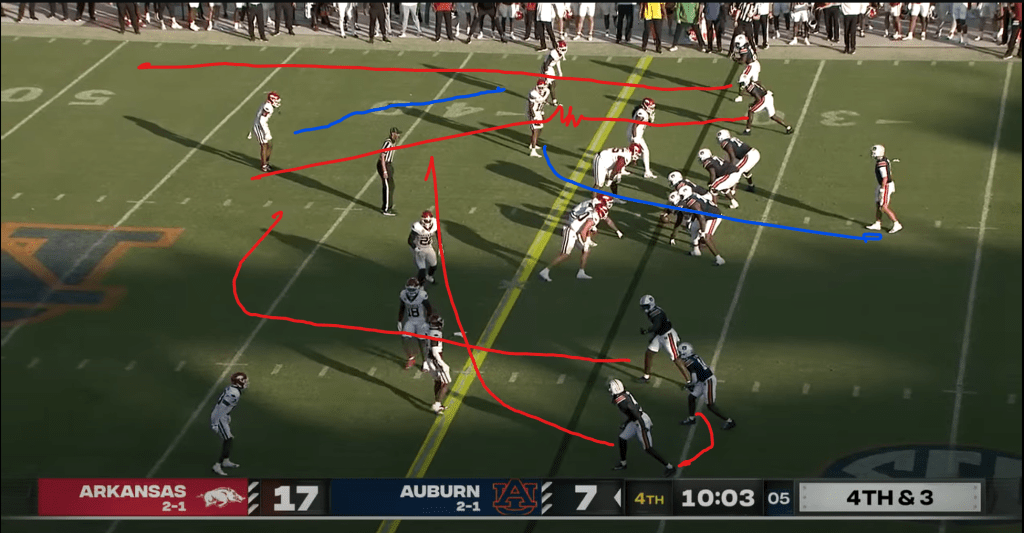
Unfortunately for the Tigers, Arkansas was able to put together a lengthy drive on the ground on the ensuing possession to just about ice the game. I want to look at a couple of plays from this drive, because they’re a good example of sequential playcalling, where one play sets up the next, something Auburn’s offense is sorely lacking, as I mentioned above. In this first clip, Arkansas runs a split zone concept with jet motion to create some misdirection. This variation of the standard zone concept has the H-back come from the playside of the formation across to the backside to kick out the backside DE, creating a split flow action that sets up the cutback for the RB. Note here that the H-back is able to make the block, but the edge defender (6) crashes down pretty hard on him. Petrino saw this and took advantage of it on the next play.

This is the exact same play, except now instead of kicking out the edge defender, the H-back comes across and seals him inside, allowing Taylen Green to keep the ball around the end for another first down. Since he knew how Auburn would respond to the first play, Petrino was able to use Auburn’s defensive rules against them to generate a second big play off of the same action. This is how good coaches structure their offenses, with plays that build off of one another in a cohesive way, rather than just throwing things at the wall and hoping they stick, which is what Auburn’s offense has seemed like for much of the season so far. Arkansas punched the ball in three plays later, and the game was essentially over. Auburn went four and out on their next possession and Arkansas was able to kneel the game out.

For the third time in the last six games, Auburn has lost to an inferior opponent at home, which is embarrassing no matter how you try to spin it. Freeze, for his part, shifted the blame onto his players, as usual, attributing the Tigers’ failures to their inability to avoid turning the ball over. This is obviously true, but keep in mind the Bill Parcells saying I quoted above. If the team is turning the ball over, you’re either coaching it or allowing it to happen. Instead of taking responsibility, Freeze once again threw his team under the bus, prompting a notable former QB of his, Bo Wallace, to call him out directly for it on Twitter.
Over the last few games, Auburn has been so sloppy and undisciplined that multiple people have said to me that this is the worst-coached Auburn team since 2012, worse than even the Potato Famine, and I can’t say I disagree with them. The coaching staff simply isn’t getting the team ready to play or instilling the discipline and focus necessary to win in this conference. I’m not sure I see a win on this schedule other than ULM at this point, because I have no hope whatsoever of the coaching staff actually improving the team over the course of the season, given the lack of development the team has shown from last season to this season. Yet another lost year due to inadequate coaching.
And givin’ him tools to walk through life like day-by-day, know nothin’ ’bout that. Teachin’ him morals, integrity, discipline, listen, man, you don’t know nothin’ ’bout that. Speakin’ the truth and consider what God’s considerin’, you don’t know nothin’ ’bout that.
After four years of underachievement under two mediocre coaches, this feeling of ennui has become all too familiar for Auburn fans. We’re tired of this, and we’ve got to start demanding better from our program and our leaders who have put us in this position. Or at least those of us who can even be bothered to care anymore are tired of it. A lot of us have just checked out altogether, finding better things to do with our Saturdays than sinking time and effort into a team whose coaches are obviously not putting in the time and effort Sunday through Friday. We can’t go on like this, something has to change.
And notice, I said “we,” it’s not just me, I’m what the culture feelin’.
So, where does Auburn go from here? The first step is very simple: fire Hugh Freeze. I know he’ll be the second consecutive Auburn coach fired within two years of being hired, but he’ll also be the second Auburn coach who has deserved to be fired within two years of being hired. He never should have been hired in the first place, for reasons that yours truly articulated two years ago, but there’s no time like the present to fix the problem. There’s absolutely no point in sinking any more precious time into a loser who refuses to accept responsibility for his team’s shortcomings and is clearly incapable of making the changes that need to be made for the team to improve. He’s not capable of performing the job to the required standard, and he needs to go.
From there, Auburn absolutely must nail this next coaching hire. We cannot have a third straight disaster of a coach to plunge this program further into irrelevance. I’ve got a prewrite ready with coaching candidates for whenever we pull the trigger on Freeze, but I’ll say a bit here about what Auburn needs in its next coach without naming any specific candidates.
First, we need someone with SEC coaching experience, preferably as a head coach. We found out the hard way how badly hiring someone who doesn’t understand that It Just Means More can go. Second, they need to have an organic connection to Auburn and be able to immediately relate to the fans and understand its culture, something both of the last two coaches have failed to do. Third, they need to have a proven track record of building up programs, because this is going to be a true rebuild, something that should never happen at a program with Auburn’s level of history and tradition.
Most importantly, however, what Auburn needs in its new coach is a real leader. Real leadership means accepting responsibility for the team’s failures and taking steps to improve them, not continually passing the buck to your players and subordinates. Real leadership means having the team prepared to play week in and week out, regardless of the level of the opposition. Real leadership means putting the school and the program ahead of yourself, rather than expecting the entire Auburn community to cater to your ego. As a fan once infamously said, “we need a leader, not a loser.”
In other words, we need the exact opposite of Hugh Freeze.
We don’t wanna hear you say “Auburn” no more.
We don’t wanna hear you say “Auburn” no more.
Stop
 Auburn Analysis
Leave a reply to Some Thoughts on Auburn’s Impending Coaching Search – Auburn Analysis Cancel reply