Say that five times fast.
Glory hallelujah! The moment this blog has been waiting for for three long years has finally come. Hugh Freeze is gone and Auburn can move on from his shambolic tenure. And what better way to do that than by dancing on his grave? Join me as we take a look at one of the most jarring examples of addition by subtraction you’ll ever see.

I haven’t written much about the Auburn offense over the last year or so, because frankly who cares, but if I had, there are a few specific criticisms I would have made of Hugh Freeze’s lackluster, clogged-toilet offense: the over-reliance on the use of 12 personnel (1 RB, 2 TEs, and 2 WRs) on a team that didn’t have good tight ends, the lack of tempo, the lack of an effective QB run game, the lack of an effective downfield RPO game, the lack of a true three-step passing game, and a complete absence of any kind of play sequencing (where one play sets up another).
Guess who immediately checked all of those boxes once he was given full control over the playcalling on every down? That’s right folks, Derrick Nix got it in one, with a gameplan that, if you can believe it, utilized the strengths of Auburn’s personnel with plays that actually built upon one another to form a coherent system, rather than a disconnected mishmash of personnel and plays run at a pace so slow that Kirk Ferentz would tell you to speed it up. Let’s take a look at how Nix utilized the concepts I outlined above to put together one of Auburn’s best offensive showings of the 2020s (which was as depressing a sentence for me to write as it was for you to read, I promise).
PERSONNEL
I don’t really need to cut up film to discuss this one, so I’ll get it out of the way first. After a few years with a bevy of good tight ends on the roster, the 2025 Auburn offense has…one good tight end? Maybe none? Brandon Frazier’s mobility is limited after his recovery from injury and Preston Howard hands are hard enough to cut diamonds, so I think the answer is none. Despite that, Hugh Freeze spent an inordinate amount of time with two tight ends on the field during his last miserable few games on the Plains. This decision was made all the more baffling by his refusal to actually run the ball. Wide receiver is the strongest position group on the team, so being more pass-oriented makes sense, but then why would you only have two of those great wide receivers on the field at a time? This is like Dadaist personnel usage. It’s an abstract art form I can’t even get my head around.
Auburn ran 82 offensive snaps against Vanderbilt and by my count, they only used multiple tight ends on eight of them, less than 10%. Almost the entire game was spent in 11 personnel, generally with Preston Howard as the sole tight end, although he was often lined up as an additional slot receiver rather than a true inline or Y-off tight end. Nix moved him around a good bit as a receiver and perimeter blocker with mixed success and got him involved in the passing game with…less success because he can’t really catch, but it was a better use of him than what Hugh Freeze was doing at least.
THE QB RUN GAME
Auburn announced Ashton Daniels as the starter during the week before the game, which I personally saw as rearranging deck chairs on the Titanic, but it turned out that Derrick Nix actually had a concrete reason for this decision, namely that he wanted to get the QB more involved in the run game. This is something that Auburn has desperately needed this season. If you’re going to run the ball successfully, you have to have a way to equalize numbers in the box. If your QB is handing the ball off, then you’re automatically losing one potential blocker. Thus, unless the defense is playing with two high safeties on every snap, they’re going to have an extra man in the box. See mom, that semester as a math major served me well!
One of the easiest ways for a team to equalize numbers if they don’t have a strong enough passing game to scare the other team into playing two high safeties is to get the QB involved in the run game. If he’s carrying the ball (or potentially carrying the ball) instead of just handing it off, you get that extra man back and the numbers are equal again. This was something Auburn did a fair amount in the season-opening win against Baylor (the only game where the offense looked any good this year before Hugh was fired) but after that, the QB run element disappeared and so did most of Auburn’s offensive success.
Derrick Nix signaled his intention to bring that aspect of Auburn’s offense back from the very first offensive snap of the game. Auburn starts in a compressed formation with Eric Singleton, Jr. aligned in a way that suggests he’s probably going to go in jet motion, which he does. Auburn runs a power read concept here, originally brought to national prominence by the 2010 Auburn offense.
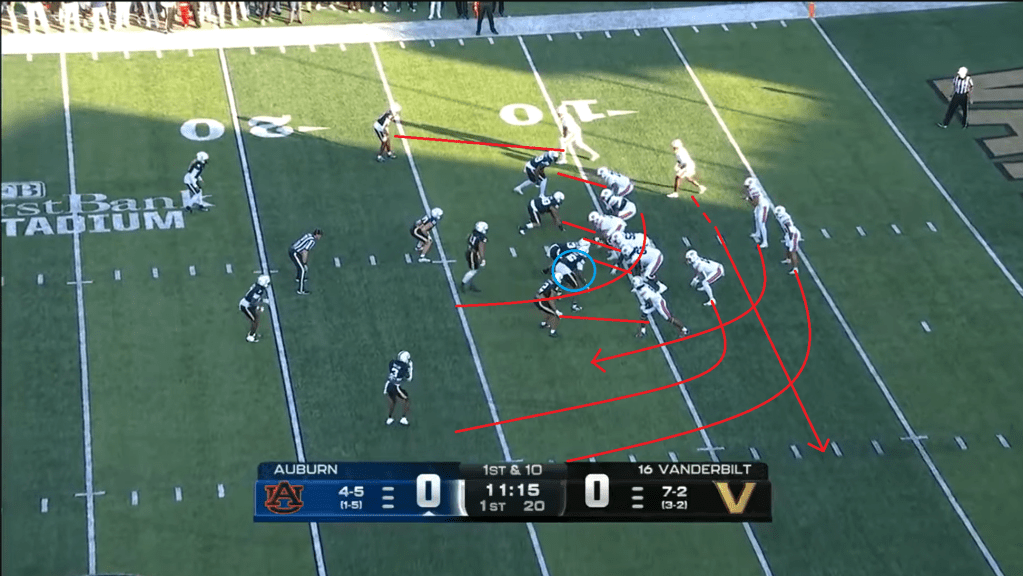
The offensive line blocks like a traditional power play, with the playside linemen blocking down and the backside guard wrapping around to block the playside linebacker. However, instead of having a fullback or tight end kick out the playside defensive end, he’s left unblocked, and the quarterback will read him and either hand the ball to the sweep man or keep it himself and run the power play depending on what he does.
Auburn made a ton of hay running this play with Cam Newton and Onterrio McCalebb back in the day. It’s not quite as successful here, as Vanderbilt does a good job in pursuit and stalemates the perimeter blockers to string Singleton out and hold him to a two-yard gain, but it was encouraging to see something like this right out of the gate.
Another advantage of having a QB like Daniels who’s good with his legs is that he can make plays for you when the blocking breaks down or when receivers don’t come open. Daniels didn’t actually end up scrambling all that much, six times in total, but he had a success rate of 66.6% (repeating, of course) on those scrambles, with all four of his successful scrambles resulting in a first down (and another successful conversion via scramble wiped out by a holding penalty). Whether you can technically consider these successful plays is debatable, since they’re improvisations after the play you actually called break down, but having a QB with the presence of mind to get out of the pocket and run instead of eating sack after sack is a good change of pace.
Here’s a good example from Auburn’s first drive of Daniels extending the play and converting the first down with his legs. Auburn motions Jeremiah Cobb out of the backfield and runs a deep cross concept, where Daniels is looking to hit Eric Singleton over the middle. Vanderbilt is in quarters coverage here and has two defenders bracketing Singleton, but Daniels does a good job of feeling the pressure coming and escaping the pocket to convert the first down. Auburn would score on the next play; more on that in a moment.
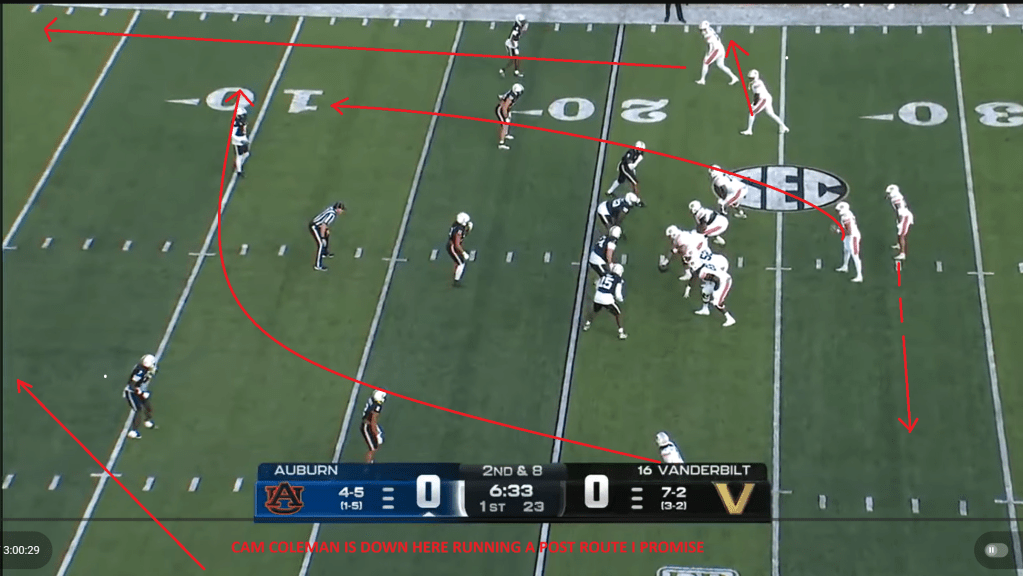
Nix also utilized Daniels’ legs on a few straight QB runs. Auburn’s second touchdown of the night came on a QB power play, with Daniels taking it to the house from 11 yards out. This is the same blocking scheme as the power read play above for the offensive linemen, but now the tight end will kick out the defensive end like a normal power concept. Usually the RB would be used as an additional lead blocker, but he just kind of wanders outside here. I’m not really sure what he’s doing to be honest, but whatever it is freezes the playside linebacker long enough that he’s an easy mark for the pulling guard, whose block springs Daniels for the TD.

Nix went back to the well with this play right before halftime, and it should have resulted in another Auburn touchdown, if it hadn’t been wiped out by an extremely questionable holding call.

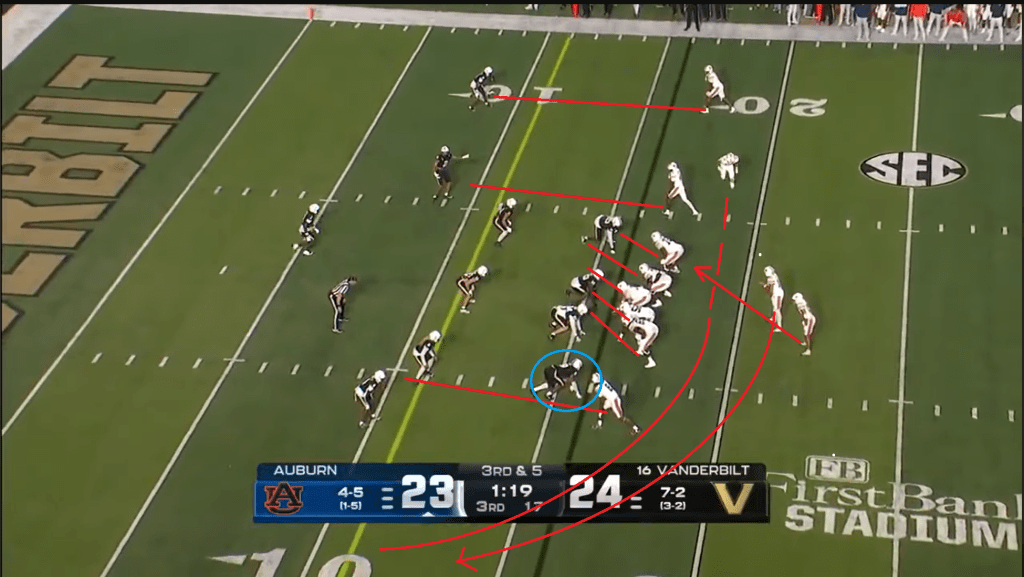
Daniels got the Tigers’ offense one more touchdown with his legs late in the third quarter. This is a good example of incorporating motion into the QB run game. Auburn is just running a basic zone read here, with the tight end coming across to block the overhang player on the playside (the guy who would usually be responsible for tackling the QB). This was a staple of Gus’ offense during the Nick Marshall era, and if you squint a little bit, that #12 might start to look a bit like a #14 here. (Ignore the hold by Preston Howard there, they owed us one after the weak holding call on the last play I showed and Vanderbilt got away with much worse.)
THE DOWNFIELD RPO GAME
Auburn’s RPO game was often ineffective under Hugh Freeze. Part of the reason was that Jackson Arnold’s hesitancy and indecision made him a bad RPO QB, but part of it was the lack of any sort of real downfield RPO threat to constrain the second and third level defenders. There were intermittent flashes where Hugh Freeze’s offense did this well (check out my writeup on the Alabama A&M game last year for a good example) but those occasions were few and far between this season.
Vanderbilt is a pretty aggressive team on the defensive side of the ball in terms of bringing heat from the second and third levels. If you don’t give their guys in the back seven something to think about, they’ll play aggressively downhill against the run and bring outside linebacker and corner blitzes on you all night. The first example I was going to use to illustrate my point here was the first touchdown of the game, but I realized that this ended up not being much of an RPO because there was no real “option” to read.
Auburn is in 12 personnel here (boo!) and this kind of illustrates why 12 personnel didn’t work well for this team. Vanderbilt has rolled their safety from the wide side of the field down into the box, and shuffled their safety from the boundary side over to the middle. Auburn is running a zone concept paired with a glance route by Eric Singleton on the boundary side. Usually, Daniels would be reading that boundary safety to hand off or throw the glance, but since he’s rotated to the middle of the field, there isn’t really much to read, and the glance ends up basically being free and it’s an easy touchdown.

Another good example of a downfield RPO concept, in this case attacking the second level defender, comes from Auburn’s third drive. Auburn is in a tempo situation here after an 11 yard gain on the first play of the drive. They get to the line and get set quickly in a 3×1 11 personnel look. Auburn pairs a zone run with a shock concept on the three-receiver side (a variation of stick where the #1 receiver runs a hitch, the #2 receiver runs a fade, and the #3 receiver runs a stick). Daniels is reading the outside linebacker lined up on the hash to either hand the ball off or throw the stick. Since he stays home here, Daniels hands it off and Cobb rips off another solid gain into Vanderbilt territory.
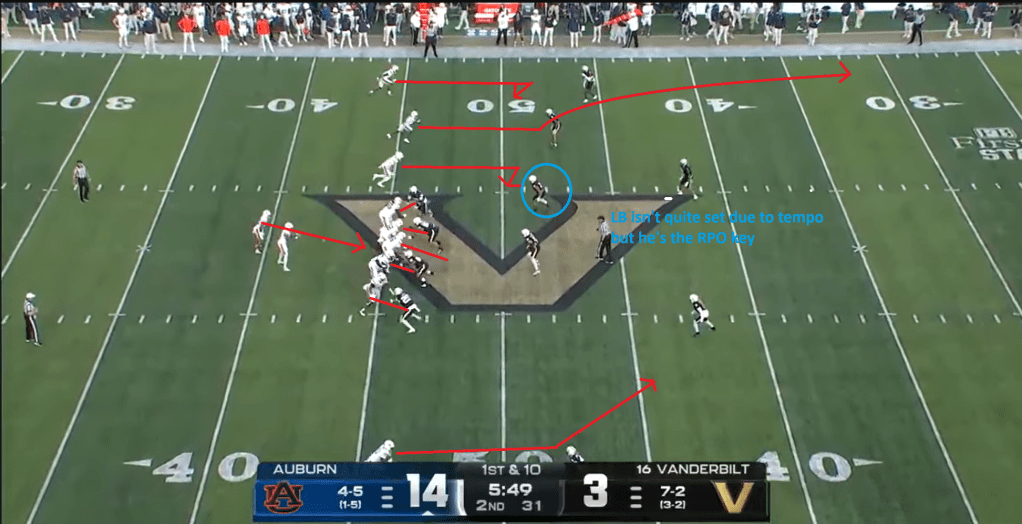
Although there’s a stoppage for a Vanderbilt player who lost his helmet, Auburn does something I love here, which is to get right back up to the line after a big play, snap the ball as fast as possible, and run the same play. This was something the good Gus Malzahn offenses would do if they got a big play. Once again, Daniels hands the ball off to Cobb, and this time it’s an even bigger gain to get Auburn into the red zone.
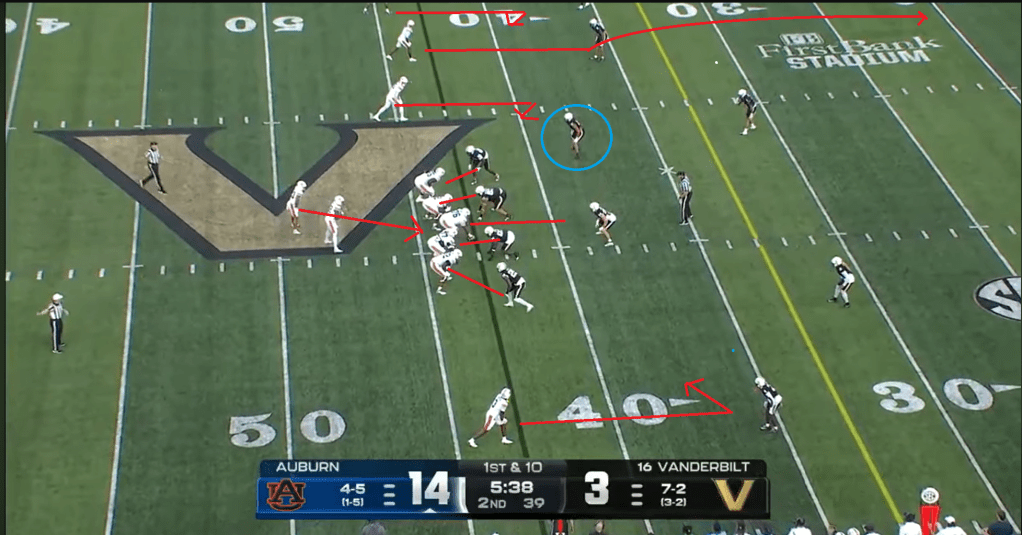
One most play I want to look at, again using this exact same zone + shock combo, was the first play of Auburn’s second drive of the fourth quarter. After being backed up by a false start on first down, Auburn runs this same RPO. However, Daniels notices here that Cam Coleman is matched up 1-on-1 on the backside, and the safety is over on the hash too far away to help (out of the picture here unfortunately), so he puts it up on the fade to Coleman and lets the best receiver in the country go make a play for him, which he does. Although he’s likely decided before the snap that he’s throwing the fade to Coleman, he does a good job of at least selling the post-snap RPO read to make sure the safety doesn’t get over in time to help on Coleman. It took a review, but Auburn got a big play here (and then got up and ran this same play again after the review for another 15-yard gain, it’s like living 24/7 in Candyland).

THE THREE-STEP PASSING GAME
Another issue Auburn’s offense suffered from under Hugh Freeze was the lack of a real quick passing game. In the modern era, many teams have folded their quick game into their RPO concepts, which makes sense; there’s no need to run hitches, slants, or quick screens if they’re already built into your run game. However, Freeze’s offenses also lacked any kind of real underneath passing game, like stick, snag, or shallow crossing concepts. These kinds of plays are important for controlling the second level defenders and keeping them from teeing off on your QB, as often happened to Jackson Arnold. Even Auburn’s deep passes tended under Freeze tended to lack any real underneath option, which was part of the reason Arnold ended up eating so many sacks.
Nix obviously didn’t have time to go through and reinstall Auburn’s entire passing game, but he did have a few three-step concepts that he leaned on throughout the game. Wow, a having a few plays that you’ve repped really well instead of just whatever random stuff the coach happens to come up with on gameday? Perish the thought!
We saw the three-step game on display on Auburn’s first series of the game. After two unsuccessful running plays, Auburn faced a third and eight. This was a situation where you’d almost put money on a sack under Freeze, but here, Nix sets Daniels up for success with a play that’s designed to get the ball out of his hand quickly. Auburn is in an empty set and has some type of middle hook concept called with the #1 receivers running spot routes and the #2 receivers running deeper hooks. Vanderbilt is in man or man-match coverage and has everybody covered initially, but Daniels extends the play with his legs and is able to move the chains.

On the very next play, Nix calls another quick pass from an empty set. This time, it’s a regular stick concept to the wide side of the field paired with a hitch and a glance to the boundary side. Daniels gets the ball out in rhythm to Singleton on the stick and gets another first down. Imagine that, getting your QB some quick completions out of the gate to get him in rhythm with his receivers.
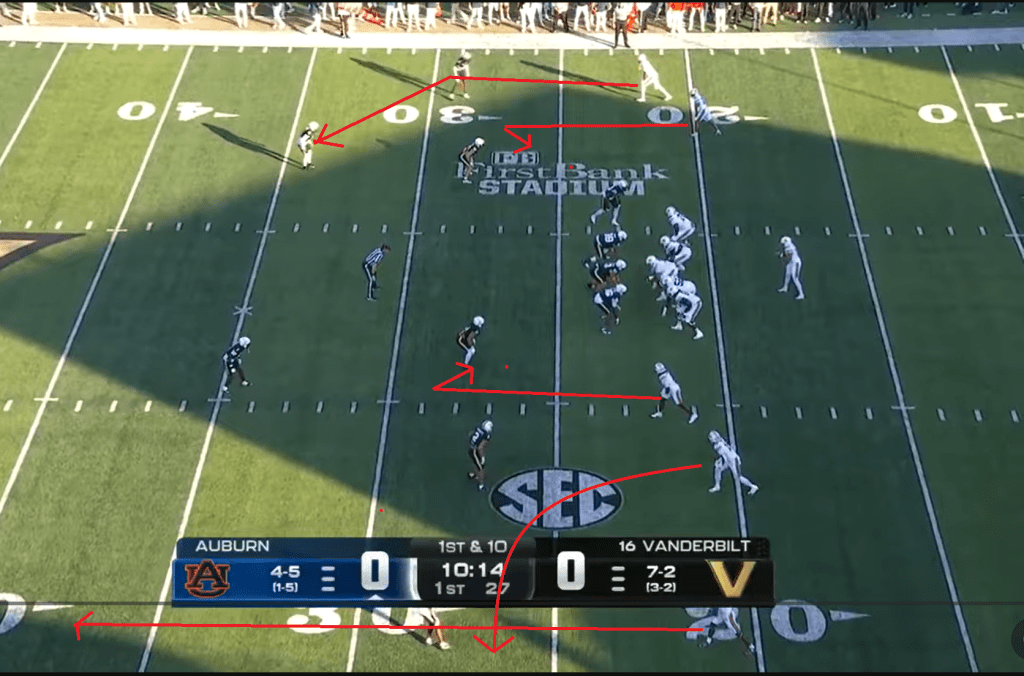
Eventually, Vanderbilt started playing more man on third downs to clamp down on Auburn’s underneath passing game. Man coverage tends to nerf the stick and spot concepts Auburn had been relying on in the three-step game pretty well, but Derrick Nix had another idea up his sleeve, which brings me to my last point…
PLAY SEQUENCING
Yes, unlike Hugh Freeze, who seemingly never made a single adjustment in his life, Nix has the all-important counter to the defense’s counter. In this case, it’s a stick-nod play, where the receiver settles down like he’s running a stick route, and then bursts to the middle of the field, so that a man or zone defender who clamps down on the stick is left flat-footed. That’s exactly what Auburn runs here on the second play of their penultimate drive of regulation. Although Daniels ends up throwing the slant to Cam Coleman instead, Singleton was open on the stick-nod after the defender bit on the route.

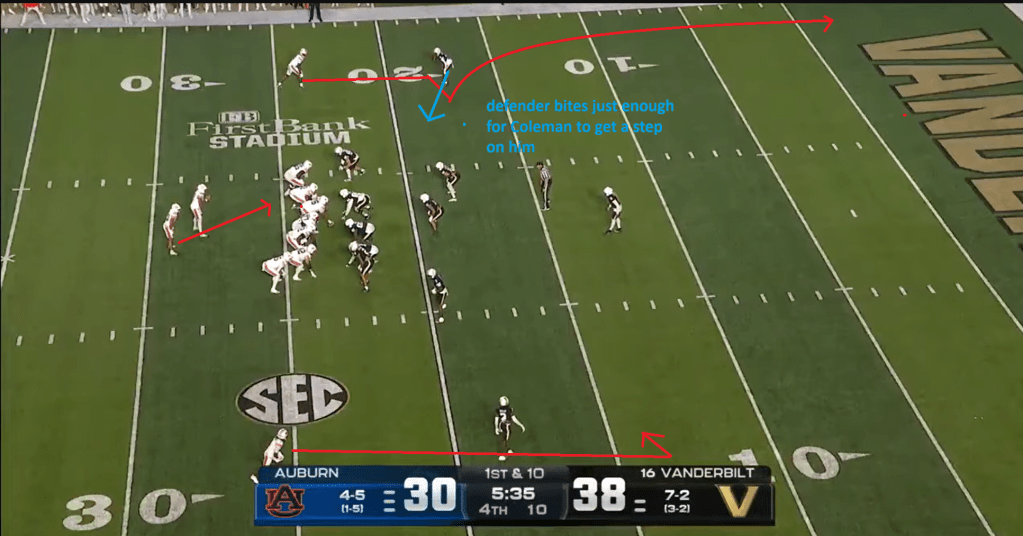
Another good example of play sequencing came on the denouement of that drive, the incredible touchdown catch that Cam Coleman made, followed by the game-tying PAT that sent the game to OT after some baffling coaching decisions by Vanderbilt on their last drive. Auburn had been working that zone/glance RPO I discussed above quite a bit, to the point where the defender who was lined up on Coleman was starting to cheat inside to cut it off. Here, Coleman runs a sluggo route, faking inside before heading up the sideline on a go route. Coleman makes an absolutely otherworldly catch for the touchdown here, but it was set up by great play sequencing to get him just enough separation from the defender to work his magic.
ONE LAST THING…
Unfortunately, it wasn’t all sunshine and roses for Auburn in this game. Despite the refreshing performance from the offense, Auburn’s defense got carved up by Diego Pavia and lost the game. I don’t really blame the remaining coaching staff for this since they were dealt a pretty rotten hand by Hugh Freeze and didn’t even have the luxury of a bye week to work out their new responsibilities, but simply put, good programs find ways to win these types of games and bad programs find ways to lose them.
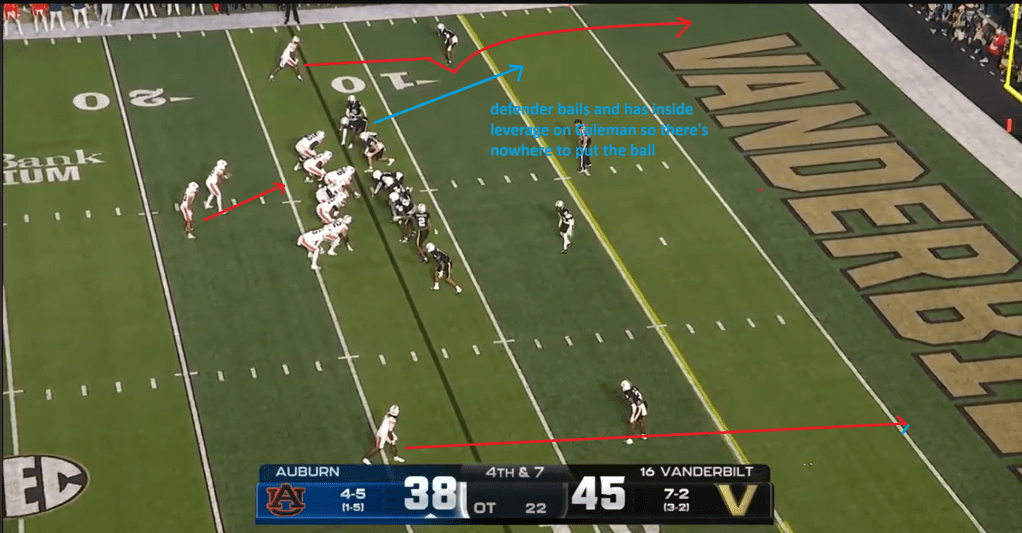
One of the very few playcalls I can really criticize from Derrick Nix was the last play of the game. If it looks familiar, it should, because it’s the exact same play as Auburn’s last touchdown in regulation. Vanderbilt is showing zero blitz before the snap here, but before Auburn checks to the sideline, we see one of the defenders start to peel off to shadow Coleman on the inside. This would’ve been the time to change the playcall and get into something else (although that was a bit limited since Auburn was in 12 personnel here, ahem), but Auburn went ahead with the play and had nothing because it was a one-man route to Coleman, who was bracketed by two defenders and had no chance of making a play even if the ball had been catchable. Old habits die hard, I guess.
I wouldn’t expect much more from the blog this season until the new coaching hire is made, as long as there’s some kind of Xs and Os angle to be interested in there. I don’t really plan on writing another article on coaching candidates since my thinking from the last one hasn’t changed very much. I’m working on a book (on a subject totally unrelated to the subject of this blog) at the moment and don’t really expect to have much time for the blog for the rest of the year anyway. We’ll see what happens. It’ll be hard to do worse than Hugh (knock on wood).
 Auburn Analysis
Leave a comment