Playing Mississippi State, Vanderbilt, and Arkansas. Okay, great, see y’all in the next post.
Okay, fine, there’s more to it than that, but everything I’m going to say here should be prefaced with the caveat that Auburn’s recent offensive improvement has taken place against the three worst teams in the SEC, one of whom has already fired their coach and one of whom probably will in the next few weeks.
That caveat aside, however, there have been some encouraging signs that Auburn’s offense is at least progressing toward the vision that the coaching staff had at the start of the season. Some Auburn fans have debated whether this is a product of Brother Hugh taking over more of the playcalling or having more influence over the offense somehow, but I think that largely misses the point. People like to harp on playcalling when an offense isn’t doing well, but no matter how good the playcalling is, the players still have to execute, and Auburn wasn’t doing nearly enough of that in the first seven games of the season.
THE BIG PICTURE
Probably the most important factor in Auburn’s recent improvement doesn’t even require looking at any film (although we’re obviously going to do that). After the coaching staff blew a very winnable game at home against Ole Miss by re-enacting the 2016 Clemson game (minus the Chandler Cox single wing experiment), Brother Hugh and company finally picked a quarterback and stuck with him. Obviously Payton Thorne is a flawed player; he probably lacks the physical tools to be a top-tier SEC QB and he’s generally good for one boneheaded decision per game. However, the coaching staff was making things way, way harder for him by jerking him in and out of games and never allowing him to get into a rhythm. Ending the revolving door at QB was probably more decisive than anything else I’m going to talk about here, but I think we all knew that already, so there’s no need to belabor the point. We’re going to look at some of the areas where he’s improved later on anyway.
The second factor we should discuss before breaking down film is tempo. Brother Hugh has repeatedly talked about tempo and RPOs (more on that later) as the key component of his offense, and Philip Montgomery was the architect (along with Art Briles) of maybe the fastest-paced offense college football has ever seen, and yet Auburn was plodding along with middling stats in terms of tempo that were a far cry from those of some of the other up-tempo gurus (e.g., Lane Kiffin and Josh Heupel). After failing to top 65 plays in their first three SEC games, the Tigers got off 74 snaps against the beleaguered Ole Miss defense (insert “it’s spelled ‘Ole’ because there’s no D” joke here), 67 against Moo State despite going into the Tubershell for most of the second half, 64 against Vanderbilt despite the Commodores running off a 9-minute drive while losing by two scores in the fourth quarter, and 76 in last weekend’s pig roast.
Tempo is a fickle mistress because it’s not something you can always directly control as an offensive coach. The benefit of going fast is that you keep the defense on their heels and prevent them from substituting, which can generate big plays, but to take advantage of going fast, you have to generate big plays to start with; otherwise all you’re doing is going three-and-out at warp speed and wearing out your defense. Auburn’s offense didn’t crack 5 yards per play against A&M, Georgia, or LSU, but has been at or over 6 yards per play in the last four games. YPP doesn’t tell the whole story, of course; against Vanderbilt, that stat was inflated by several long touchdowns mostly surrounded by ineffective offensive play, while against Arkansas, it was a product of consistently ripping off substantial gains. The latter is really more suited for going fast, and it’s no coincidence that Auburn ran 12 more plays against Arkansas than it did against Vanderbilt.
RPOs
Okay, enough of that, let’s get into what you’re really here for: some film study. There are a few different areas where Auburn has improved substantially over the last three games in terms of Xs and Os, but the most important is RPOs. As regular readers of the blog will know, Brother Hugh and Philip Montgomery were both known as leading progenitors of the RPO game, and most in the know expected that to be the case for their Auburn offense. However, in the first seven weeks of the season, Auburn’s RPO game was mostly ineffective, largely because teams were able to counteract it with man coverage, as I discussed in my last article.
In the last three games, this issue has been less prevalent, as Auburn has faced less man coverage and has had an opportunity to work against the zone defenses RPOs are designed to attack. This may be a function of the individual DCs’ preferences or a function of Auburn simply having a talent advantage over the last three opponents that rendered a man-heavy gameplan undesirable, but either way, it’s allowed the RPO game to overcome its earlier hang-ups and get rolling in earnest.
We saw this on the first play of the first game of the Tigers’ winning streak against Mississippi State. Auburn lines up in their base 11 personnel grouping (1 RB, 1 TE, 3 WRs) and runs a mid-zone run tagged with a stick-arrow concept on the backside. Thorne is reading the backside overhang linebacker and will either hand off or throw based on what he does. Moo is in some kind of quarters look here, and the LB just kind of…sits there, and doesn’t actually take away either phase of the RPO; Thorne hands it off to Jarquez Hunter, who rips off a big gain, but Camden Brown was wide open on the stick route and would’ve gotten a solid gain too had Thorne thrown it to him.

Getting a solid gain on first down is so critical when you want to go fast. Obviously you’d always like to get good yardage on first down, but for teams that want to push the tempo, it’s especially important, since that gives you the opportunity to get back up to the ball fast and attack a disorganized defense.
We saw a good example of that later in the same drive. Auburn got a good gain of about seven yards on first down, allowing them to get up to the ball and snap it quickly on second and short (about 28 seconds left on the play clock). This is another element of the RPO game we’ve talked about before: the pre-snap read. Auburn is running some type of mid-zone or outside zone here with a key screen tagged on the backside, where the receivers are in a stacked alignment (a tactic Montgomery commonly used at Baylor). However, Thorne elects to go with his pre-snap read here, which is a fade route to Shane Hooks, who is matched up one-on-one with the corner here. I don’t know if this is actually man coverage or if it’s some type of pattern-matching coverage where the CB has the WR if he goes deep, but it’s a good read by Thorne because the corner has no safety help and he’s no match for Hooks physically and gets Mossed for an opening-drive touchdown.

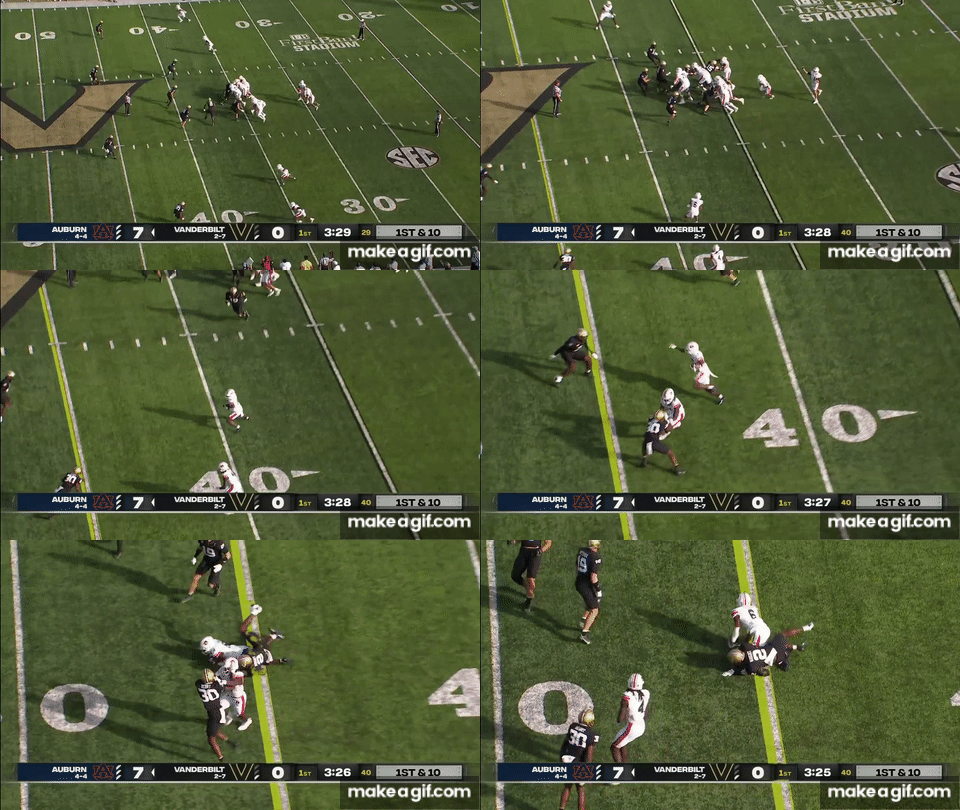
Auburn’s revitalized RPO game was on even better display against Vanderbilt, where Jarquez Hunter ripped off two long first-half touchdown runs on the exact same play. This is just RPO football 101. Vanderbilt is in a 2-high safety look (looks like some type of quarters) against Auburn’s 11 personnel set, leaving them with 6 defenders in the box and an overhang player who’s in conflict; he has to account for the slot receiver in the passing game, but if he stays home to cover him, Auburn has 6 on 6 in the box and should be able to run successfully. Auburn is just running a basic inside zone scheme with the slot receiver running a stick route behind the conflicted defensive player. You can see here how he hesitates at the snap, and by the time he gets into the box to help against the run, Jarquez is already out the front door. This was going to be a good gain no matter what, but it’s turned into a long touchdown when the Vanderbilt safety takes just about the worst possible pursuit angle, leaving a wide-open running lane for Jarquez to take it to the house.

Jarquez’ second touchdown was nearly identical to the first. Vanderbilt is in a three-down alignment here instead of a four-down front, but it’s the same situation: two deep safeties, quarters coverage, 6 vs. 6 in the box, slot defender in conflict. The wider angle on this play actually allows us to see another feature of the offense that reflects Montgomery’s Baylor roots: the wide splits from the receivers on the backside of the play, which have the advantage of making the read on the conflict player even easier for Thorne, since there’s no way he can cover the stick route if he’s anywhere near close enough to help in the run game. Thorne hands it off again and once again, the Vanderbilt safety is the goat (lower case), as he whiffs on the tackle almost completely and Jarquez is able to take it to the house. This was the thesis of Montgomery’s Baylor offenses: pace and space to overstress the defense and create busts, and it was on full display here.

I actually want to back up a bit, because the play immediately before that illustrates both the improvement in the RPO game and my previous point about tempo, because it was what allowed Auburn to push the tempo on the play that led to the touchdown. Auburn is in a 2×2 spread alignment here, but it’s still the exact same play: inside zone paired with a stick route on the backside. The defense faces the same problem: if you have two deep safeties, the slot defender can’t possibly help in the run game and cover the stick. In this case, he tries to get into the box and it’s pitch and catch on the stick route for a first down.
Auburn found success in the RPO game early against Arkansas as well. On the second play of the Tigers’ opening drive, Auburn faces a 2nd and 7 from their own 28. This time Auburn goes with a slightly different RPO concept. The run component is split zone: inside zone with the H-back coming across to kick out the backside DE and open up the cutback lane for the RB (although Luke Deal completely whiffs here); the pass component is a glance route from the single receiver, Caleb Burton. Teams like Arkansas that base out of quarters will often insert the backside safety into the box against the run game to allow them to account for the numbers in the run game while avoiding the conflict described in the above examples from the Vanderbilt game (note that the stick route at the bottom of the screen is covered). However, this leaves the space behind the LBs vulnerable, and the offense can read the safety for an RPO, throwing a glance route in behind the LBs if the safety fills in the box. That’s what happens here, and Burton is able to get some yards after the catch for an explosive play; note that he wins one-on-one against the Arkansas DB, something Auburn’s WRs have struggled to do against better competition.

Auburn’s second offensive touchdown of the game came on a similar type of RPO. Here, instead of running true split zone, Auburn is running a zone run paired with an arrow route by the H-back; instead of blocking the DE, Auburn is going to read him like they would on a zone read play. Here, he bites hard and nearly blows the play up but Thorne is able to get a wounded duck out to Fairweather, and the Arkansas DB (who was later ejected for a really dirty targeting penalty) whiffs, allowing Fairweather to stroll in and blow the game wide open early.

PLAY-ACTION PASSING
Auburn’s ability to get the RPO game rolling has opened up another avenue for moving the ball: the play-action passing game. Of course, those of you who are analytically inclined will point out (correctly) that the idea of “running to set up the pass” is a bit of a fallacy, because play-action passing success rate correlates much more strongly with dropback passing success rate than it does with rushing success rate (suggesting that good play-action passing teams are good at play-action because they’re good at passing, not because they run the ball well). However, from a schematic perspective, the run game still plays an important role in getting defenders to overcommit to the run and open up play-action passes downfield and to getting defenses to stack the box and allow favorable one-on-one matchups.
The latter is, of course, the entire premise of the vertical choice passing game that Philip Montgomery brought over from Tulsa via his stint at Baylor with Briles. Like Auburn’s RPO game, the vertical choice game was almost non-existent in the first half of the season because Auburn’s receivers couldn’t win those one-on-ones, but with a more effective run game (and weaker defensive opposition) the vertical choice game has finally had a few opportunities to shine, none more than on Auburn’s second touchdown against Mississippi State.
Again, this is a play where Auburn gets to the line and snaps the ball quickly after a first down (with less than ten seconds having run off the play clock). This is single choice, where the single receiver in a three-receiver set runs the vertical choice route. I explained the mechanics of this route in more detail in my season preview article, but the gist of it is that the tagged receiver is going to push the DB vertical and then break to the open part of the field, either continuing vertical if he can win deep, throttling down if he can’t, or breaking inside on a post if he has inside leverage on the DB (summarized in Briles’ mantra, “find grass, run fast”). Here though, there isn’t much of a “choice” for him to make as Mississippi State totally busts the coverage; I honestly can’t tell what this was supposed to be, but the safety and corner are apparently confused about who’s responsible for that deep zone. In the end, neither of them actually covers it until it’s too late, and Ja’Varrius Johnson scores the easiest touchdown of his life.

Auburn has also found some success with the more conventional play-action passing game, as illustrated by this play against Vanderbilt. This is one of the most basic forms of play-action, a bootleg with the receivers running a flood concept to the backside of the run action. A flood concept is exactly what it sounds like: you overload (“flood”) one side of the defense with receivers, leaving them with more players to cover than they have zone defenders on that side of the field. Here, Auburn combines that with a wheel route to the motion man, Jay Fair, who runs deep up the sideline while Camden Brown runs a deep route to take the top off the coverage, opening up the hole shot to Fair for a big gain and a first down (which Auburn ultimately squandered thanks to a chop block penalty and had to settle for a field goal).

Auburn’s play-action game also got some time in the spotlight during the pig roast. On the Tigers’ first possession of the second half, they made their way into the Arkansas red zone, with a chance to take a four-score lead put the game out of reach. This is an example of the RPO game directly setting up the play-action passing game. Here, Auburn lines up in an unbalanced 3×1 formation and fakes an inside zone run combined with a key screen to the inside receiver in the trips set, where they would be reading the slot defender as in the previous RPO examples from the Vanderbilt game. If the defense is going to stop the run component of the RPO, they have to commit the slot defender to the box, which should open up the key screen; if the defense wants to stop the run AND the key screen, they have to bring the safety down to cover the key screen.
And if they do that, the offense can attack the space that the safety voided, which is exactly what happens here; some coaches (like former Auburn OC Noel Mazzone) refer to these types of fake screens as locks (the key screen opens up the lock). Auburn fakes the key screen and has the two outside receivers run my favorite play-action concept, the post-wheel, with the outside receiver running the post to pull away the deep zone defender and open up the wheel route from the #2 receiver. And does he ever. The safety triggers hard on the key screen, the deep zone defender chases the post, and Ja’Varrius Johnson is wide open on the wheel for another very easy touchdown. This is a prime example of how tempo and RPOs create busts, as well as a good example of how you use constraint plays to protect your base plays, by punishing defenders who cheat to stop those base plays.

QB RUN GAME
The third component of Auburn’s offensive improvement has been the QB run game. While this has been de-emphasized somewhat without the QB-run-heavy packages that Robby Ashford usually ran when he was in the game, Payton Thorne has proven that he’s not a statue, and though the QB run game has been used more sparingly, it’s been a source of big plays. Like RPOs, QB run plays mesh well with tempo since you’re attacking an off-balance defense and isolating a single defender; this was really the secret sauce behind Auburn’s 2013 Cinderella run, as the zone read-heavy offense featuring Nick Marshall yielded an abundance of explosive run plays that allowed the Gus Bus to push the tempo. (Shoutout to Gus by the way for timing his annual out-of-the-blue blowout with his beloved annual Auburn pig roast.)
On their first possession of the second half against Moo State, Auburn demonstrated one important role the QB run game can play in an RPO heavy offense. Moo is lined up in a single high safety look here, with a defender lined up over all four receivers in Auburn’s 2×2 set. This allows them to cover all the receivers while putting an extra defender in the box to stop the run, which has been a bug-bear for Auburn all year, as discussed in my last article. However, this play shows how the QB run game can neutralize the defense’s numbers advantage: by reading one of those defenders instead of blocking him, you get back to 5-on-5 in the box and you should have favorable numbers again.
Here, Auburn combines that with motion by Rivaldo Fairweather to create a 3×1 set. I’m honestly not sure if Fairweather was supposed to be blocking the run support player (a scheme called arc read which was the bread and butter of the 2013 offense) or if he’s running a bubble screen as an RPO component, but it’s kind of a moot point. The defensive scheme Mississippi State is running here is called a scrape-exchange, and it’s one of the oldest tricks in the book for defending the zone read. The DE will pinch down, giving the QB a pull read, while the backside LB “scrapes” to the outside to tackle the QB after he pulls the ball. This is actually the primary reason the arc read was invented; the arc blocker can take out that scraping LB to keep the lane open for the QB.
In this case, however, Auburn doesn’t even have to block him, since he goes flying out to chase Fairweather for some reason, even though he was already accounted for by the safety on that side. With two guys chasing Fairweather, nobody is there to pick up Thorne when he pulls the ball and he rips off a huge gain. If you were wondering why Zach Arnett lost his job, yeah, this is it. (Also, to my earlier point about first downs and tempo, check the stat that ESPN helpfully flashed on screen.)

Auburn hasn’t just stuck with the basics in the QB run game however; there have been some creative designs that demonstrate the coaching staff’s continued commitment to the QB run game despite Robby Ashford’s diminished role. One such clever design was on display on Auburn’s first touchdown during the pig roast. I absolutely love this play design. Auburn lines up with a tight bunch set to the left, trying to get the defense to overshift to that side. This alignment is combined with run action to that side, as Jarquez Hunter fakes an outside run to the left. However, Auburn is actually running a QB counter play back to the other side; in this case, it’s GT counter, where the backside guard pulls and kicks out the playside DE, while the backside tackle follows him through the hole to block the playside LB. The backside tackle, Dylan Wade, actually whiffs his block on the playside LB, who was in position to make the play but missed the tackle, allowing Thorne to scamper through the hole for a touchdown and probably send T-Will’s blood pressure through the roof. This type of play is known as a bash concept (“BAsh” is short for “back away” meaning the RB fakes one way while the QB runs the other way), a common tactic for defenses that over-rotate against shotgun alignments, where the back usually hits the opposite side of the line from where he’s lined up; you’re counteracting your own tendencies while using the defenders’ rules against them. This is just a really clever play design, combined with some atrocious tackling from Arkansas, which is a recipe for success.

I want to bounce back to the MSU game for a second and look at a final role that the QB run game can play in an offense that isn’t primarily built around running the QB: protecting the dropback passing game. Draw plays are generally used to take advantage of an overly-aggressive pass rush, allowing the defenders to run upfield and run themselves out of the play. This is actually a sort of simplistic RPO, where the motioning receiver runs a swing route to the outside, while the QB is running a QB draw. It’s a really easy read for the QB: if someone follows the motion man, the defense is in man, and you should have numbers to run the draw; if nobody follows him, the defense is in zone, and you should have enough blockers out wide to run the swing. That’s not exactly the case here; instead, MSU spins the safety down to cover the swing, but that allows Auburn to maintain 6-on-6 in the box and run the ball. It’s honestly not blocked all that well and it probably should’ve been stopped for a loss, but Thorne does a good job of remaining patient, allowing the defense to overpursue before taking off for a big gain.

DROPBACK PASSING
Finally, I would be remiss if I didn’t notice Auburn’s improvement in the dropback passing game. I’m not going to spend a lot of time talking about this, but I did want to look at a couple of exemplary plays that show both how Auburn has progressed in pass protection and route running, as well as the role the dropback passing game plays in complementing the other parts of Auburn’s offense (which it wasn’t fulfilling earlier in the year). Payton Thorne’s decision-making has been at least a little better (probably a function of having time to read the defense and open receivers to throw to), so I’m not going to make you watch the truly brutal pick six he threw against Vandy, but I do want to point out that people who criticized the playcall were off-base; it was a good playcall for the coverage (curl-flat against a single-high safety look), Thorne just panicked and threw it straight to a defender.
Okay, enough negatives, let’s look at the positives. The first play I want to look at comes from Auburn’s excellent end-of-half possession at the end of the first half against MSU (#MiddleEight). Most defenses are going to prefer to play man coverage in the low red zone, since one of the main risks of man coverage (getting beat deep) isn’t a factor thanks to the endline acting as a twelfth defender. Thus, when offenses want to throw the ball in the low red zone, they’ll often turn to man-beater concepts. Here, Auburn runs the ultimate man-beater, mesh. I discussed this concept in the Cal film review since Auburn used it for a red zone touchdown there too.
This is what’s known as mesh-rail, with the receivers meshing and the RB running a wheel or rail route out of the backfield. This play is basically a cheat code in the low red zone because the meshing receivers can create a lot of traffic for the LBs, preventing them from being able to get outside to cover the RB. Defensive coaches will call this a pick play, but that’s because defensive coaches are cops; in any case, it’s basically never called OPI unless you’re really blatant about picking the defender. No such luck for Moo here, and Jeremiah Cobb is wide open for the score. I do note with a touch of bitter irony that this came against Mississippi State, since the greatest evangelist for the mesh play was the late Mike Leach and his Mississippi State offense scored three touchdowns on this concept (Green 92 Z Post) against Auburn during the 2021 debacle. Pour one out for the Dread Pirate.

Auburn used another of Leach’s favorite concepts, Y-Cross for a big play against Vanderbilt. Y-Cross is similar to the flood concept we discussed above: the outside receiver runs a vertical, the inside receiver runs an out, and the backside slot receiver runs a deep crossing route. Against a single-high safety look (e.g. Cover 3), this gives the offense three receivers against two zone defenders, and someone should always be open. Vanderbilt is in some type of single-high coverage here, although it looks like some version of Nick Saban’s Rip/Liz match, a variation of cover 3 where the DBs match the receivers’ routes instead of covering a specific zone (almost a combination of zone and man principles). This is a great look to run Y-Cross against, since the vertical pulls away the CB and the slot defender chases the out, leaving the Y wide open on the crossing route. Ja’Varrius Johnson cooks the Vanderbilt DB on the crossing route and it’s a big gain down the field; Auburn would score a TD to basically ice the game a few plays later.

The final example I want to look at in this novel of a blog post is second-to-last touchdown in the Arkansas game, immediately after the big fumble return in the 3rd quarter. Here, Auburn puts Jarquez Hunter in motion to run a swing route to the three-receiver side, while the three receivers block for him. However, Thorne instead decides to work the single receiver, Fairweather, running a fade route. This is a popular way to use a TE who’s a good pass catcher, singling him up on a smaller DB and just letting him outmuscle him. This may jog your memory a bit, hearkening back to the game-winner Nick Marshall threw to CJ Uzomah against Mississippi State in 2013, which was a similar setup with the big-bodied TE as the only receiver working against a CB into the boundary (although that was actually a double move and not a straight-up fade). Thorne throws a really nice back-shoulder ball here, putting it in a spot where Fairweather can use his size to keep the defender from attacking the ball and make the grab for the TD.

Alright, I think that’s enough for one post. Congrats to anyone who actually stuck it out to the end of this thing, which might be longer than my doctoral dissertation at this rate. Consider this an apology for the lack of content over the last month; I’ve been busy with work stuff and trying to get in as much golf as I can before the season ends.
Like I said at the beginning of this post, the non-Xs and Os stuff, particularly picking a QB and sticking with him, has done more to improve Auburn’s offense than the Xs and Os, but this is an Xs and Os blog, so I wanted to cover that aspect of it. I doubt there will be much to review from next week’s game, assuming Auburn can take care of business against a New Mexico State team that’s been maybe the biggest surprise of the entire season; shoutout to the eternally-underappreciated Jerry Kill for one of the most impressive program turnarounds in recent memory. Hopefully we’ll be back in a couple of weeks to break down film from an Iron Bowl upset.
 Auburn Analysis
Leave a comment